Louisiana runs foster care through DCFS regional offices, requires a hurricane evacuation binder for every licensed home, and uses a training curriculum that most agency websites still describe with the wrong name.
You searched "how to become a foster parent in Louisiana" and found the DCFS website. It told you to call your regional office. You figured out which of the eight regions covers your parish and found a phone number. Someone answered, told you the next orientation was in six weeks, and suggested you "review the Foster Caregiver Handbook" in the meantime. You found the handbook. It's over 100 pages of policy language written for caseworkers, not families. No clear starting point. No checklist. No explanation of which requirements apply to your situation and which are agency-internal procedures you'll never touch.
So you searched for something clearer. You found the LFAPN website, which is excellent for peer support and community connection. But when you tried to find a step-by-step licensing checklist for your parish, it wasn't there. LFAPN helps you understand the emotional reality of fostering. They don't walk you through the DCFS bureaucracy. You tried Catholic Charities next, or Volunteers of America, and found orientation schedules for their specific programs. Useful if you want to go through that particular agency. Not useful if you want to understand the full system before choosing a path.
Meanwhile, the terminology keeps shifting. Half the resources you find online still reference MAPP or TIPS for pre-service training. Louisiana's current curriculum is Deciding Together. Several agency websites haven't updated their pages. If you search for "MAPP training Louisiana" you'll find information about a program that no longer exists in this state. And if you're a kinship caregiver who just received an instanter order, everything you're reading assumes you chose to foster. Nobody explains the expedited process for a grandmother who took in her grandchild at midnight because a caseworker called.
Then there's the hurricane binder. Louisiana is the only state where your foster home licensing file must include a written evacuation plan with out-of-parish contact information, a communication strategy, and proof that you can relocate your placement safely during a mandatory evacuation. It's not optional. It's not a suggestion. It's a licensing requirement. And the DCFS handbook mentions it in passing without explaining what the plan needs to contain or what happens if yours is incomplete during a home study review.
The DCFS Regional Navigator: Your Complete Louisiana Foster Care Guide
This guide is built for how foster care licensing actually works in Louisiana -- the eight DCFS regional offices, the parish-level realities that shape your experience, the Deciding Together training curriculum, the CINC court process that governs every placement, and the specific forms, statutes, and safety requirements that apply in this state and no other. Every chapter reflects current Louisiana law under LAC 67:V.7315, the 2025 DCFS requirements, and the administrative realities that vary from Orleans Parish to Caddo Parish to the Acadiana region. It is not a generic fostering handbook repurposed with Louisiana in the title. It is the operating manual for this state's system -- through your regional office, under current rules, with the agencies and training programs that serve your area.
What's inside
- DCFS Regional Office Navigator -- Louisiana licenses foster homes through eight regional offices covering 64 parishes. Your parish of residence determines your assigned office, your caseworker pool, your orientation schedule, and your training cohort. The guide maps every regional office, explains how to identify your licensing authority on the first call, and covers the private child-placing agency alternatives -- Catholic Charities Therapeutic Family Services, Volunteers of America, Bethany Christian Services, Lutheran Services -- for families who want faith-based support or specialized placement types.
- Deciding Together Training Breakdown -- The current pre-service curriculum: classroom-based sessions covering trauma-informed care, cultural competency, and the Louisiana foster care system. The guide covers scheduling realities across regions, how to request reasonable modifications for shift workers and offshore schedules, and what to expect from each session so you walk in prepared. If you see MAPP or TIPS on an agency website, ignore it -- Deciding Together is the current standard.
- Home Safety Standards with Fire Marshal Checklist -- Every item your licensor and the State Fire Marshal inspect, decoded. Pool fence requirements (four feet minimum with a self-closing, self-latching gate and a ring buoy within reach), water testing for rural homes not on municipal supply, smoke and carbon monoxide detector placement, firearm and ammunition storage, bedroom square footage minimums, and the specific items that cause the most first-visit failures across the state. Know exactly what to fix before your caseworker walks through the door.
- Hurricane Evacuation Binder Template -- The licensing requirement that exists nowhere else in America. The guide provides a complete template for your mandatory evacuation plan: out-of-parish emergency contacts, communication chain, essential document copies, medication records, the child's school and medical provider information, and your planned evacuation route with destination. Don't wait until June to build this. Your home study reviewer will ask for it.
- Kinship Care and Instanter Order Guide -- For grandparents, aunts, uncles, and family members thrust into care by a late-night call from DCFS. The instanter order process, the expedited licensing track for relatives, your right to request the same board rate as non-relative foster parents, how to obtain legal authority for medical and educational decisions, and the financial assistance programs available to kinship caregivers on fixed incomes.
- CINC Hearing Timeline and Legal Rights -- The Child in Need of Care process governs every foster placement in Louisiana. The guide walks through the Continued Custody Hearing, Adjudication, Disposition, and Permanency Review -- what happens at each stage, what the judge is evaluating, what foster parents can and cannot say in court, and why DCFS does not make the final decisions about reunification or placement. The judge does. Understanding this changes how you prepare for every hearing.
- Louisiana Foster Care Payment Rates -- Monthly board rates by age group, supplemental rates for children with higher needs, initial clothing allowances, Medicaid eligibility for foster children, childcare assistance, transportation reimbursement, and the financial realities of fostering in Louisiana. Board payments are not income -- the guide explains what they actually cover and what your household budget needs to absorb.
- Background Check and Disqualification Guide -- Every adult household member aged 18 and older must clear a fingerprint-based criminal background check. The guide explains what offenses are absolute disqualifiers, what triggers a waiver review, how to handle out-of-state history, how long checks remain valid, and the honest disclosure strategy that prevents a decades-old misdemeanor from derailing your application six months in.
Who this guide is for
- New Orleans, Baton Rouge, and Lafayette families -- You work in healthcare, education, or the energy sector. You've been on the DCFS website for two hours and still can't tell whether to call the regional office directly or go through a private agency. You want a clear, linear process that tells you what to do and in what order, so you can register for Deciding Together this month instead of next quarter.
- Kinship caregivers in crisis -- An instanter order was filed and your grandchild, your niece, or your nephew is in your home tonight. The caseworker told you that you need to begin the licensing process. You need to know exactly what forms to file, what background checks to expect, and what financial support you can access -- tonight, not after six weeks of orientations.
- Rural parish families -- You live in a parish where Deciding Together runs twice a year and the nearest DCFS regional office is an hour's drive. You need to know about training schedules, cross-region options, and which private agencies serve your area, because the New Orleans-focused advice on most websites doesn't apply to you.
- Offshore and shift-work families -- Your spouse works a 14-on/14-off offshore rotation or 12-hour hospital shifts. You need to know how to schedule Deciding Together sessions around a non-traditional work life and what DCFS considers "reasonable modifications" for training attendance.
- Faith-motivated families -- Your church or parish held a foster care ministry event and you felt called to act. You need the administrative roadmap that turns conviction into licensure -- the forms, the timelines, the home safety fixes -- so your family's willingness doesn't stall in bureaucratic limbo.
Why the free resources fall short
The DCFS Foster Caregiver Handbook is over 100 pages of policy language written for the system, not for you. LFAPN provides community support and peer advice, but their information is anecdotal rather than a structured licensing roadmap. Catholic Charities and Volunteers of America publish orientation schedules for their specific programs, not comprehensive guides to the state system. The Clarola.org legal benchbooks are written for judges and attorneys -- accurate but impenetrable for a parent trying to understand their rights in a CINC hearing.
National foster care books describe a generalized process that doesn't account for Louisiana's parish structure, the Deciding Together curriculum, the mandatory hurricane evacuation binder, the CINC court timeline unique to Louisiana's civil law system, or the instanter order process that kinship caregivers face. A book written for Texas or Georgia will not prepare you for the Fire Marshal checklist your licensor uses, the pool fence specification that trips up families across the Gulf Coast, or the water testing requirement that affects every rural home not on municipal supply.
The free Quick-Start Checklist
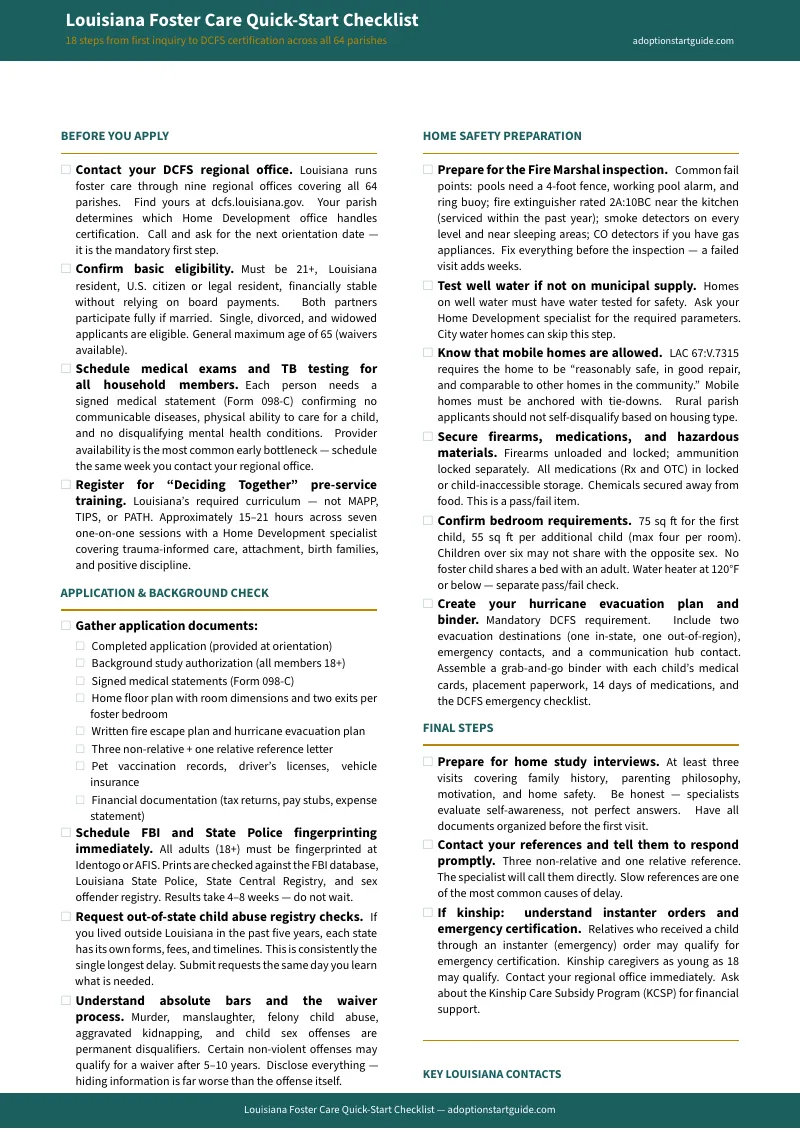
Download the Louisiana Foster Care Quick-Start Checklist for the essential actions that get you from first inquiry to moving through the system -- including the home safety items that cause the most inspection failures in the state. Free, instant download, no commitment. If you want the full guide with the DCFS regional navigator, the Deciding Together training breakdown, the Fire Marshal home safety checklist decoded, the hurricane binder template, kinship and instanter order procedures, CINC hearing timeline and legal rights, payment rates, and background check walkthrough, click the button in the sidebar.
-- less than one visit from a DCFS caseworker who finds something you could have fixed
One failed home inspection means rescheduling, waiting for your caseworker's next available slot, and adding weeks or months to your licensing timeline. One missing document means your application stalls in a regional office where caseloads are already stretched thin. One misunderstanding about the CINC hearing process means walking into court unprepared for what the judge expects. This guide puts the entire Louisiana foster care licensing process in your hands for less than what most families spend on a single re-inspection fix. Families who understand the system before they enter it register for Deciding Together sessions earlier, avoid the home safety failures that delay licensing across the state, and walk into their first meeting with their caseworker prepared.
If the guide doesn't deliver, reply to your download email at any time for a full refund. No forms. No justification required.