
You Called the State. They Told You to Call Your County. Your County Put You on Hold.
You called the Minnesota Department of Children, Youth, and Families. They told you to contact your county social services office. You called your county. They transferred you to the adoption worker — who is out until Thursday because they're covering a foster care caseload too. You left a voicemail. That was two weeks ago.
Meanwhile, you're trying to figure out the basics. If you're a foster parent in Hennepin County with a child who's been in your home for eleven months, you don't know whether the county has started the Termination of Parental Rights petition — or whether the 12-month clock even applies to your case. If you're a couple in Edina who connected with an expectant mother through an agency, you know the 10-working-day revocation period exists, but nobody has explained what "working days" means when the signing happens on a Friday before a holiday weekend. If you're a grandmother in St. Cloud who took in your daughter's children after a CHIPS removal, you can't figure out whether adopting them formally will increase your financial support through Northstar — or accidentally reduce it.
You're not confused because you haven't tried. You're confused because Minnesota adoption law lives in Chapters 259 and 260C, is administered by 87 separate county offices that each operate on different timelines, is adjudicated across 10 judicial districts, must comply with the federal Indian Child Welfare Act and the stricter Minnesota Indian Family Preservation Act whenever a child has any tribal heritage — and the entire administrative structure is in the middle of a reorganization from DHS to the new DCYF. No single resource connects all of it.
The Minnesota Adoption Process Guide is an 87-county navigation system for the entire Minnesota adoption process. It connects the statutes, the county procedures, the tribal sovereignty requirements, and the District Court filing process into one step-by-step roadmap — from your first county phone call through finalization and the birth certificate amendment that follows.
What's Inside
The Six-Pathway Decision Map — Minnesota offers six distinct adoption pathways: foster-to-adopt through your county social services, private agency (LSS, Catholic Charities, Children's Home Society), independent attorney-facilitated, kinship/relative, stepparent, and adult. Foster care adoption costs nothing out of pocket — the county covers training, licensing, and placement. A domestic infant placement through a private agency can exceed $50,000. The guide compares every pathway side by side — cost, timeline, governing statute, and process — so you choose the right one before spending a dollar or filling out a form.
The 87-County System Explained — Minnesota's laws are statewide, but 87 county social services offices administer them independently. A home study that takes 30 days in rural Wadena County may take six months in metro Hennepin County. The guide explains how the county-administered model actually works, why your county office is your most important relationship, and what the DHS-to-DCYF transition means for your paperwork — so you stop calling the state main line that can't tell you anything about your case.
The Consent and Revocation Windows — Day by Day — This is where Minnesota families lose sleep. For voluntary infant adoption, consent cannot be signed until at least 72 hours after the child's birth — any earlier signing is legally void under MN Stat. 259.24. After signing, birth parents have 10 working days to revoke for any reason, with no hearing and no "best interests" analysis required. The guide provides a day-by-day walkthrough of the revocation window — what is legally happening, what you should and should not do, and exactly when consent becomes irrevocable.
The NETStudy 2.0 Background Study — Every adoption in Minnesota requires a background study through the state's encrypted applicant portal. The guide walks through the entity referral process, the 48-hour fingerprint submission window that causes delays when missed, the four-tier disqualification framework (immediate vs. discretionary vs. set-aside-eligible), and the common system errors that void fingerprints and push back your finalization date by weeks. No free resource explains how to navigate this portal without triggering a reset.
The CHIPS-to-Finalization Pipeline — For foster-to-adopt families, the guide maps the entire child protection timeline: the CHIPS petition, the 12-month permanency review (6 months for children under eight), concurrent planning requirements, the county attorney's decision to file for TPR, the admit/deny hearing, the trial, and the appeal period that follows. Special attention to what happens between the TPR order and the adoption petition — the legal limbo where children are freed for adoption but finalization can't happen until appeals are exhausted.
ICWA and MIFPA Compliance — Minnesota has 11 sovereign Tribal Nations with their own Tribal Social Service Agencies. The federal Indian Child Welfare Act sets a baseline, but the Minnesota Indian Family Preservation Act creates stricter standards — requiring "active efforts" (not just "reasonable efforts") to place Native children with relatives, tribal members, or other Native families before any non-Native placement is considered. The guide includes the complete TSSA contact directory and an ICWA/MIFPA compliance checklist for families navigating cases involving children with any tribal heritage.
Northstar Care for Children — The Financial Framework — If you're adopting from foster care, Northstar provides monthly adoption assistance payments, Medicaid coverage, and nonrecurring expense reimbursement. But the rates depend on the child's assessment level (Basic, Moderate, Intensive, or Professional), and the agreement must be negotiated before the adoption is finalized. The guide explains how the assessment works, what's negotiable, and the TPLPC-vs.-adoption financial comparison that helps kinship families decide which permanency option actually pays more.
Cultural Community Considerations — Minnesota's adoption landscape includes the largest Somali community in the United States, where Islamic Kafala principles create cultural tension with Western-style adoption. It includes over 66,000 Hmong residents in the Twin Cities, where clan-based kinship structures shape how families define caregiving. The guide explains how these cultural frameworks interact with Minnesota's legal requirements — and the alternative permanency pathways (TPLPC, guardianship) that may align better with cultural values while still meeting the state's permanency goals.
Federal Tax Credit Strategy — The Federal Adoption Tax Credit is worth up to $17,280 per child for 2025. For families who adopted through foster care, the "Special Needs" designation lets you claim the full credit regardless of actual out-of-pocket expenses — even if they were zero. The guide explains the IRS filing strategy and the Minnesota-specific documentation you need.
Minnesota Employer Adoption Benefits — The guide covers adoption benefits from Minnesota's largest employers — Target, UnitedHealth Group, 3M, Medtronic, Mayo Clinic, and the State of Minnesota itself — including reimbursement amounts, leave policies, and how to layer them with the federal tax credit and Northstar assistance.
Who It's For
- Foster parents in any Minnesota county who are approaching the 12-month permanency review and need to understand how the CHIPS timeline, the TPR petition, and Northstar adoption assistance connect
- Couples and singles pursuing domestic infant adoption through LSS, Catholic Charities, Children's Home Society, or an independent attorney — who need to understand the 72-hour consent waiting period and the 10-working-day revocation window
- Kinship caregivers and grandparents who have been caring for a relative's child and need to decide between formal adoption and Transfer of Permanent Legal and Physical Custody — and understand how each option affects Northstar payments
- Stepparents looking for the shortest legal path to finalization — including how to handle absent or uncooperative non-custodial parents and when the Fathers' Adoption Registry applies
- Families involved in any case with tribal heritage who need to understand ICWA, MIFPA, and how to work with Tribal Social Service Agencies
- Somali, Hmong, and multicultural families exploring permanency pathways that respect cultural values while meeting Minnesota's legal requirements
- Anyone who has spent two hours on the DCYF website and still doesn't know which county office to call or what happens after they call it
Why Not the Free Resources?
The Minnesota DCYF website provides statutes and policy bulletins written for county social workers. It tells you that a home study is required — it doesn't tell you how long it actually takes in your county, what NETStudy 2.0 errors to watch for, or what to do when your background study fingerprints get voided because the entity referral wasn't initiated within the 48-hour window.
MN ADOPT (Foster Adopt Minnesota) runs excellent recruitment events and maintains the Waiting Child gallery. But their materials are designed to get families into the system — not to navigate the CHIPS timeline, the TPR appeal period, or the Northstar subsidy negotiation that happens after placement.
Agency orientations from LSS and Catholic Charities are informational sessions for their own programs. They don't compare their pathway against county foster-to-adopt, independent adoption, or kinship — because those pathways don't generate agency revenue.
The Minnesota District Court Self-Help Center provides the ADO101 and ADO103 forms. It provides zero guidance on filling them out, timing the filing, or what to do if the other birth parent can't be located.
The Minnesota Adoption Process Guide sits in the space between the statute and the reality. It's the document the system should hand you at your first orientation — but doesn't.
What You Get
- The Complete Guide — 12 chapters covering all six pathways, the 87-county system, the DHS-to-DCYF transition, the home study and NETStudy 2.0 background study, consent timing and the 10-day revocation window, the Minnesota Fathers' Adoption Registry, the CHIPS-to-TPR timeline, Northstar Care for Children, ICWA and MIFPA compliance, cultural considerations for Somali, Hmong, and diverse communities, open adoption and PACAs, court finalization, post-adoption steps, the 2024 records access reform, and a complete agency and contact directory
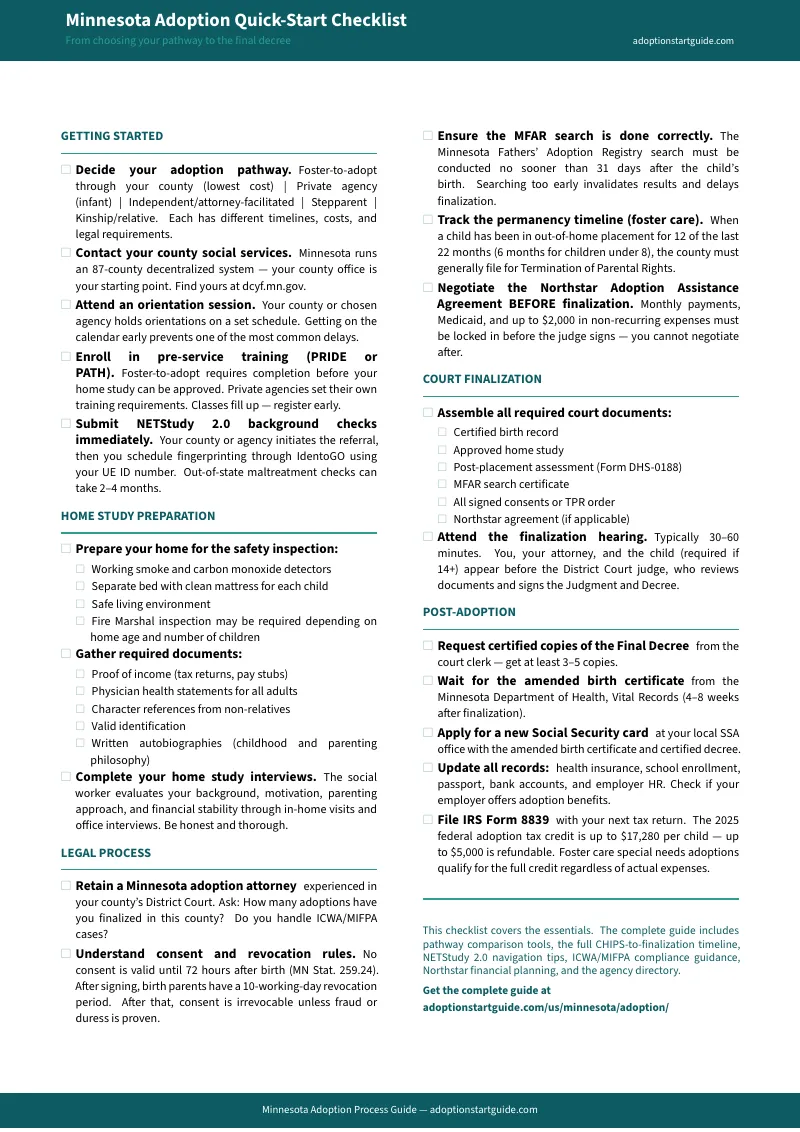
- Minnesota Adoption Quick-Start Checklist — 20 action items covering pathway selection, document gathering, home study preparation, and the legal process — organized so you always know your next step
- Home Study Preparation Checklist — One-page printable covering every document to gather, NETStudy 2.0 background study steps (including the 48-hour IdentoGO fingerprint window), PRIDE/PATH training requirements, physical home safety items, and what the social worker evaluates — so nothing surprises you on the day
- Court Finalization Document Checklist — Every document your attorney needs to file the District Court petition under MN Stat. 259.22 — birth record, home study, MFAR search proof, consents, Northstar agreement — with the critical pre-finalization deadline and what to expect at the hearing
- Post-Finalization Checklist — Week-by-week action plan for after the judge signs the decree — amended birth certificate through MN Vital Records, Social Security update, insurance enrollment window, employer adoption reimbursement, IRS Form 8839, and the 2024 records access reform
— Less Than One Phone Call to a Minnesota Adoption Attorney
A consultation with an adoption attorney in Minneapolis or St. Paul starts at $250 per hour. A single phone call to clarify the revocation window or the Northstar subsidy structure runs $75 or more. This guide covers the full statutory framework, every pathway's process, the administrative reality of the 87-county system, and the cultural and tribal considerations that make Minnesota unique — for a fraction of one billable quarter-hour.
Every purchase includes free updates as Minnesota law and DCYF policy change. When Northstar rates adjust, court procedures update, or the tax credit changes, your guide stays current.
Start with the free checklist
Not ready to commit? Download the Minnesota Adoption Quick-Start Checklist — a 20-item action plan covering pathway selection, document gathering, home study preparation, and the key legal milestones. It's the fastest way to see what's ahead before you invest in the full guide.