Minnesota has 87 county agencies, a background check system that swallows applications whole, and a training curriculum that most county websites still list under the wrong name.
You searched "how to become a foster parent in Minnesota" and found the DCYF website. It told you to contact your county social service agency. You looked up your county and found a phone number. You called, and someone gave you the date of the next orientation session — in three months. You asked what to do in the meantime. They said to review the forms on the DHS website. You went to the DHS site and found the Child Foster Care Licensor Library: over 100 PDFs with names like DHS-3531, DHS-8313, Form H7, Form H8, and PIF. No order. No explanation of which forms are yours and which are for the licensor. No indication of where to start.
So you searched for a clearer explanation. You found the Foster Adopt Minnesota website, which is excellent for emotional preparation — understanding trauma, connecting with support groups, learning why foster care matters. But when you tried to find a step-by-step administrative checklist for getting licensed in your specific county, it wasn't there. FAM is a non-placing agency. They help you understand the mission. They don't walk you through the 87-county bureaucracy.
You tried a county-specific handbook next. Anoka County publishes one. So does Hennepin. They're detailed and well-written — for residents of those two counties. If you live in Stearns County or Beltrami County or any of the other 85, those handbooks describe a process that doesn't apply to you. Your county might be part of a consolidated agency like Southwest Health and Human Services or MN Prairie County Alliance. The orientation schedule, the training cohort, the licensor's expectations about Rule 2960 home standards — all of it varies.
Meanwhile, half the county websites in the state still reference TIPS-MAPP for pre-service training. Minnesota switched to PATH — Parents as Tender Healers — through the Child Welfare Training Academy. Several counties haven't updated their pages. If you Google "TIPS-MAPP Minnesota" you'll find information about a training program that no longer exists. And if you search for the 2025 car seat training requirement, some county sites still say CARS. The current standard is B.E.S.T. — Basic Education for Safe Travel — and new applicants must meet it from day one. Good luck finding that on your county's FAQ page.
Then there's NETStudy 2.0. The background check system that every adult in your household must clear before you can be licensed. If you've lived outside Minnesota in the past five years, you need Child Abuse and Neglect Registry checks from every previous state — each with its own timeline, its own forms, and its own fees. If you have anything in your past — a decades-old misdemeanor, a DUI from your twenties — the system flags it and you enter the 12-factor variance review process. Nobody explains this to you at orientation. You find out when your application stalls.
The County Licensing Navigator: Your Complete Minnesota Foster Care Guide
This guide is built for how foster care licensing actually works in Minnesota — the 87-county system, the consolidated agencies, the private child-placing agency alternative, the DCYF transition from DHS, and the specific forms, statutes, and training requirements that apply in this state and no other. Every chapter reflects current Minnesota law under Chapters 245A, 245C, and 260C, the 2025 legislative changes, and the administrative realities that vary from Hennepin County to the Iron Range to White Earth Nation. It is not a generic fostering handbook repurposed with Minnesota in the title. It is the operating manual for this state's system — through your county, under current rules, with the agencies and training programs that serve your region.
What's inside
- 87-County Navigation System — Minnesota is the only state where the licensing authority is this fragmented. Your county of residence determines everything: your licensor, your orientation schedule, your training cohort, your placement pool. The guide maps every county agency including the consolidated multi-county offices like Des Moines Valley Health and Human Services and Southwest Health and Human Services, explains how to identify your licensing authority on the first call, and covers the private agency alternative — Lutheran Social Service, Nexus-Kindred Family Healing, Ampersand Families, North Homes — for families who want smaller caseloads or specialized support.
- NETStudy 2.0 Background Check Walkthrough — The most common source of licensing delays in the state, explained start to finish. How fingerprinting works at Identogo, what the BCA and FBI checks cover, how the Minnesota Child Maltreatment Report and predatory offender registry fit in, and the out-of-state CANR checks that can add months to your timeline. Includes the complete 12-factor variance review process for past offenses — what gets evaluated, what documentation to prepare, and why honest disclosure is the only strategy that works.
- PATH Training Guide — The current pre-service curriculum: ten-plus self-paced eLearning modules through Foster Parent College or Canvas, plus four instructor-led sessions. The guide covers scheduling realities (Hennepin and Ramsey fill up months out), cross-county attendance options for rural families, and the online hybrid formats that were expanded in late 2024 to serve Greater Minnesota. If you see TIPS-MAPP on your county's website, ignore it — PATH is the current standard.
- Rule 2960 Home Safety Standards with DHS-8313 Checklist — Every item your licensor inspects, decoded. Basement egress window dimensions (the single most common home inspection failure in Minnesota), water heater temperature limits for older homes set high for winter, furnace clearance rules, the 2A:10BC fire extinguisher rating that most household extinguishers don't meet, firearms and ammunition storage requirements, and the lead paint concern for pre-1978 housing stock. Know exactly what to fix before your licensor walks through the door.
- B.E.S.T. Car Seat Certification (2025 Mandate) — Minnesota fully transitioned from CARS to B.E.S.T. on January 1, 2025. New applicants must meet the new standard immediately. Existing CARS holders have until July 1, 2026. Relative providers who don't complete it within 30 days of licensing face a correction order. The guide explains the requirement, the transition timeline, and how to find approved training providers in your region — because your county website probably still says CARS.
- Kinship and Emergency Placement — For grandparents, aunts, uncles, and family friends thrust into an emergency. The 120-day emergency placement window, the expedited licensing track, the 2025 domestic partner exception (your partner no longer needs to be licensed for kinship care), the SUID/AHT 30-day grace period for relatives caring for children under six, and the kinship navigator programs through Lutheran Social Service and Urban League Twin Cities.
- Tribal Foster Care and ICWA/MIFPA — Minnesota's 11 Tribal Social Service Agencies operate sovereign child welfare systems. For tribes under the American Indian Child Welfare Initiative — Leech Lake, Mille Lacs, Red Lake, White Earth — a tribal license replaces the county license entirely. The guide explains when to contact a TSSA instead of your county, the Active Efforts standard that applies to all placements involving American Indian children, and the placement preference hierarchy under federal and state law.
- Somali and Hmong Community Sections — Fostering in the Twin Cities means working across cultures. The guide covers the Somali community's collectivist child-rearing tradition, the Hooyo Hour bridge program in St. Cloud, the Hmong 18-clan structure and its role in kinship decisions, religious practice support requirements for Islamic and traditional Hmong families, and the community organizations that help foster families maintain cultural connections.
- Northstar Care Financial Breakdown (SFY 2026) — Basic maintenance rates by age ($827 to $1,157 per month), MAPCY supplemental levels for higher-needs placements (up to $1,815/month), initial clothing allowances, Medical Assistance eligibility, Child Care Assistance Program access, transportation reimbursement for school-of-origin, and adoption assistance rates. Reimbursement is not income — the guide explains what it actually covers and what your household budget needs to look like.
- Court Participation and CHIPS Rights — Your legal rights under MN Statute 260C.215: notice of all hearings, the right to attend and provide input, access to non-confidential records. Plus the reunification timeline, the permanency hearing at 12 months, and what happens when reunification is not possible.
Who this guide is for
- Twin Cities metro professionals — You work in healthcare, finance, or tech. You value efficiency. You've been on the DCYF website for two hours and still can't figure out whether to call Hennepin County directly or go through a private agency. You want a clear, linear process that tells you what to do and in what order, so you can register for training today instead of next quarter.
- Kinship caregivers in crisis — A CHIPS case was filed involving your grandchild, your niece, your neighbor's child. The county placed the child with you on an emergency basis and told you that you have 120 days to complete the licensing process. You need to know exactly what forms to file, what background checks to expect, and what training grace periods apply to relatives — tonight, not after three months of orientations.
- Greater Minnesota and Iron Range families — You live in a county where PATH training runs once a year and the nearest Identogo location is an hour away. You need to know about cross-county training attendance, online hybrid options, and which private agencies serve your region, because the metro-focused advice on most websites doesn't apply to you.
- Families from Minnesota's Somali, Hmong, and Native communities — You want to formalize and protect the care you're already providing, but you're wary of a system that hasn't always served your community well. The guide explains your rights, the cultural competency requirements your county must meet, the tribal sovereignty provisions, and the community organizations that can bridge the gap.
- Faith-motivated families — Your church ran a foster care ministry drive and you felt called to act. You need the administrative roadmap that turns conviction into licensure — the forms, the timelines, the home safety fixes — so your family's willingness doesn't stall in bureaucratic limbo.
Why the free resources fall short
The DCYF website maintains the Child Foster Care Licensor Library — over 100 forms designed for licensors, not families. Foster Adopt Minnesota provides emotional preparation, support groups, and matching services, but they are a non-placing agency and do not publish step-by-step licensing checklists. Lutheran Social Service runs kinship navigator programs for after-placement support, not pre-licensing navigation. County handbooks from Anoka and Hennepin are excellent — for residents of those two counties. The other 85 counties have different consolidated agency structures, different orientation schedules, and different licensor expectations.
National foster care books describe a generalized process that doesn't account for Minnesota's 87-county system, NETStudy 2.0's specific delays, the PATH curriculum that replaced TIPS-MAPP, the B.E.S.T. standard that replaced CARS, or the 11 Tribal Social Service Agencies that operate outside the county system entirely. A book written for Ohio or California will not prepare you for the furnace inspection form that Stevens County requires, the egress window problem that affects every older Twin Cities home with a basement bedroom, or the 2025 domestic partner exception that changes kinship licensing for the first time in a decade.
The free Quick-Start Checklist
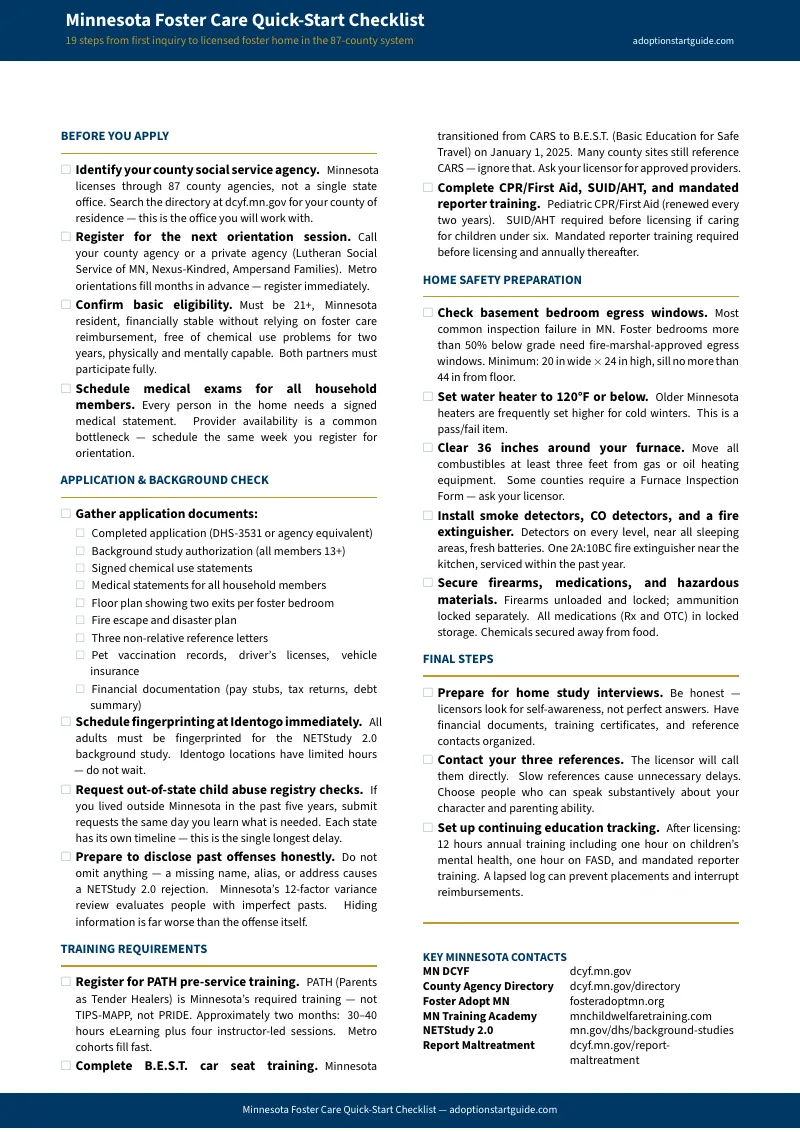
Download the Minnesota Foster Care Quick-Start Checklist for the 19 essential actions that get you from first inquiry to moving through the system — including the home safety items that cause the most inspection failures in the state. Free, instant download, no commitment. If you want the full guide with the 87-county directory, the NETStudy 2.0 walkthrough, the Rule 2960 home standards decoded, the PATH and B.E.S.T. training breakdowns, kinship emergency procedures, tribal foster care navigation, Somali and Hmong community guidance, and Northstar reimbursement rates, click the button in the sidebar.
— less than ten minutes with a Minnesota family law attorney
Minnesota family law attorneys charge $150 to $350 per hour. A one-hour consultation gets you general advice about your specific county — not a walkthrough of the 87-county system, not a NETStudy 2.0 background check strategy, not the B.E.S.T. training provider list, not the 12-factor variance review documentation guide, not the home safety checklist that your licensor uses during the Rule 2960 inspection. This guide puts the entire Minnesota foster care licensing process in your hands for less than what most families spend troubleshooting a single NETStudy delay with their caseworker. Families who understand the system before they enter it register for training months earlier, avoid the home inspection failures that delay licensing across the state, and walk into their first meeting with their county licensor prepared.
If the guide doesn't deliver, reply to your download email at any time for a full refund. No forms. No justification required.