The Probate Court Roadmap for Granite State Families
You have read the DCYF website and downloaded forms from the NH Judicial Branch. You may have opened RSA 170-B on Justia and closed it three paragraphs later. You have found Reddit threads that offer comfort but contradict each other on critical legal details. And you still cannot answer the question that brought you here: what exactly do I need to do, in what order, to legally adopt a child in New Hampshire?
The problem is not a lack of information. The problem is that adoption in New Hampshire routes through the Probate Division of the Circuit Court — not the Family Division — and the process involves a web of statutes, forms, and agencies that no single free resource explains from start to finish. Generic national guides tell you what adoption is. This guide tells you how adoption works in New Hampshire — step by step, statute by statute, form by form.
What Makes New Hampshire Different
New Hampshire adoption law has quirks that trip up even experienced attorneys from neighboring states. The guide addresses each one in plain English:
- The 72-Hour Consent Rule (RSA 170-B:8) — A birth parent cannot sign a valid surrender until 72 hours after birth. Once a judge approves it, it is irrevocable. No revocation window. No take-backs. The guide walks you through exactly what happens during those 72 hours and who must be present at the consent hearing.
- The Six-Month Interlocutory Decree (RSA 170-B:18) — After placement, you wait six months under a temporary court order while a social worker conducts post-placement visits. National guides barely mention this period. The New Hampshire guide devotes an entire chapter to it — what the social worker evaluates, what triggers concerns, and how the temporary decree protects your legal position.
- RSA 170-B vs. RSA 170-C — One statute governs adoption. The other governs termination of parental rights. Most families do not know which one applies to their situation until an attorney explains it during a billable hour. The guide explains the relationship up front so you arrive at that meeting prepared.
- The Town-Based Birth Certificate System — New Hampshire does not issue amended birth certificates from a central state office. The court sends your decree to the Division of Vital Records, which then contacts the town clerk where the birth occurred. This decentralized process creates delays that families do not anticipate.
- The Putative Father Registry (RSA 170-B:5-a) — Any man claiming paternity must file a notice before an adoption can proceed. The guide explains what happens when no claim is filed, how the In re J.P. (2020) Supreme Court ruling changed notice requirements, and why verifying the registry is essential before any placement.
What's Inside
The New Hampshire Adoption Process Guide covers every pathway to adoption in the Granite State — from your first inquiry through the final decree and the new birth certificate:
- Six Adoption Pathways Compared — Foster-to-adopt through DCYF, private agency, independent (attorney-facilitated), stepparent, kinship/relative, and adult adoption. Eligibility, realistic costs, expected timelines, and the legal differences between each one.
- The Complete Legal Framework — RSA 170-B (adoption), RSA 170-C (termination of parental rights), RSA 169-C (child protection), and the administrative rules under HE-C 6448 that govern home studies and post-placement supervision. Translated from legalese into actionable steps.
- Home Study Preparation — What the social worker actually evaluates, the full documentation checklist (FBI fingerprints, NH Central Registry, out-of-state clearances, medical exams, financial disclosure), the 120-day completion window, and the kinship waiver for relatives.
- Every Required Court Form — NHJB-2185-FP (Petition for Adoption), NHJB-2193-FP (Medical Information on Birth Parents), DCYF Form 1807 (Affidavit of Expenses), and the supporting attachments. What each form does, where to file it, and what happens when it is deficient.
- The Finalization Hearing — What the Probate Court judge looks for under the "best interests" standard in RSA 170-B:1, the role of the Guardian ad Litem report, and what to bring on the day of the hearing.
- ICPC Interstate Adoption — The 100A and 100B forms, the 60-day window, Regulation 7 expedited placement, and the rule against crossing state lines before clearance. Essential reading for anyone adopting across the Massachusetts, Vermont, or Maine border.
- Costs and Financial Assistance — Full cost breakdowns by pathway, DCYF adoption assistance subsidies, Medicaid continuation for children adopted from foster care, and the federal adoption tax credit.
- Post-Adoption Resources — Waypoint NH, NHFAPA, DCYF post-adoption services, and a county-by-county Probate Court directory with addresses and phone numbers.
Who This Guide Is For
- Families exploring adoption for the first time who need a clear overview of all six pathways before committing time and money to the wrong process.
- Foster parents whose child's case plan has changed to adoption and who need to understand the legal transition from foster care to permanency.
- Grandparents and relatives raising a child who need to formalize the legal relationship and understand the difference between guardianship and adoption.
- Stepparents ready to adopt who need to navigate the consent requirements and the Probate Court petition process.
- Families adopting across state lines who need the ICPC process explained before the first interstate placement call.
Why Not Just Use the Free Resources?
DCYF covers the foster-to-adopt pipeline well but is silent on private and independent adoption. The NH Judicial Branch provides the forms but no narrative guide on how to file them or what happens at the hearing. Waypoint NH offers counseling but not a legal roadmap. Reddit gives you peer support alongside anecdotal advice that may not reflect current law.
The single biggest gap in New Hampshire's free resources is the procedural connective tissue. You can find a form and you can find a statute, but you cannot find a guide that explains the sequence of events, the expected timelines, the "unwritten rules" of the Probate Court, and how all the pieces fit together from day one to the final decree.
That is what this guide provides.
— Less Than One Hour with an Attorney
An hour with a New Hampshire adoption attorney runs $250 to $400. Every hour you spend in that office asking basic procedural questions is money you could have saved by walking in prepared. The guide covers the same legal framework your attorney will walk you through — so you use billable time for strategy, not education.
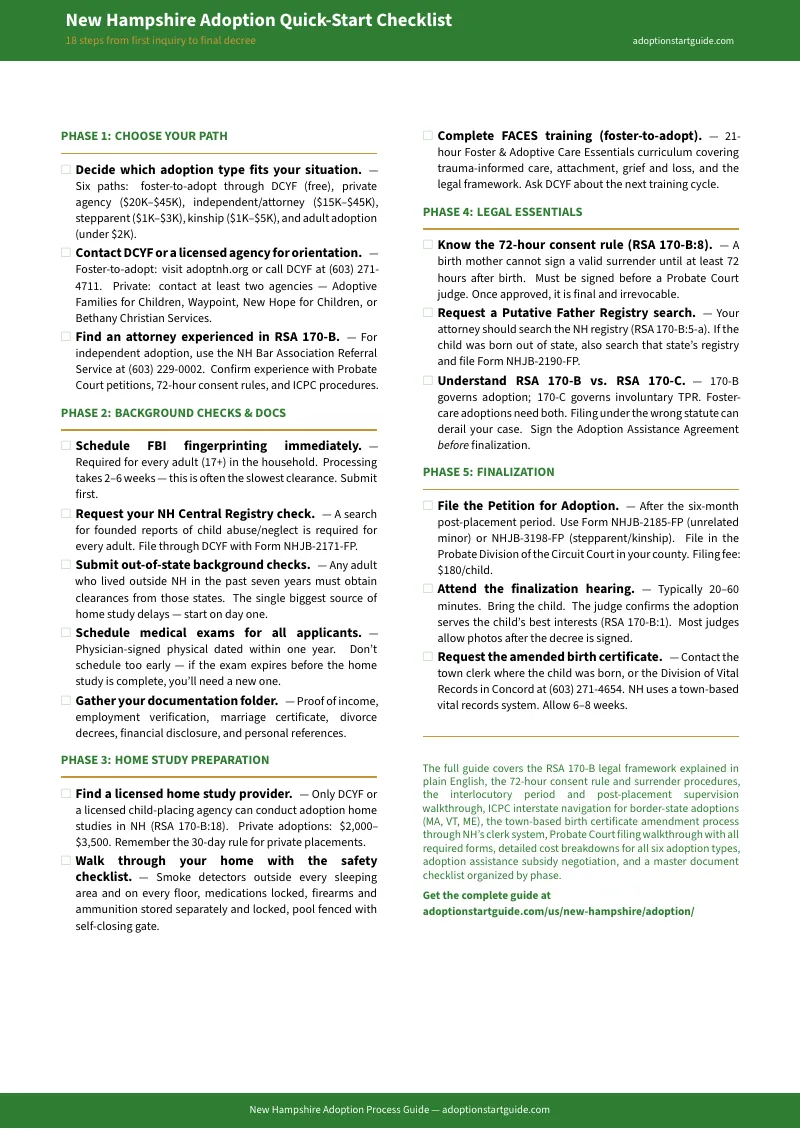
The free checklist gives you the 18 most critical action items at a glance. The full guide gives you the complete roadmap — every statute, every form, every timeline, every contact — so nothing catches you by surprise between your first inquiry and the day you walk out of the Probate Court with a final decree.