South Carolina has five adoption pathways, a Responsible Father Registry that can unravel your case, and a faith-based agency ecosystem that shows most families only one of them.
You started researching adoption in South Carolina and found the DSS website, which told you to call your county office. You called, and they transferred you to a regional office that gave you a list of licensed child-placing agencies. You looked up the agencies and found Bethany Christian Services, Miracle Hill Ministries, A Chosen Child, the Children's Home Society of North Carolina serving the border counties. Each one described the adoption process slightly differently. Some mentioned foster-to-adopt. Others talked exclusively about private domestic placement. One required a church reference. None of them explained that South Carolina has five distinct legal pathways to adoption, that the costs range from effectively free to over $50,000, or that the pathway you choose determines everything about your timeline, your legal exposure, and your financial obligations.
That missing context is where families lose money and time. South Carolina's Responsible Father Registry is the single most overlooked legal requirement in the state. Under Section 63-9-820, a putative father can register his interest in a child at any time before the adoption petition is filed. If your attorney or agency fails to conduct the $50 registry search and obtain a Certificate of Diligent Search before proceeding, a birth father can appear months into your placement and contest the adoption. It happens. It is the number one cause of contested adoptions in South Carolina, and the fix costs fifty dollars and two weeks of lead time. But nobody tells you about it until your attorney bills you for the emergency hearing.
The consent rules are faster than most states — a birth mother can sign relinquishment just 24 hours after delivery with no statutory revocation period once signed. That speed protects adoptive families from prolonged uncertainty, but it also means every financial disclosure must be finalized before the birth, not after. Section 63-9-390 requires every dollar spent on a birth mother's expenses to be itemized and submitted to the Family Court judge. If the court finds an unreported payment — even a grocery run that wasn't logged — it can deny the entire adoption petition. Families working with out-of-state facilitators who don't understand South Carolina's financial transparency rules have had petitions challenged over expenses that were perfectly legal but improperly documented.
South Carolina's faith-based agency ecosystem compounds the problem. Miracle Hill Ministries alone recruits roughly 15 percent of all foster parents in the state, and they operate under a federal waiver that allows them to place children exclusively with families who share their religious beliefs. If your first contact with the adoption system is through a faith-based agency, you may be shown only one pathway — their pathway — without learning that DSS foster-to-adopt is effectively free with monthly subsidies and a $1,500 reimbursement for non-recurring adoption expenses, or that independent adoption through an attorney is legal in South Carolina and often faster than the agency route for infant placement. The agency that recruited you has no obligation to tell you about the alternatives. That is not a criticism of faith-based agencies. It is a structural feature of how South Carolina's system works, and families deserve to see the full map before committing to a single road.
The Palmetto Adoption Blueprint: Your Complete Guide to Adopting in South Carolina
This guide is built for how adoption actually works in South Carolina — the DSS regional structure, the licensed child-placing agency network, the Family Court process, the statutes that govern consent and termination, and the financial rules that trip up families who rely on generic national advice. Every chapter reflects current South Carolina law under Title 63, Chapter 9, the DSS foster-to-adopt pathway including monthly subsidy rates and Medicaid coverage, the independent adoption route that most agencies never mention, and the specific documentation requirements that Family Court judges in Charleston, Greenville, Richland, and Spartanburg counties expect to see. It is not a repurposed handbook from another state. It is the operating manual for South Carolina's system — through your pathway, under current conditions, with the agencies and attorneys who practice here.
What's inside
- Five-Pathway Decision Framework — South Carolina allows adoption through DSS foster-to-adopt, licensed private child-placing agencies (CPAs), independent adoption via attorney, stepparent adoption, and kinship adoption. Each pathway has radically different costs, timelines, and legal requirements. This chapter maps all five side by side — who qualifies, what it costs, how long it takes, and which pathway matches your family's situation — so you choose with full information instead of being funneled into whichever agency you contacted first.
- Responsible Father Registry Navigator — The Responsible Father Registry (Section 63-9-820) is the most consequential and least understood element of South Carolina adoption law. A putative father can register at any time before the adoption petition is filed. If your attorney does not request the $50 search and obtain a Certificate of Diligent Search before filing, a birth father can contest the adoption after placement. This chapter explains when to request the search, how to read the certificate, what happens if a father is registered, and the legal timeline for contesting paternity — so you never face a surprise filing that could have been prevented for the cost of a restaurant dinner.
- Consent and Relinquishment Guide — South Carolina allows birth parents to sign consent just 24 hours after delivery, with no statutory revocation period once the consent is executed. This chapter explains what the 24-hour window means for your pre-placement legal preparation, the witnessing requirements (two witnesses plus a Family Court judge or notary), the difference between consent and relinquishment, and the narrow legal grounds under which a signed consent can be challenged.
- Financial Disclosure Compliance Kit — Section 63-9-390 requires every expense paid to or on behalf of a birth mother to be itemized and disclosed to the Family Court before the adoption is finalized. This includes medical bills, living expenses, counseling, legal fees, and transportation. An undisclosed payment — even one that is legal — can result in the court denying the petition. This chapter includes a fill-in expense tracking template, the categories the court expects, and the documentation standard that judges apply when reviewing the financial affidavit.
- DSS Foster-to-Adopt Roadmap — Adopting through DSS is the lowest-cost pathway in South Carolina. Families pay no agency fees, receive monthly foster care subsidies during placement, qualify for adoption assistance after finalization (monthly subsidy plus Medicaid for the child), and can claim up to $1,500 in non-recurring adoption expense reimbursement. This chapter covers the licensing process, the CAPSS background checks, the training requirements, the matching process through SC Heart Gallery, and the subsidy negotiation — including what is negotiable and what most families accept without question because nobody told them they could ask for more.
- Home Study Preparation Guide — The home study is conducted by a licensed agency (private adoption) or DSS (foster-to-adopt). This chapter covers what the social worker evaluates — home safety, financial stability, relationship history, parenting philosophy, support network, and trauma-informed care readiness — and provides a document preparation checklist so everything is assembled before the first visit. South Carolina requires SLED background checks, FBI fingerprinting, a medical clearance, and personal references. The processing time for SLED checks alone can take 4 to 8 weeks, so starting early is not optional.
- Family Court Filing Guide — All adoptions in South Carolina are finalized through the Family Court division of the Circuit Court. This chapter explains the filing requirements by pathway, the mandatory 90-day waiting period after placement (waivable in stepparent and kinship cases), the Guardian ad Litem appointment for contested cases, the court hearing itself, and what happens after the judge signs the decree — including the amended birth certificate process through DHEC.
- Financial Planning Framework — Cost breakdown by adoption pathway. DSS foster-to-adopt costs $0 to $2,000 in legal fees, with monthly subsidies offsetting expenses during placement. Private agency adoption runs $25,000 to $50,000 depending on the agency. Independent adoption through an attorney runs $15,000 to $30,000. Stepparent adoption with an attorney costs $1,500 to $3,500. This chapter maps the federal adoption tax credit (up to $16,810 per child), South Carolina's adoption tax credit (up to $2,000), and the non-recurring expense reimbursement available for DSS adoptions.
- South Carolina Attorney and Agency Directory — Vetted directory of South Carolina adoption attorneys and licensed child-placing agencies organized by region. Charleston: Jim Fletcher (Fletcher & Doar), Cheryl Slay Carr. Columbia: McCutchen & Taylor, Catherine H. Kennedy. Greenville: Betsy Goodale (Wyche PA), Parker Law. Statewide agencies: A Chosen Child, Bethany Christian Services, Nightlight Christian Adoptions, Children's Home Society. Includes what to ask in a first consultation, typical fee structures, and which attorneys specialize in each pathway.
Printable standalone worksheets included
- Adoption Timeline Tracker — Every milestone from initial agency contact or DSS licensing through court finalization, with fill-in date fields. Print it, update it after every caseworker or attorney meeting, and always know where your case stands.
- Home Study Document Checklist — SLED background checks, FBI fingerprinting, medical clearances, financial records, references, and home safety items organized in the order the social worker expects them.
- Birth Mother Expense Tracker — Fill-in template for every expense paid to or on behalf of a birth mother, organized by the categories Family Court requires in the financial affidavit. Ensures Section 63-9-390 compliance so no payment goes undisclosed.
- Financial Planning Worksheet — Costs by pathway, federal and state tax credit calculations, DSS subsidy rates, and reimbursement tracking in one printable sheet for your household budget conversation.
Who this guide is for
- Families pursuing foster-to-adopt through DSS — You attended an orientation meeting and left with a folder of general information but no clear picture of the licensing timeline, the matching process, or how the subsidy negotiation works. Your caseworker is juggling dozens of cases and cannot walk you through every detail. You need a roadmap that covers the full DSS pathway from licensing through finalization — including what subsidies you qualify for and how to negotiate them before the decree is signed.
- Families pursuing private infant adoption — You are working with a licensed agency or an attorney for a domestic infant placement. You want to understand the Responsible Father Registry, the 24-hour consent window, the birth mother expense rules that can derail a petition if violated, and how to budget realistically for a process that agencies routinely quote at the low end of the range.
- Stepparent adopters — A child is already in your home and you want to make the legal relationship permanent. You need to know whether the absent parent's consent is required, what constitutes grounds for dispensing with consent under Section 63-9-310, and how to file in Family Court without paying $3,000 to an attorney for a process you can largely prepare yourself.
- Kinship and relative adopters — You stepped in when a child needed family. The school wants legal documentation. The pediatrician needs authorization for treatment decisions. You want to understand the difference between legal custody, guardianship, and full adoption in South Carolina — and which one gives you the authority you actually need to make decisions for this child without another court appearance.
Why the free resources fall short
The DSS website publishes policy manuals written for caseworkers, not families. The SC Heart Gallery showcases waiting children but does not explain the licensing process, the subsidy negotiation, or the Family Court timeline. Agency websites describe their own process — one pathway out of five — and present it as the adoption process. A family that contacts Miracle Hill gets the faith-based foster-to-adopt pathway. A family that contacts A Chosen Child gets the private domestic pathway. Neither tells you about the other four options, and neither explains that the independent adoption route — working directly with an attorney, no agency intermediary — is legal in South Carolina and is often the fastest path for infant placement.
National adoption books describe a generalized process that doesn't account for South Carolina's specific legal requirements. They won't mention the Responsible Father Registry, the 24-hour consent window, the financial disclosure requirements under Section 63-9-390, or the fact that the SLED background check takes 4 to 8 weeks and must be completed before your home study can be approved. A guide written for California or Texas will not prepare you for the Family Court hearing in Greenville or the DSS regional office structure that determines which caseworker handles your case.
South Carolina adoption attorneys charge $200 to $400 per hour. A one-hour consultation buys you general advice about your specific pathway — not a complete walkthrough of all five pathways, not a financial disclosure compliance template, not a Responsible Father Registry timeline, not a vetted directory of every adoption attorney and agency in the state. The guide puts the entire South Carolina adoption system in your hands for a fraction of what a single legal hour costs.
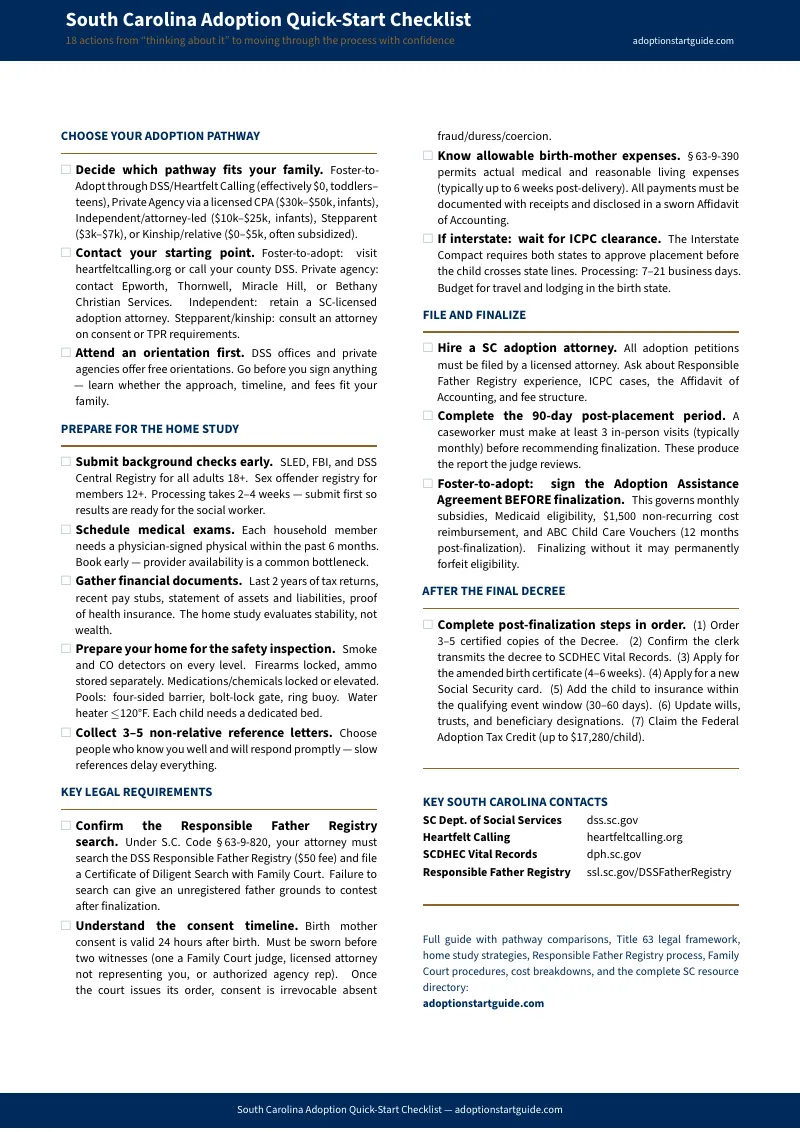
The free Quick-Start Checklist
Download the South Carolina Adoption Quick-Start Checklist for a one-page overview of the adoption process, from identifying your pathway through court finalization. Free, no commitment. It includes the five-pathway decision framework and the Responsible Father Registry search reminder — the two items that cause the most confusion and the most preventable legal complications in South Carolina adoption. If you want the full guide with the consent and relinquishment decoder, financial disclosure compliance kit, DSS subsidy negotiation walkthrough, attorney and agency directory, and printable worksheets, click the button in the sidebar.
— less than fifteen minutes with a South Carolina adoption attorney
South Carolina adoption attorneys charge $200 to $400 per hour. Agency application fees start at $500. A contested adoption triggered by a missed Responsible Father Registry search can cost $10,000 or more in emergency legal fees. This guide puts the entire South Carolina adoption system — five pathways compared, Registry navigation, consent and relinquishment rules, financial disclosure compliance, DSS subsidy negotiation, and a vetted attorney and agency directory — in your hands for less than the cost of a single phone consultation. Families who understand the system before they enter it choose the right pathway, avoid financial disclosure errors that can sink a petition, and never get blindsided by a registry filing that a $50 search would have caught.
If the guide doesn't deliver, reply to your download email at any time for a full refund. No forms. No justification required.