Virginia has 120 local departments of social services, a training curriculum that changed six months ago, and a home study process governed by regulations most agency websites haven't updated since 2023.
You called your county's Department of Social Services to ask about becoming a foster parent. Someone transferred you to a voicemail. You left a message. Nobody called back for two weeks. When they did, they told you to attend an orientation — but the next one isn't for six weeks, and they couldn't tell you what documents to start gathering in the meantime.
So you went online. You found FosterVA.org, which gave you a clean overview and told you the basics — minimum age 21, background check, home study. You found the VDSS website, which gave you a 300-page manual written for caseworkers, not families. You found blog posts from 2022 telling you to prepare for PRIDE training. PRIDE was replaced by the National Training and Development Curriculum in October 2025. Nobody updated the blog posts. And somewhere between the third unanswered phone call and the fourth outdated search result, you started wondering whether you were even doing this right.
This is how Virginia's system works. Deliberately. Just in 120 different directions at once. The Commonwealth doesn't run a single foster care system. It runs 120 of them — one per local department of social services, each with its own orientation schedule, its own caseworker vacancy rate, and its own interpretation of how the home study regulations apply to your home. A family in Fairfax County has a different experience than a family in Wise County. A family contacting a private child-placing agency gets a different timeline than a family going through the LDSS. And unless you know the system before you enter it, nobody explains any of this until you're already committed to whichever path you happened to find first.
The 120-Agency Navigator: One Guide Through Virginia's 120-Door System
This guide is built for how Virginia's foster care system actually works in 2026 — the decentralized LDSS structure, the new NTDC training curriculum, the home study standards under the administrative code, the VEMAT scoring system that determines your monthly support, and the specific requirements that differ between your local department and a private child-placing agency. Every chapter reflects current Virginia law and regulation, not the PRIDE-era information that still dominates search results. It is the operating manual for getting licensed in the Commonwealth — through your pathway, under current conditions, with the training and documentation the system actually expects today.
What's inside
- LDSS vs. CPA Decision Framework — Virginia gives you two paths to licensure: your Local Department of Social Services (free, but dependent on caseworker availability that JLARC documented at 35% vacancy in some offices) or a Licensed Child-Placing Agency (often faster and more specialized, but some charge fees and focus on therapeutic placements). This chapter maps both options so you choose based on your goals, not whichever office answered the phone first.
- NTDC Training Roadmap — Virginia's pre-service training shifted from PRIDE to the National Training and Development Curriculum in October 2025. The NTDC is modular and research-backed — online self-assessments, video modules, in-person sessions, and on-demand "Right-Time" training after placement. This chapter explains what the new curriculum looks like so you show up prepared while other families are still searching for PRIDE classes that no longer exist.
- Home Study Decoder — The room-by-room walkthrough that translates Virginia's administrative code into plain language: water temperature at 120 degrees or below, bedroom square footage, firearm storage protocols, pool fencing, carbon monoxide detectors on every level. Every requirement addressed before the social worker's first visit — not discovered during it.
- VEMAT and Financial Support Guide — Virginia's Enhanced Maintenance Assessment Tool scores the difficulty level of each placement, which directly determines your monthly support above the base rate. Base rates for 2026 range from $580 per month (ages 0-4) to $861 (teens), with VEMAT supplements of $200-$600 depending on the child's needs. This chapter explains the scoring, the Medicaid coverage, and the clothing and school supply allowances so you can plan your budget on real numbers.
- Background Check and Barrier Crimes Navigator — Fingerprint processing through the state and FBI takes 4 to 8 weeks. Submit late, and your entire timeline shifts by two months. This chapter covers the CCRE and FBI checks, the CPS central registry search, the sex offender registry, and the barrier crimes list under Virginia Code Section 63.2-1719 — which convictions permanently disqualify, which have waiting periods, and how the appeal process works.
- Dual Approval Explained — Virginia allows simultaneous approval for foster care and adoption, which means you can be licensed to foster while also being considered for adoption placements. Critical for foster-to-adopt families and especially for military families who may face a PCS move before an adoption is finalized. This chapter covers dual approval, the Interstate Compact on the Placement of Children (the agreement that governs cross-state placement transfers), and how to protect your placement timeline against relocation.
- Military Family Licensing Guide — Fort Belvoir, Quantico, Naval Station Norfolk, Joint Base Langley-Eustis. How on-post housing interacts with bedroom requirements, how BAH fits the financial stability evaluation, and what happens to your license when PCS orders arrive. The ICPC transfer process, SCRA protections for military spouses, and the dual-approval strategy that keeps your case moving even if you move.
- Kinship Care Pathway — If you're a relative or family friend caring for a child who was removed from their home, Virginia has an expedited approval process. This chapter explains the kinship-specific requirements, the financial support available through the Kinship Guardianship Assistance Program, and the legal difference between foster care licensing, legal custody, and guardianship — so you know which status gives you authority over medical, educational, and travel decisions.
Printable standalone worksheets included
- Licensing Timeline Tracker — Every milestone from initial LDSS or CPA contact through final approval, with fill-in date fields so you always know where your case stands.
- Home Safety Inspection Checklist — Room-by-room walkthrough of Virginia's home study standards: water temperature, detectors, firearm storage, medication lock-up, pool barriers, bedroom configuration.
- Document Preparation Checklist — Background checks, medical clearances, financial records, reference letters, and training certificates in the order your caseworker expects them.
- Monthly Budget Worksheet — Maintenance rates by age group, VEMAT supplements, Medicaid coverage, clothing allowances, and household expense tracking in one printable sheet.
Who this guide is for
- First-time prospective foster parents — You've decided to foster and you're staring at a system that has 120 front doors. Your local DSS hasn't returned your call, or they told you to wait for an orientation that's weeks away. You need a roadmap that tells you what to do right now — what documents to gather, what training to expect, what the home study actually evaluates — so you're building momentum while the system moves at its own pace.
- Single applicants — Virginia allows single adults to foster, and the process is the same. But single applicants often face more pointed questions during the home study about support systems and backup care plans. This guide covers what the social worker evaluates so you walk in prepared, not defensive.
- Military families at Virginia installations — You're stationed at Belvoir, Norfolk, Quantico, or Langley-Eustis and you want to foster, but PCS orders could arrive mid-process. You need to understand how dual approval protects you, how the ICPC transfer works, and how your BAH and on-post housing factor into the home study.
- Kinship caregivers — A child in your family needs a stable home, and the county told you to get licensed. You didn't plan for this. You need the fastest path to legal authority for that child — medical decisions, school enrollment, travel — and you need to know what financial support is available through the Kinship Guardianship Assistance Program.
- Families considering foster-to-adopt — You want to adopt, and you've heard that fostering first is one pathway. You need the foster care licensing roadmap with the adoption pathway clearly marked, and you need to understand how Virginia's dual approval works before you commit.
Why the free resources fall short
The VDSS website publishes guidance manuals designed for caseworkers, not families. FosterVA.org gives a helpful overview but stops short of the specific home study standards that determine whether your home passes inspection. Agency websites describe their own orientation process — one agency's version of it — without explaining that another agency two counties over does it differently, or that going through your LDSS is a free alternative with different timelines and training schedules. Blog posts from 2022 still reference PRIDE as the standard pre-service curriculum. PRIDE ended in Virginia in October 2025.
Etsy sells foster care organization binders for $10 to $25 — chore charts, visit logs, medication trackers. They're useful after you're licensed and a child is in your home. They do nothing to get you licensed. They don't explain the training requirements, the home study standards, the background check timeline, or the financial support system. They organize the life of fostering without addressing the process of becoming a foster parent, which is the part where families actually get stuck.
And the orientation your LDSS eventually schedules? It's a general overview of the foster care system, not a walkthrough of NTDC training specifics, VEMAT financial calculations, or room-by-room home study standards. It gets you started. It doesn't get you prepared.
The free Quick-Start Checklist
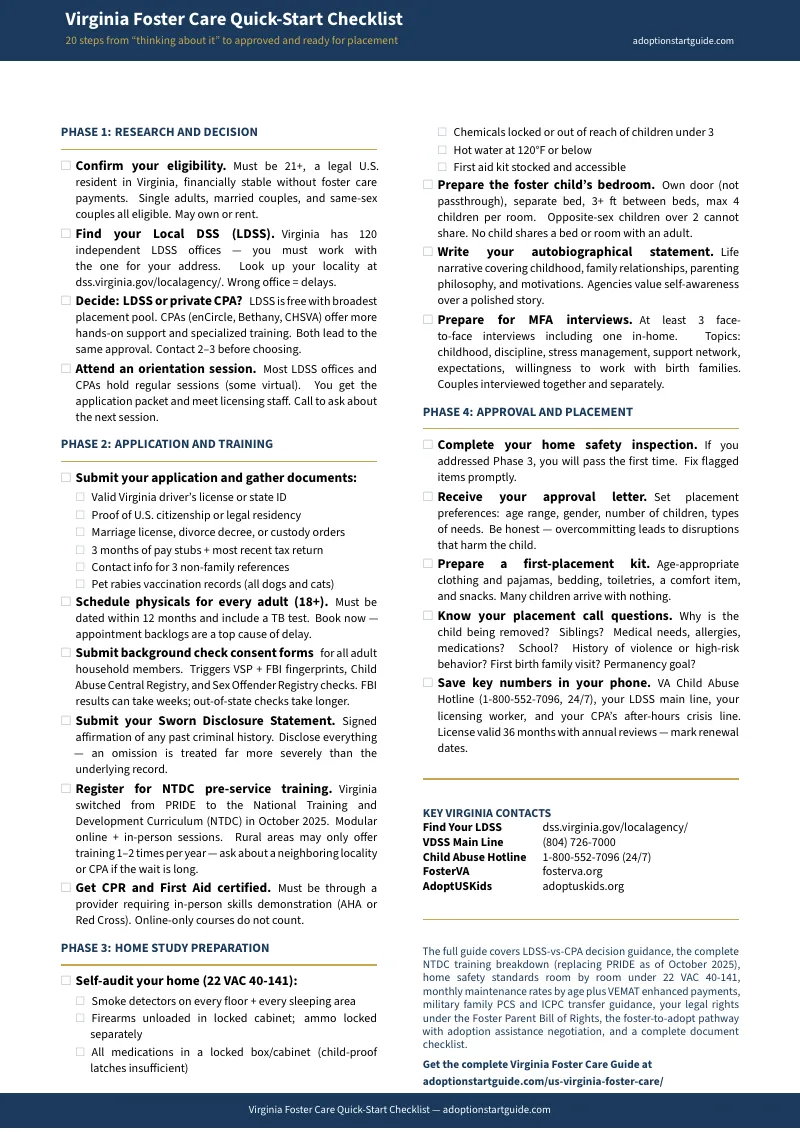
If you're not ready for the full guide, start here. Download the Virginia Foster Care Quick-Start Checklist for a one-page action plan covering the licensing process in the order the system expects you to complete it. Free, no commitment. It includes the LDSS-vs-CPA decision point and a training-readiness reminder so you don't spend weeks preparing for a curriculum that changed in late 2025. If you want the full guide with the NTDC training roadmap, the room-by-room home study decoder, the VEMAT financial breakdown, the military family licensing chapter, and all four printable worksheets, click the button in the sidebar.
— less than one background check processing fee
A missed fingerprint deadline costs you two months. A failed first home study visit because you didn't know the water temperature standard means a follow-up visit and another month of waiting. A family that chose the wrong agency pathway and realized it six months in has to start over. This guide puts the entire Virginia foster care licensing system — 120-LDSS navigation, NTDC training preparation, home study standards, VEMAT financial planning, barrier crimes, dual approval, military family considerations, and kinship pathways — in your hands for less than what most families spend on a single processing fee in this system.
If the guide doesn't deliver, reply to your download email at any time for a full refund. No forms. No justification required.