
You want to foster a child in Queensland. There are dozens of Licensed Care Services to choose from, a Blue Card system that can stall your application for months, and a Department that publishes policy manuals but won't tell you which agency actually answers the phone at 2 a.m.
You went to the DCSSDS website and found the foster care page. It told you about the Child Safety Practice Manual. It explained that Queensland uses Licensed Care Services -- non-government agencies contracted by the Department of Child Safety, Seniors and Disability Services to recruit and support foster carers. It listed some names: Anglicare Southern Queensland, Life Without Barriers, Churches of Christ, Mercy Community, OzChild, UnitingCare. It told you to contact one. It did not tell you how they differ from each other, which one has caseworkers in your region, or which one still has capacity for new carers versus the one running a recruitment campaign because their retention rate is terrible. It told you to register your interest. You filled in a form. Someone would call back.
While you waited, you joined the Foster Care Queensland Facebook group. You found carers describing a system under pressure -- 11,000 children in care and not enough homes. You found someone in Townsville who loved the child placed with them but hadn't heard from their caseworker in six weeks. You found a carer in the Brisbane suburbs who described the "Standard of Care" review process -- an investigation triggered by an allegation that turned her household upside down for months, even though she'd done nothing wrong, because the system is built to "cover their butts" first and support carers second. You found a Toowoomba foster parent who said the fortnightly allowance left them $400 out of pocket every fortnight and nobody at the Department seemed to care. You found someone who said their LCS information session was "warm and encouraging" but the reality of caseworker turnover, birth family contact management, and the sheer weight of paperwork bore no resemblance to what they were told at that first Thursday evening meeting. You closed the tab feeling less confident than when you started.
Then you looked into the Blue Card. You knew you needed one -- Queensland's working with children check, managed by Blue Card Services. You didn't know that the "No Card, No Start" law means no child can be placed with you until every adult in your household has been cleared. Not just you and your partner -- your adult child who moved back after their gap year, the grandparent who stays over every second weekend. You didn't know that a "negative notice" triggers a QCAT appeal process that averages 12 to 18 months. You didn't know you need a Customer Reference Number from the Department of Transport and Main Roads before you can even lodge the application. Your partner mentioned a minor charge from twenty years ago -- long spent, never repeated. You couldn't tell them whether it mattered. Neither could the Queensland Government website.
Meanwhile, you learned that the mandatory "Fostering Connections" preparation training covers trauma-informed care, child development, and the role of the Child Safety Officer. Useful. But it's delivered after you've already chosen an LCS and started the process. It doesn't help with the decision you're stuck on now: which agency to approach, how to prepare your household for a 6-to-12-month assessment that involves multiple home visits and a written life history, or how to explain to your teenage children what fostering will actually mean for Saturday mornings when a child with trauma-driven behaviours joins the household. Nobody prepares you for the gap between wanting to help and knowing what you're walking into.
You asked a friend who considered fostering a few years ago which agency they went with. They said they started with one LCS, found the support inadequate, and gave up. Someone in a Queensland parenting group recommended a different provider. Someone else said it doesn't matter because the Department holds ultimate authority over the child regardless of which agency you're with. Someone posted a link to the same DCSSDS page you started on. The advice was well-meaning, out of date, and contradictory.
The Queensland Carer Authorisation Roadmap: Your Independent Guide to Foster Care in Queensland
This guide is built for how the Queensland foster care system actually works in 2026 -- under the decentralised Licensed Care Services model, within the legislative framework of the Child Protection Act 1999, governed by a Department of Child Safety, Seniors and Disability Services that sets the rules but delegates the front-line work to agencies whose quality and responsiveness vary enormously depending on where you live and which provider you choose. Every chapter reflects current Queensland law, the specific LCS landscape across SEQ and regional Queensland, and the operational realities that the DCSSDS website and agency recruitment brochures systematically leave out. It is not a national fostering handbook with "Queensland" in the title. It is the operating manual for this state's system -- built for a jurisdiction where the distance between Brisbane and Cairns is the same as London to Rome, where the agency that works well in the Gold Coast corridor may have no presence in Central Queensland, and where 76% of carers report being out of pocket every fortnight.
What's inside
- Licensed Care Services Comparison Framework -- Queensland outsources foster carer recruitment and support to Licensed Care Services. Anglicare Southern Queensland, Life Without Barriers, Churches of Christ, Mercy Community, OzChild, UnitingCare, Key Assets -- each operates with a different model of care, different caseworker-to-carer ratios, different after-hours crisis response, different specialisations in emergency, respite, and long-term placements. The guide compares what matters -- not brochure language but actual support structures, regional coverage, caseload capacity, and staff continuity -- so you choose a provider based on substance, not whichever LCS happens to be running a recruitment drive when you search "foster care Queensland."
- Blue Card "No Card, No Start" Household Walkthrough -- The Blue Card system extends to every adult in your household and regular overnight visitors. The guide explains the application process for each person, the CRN requirement from the Department of Transport and Main Roads, what triggers a "negative notice," the QCAT appeal process and its 12-to-18-month timeline, how spent convictions from decades ago interact with the risk assessment, and how to have the honest conversation with household members before their application creates a surprise. Because the awkwardness of asking your partner's adult child to submit to a screening check is a real barrier that no LCS information session addresses.
- Assessment Preparation for the Queensland Process -- The Queensland carer assessment spans 6 to 12 months and involves multiple home visits, referee interviews, medical reports, a structured decision-making (SDM) assessment, and the written life history that becomes part of your permanent file. The guide decodes what assessors are actually evaluating at each stage: relationship stability, emotional regulation, capacity for grief when reunification happens, flexibility around placement types, and your understanding of developmental trauma. It includes a preparation framework for the home safety inspection -- bedroom configurations, pool fencing, medication and chemical storage, smoke detectors -- and the life history, so you can be thorough without feeling like you've surrendered your entire past to a stranger.
- DCSSDS vs. LCS Authority Decoder -- The most persistent source of confusion in Queensland foster care is the split between the Department and the Licensed Care Service. The Department -- through the local Child Safety Service Centre and the Child Safety Officer -- holds statutory authority over the child. The LCS manages your day-to-day support, training, and casework. The carer does the actual parenting. The guide explains where each authority begins and ends, what decisions you can make independently, what needs LCS sign-off, what requires the CSO's approval, and why getting permission for a school camp can take three weeks when you need an answer by Friday. Understanding this structure before your first placement prevents the "bureaucratic no-man's-land" that drives carers out of the system faster than anything the child does.
- 2026 Fortnightly Allowance Breakdown -- Queensland's carer allowance rates by age bracket, additional support for children with complex needs, establishment payments for initial clothing and supplies, and one-off expense claims for medical, education, and travel costs. The guide provides current figures, explains what each payment category genuinely covers, and addresses the financial reality honestly -- because 76% of Queensland carers report being out of pocket up to $400 per fortnight, and the ones who enter the system expecting the allowance to cover the actual cost of raising a child in Brisbane or Townsville or Cairns are the ones who leave the system fastest.
- Birth Family Contact and Reunification Navigation -- Queensland legislation strongly prioritises maintaining connections between children in care and their birth families. Carers are frequently expected to facilitate contact visits with limited training and less support, including situations where the relationship with the birth parent is hostile or fractured. The guide covers how contact visits are structured, how to prepare a child before and stabilise them after contact, what information you're legally required to share, managing unregulated social media contact between older children and birth families, and the emotional preparation for reunification -- the grief of a child leaving when the case plan goal was always "restoration." This is the chapter that addresses the fear most prospective carers won't say out loud.
- "Standard of Care" Protection Strategy -- The Standard of Care review process is triggered when an allegation is made about a carer's conduct -- from a child, a birth parent, a community member, or the Department itself. It can be launched over an incident as minor as a bath-time routine or a raised voice. The guide explains how the process works under the Child Safety Practice Manual, what your rights are during a review, how to document your care from day one to protect yourself, and how to maintain natural family warmth -- cuddling, bathing, physical comfort -- without the constant fear that an ordinary parenting moment becomes a formal complaint. Male carers and carers of opposite-gender children especially need this chapter.
- Regional vs. SEQ Resource Map -- The experience of fostering in the South East Queensland corridor -- Brisbane, Gold Coast, Sunshine Coast -- is vastly different from fostering in Toowoomba, Mackay, Rockhampton, Townsville, or the Far North. Metro carers face more LCS choice but a more clinical, fragmented system. Regional carers benefit from stronger community bonds but contend with workforce shortages, fewer specialists, and travel burdens for appointments that standard allowances may not cover. The guide maps the support resources, LCS regional presence, and specialist availability across Queensland's major regions so you know what's actually available where you live, not what the state-wide brochure implies.
Who this guide is for
- Working families in Brisbane, Gold Coast, and the Sunshine Coast -- You work full-time, you have a spare room, and you've been thinking about fostering for months. You've browsed the DCSSDS website and maybe attended an LCS information session that was encouraging but left your actual questions unanswered. You need the independent comparison that tells you which agency matches your suburb, your work schedule, and your family -- not the one spending the most on Facebook ads this month.
- Regional and remote Queensland families -- You live in Toowoomba, Rockhampton, Mackay, Townsville, Cairns, or further out. You know the need is high in your community. You also know that service access is uneven, specialist support is thin, and the closest Child Safety Service Centre may be an hour's drive away. The guide maps exactly which LCS providers serve your region and what support infrastructure actually exists outside the SEQ corridor.
- Kinship carers who just received an emergency placement -- Child Safety placed your grandchild, your niece, or a family connection with you. You have limited time to understand your rights, the carer allowance you're entitled to, the Blue Card requirements, and the ongoing obligations. The guide covers the kinship pathway specifically -- because the process for family carers is different from the general foster care pipeline, and nobody hands you a manual when the CSO calls at 10 p.m.
- People who want permanency, not temporary care -- You want to provide a forever home. Queensland doesn't let you skip to that. The primary legislative goal is family reunification. Long-term guardianship and Permanent Care Orders under the "My Home" program come only after the system has attempted restoration and the child has been in care long enough for the court to consider an alternative. The guide explains how this pathway works, what the realistic timeline looks like, and how to prepare emotionally and legally for a process that begins with temporary care and a child whose case plan goal may still be "restoration."
- Single applicants, same-sex couples, and renters -- You don't need to be married, own your own home, or fit the "nuclear family" profile to foster in Queensland. The system actively seeks diverse carers. But the assessment process evaluates your support network differently when you're single, and same-sex couples sometimes encounter questions that heterosexual applicants don't. The guide addresses how the assessment handles these circumstances, what the LCS looks for in your personal support structure, and how to prepare for questions specific to your situation.
Why the free resources fall short
The DCSSDS publishes the Child Safety Practice Manual -- an exhaustive policy document that covers legislation, standards of care, and procedural requirements. It is thorough, bureaucratic, and written for caseworkers, not prospective carers. It does not tell you how to get through the door. Agency websites like Anglicare's and Life Without Barriers' explain their own models of care because they're recruiting for their own caseloads. None of them will tell you that a different LCS might be a better fit for your region, your work hours, or your care preferences. They are recruitment tools dressed as information resources. They show you the reward and gloss over the red tape, the Blue Card delays, the caseworker turnover, the financial gap, and the emotional reality of managing birth family contact with a hostile parent.
The mandatory "Fostering Connections" preparation training is delivered after you've already committed to an LCS and begun the process. It covers the theoretical foundations -- trauma, child development, the system's legal framework -- but it doesn't help with the pre-application anxiety or the strategic decisions that shape your entire experience: which agency to approach, how to prepare your household for the assessment, how to budget realistically, how to explain to your teenage children what fostering will actually change. Reddit threads and Queensland Facebook groups provide raw, emotional accounts from current and former carers -- some from last month, some from years ago, frequently contradictory and impossible to verify. A carer who went through the process in 2021 may be describing an LCS that has since changed leadership, a subsidy rate that no longer exists, or a caseworker-to-carer ratio that doubled after a restructure. National foster care guides describe a generalised Australian process that doesn't account for Queensland's LCS model, the Blue Card "No Card, No Start" law, the DCSSDS-and-LCS authority split, the regional disparities between SEQ and the rest of the state, or the reality that in a decentralised system, your experience depends almost entirely on which agency you choose -- and nobody is set up to help you make that choice.
The free Quick-Start Checklist
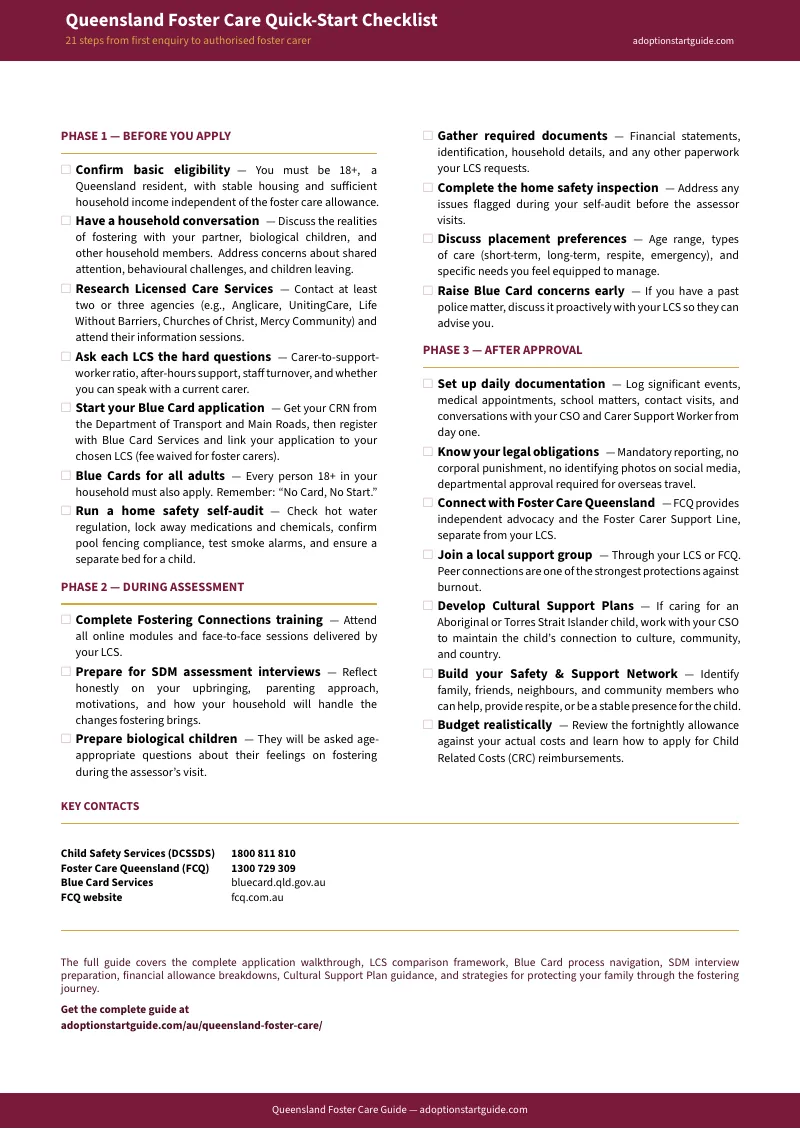
Download the Queensland Foster Care Quick-Start Checklist for the essential steps from first enquiry through the LCS selection process -- including the Blue Card household requirements and home safety items that cause the most delays. Free, instant download, no commitment. If you want the full guide with the LCS Comparison Framework, the Blue Card household walkthrough, the assessment preparation system, the DCSSDS vs. LCS authority decoder, the 2026 fortnightly allowance breakdown, birth family contact and reunification navigation, the "Standard of Care" protection strategy, and the regional vs. SEQ resource map, click the button in the sidebar.
-- less than what the average Queensland carer is out of pocket in a single week
One wrong LCS choice means months invested in a provider whose support model doesn't match your needs -- and in a decentralised system with dozens of agencies, the difference between an LCS that answers your crisis call at midnight and one that routes you to a generic hotline is the difference between staying in the system and walking away. One incomplete Blue Card application for a household member stalls your entire assessment by months. One misunderstanding about the DCSSDS-and-LCS authority split -- believing your caseworker can approve decisions that actually require the Child Safety Officer -- sets you up for weeks of frustrated waiting over things that should take a phone call. One "Standard of Care" review you weren't prepared to document against can shake your confidence in every parenting instinct you have. This guide puts Queensland's complete foster care process in your hands for less than the cost of a single family takeaway dinner. Families who understand the system before they enter it choose the right LCS for their region, pass the home assessment with confidence, and walk into their first placement prepared for the realities that the recruitment brochures leave out.
If the guide doesn't deliver, reply to your download email within 30 days for a full refund. No forms. No justification required.