You can deploy to a combat zone on 72 hours' notice. Getting TRICARE for your foster child takes three months of arguing with a DEERS clerk.
You passed the home study. You completed the PRIDE training on nights and weekends between duty shifts. A child is in your home, or about to be, and you are trying to do the one thing the military trained you to do: execute the mission. But the mission paperwork is worse than anything your MOS ever threw at you.
The RAPIDS office says your foster child cannot be enrolled in DEERS until the adoption is final. That is wrong. DoD policy is clear that pre-adoptive children placed by a recognized agency are eligible. But the clerk does not know that, and you do not have the regulation number in your hand to prove it. So you go home, the child has no TRICARE, and you are paying out of pocket for a pediatrician visit that should be covered.
Your spouse files DD Form 2675 for the $2,000 adoption reimbursement. DFAS-Cleveland kicks it back because one line item said "travel" and that invalidated the entire claim. Nobody told you travel is excluded. The two-year filing deadline is still ticking, and you just lost three months to a paperwork error.
Then the PCS orders arrive. The child has been in your home for eight months. The adoption is not finalized. The Interstate Compact on the Placement of Children says you cannot move the child across state lines without approval from both states, and that process takes three to six months. The military gave you 45 days. You can request an assignment extension under DoDI 1341.09, but your command has never processed one for a foster parent and does not know where to start.
Military OneSource has a page about adoption. It tells you these benefits exist. It does not tell you why your specific claim was denied, which policy citation to print and hand to the DEERS clerk, or how to word a deferment request so your CO actually approves it. The base Family Service Center hands you a brochure. The brochure is the same one they gave you two years ago.
There is a gap between what the DoD says you are entitled to and what actually happens when you try to claim it. This guide closes that gap.
The Military Family Adoption Ops Manual
This is not an overview of adoption for people who happen to be in the military. It is the operational manual for executing a foster care placement or adoption inside a system that moves you across state lines, deploys you overseas, and buries your benefits behind forms that get rejected for documentation errors one in three times.
The guide covers every branch, every pathway (foster care, private agency, intercountry, and OCONUS adoption), and every administrative chokepoint where military families get stuck. It is organized around the specific friction points that make military adoption different from civilian adoption: mobility, benefits enrollment, reimbursement claims, command dynamics, and overseas placements.
What's inside
- DD Form 2675 Walkthrough — DFAS rejects roughly one in three adoption reimbursement claims for documentation errors. The $2,000 per child benefit has a hard two-year deadline that deployments do not extend. This chapter walks through every section of the form, lists every qualifying and non-qualifying expense, and shows you exactly what documentation to attach so your claim does not get kicked back to Cleveland.
- The DEERS Enrollment Fix — The print-and-carry policy citations (TRICARE Policy Manual, Chapter 10, Section 3.1) that prove your pre-adoptive or foster child is eligible for enrollment. What to say when the RAPIDS clerk says no. How to escalate to a supervisor. The 90-day CONUS and 120-day OCONUS enrollment deadlines that, if missed, cannot be backdated. Step-by-step, from the documents you need to the phone number to call when the installation will not process it.
- The PCS Survival Kit — How to "port" your home study and foster care license between duty stations. The ICPC process explained in plain language: who files what, realistic timelines, and the paperwork mistakes that restart the clock. How to request an assignment extension under DoDI 1315.18 with a template memorandum your CO can approve without researching the regulation themselves. When to push for expedited finalization instead of ICPC. The 2023 SCRA amendments and whether foster care licensure portability applies in your state.
- Command-Level Templates — Pre-written request memoranda for 12 weeks of parental leave under the MPLP, assignment extensions for pending adoptions, and deployment deferments for placement stability. Each template cites the relevant DoDI, uses language your chain of command recognizes, and includes the enclosure list so nothing gets sent back for missing attachments. Adapt to your branch's format and submit.
- The OCONUS Adoption Blueprint — The specific requirements for adopting a child from the host nation while stationed in Germany, Japan, South Korea, or elsewhere. Hague Convention vs. non-Hague pathways, SOFA limitations on non-citizen adoption, dual home study requirements (U.S. and host nation), USCIS Form I-800/I-600 filing, IR-3 and IR-4 visa categories, and how to get a U.S. passport for your child through the installation Passport Office. The chapter civilians never need and Military OneSource does not cover in detail.
- The Financial Ops Plan — How to stack the $2,000 DoD reimbursement, up to $16,810 in federal adoption tax credits, state-specific tax benefits, and foster care subsidies without double-counting expenses. Which costs qualify for which program. Why your VITA tax preparer may get the interaction between the DoD W-2 and IRS Form 8839 wrong, and how to catch it. The complete financial planning checklist from day one through five years of carried-forward credits.
- The Family Care Plan for Foster Parents — DoDI 1342.19 requires a Family Care Plan for single parents, dual-military couples, and sole custodians. For foster parents, the designated caregiver also needs approval from the placing agency, which means background checks and caseworker sign-off that the standard FCP does not account for. This chapter covers branch-specific forms (DA 5305, NAVPERS 1740/6, AF Form 357, NAVMC 10922), the 60-day update requirement after any placement change, and why failure to maintain a valid FCP can result in administrative separation.
- 12 Weeks of Parental Leave — The expanded MPLP grants 12 weeks of non-chargeable leave for adoption and long-term foster care placements (24+ months). Both members of a dual-military couple get the full 12 weeks. But your command can delay it for "operational necessity," and the qualifying threshold for foster placements trips up families whose initial placement agreement does not specify a 24-month commitment. This chapter covers eligibility, how to request it, what to do when command pushes back, and how to get a placement agreement updated to meet the 24-month requirement.
- VA Benefits for Veterans — If you separated with a service-connected disability that affects fertility, the VA offers its own $2,000 adoption reimbursement on top of any active-duty benefits you already claimed. This chapter covers eligibility, the application process, and why ensuring your VA disability rating reflects infertility matters for benefits beyond adoption.
- Bonus: DEERS Enrollment Reference Card — A one-page print-and-carry sheet with the exact TRICARE policy citations, required documents, enrollment deadlines, a script for the RAPIDS clerk, and the full escalation path. Bring it to the ID card office and hand it to the person who says your foster child cannot be enrolled.
- Bonus: Financial Reference Card — A one-page summary of the DoD reimbursement, federal tax credits, VA benefits, and qualifying vs. non-qualifying expenses. Keep it with your receipts. Use it at tax time. Know exactly how to stack all three programs without double-counting.
Who this guide is for
- Active-duty E4 to E6 families — You have the income stability and healthcare access that agencies love, but you lack the personal staff or legal resources of senior officers. You need the regulation numbers, the template letters, and the step-by-step procedures that your First Sergeant does not have on file.
- Military spouses leading the process — The service member is deployed or TDY. You are managing the home study, the agency relationship, the caseworker visits, and the court dates alone. This guide is written so either spouse can execute every step independently.
- Dual-military couples — Both of you deploy. Both of you PCS. Your Family Care Plan is more complex, your scheduling is harder, and your parental leave is doubled (12 weeks each). The guide addresses the specific logistics of two service members fostering or adopting together.
- Veterans with service-connected infertility — Up to 40% of active-duty women report chronic problems conceiving. Toxic exposures, physical trauma from ill-fitting body armor, and operational tempo that prevents timed treatment cycles all contribute. If adoption is your path to parenthood because the military took a biological one, this guide covers the VA-specific benefits you have earned.
- Single soldiers — Yes, you can foster and adopt. The Family Care Plan requirements are stricter, and some agencies have outdated assumptions about single service members. This guide covers both the legal requirements and the practical strategies for navigating agency bias.
Why the free resources fall short
Military OneSource tells you that adoption reimbursement exists. It does not tell you why DFAS denied your claim or which line item triggered the rejection. It lists the ICPC as a consideration. It does not walk you through the actual packet requirements or the realistic timeline when both states are understaffed and your PCS date is in six weeks.
The base Family Service Center connects you to a specialist who can answer general questions. That specialist cannot advise you on how to word a deferment request for a commanding officer who has never approved one, or explain why the RAPIDS office is wrong about DEERS enrollment and what specific policy to cite when you go back.
The Facebook groups and Reddit threads are brutally honest about the frustrations. They are not organized. You are reading through three years of posts to find the one person who dealt with your exact situation at your exact installation, and by the time you find it, the regulations they cited may have changed.
This guide is the structured synthesis of all of it: the regulations, the workarounds, the peer-tested tactics, and the template documents. It is organized by the problem you are facing right now, with the policy citations you can print and hand to the person who is telling you no.
The free Quick-Start Checklist
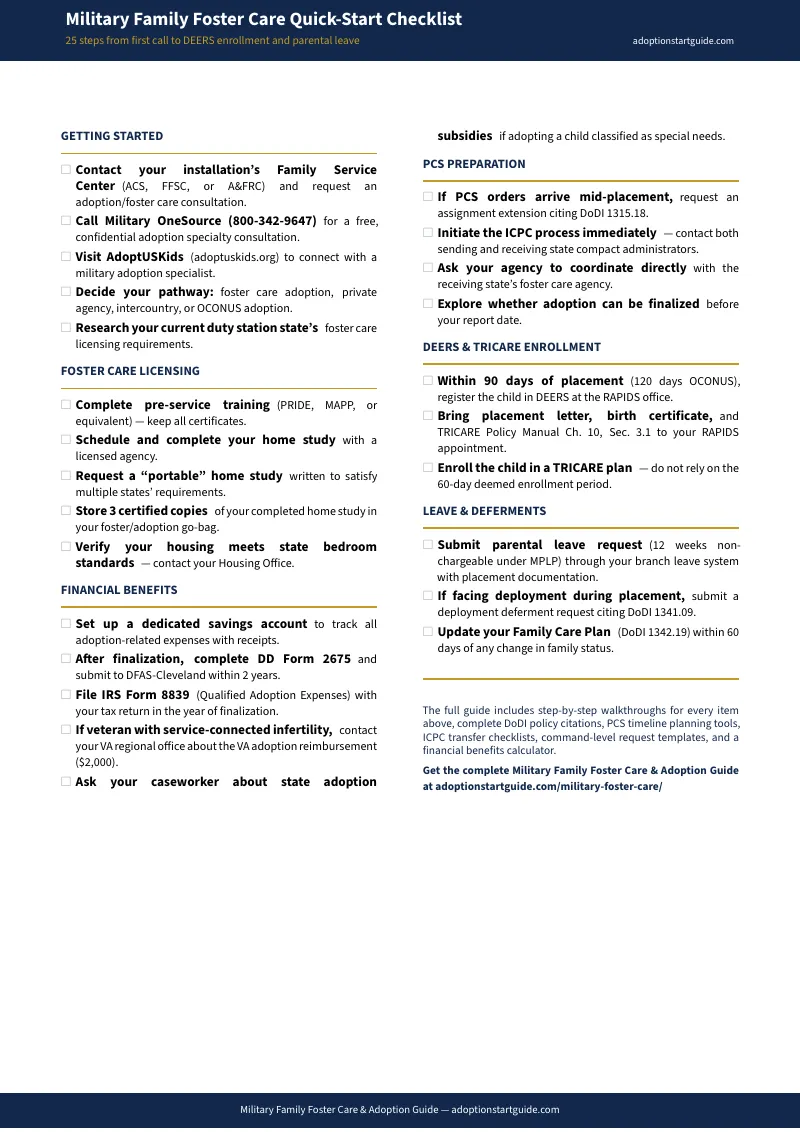
Download the Military Family Foster Care Quick-Start Checklist for a one-page overview of the key milestones, deadlines, and forms from licensing through finalization. Free, no commitment. If you want the full Ops Manual with the DD Form 2675 walkthrough, DEERS enrollment fix, PCS survival kit, OCONUS blueprint, command templates, and financial planning tools, click the button in the sidebar.
— less than one rejected reimbursement claim costs you in time
A single DFAS rejection costs you the time to refile, the time to track down missing receipts, and the risk of blowing the two-year deadline entirely. One missed DEERS enrollment window means months of out-of-pocket medical bills that should have been covered. One botched ICPC packet restarts a three-to-six-month clock while your PCS date does not move.
The Ops Manual does not replace your JAG office or your caseworker. It makes sure you walk into both of those conversations knowing exactly what you are entitled to, which form to file, and what to say when someone tells you it cannot be done.
If the guide does not deliver, reply to your download email at any time for a full refund. No forms. No justification required.