
You want to foster a child in Western Australia. The system wants you to call ten different agencies and hope someone explains the difference.
You went to the Department of Communities website. It told you that WA needs more foster carers -- urgently. It described the types of care: emergency, short-term, long-term, respite. It mentioned the Fostering Foundations training and the competency-based assessment. It told you to contact an agency or submit an expression of interest through wa.gov.au/foster. It did not tell you which agency to contact. It listed the Department itself, plus Wanslea (now called Uplyft), MercyCare, MacKillop Family Services, Anglicare WA, Key Assets, Life Without Barriers, Yorganop, and Wungening Aboriginal Corporation. It did not explain what distinguishes any of them from each other. You asked which one suits someone in your suburb. The website didn't answer that.
While you waited, you searched "foster care WA reddit." You found carers describing the heartbreak of bonding with a child for eighteen months only for reunification to happen. You found people saying their caseworker changed three times in a year. You found a thread about a carer whose Working with Children Check took four months because a household member had an old minor offence nobody had warned them about. You found someone describing the Fostering Foundations training as valuable but saying nothing prepared them for the actual assessment -- five to eight interviews where an assessor evaluates your life story, your relationship stability, your capacity for loss, and your parenting philosophy. You closed the tab. You sat with it for a week.
Then you looked into the Working with Children Check. You knew you needed one. You didn't know that every adult in your household needs one too -- your partner, your adult child home from uni, anyone over 18 living under your roof. You didn't know that certain historical offences don't disqualify you but will trigger a WWC Screening Unit review that adds months to your timeline. Your partner asked what happens if something shows up from twenty years ago. You couldn't answer. Neither could the DoC website.
Meanwhile, you learned that the mandatory Fostering Foundations training is 18 hours across six modules, covering developmental trauma, attachment, the PACE model, cultural safety, managing behaviour without physical discipline, and working with birth families. Good. But nobody told you what happens after training -- the competency-based assessment where a social worker writes your "life story," interviews your referees, walks through your home, and evaluates five specific competencies. The training prepares you for the child's needs. Nothing prepares you for the assessment of you.
You asked a forum whether to go with DoC directly or through an NGA like Wanslea. Half the responses praised Wanslea's dedicated Family Support Worker model -- one person who stays with you regardless of which child is placed. The other half said it doesn't matter because the Department makes all the real decisions anyway. Someone recommended MacKillop for their 24/7 therapeutic team. Someone else said Key Assets has better respite arrangements. The advice was passionate, contradictory, and came from carers in different decades of the system.
The WA Carer's Navigation System: Your Independent Guide to Foster Care in Western Australia
This guide is built for how Western Australia's foster care system actually works in 2026 -- the Children and Community Services Act 2004, the Department of Communities commissioning model, the Fostering Foundations training curriculum, the five-competency assessment framework, the agency landscape from DoC through to Wanslea/Uplyft and the Aboriginal Community-Controlled Organisations, the subsidy structure that most free resources describe in vague terms, and the metro-versus-regional divide that affects everything from caseworker access to training availability across 2.5 million square kilometres. Every chapter reflects current WA law, the specific agency landscape across Perth and regional WA, and the operational realities that DoC compliance pages and agency brochures systematically leave out. It is not a national fostering handbook with "Western Australia" in the title. It is the operating manual for this state's system.
What's inside
- Agency Comparison Framework (DoC vs. Every NGA) -- WA runs foster care through the Department of Communities directly and through contracted non-government agencies. Wanslea/Uplyft, MercyCare, MacKillop, Anglicare WA, Key Assets, Life Without Barriers, Yorganop, and Wungening each operate with different support models, caseworker-to-carer ratios, geographic coverage, and after-hours crisis response. The guide compares what matters -- who assigns you a dedicated Family Support Worker, who offers 24/7 therapeutic teams, who has the strongest regional presence, and who matches your values and suburb -- so you choose an agency based on substance, not whoever answers the phone first.
- Working with Children Check Household Walkthrough -- WA's WWCC requirement extends to every adult in your household. The guide explains the application process through the WWC Screening Unit, how historical offences and police contact trigger reviews, what "work on application" means during the waiting period, typical processing times, the interim negative notice process, and how to handle the screening conversation with reluctant household members -- because the awkwardness of asking your adult stepson to get checked is a real barrier that nobody at the Department will help you navigate.
- Five-Competency Assessment Preparation -- The assessment involves five to eight in-depth interviews, referee checks, a home environment evaluation, and the written life story that becomes part of your permanent file. The guide decodes the five competencies -- Promoting Wellbeing, Providing a Safe Living Environment, Working in Partnership, Developing Personal Knowledge, and Character and Repute -- explaining what assessors are actually evaluating at each stage. It includes a preparation framework for the life story so you can be thorough without feeling like you've surrendered your diary.
- Fostering Foundations Training Navigator -- The 18-hour mandatory training covers developmental trauma, attachment, the PACE approach, cultural safety including the Stolen Generations, managing behaviour without physical discipline, and working with birth families. The guide maps what the curriculum covers well and what it doesn't prepare you for (bureaucratic navigation, the assessment itself, court processes, caseworker turnover), and provides context for the therapeutic concepts so you walk in ready to engage, not just attend. Covers metro face-to-face, regional, and online delivery options.
- Aboriginal and Torres Strait Islander Child Placement Principle -- Practical Guide -- Aboriginal children are significantly over-represented in WA's care system. Non-Aboriginal carers who receive an Aboriginal child need to understand all five pillars -- Prevention, Partnership, Placement, Participation, and Connection -- not as policy abstractions but as practical obligations. The guide explains Cultural Support Plans, connecting with Aboriginal Community-Controlled Organisations like Yorganop and Wungening, the placement hierarchy, and how to support a child's connection to Country and community with respect rather than anxiety.
- Financial Reality Check -- WA's subsidy structure includes base rates by age group (with the 10% uplift), special needs loading for high-support placements, the Foster and Grand Carer Gold Card, KidSport vouchers, clothing allowances, education support, and Centrelink entitlements (Family Tax Benefit, Health Care Card). The guide provides current 2026-27 figures, explains what each payment covers, clarifies that subsidies are reimbursements not income, and addresses the financial reality honestly -- because carers who enter expecting the allowance to cover the actual cost of care burn out fastest.
- Perth Metro vs. Regional and Remote WA -- Metropolitan Perth carers deal with higher agency density, more caseworker options, and specialist services within driving distance. Regional carers in the Kimberley, Pilbara, Goldfields, Great Southern, and South West face training delivered by webinar, hundreds of kilometres between service hubs, privacy challenges in small towns, and the Remote Area Allowance. The guide addresses both realities with specific logistics for each region -- because fostering in Broome is a fundamentally different experience from fostering in Joondalup.
- Permanency Pathway Decoder -- WA's system distinguishes between restoration (reunification with birth family), Special Guardianship Orders (long-term legal authority transferred to carers), and adoption from care (rare, full transfer of parental rights). Home Stretch WA now extends support to age 21, with transition coaches, the Staying On Subsidy, and the Invest in Me Fund. The guide explains when and how each pathway becomes available, what the realistic timelines look like, and how to prepare emotionally for a process that starts with temporary care.
Who this guide is for
- Perth metro couples and families -- You have a spare room in Joondalup, Stirling, Melville, or Rockingham and you've been thinking about fostering for months or years. You've browsed the DoC website and maybe attended one information session. You need the independent agency comparison that tells you which NGA fits your suburb, your work schedule, and your family situation -- not the one that's spending the most on recruitment marketing.
- Regional and remote WA families -- You're in Bunbury, Geraldton, Kalgoorlie, Karratha, or Broome. Every training session and agency meeting requires planning around distance, work, and childcare. You need to know which agencies operate in your region, how training is delivered remotely, what the Remote Area Allowance covers, and how to access support services when the nearest agency office is hours away.
- Kinship carers who just received a placement -- The Department or an NGA placed your grandchild, your niece, or a family connection with you. You have limited time to understand your rights, the subsidy you're entitled to, the training requirements, and the ongoing obligations. The guide covers the kinship pathway specifically -- because the process for relatives is different from the general foster care pipeline, and nobody hands you a manual at the door.
- People who want permanency, not temporary fostering -- You want to provide a permanent home. WA doesn't let you skip to that. A Special Guardianship Order comes after the system has exhausted reunification efforts. The guide explains how this pathway works, what the realistic timeline looks like, and how to prepare emotionally and legally for a process that starts with temporary care.
- LGBTQ+ individuals and couples -- WA's anti-discrimination protections are clear, and multiple agencies actively welcome LGBTQ+ applicants. The guide addresses how the competency-based assessment handles same-sex couples and single applicants, which agencies have specific support, and the practical realities of the process so you enter with confidence, not guesswork.
- Single applicants -- You don't need a partner to foster in Western Australia. But the assessment evaluates your support network differently when you're doing it alone. The guide addresses how single applicants demonstrate capacity, what assessors are looking for in your personal support structure, and how to prepare for questions about managing placement demands without a co-carer.
Why the free resources fall short
The Department of Communities website publishes the statutory framework and directs you to wa.gov.au/foster. That page is designed to get you to submit an expression of interest, not to help you compare agencies independently. NGA websites like Wanslea's and MacKillop's explain their own models of care in careful detail, because they're recruiting for their own caseloads. None of them will tell you that a different agency might be a better fit for your suburb, your work hours, or your preference for therapeutic versus generalist support. They're recruitment tools dressed as information resources.
The Foster Care Association of WA provides excellent advocacy for existing carers, but its resources assume you're already in the system. Reddit and forums provide raw, emotional accounts from current and former carers -- some from 2019, some from last week, some from New South Wales mislabelled as Western Australian. The advice is real but unsorted, outdated, and impossible to verify against current regulations and agency structures.
National foster care guides describe a generalised Australian process that doesn't account for WA's specific commissioning model, the Children and Community Services Act 2004, the Fostering Foundations curriculum specific to this state, the five-competency assessment framework, the subsidy tiers with the 10% uplift, the DoC-versus-NGA choice architecture, the metro-versus-remote divide across 2.5 million square kilometres, or the practical differences between fostering through Wanslea in Mirrabooka and through Life Without Barriers in the Pilbara. A book written for Victoria or Queensland won't tell you that your Bunbury application processes through a different agency landscape than your cousin's in Cannington, or that the Working with Children Check in WA is administered by a different unit with different timelines than any other state.
8 standalone printable tools included
Beyond the 70-page guide, you get printable worksheets and reference cards you can use independently — bring the Agency Comparison Worksheet to information sessions, pin the Financial Entitlements Card to your fridge, track every household member's clearances on the WWCC Household Checklist, prepare for each assessment interview with the Assessment Preparation Worksheet, and keep the Key Contacts Card in your phone case. Each standalone works on its own — print what you need, when you need it.
The free Quick-Start Checklist
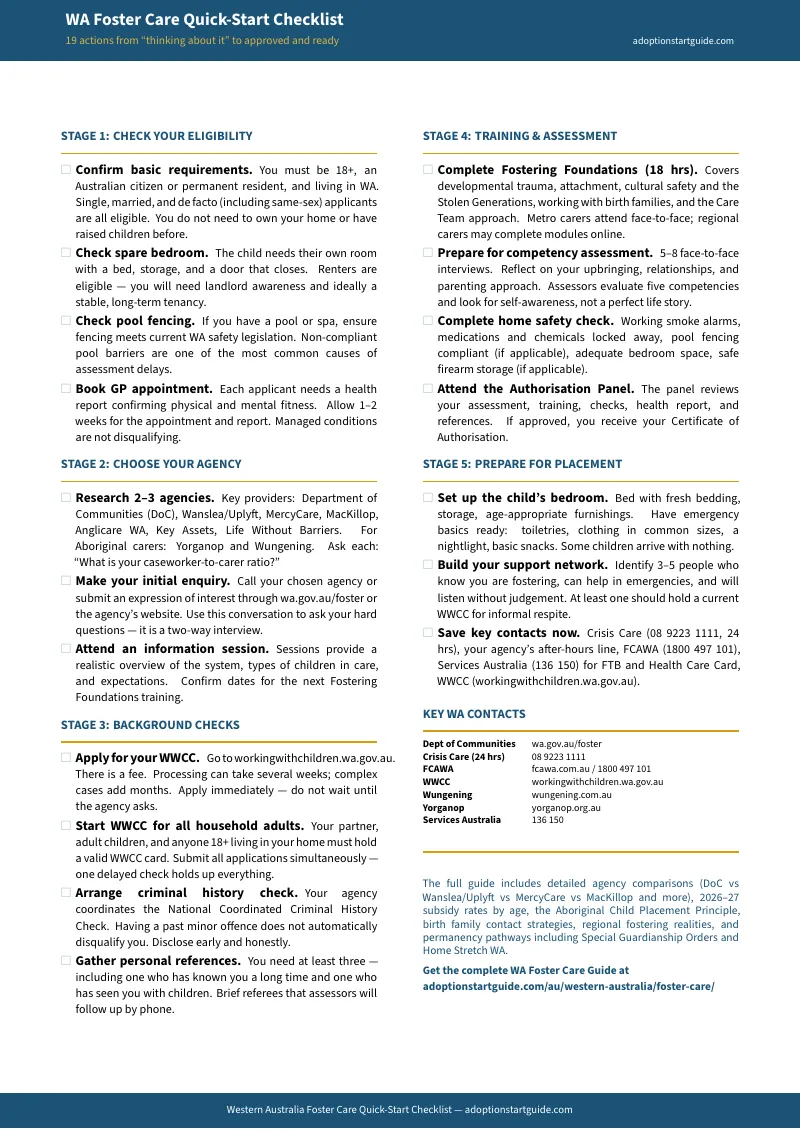
Download the Western Australia Foster Care Quick-Start Checklist for the 19 essential actions from first enquiry through the authorisation pipeline -- including the household screening requirements and home safety items that cause the most delays. Free, instant download, no commitment. If you want the full guide with the agency comparison framework, the WWCC household walkthrough, the five-competency assessment preparation, the Fostering Foundations training navigator, the ATSICPP practical guide, the financial reality check, metro-vs-regional logistics, and the permanency pathway decoder, click the button in the sidebar.
-- less than the petrol for one round trip to an agency information session you're not sure is right for you
One wrong agency choice means months invested in an organisation whose support model doesn't match your needs. One incomplete Working with Children Check application for a household member stalls your entire assessment. One misunderstanding about how reunification works -- believing you can skip temporary care and go straight to a Special Guardianship Order -- sets you up for years of emotional conflict with a system designed around restoration. This guide puts Western Australia's complete foster care authorisation process in your hands for less than what most families spend on parking and coffee for a single agency open day. Families who understand the system before they enter it ask the right questions at their first agency meeting, pass the home assessment on the first visit, and walk into their first placement prepared.
If the guide doesn't deliver, reply to your download email at any time for a full refund. No forms. No justification required.