You've Read the Alberta.ca Page Three Times. You Still Don't Know Where to Start.
You want to foster. You've told your partner, your mom, maybe your best friend. You've searched "how to become a foster parent in Alberta" and landed on the Children and Family Services website. You clicked through the seven-step overview, noted the phone number, and then sat there wondering: what actually happens after I call?
The government page doesn't tell you that. Neither does the 82-page AFKA Foster Care Handbook, which was written for people who already have a child placed in their home. The Foster Calgary guide is four pages long and skips every hard question. And the info session you signed up for is three weeks out — if you can get a spot.
Meanwhile, the questions keep stacking up. Will your history of managed anxiety disqualify you? Does your rental count? What's the actual per diem, and is it enough to cover a teenager's appetite? What do they really look for during the home study? Nobody answers these questions clearly, because the system assumes you'll figure it out along the way. Most people don't. They stall at the information stage and never make the call.
The Alberta Foster Care Guide is your Pre-Licensing Navigator — the reference that takes you from "thinking about it" to "ready for placement" without spending six months decoding government PDFs, waiting for callbacks, or guessing what your social worker actually wants to see.
What's Inside
The PRIDE Online Training Breakdown — Alberta uses a PRIDE-based pre-service training program delivered through the CourseMill platform. The guide explains what each module covers, how many hours to expect, and how to prepare for the reflection exercises that trip up most applicants. You'll walk into the first session knowing exactly what they're teaching and why.
Home Study Unwritten Rules — The official checklist says "safe sleeping space" and "working smoke detectors." But the home study is really a conversation about your parenting philosophy, your relationship stability, and how you handle conflict. The guide covers the questions assessors actually ask, the safety items they check room by room, and how to address sensitive topics — like managed mental health, past trauma, or a distant criminal record on your Vulnerable Sector Check — without panic.
The DFNA Landscape — Roughly two-thirds of children in Alberta's care are Indigenous. Most generic fostering guides ignore this entirely. The Alberta guide explains how Delegated First Nations Agencies operate alongside the Ministry, what cultural competency expectations apply to non-Indigenous caregivers, and how your placement experience will differ depending on whether you're licensed through CFS or a DFNA. This isn't a side note — it's the reality of fostering in this province.
Per Diem Reality — The government publishes a "Caregiver Rate Schedule," but it's a dense PDF with columns for basic maintenance, specialized levels, and mileage. The guide translates that into plain numbers: what lands in your bank account each month for a preschooler versus a teenager, what the April 2026 rate increase means for your family budget, and which additional supports (respite, clothing, school supplies) you can claim on top of the base rate.
The "Major Life Event" Rule — Alberta requires applicants to have no major life events — divorce, job loss, death in the family, serious illness — within the past twelve months. Most people don't discover this until they're already in the application process. The guide explains exactly what qualifies, how the timeline is calculated, and how to have a productive conversation with your worker if you're on the edge.
VSC and CIRC Process — The Vulnerable Sector Check and Child Intervention Record Check are two of the three documents that stall the most applications. The guide breaks down where to apply, how long each one takes in Calgary versus rural Alberta, what triggers a "flag" versus an automatic disqualification, and how to get your results back before they expire.
Kinship Care Pathway — If you're already caring for a relative's child informally, formalizing through the kinship program unlocks per diem payments, respite funding, and case management support. The guide walks through the formalization process step by step so you can access financial supports without disrupting the care you're already providing.
Agency Selection — Alberta has multiple delegated agencies beyond CFS: Catholic Social Services, Trellis Society, Closer to Home, and others operate in different regions with different intake processes. The guide compares them so you can pick the agency that matches your location, your values, and your timeline — instead of defaulting to whichever one shows up first on Google.
Who It's For
- Couples and individuals in Calgary, Edmonton, Red Deer, or Lethbridge ready to start the application but unsure what comes after the info session
- Rural and small-town families in communities where agency access is limited and wait times are longer
- Kinship caregivers already raising a relative's child who want to formalize care and access the per diem and supports they've been missing
- Empty nesters with a spare room and 20 years of parenting experience looking for the fastest path from interest to placement
- People exploring foster-to-adopt who need to understand how Alberta's reunification-first policy affects permanency timelines
- Anyone who's been told "just call the intake line" and wants to show up prepared with the right questions
Why Not the Free Resources?
Alberta Children's Services (ACS) gives you a seven-step overview and a phone number. The website is clinical, the navigation is confusing, and it doesn't explain what happens inside each step or how to succeed at it.
The AFKA Foster Care Handbook is 82 pages written for current foster parents — not applicants. It's a reference manual for people who already have a child in their home. If you're still at the "should we?" stage, it buries the answers you need under policy language you don't.
The Foster Calgary guide is a four-page PDF that covers the surface and skips every difficult question. It won't tell you what assessors look for during the home study, how per diem rates actually work, or what the DFNA pathway means for your placement.
Facebook groups and Reddit threads give you real stories, but they also give you outdated rates, jurisdictional confusion (Alberta rules mixed with BC or Ontario advice), and worst-case horror stories that spike your anxiety without solving anything.
The Alberta Foster Care Guide pulls from all of these sources, filters out what's wrong or irrelevant, and gives you one accurate, current reference written specifically for Alberta's system.
What You Get
- The Complete Guide (guide.pdf) — 60 pages covering every step from first inquiry through PRIDE training, home study, and placement matching, including financial tables, agency comparisons, DFNA context, and legal framework
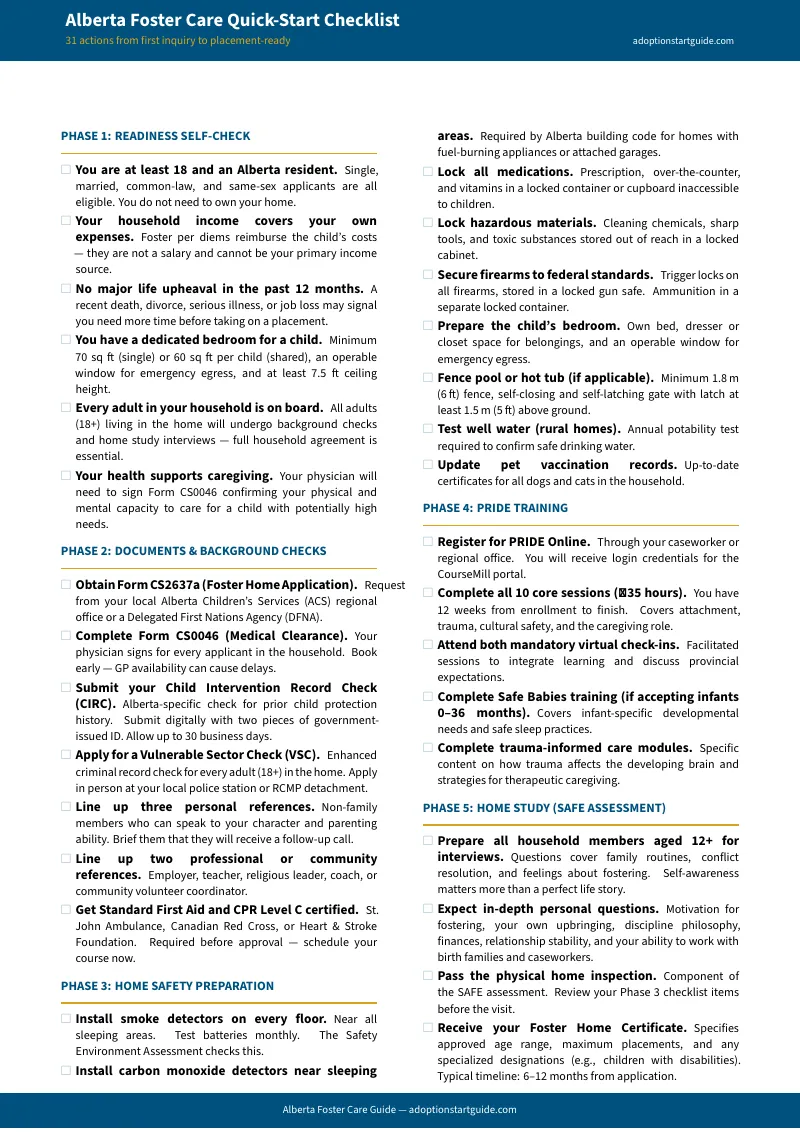
- Quick-Start Checklist (checklist.pdf) — a printable action plan organized by phase with key contacts, document deadlines, and the CFS intake number for your region
- Home Safety Checklist (home-safety-checklist.pdf) — room-by-room inspection prep sheet covering bedroom standards, fire safety, medication storage, weapon rules, pool fencing, and rural home requirements
- Document Tracker (document-checklist.pdf) — track every form, clearance, and certificate through the application process with submission dates and processing times
- First Placement Checklist (first-placement-checklist.pdf) — everything to confirm in the first 24 hours after a child arrives, from medical inventory to school arrangements
- Key Contacts Sheet (key-contacts-sheet.pdf) — one-page fridge sheet with every phone number, website, and form reference you'll need
— Less Than One Day of Foster Per Diem
Alberta's basic maintenance per diem starts at $26 per day for a young child and goes up to $39 for a teenager. The guide costs less than a single day's payment — and it helps you reach that first placement months faster by eliminating the confusion that stalls most applications.
Every purchase includes free updates as Alberta policy changes — because per diem rates, training requirements, and agency structures shift, and your guide should keep up.
Start with the free checklist
Not sure yet? Download the Alberta Foster Care Quick-Start Checklist — a printable action plan covering documents, background checks, training steps, and regional CFS contacts. It's the fastest way to see where you stand before committing to the full guide.