
You Called the CSSD Regional Office. They Said to Wait for a PRIDE Session. That Was Four Months Ago.
You found the Foster a Future portal. You clicked through the pages, looking for a step-by-step process. Instead, you got a phone number and a vague promise that someone would contact you. You called your regional office — Metro, Central-West, or maybe you're up in Labrador and had to figure out whether Goose Bay or Nain handles your application. They told you to attend a PRIDE information session. You asked when. They said they'd let you know. That was months ago. In the meantime, you've been reading CBC NL stories about the province spending $400,000 per child per year on corporate placements because there aren't enough foster homes. You've seen the Child and Youth Advocate's reports — one youth had 75 different staff members in six months, 11 different placements. You know the need is urgent. But every time you try to move forward, you hit another wall of missing information.
None of this is the system being deliberately unhelpful. It's the system being over-extended. The Department of Children, Seniors and Social Development manages roughly 900 children in foster care and another 715 in kinship care — with staff turnover that makes consistent guidance nearly impossible. The CSSD website assumes you already know things you don't: which of the three regions handles your application, what the PRIDE training's 27 hours and five competencies actually cover, what the difference between a Vulnerable Sector Check and a Child Protection Clearance Check is, what your home needs to pass the assessment, and what you'll actually receive financially under the 2026 Integrated Rates — the first rate increase in 12 years. The NL Foster Families Association publishes a handbook, but it's written for families who are already approved, not for people trying to figure out whether they qualify in the first place.
Meanwhile, one-third of children in care are Indigenous — in a province where Indigenous people make up 9% of the population. The Nunatsiavut Government, Innu Nation, and NunatuKavut Community Council are all moving toward self-governed child welfare. If you're fostering in Labrador or caring for an Indigenous child anywhere in the province, you need to understand Cultural Connection Plans, not as a compliance checkbox, but as a fundamental right of the child in your home. No free resource explains how to do that in practice.
The NL Application Roadmap: CSSD, CYCPA, and Everything the Province Doesn't Explain Upfront
This guide is built for the Newfoundland and Labrador foster care system as it actually works in 2026 — the three-region CSSD structure, the Children and Youth Care and Protection Act, the PRIDE pre-service training model, the newly restructured Integrated Rates, and the specific realities of fostering on the Island versus fostering in Labrador. Every chapter reflects current NL legislation and departmental policy, not a generic Canadian overview adapted from Ontario or BC. It is the preparation manual that the CSSD doesn't have the resources to provide.
What's inside
- Three-Region Navigation — Newfoundland and Labrador delivers child welfare through Metro (St. John's, Bay Roberts, Conception Bay South), Central-West (Corner Brook, Gander, Grand Falls-Windsor, Stephenville, Bonavista, Clarenville), and Labrador (Happy Valley-Goose Bay, Labrador City, and the northern coastal communities). Your regional office determines your social worker, your PRIDE training schedule, and your placement profile. This chapter maps every office, identifies the right contact for your community, and explains the practical differences between applying in St. John's and applying in Marystown or Nain — so your first call goes to the right desk.
- PRIDE Training Breakdown — The CSSD requires 27 hours of PRIDE pre-service training covering five core competencies: protecting and nurturing, meeting developmental needs, supporting birth family relationships, connecting children to permanency, and working as a professional team member. This chapter explains what each session covers, how facilitators evaluate your readiness, what "professional team member" actually means in practice, and how to approach the self-assessment exercises — so the training feels like preparation, not an exam you didn't study for. Includes guidance on Session 7 (impact on your own children) and the final informed-decision session where you formally commit.
- Home Assessment Decoder — The home study goes far beyond checking that you have a spare bedroom. The social worker conducts three to four in-home visits covering your childhood, your parenting philosophy, your relationship stability, and your capacity to manage grief when a child returns to their birth family. The physical inspection covers fire safety under the NL Fire Prevention Act, smoke and CO detectors, egress windows, medication storage, and — if you're rural — well water testing and wood stove compliance. This chapter translates the licensing standards into a room-by-room checklist and prepares you for the interview questions that make applicants feel exposed.
- Background Checks — RNC vs. RCMP and the CPCC — If you live in St. John's, Corner Brook, or another RNC jurisdiction, your Vulnerable Sector Check goes through the Royal Newfoundland Constabulary. Everywhere else — most of rural Newfoundland and all of Labrador — it's the RCMP. Both are free for foster applicants, but most people don't know that because the fee exemption is buried in police department schedules. On top of the VSC, every applicant needs a Child Protection Clearance Check — an internal CSSD search that requires every address you've lived at since birth. This chapter maps both processes, explains timelines, covers the CPCC Address Tracker concept for organizing your residential history, and clarifies what happens if you have a prior record — because having one doesn't automatically disqualify you, but not disclosing one does.
- 2026 Integrated Rates and Financial Supports — For the first time in 12 years, Newfoundland and Labrador increased foster care rates in Budget 2026. The new Integrated Rates combine multiple stipends into a single semi-monthly payment: $1,695/month for Island Level 1 homes, $1,845 for Labrador, and $1,995 for Remote Labrador communities. Level 2 and Level 3 homes receive up to $3,830/month. Beyond the monthly rate, you're entitled to a $300 initial clothing allowance, $200 for school supplies, a $400 Christmas allowance, up to $750 for graduation, childcare reimbursement, mileage at $0.25/km, and PAL Airlines vouchers for medical travel from Labrador. This chapter gives you every rate, every allowance, and a budget worksheet — because "financial support is available" means nothing without the actual numbers.
- Labrador-Specific Sections — Fostering in Labrador is not the same as fostering on the Island. Remote communities are accessible only by air or snowmobile for much of the year. The cost of groceries and heating dwarfs what families pay in St. John's. Social workers may visit once a month. The Integrated Rates reflect this with higher per diems, and the guide covers the practical logistics: PAL Airlines medical travel vouchers, mileage reimbursement for multi-hour drives to appointments, how to manage emergency placements when the nearest CSSD office is a flight away, and what the Labrador-Grenfell Health Zone means for the children in your care.
- Indigenous Cultural Connection Plans — One-third of NL's children in care are Indigenous. If you foster an Indigenous child — Inuit, Innu, or Southern Inuit — you are legally and morally responsible for maintaining their connection to language, land, ceremony, and community. This chapter breaks the Cultural Connection Plan into actionable steps: facilitating visits to home communities, supporting land-based activities central to Innu and Inuit identity, preserving Innu-aimun or Inuktitut through recordings and elder connections, and collaborating with the Nunatsiavut Government, Innu Nation, or NunatuKavut Community Council. It reframes cultural requirements not as extra compliance, but as stewardship of a child's identity.
- The Permanency Framework — Under the CYCPA, the CSSD develops a "Plan for the Child" that guides every placement. The plan may lead to reunification, a Continuous Custody Order (Crown wardship), or a foster-to-adopt pathway under the Adoption Act, 2013. Youth Services Agreements extend support to age 19 or 21 for those in education. This chapter explains what permanency planning means for you as a foster parent, how concurrent planning works, and how to emotionally prepare for a process where the goal is reunification — unless the court determines otherwise.
Printable standalone worksheets included
- Home Safety Inspection Checklist — Room-by-room walkthrough of NL fire, safety, and environmental standards: smoke and CO detectors, egress windows, medication and cleaning product storage, wood stove clearance, well water testing, and outdoor safety requirements.
- Document Preparation Checklist — VSC (RNC or RCMP), CPCC application with address history, medical clearances, three non-relative references plus a collateral reference, financial verification, and training certificates — organized in the order your regional office expects them.
- Monthly Budget Worksheet — 2026 Integrated Rates by region and level, initial clothing allowance, school supplies, Christmas and graduation allowances, mileage reimbursement, childcare costs, and household expense tracking in one printable sheet.
- Training Log — Track all PRIDE sessions, First Aid/CPR certification, and ongoing professional development hours for licence renewal.
Who this guide is for
- St. John's and Metro families — You've been on the Foster a Future portal. You may have attended an information session at the Metro office, or you're still waiting for one to be scheduled. You need a roadmap that covers the RNC-specific Vulnerable Sector Check, the longer waitlists in the metro area, and how to build momentum while the system processes at its own pace.
- Central-West families — You're in Corner Brook, Gander, Grand Falls-Windsor, or one of the smaller communities served by satellite offices in Stephenville, Bonavista, or Clarenville. PRIDE training runs less frequently outside St. John's, and district offices cover vast rural areas. You need to know what the process looks like when you're not in the Metro bubble and the nearest specialist services require a drive.
- Labrador families — You're in Happy Valley-Goose Bay, Labrador City, or one of the northern coastal communities. You've seen children from your community sent south because there aren't enough local foster homes. You need a guide that addresses the higher Integrated Rates, the PAL Airlines travel vouchers, the logistics of fostering when communities are connected by air and snowmobile, and the Indigenous governance structures shaping child welfare in the Big Land.
- Outport families — You live in a community without a physical CSSD office. Social workers may visit monthly. You need to understand how rural logistics — well water, wood stoves, distance from emergency services, digital communication for case reviews — affect your application and your daily reality as a foster parent.
- Indigenous families — You want to keep children in your community and culture. Whether you're Inuit working with the Nunatsiavut Government, Innu connected to Sheshatshiu or Natuashish, or Southern Inuit through NunatuKavut, you need a guide that explains how CSSD interacts with Indigenous governance, what the Cultural Connection Plan means in practice, and how self-governed child welfare is reshaping placements in the province.
- Kinship caregivers — A grandchild, niece, nephew, or family friend's child needs a home now. You didn't plan for this. The guide covers the kinship pathway, what financial supports you're entitled to under the 2026 Integrated Rates, and how to get legal authority for medical and educational decisions as quickly as the NL system allows.
- Single applicants and LGBTQ+ families — Newfoundland and Labrador does not restrict foster care licensing by marital status, sexual orientation, or gender identity. The guide covers the licensing pathway without assumptions about family structure.
Why the free resources fall short
The Foster a Future portal gives you the phone number and the broad steps. It tells you there's training, a home study, and background checks. It doesn't tell you that the PRIDE training evaluates five specific competencies across 27 hours, that the CPCC requires every address you've lived at since birth, that the VSC is free for foster applicants, or what your monthly Integrated Rate will actually be. The portal's forms sometimes require outdated browser configurations just to load. It gives you enough information to make one phone call — and then you wait.
The NL Foster Families Association publishes a handbook and runs peer support programs. Both are designed for families who are already licensed. If you're still deciding, still preparing, still trying to understand whether your home qualifies and what the financial reality looks like under the new 2026 rates, the NLFFA's resources assume a step you haven't taken yet.
Facebook groups like "Foster and Adoptive Families of NL" fill some gaps, but they also spread outdated per diem figures from before the 2026 increase, confuse RNC and RCMP processes, and offer advice based on one family's experience in St. John's that may not apply if you're in Labrador City or Bonavista. And the national Canadian foster care guides describe a system that doesn't exist — because foster care in Canada is provincial, and NL's CYCPA legislation, three-region CSSD structure, Integrated Rate model, and Indigenous governance arrangements are specific to this province.
The free Quick-Start Checklist
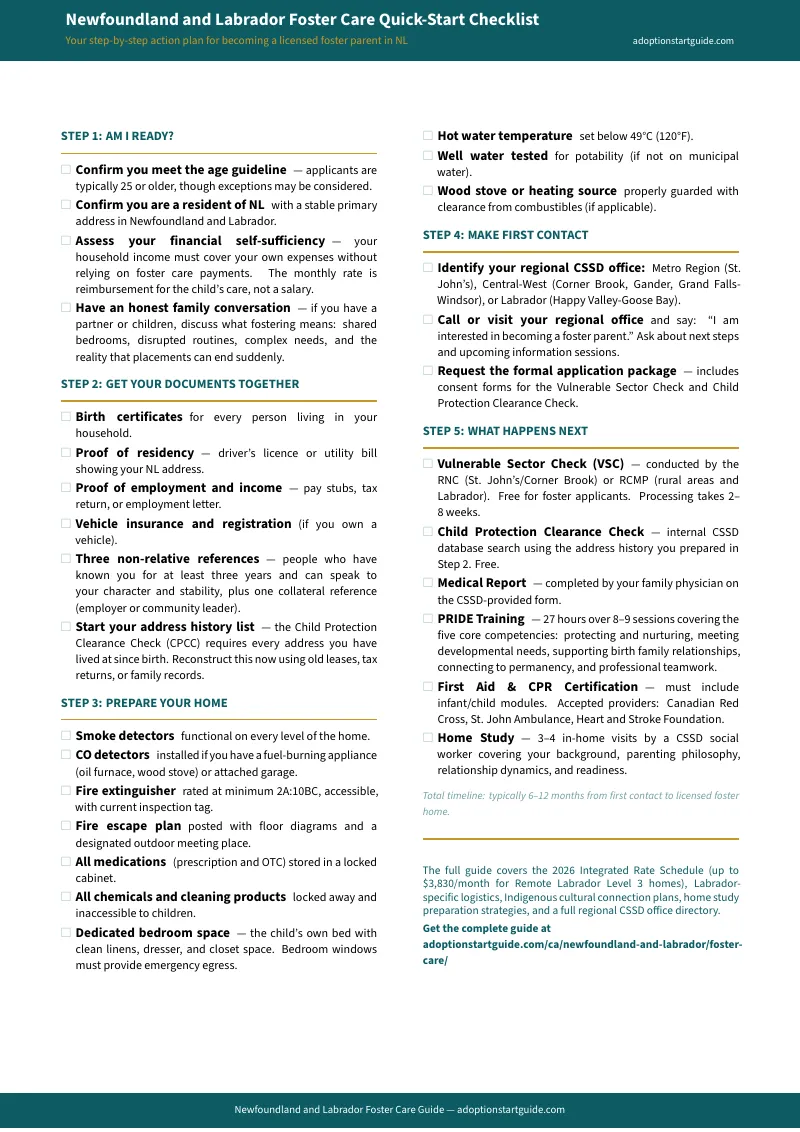
If you're not ready for the full guide, start here. Download the Newfoundland and Labrador Foster Care Quick-Start Checklist — a one-page action plan covering the licensing steps in the order the CSSD expects you to complete them. Free, no commitment. It includes the regional office decision point, the key documents to start gathering, and the provincial intake contacts. If you want the full NL Application Roadmap with the three-region navigation, the PRIDE training breakdown, the home assessment decoder, the complete 2026 financial breakdown, the Labrador-specific sections, the Indigenous Cultural Connection Plan walkthrough, and all four printable worksheets, click the button in the sidebar.
— Less Than 1% of One Month's Basic Rate
A missed background check delays your application by months. A failed first home visit because you didn't know about the egress window requirement or the wood stove clearance means a follow-up visit and weeks of lost time. A family who called the wrong regional office — or didn't know the VSC was free — wastes time and energy they could have spent preparing. This guide puts the entire Newfoundland and Labrador foster care licensing system — three-region navigation, PRIDE training preparation, home assessment standards, 2026 Integrated Rates, background check pathways, Labrador logistics, Indigenous Cultural Connection Plans, permanency planning, and outport-specific guidance — in your hands for less than 1% of a single month's basic Integrated Rate.
If the guide doesn't deliver, reply to your download email at any time for a full refund. No forms. No justification required.