You Called 1-800-565-1884. They Said Attend an Information Session. That Was Three Months Ago.
You started where everyone starts — the Department of Community Services website. It told you to call the provincial intake line. You called. They asked which district office covers your area. You didn't know. They told you to attend a PRIDE information session. You asked when the next one was. They said they'd get back to you. That was weeks ago. Or maybe months. In the meantime, you've been searching online, finding a mix of outdated DCS brochures, national Canadian fostering guides that assume every province works the same way, and Facebook groups where a foster parent in Truro gives completely different advice than one in Sydney.
None of this is unusual. Nova Scotia's child welfare system has 766 children in care and not enough homes — especially outside Halifax. The Department of Community Services runs the provincial system through district offices, but the information they publish assumes you already know things you don't: which stream applies to your family (DCS or Mi'kmaw Family & Children's Services), what the SAFE assessment actually covers, how the PRIDE training's 27 hours are structured across 9 sessions, what your home needs to pass inspection, and what you'll actually receive financially once a child is placed. The Federation of Foster Families has a Welcome Package — but it's designed for families who are already approved, not for people trying to figure out whether they qualify in the first place.
Meanwhile, the children who need you the most — the sibling groups, the teenagers, the kids in rural communities where there's one district office serving four counties — are waiting for someone to push through the confusion and get certified.
The Nova Scotia Approval Roadmap: DCS, MFCS, and Everything the Province Doesn't Explain Upfront
This guide is written for the Nova Scotia foster care system as it actually works in 2026 — the dual-track structure (DCS for most families, Mi'kmaw Family & Children's Services for Mi'kmaw families), the PRIDE pre-service training curriculum, the SAFE home study methodology, the specific per diem rates and allowances, and the regional differences between applying in Halifax, Cape Breton, the Annapolis Valley, and the South Shore. Every chapter reflects current Nova Scotia law under the Children and Family Services Act, not a generic Canadian overview adapted from Ontario or BC. It is the preparation manual that the Department of Community Services doesn't publish.
What's inside
- DCS vs. MFCS Decision Framework — Nova Scotia runs two parallel child welfare systems. The Department of Community Services covers most families. Mi'kmaw Family & Children's Services serves Mi'kmaw families across 13 First Nations communities through a Customary Care model grounded in "Traditions of Caring" training rather than standard PRIDE. If you're Mi'kmaw, off-reserve, or in a mixed family, this chapter clarifies which agency handles your application, what the process differences are, and how to avoid weeks of being redirected between the wrong offices.
- PRIDE Training Breakdown — Nova Scotia requires 27 hours of pre-service training spread across 9 PRIDE sessions. Each session covers specific competencies: protecting and nurturing development, supporting relationships between children and their families, connecting children to safe lifelong relationships. This chapter explains what each session covers, what facilitators are evaluating, and how to approach the self-assessment exercises — so the 9-week commitment feels like preparation, not an exam you didn't study for.
- SAFE Home Study Decoder — The Structured Analysis Family Evaluation goes far beyond checking that you have a spare bedroom. The questionnaires ask about your childhood, your parenting philosophy, your relationship stability, and your capacity to manage grief when a child returns to their birth family. The physical inspection covers fire and safety standards, adequate beds and privacy for each child, sanitary conditions, and secure storage. This chapter translates the licensing standards into a room-by-room checklist and prepares you for the interview questions that make applicants feel exposed.
- Background Checks — HRM vs. Rural — If you live in Halifax Regional Municipality, your police record check goes through the Halifax Regional Police online portal. If you live anywhere else in the province, you're dealing with your local RCMP detachment for a Vulnerable Sector Check — different process, different timeline, different fees. Every adult in your household also needs a Child Abuse Registry check through the province. This chapter maps out both pathways, explains processing times for each, and covers what happens if you have a prior record — because having a record doesn't automatically disqualify you, but not disclosing one does.
- Nova Scotia Per Diem Rates and Financial Supports — The province pays $19.00 per day for children ages 0-9 and $27.50 per day for children ages 10 and older. Beyond the daily rate, you're entitled to a $200 placement allowance for each new child, a $400 Christmas allowance, a $750 graduation allowance, a $50 monthly auto-payment plus $0.5932 per kilometre for transportation, and $10.60 per hour for approved babysitting. Advanced Level of Care placements add an additional daily increment. This chapter gives you every rate, every allowance, and a budget worksheet — because the DCS website mentions "financial support" without specifying any of these numbers.
- Regional Application Guide — Fostering in Halifax is not the same as fostering in Cape Breton. HRM has more applicants but longer orientation waitlists. Cape Breton has acute placement shortages but fewer training sessions available locally. The Annapolis Valley and South Shore have some of the highest child poverty rates in the province — Annapolis County at 35%, Digby at 34.6% — and district offices that cover vast rural areas. This chapter covers the practical differences by region: which district office serves you, what the local training schedule looks like, and how geography affects placement matching.
- Cultural Considerations — Nova Scotia has specific obligations for placements involving African Nova Scotian and Mi'kmaw children. The Cultural Connector Initiative supports culturally appropriate placements for Black children, including guidance on hair and skin care, sickle cell awareness, and maintaining connection to the African Nova Scotian community. For Mi'kmaw children, the 13 First Nations communities and MFCS have specific protocols around language, ceremony, and family connection. For newcomer families considering fostering, the guide explains duty-to-report laws, discipline boundaries under Canadian law, and how the system works for families whose first language isn't English.
- The 18-Month Permanency Window — Under the Children and Family Services Act, DCS has 18 months to achieve a permanent plan for a child in care. That timeline drives everything — from concurrent planning to the possibility of a foster-to-adopt transition. This chapter explains what the permanency window means for you as a foster parent, how concurrent planning works, and how to emotionally prepare for a process where the goal is reunification with the birth family, not adoption — unless reunification fails.
Printable standalone worksheets included
- Home Safety Inspection Checklist — Room-by-room walkthrough of Nova Scotia's fire, safety, and sanitary standards: smoke detectors, CO detectors, medication storage, cleaning product storage, pool and water safety, bedroom privacy, and outdoor space requirements.
- Document Preparation Checklist — Police record check (HRM online portal or RCMP Vulnerable Sector Check), Child Abuse Registry application, medical clearances, references, financial documents, and training certificates — organized in the order your district office expects them.
- Monthly Budget Worksheet — Per diem rates by age group, placement allowance, transportation reimbursement, babysitting rate, and household expense tracking in one printable sheet so you plan on real numbers.
- Training Log — Track all 9 PRIDE sessions and ongoing professional development hours for licence renewal.
Who this guide is for
- Halifax and HRM families — You attended an information session at the Mumford Road office or you're still waiting for one to be scheduled. You need a roadmap that covers the HRM-specific police check process, the longer orientation waitlists in the metro, and how to build momentum while the system catches up to your timeline.
- Cape Breton families — You're in Sydney, Glace Bay, or the rural municipalities. You've seen the need in your community firsthand. You want to know how the process works when training sessions are less frequent, district offices cover wider areas, and the nearest specialist services are a drive to Halifax.
- Annapolis Valley and South Shore families — You're in a region where child poverty rates top 35% and the need for foster homes is urgent. You need to understand how rural district offices handle applications, what the mileage reimbursement means for families who drive an hour to medical appointments, and how the process works when you're not in the HRM bubble.
- Mi'kmaw families — You want to foster through MFCS using the Customary Care model. You need clarity on whether to go through MFCS or DCS, what "Traditions of Caring" training involves, and how the 13 First Nations communities are served — especially if you're off-reserve.
- African Nova Scotian families — You know the system hasn't always served your community well. You want a guide that acknowledges that history, explains the Cultural Connector Initiative, and prepares you for a home study process that respects your family's strengths and cultural practices.
- Newcomers to Nova Scotia — You've settled in HRM and you want to give back. You need a guide that explains Canadian child welfare law, the duty-to-report framework, and the discipline boundaries that may differ from your country of origin — without assuming you already know how the system works.
- Kinship caregivers — A grandchild, niece, nephew, or family friend's child needs a home now. You didn't plan for this. The guide covers the kinship pathway, what financial supports you're entitled to, and how to get legal authority for medical and educational decisions as quickly as the Nova Scotia system allows.
- Single applicants and LGBTQ+ families — Nova Scotia does not restrict foster care licensing by marital status, sexual orientation, or gender identity. The guide covers the licensing pathway without assumptions about family structure.
Why the free resources fall short
The DCS website gives you the phone number and the broad steps. It tells you there's a home study, training, and background checks. It doesn't tell you that the SAFE assessment includes questionnaires about your childhood and your disciplinary philosophy. It doesn't tell you the per diem rate for a 12-year-old or how much you'll get reimbursed for driving to appointments. It doesn't explain the difference between fostering through DCS and fostering through MFCS. It gives you enough information to call the intake line — and then you wait.
The Federation of Foster Families of Nova Scotia publishes a Welcome Package and runs a support line. Both are designed for families who are already licensed. If you're still deciding, still preparing, still trying to understand whether your home qualifies and what the financial reality looks like, the Federation's resources assume a step you haven't taken yet.
Facebook groups fill some gaps, but they also spread outdated per diem figures, confuse DCS and MFCS requirements, and offer advice based on one family's experience in one district that may not apply to yours. And the national Canadian foster care guides on Amazon describe a system that doesn't exist — because foster care in Canada is provincial, and Nova Scotia's dual-track DCS/MFCS structure, PRIDE training model, and CFSA legislation are specific to this province.
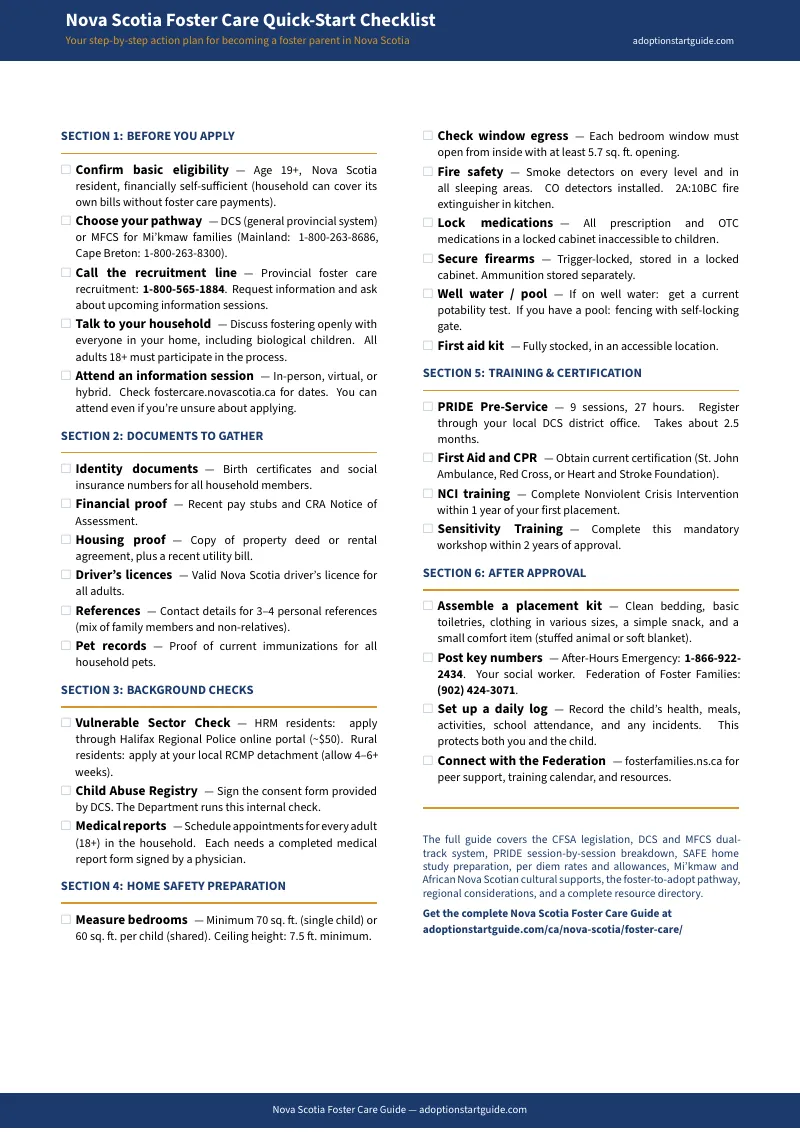
The free Quick-Start Checklist
If you're not ready for the full guide, start here. Download the Nova Scotia Foster Care Quick-Start Checklist — a one-page action plan covering the licensing steps in the order the DCS expects you to complete them. Free, no commitment. It includes the DCS vs. MFCS decision point, the key documents to start gathering, and the provincial intake number. If you want the full guide with the dual-track navigation, the PRIDE training breakdown, the SAFE home study decoder, the complete financial breakdown, the regional application differences, the cultural considerations chapter, and all four printable worksheets, click the button in the sidebar.
— Less Than One Day's Per Diem
A missed background check delays your application by months. A failed first home study visit because you didn't know about the fire safety standards or the bedroom privacy requirements means a follow-up visit and weeks of lost time. A family who went through DCS when they should have gone through MFCS — or who didn't know MFCS existed — may have to start over. This guide puts the entire Nova Scotia foster care licensing system — dual-track navigation, PRIDE training preparation, SAFE home study standards, current per diem rates and allowances, background check pathways, cultural considerations, permanency planning, and regional differences — in your hands for less than one day's per diem payment for a single child.
If the guide doesn't deliver, reply to your download email at any time for a full refund. No forms. No justification required.