
You want to adopt in Prince Edward Island. You just didn't expect a province with zero private adoption agencies, an eight-year waitlist rumor that won't die, and a Licensed Liaison system that no other guide in Canada even mentions.
Prince Edward Island is the only province in Canada where private adoption is not handled by agencies. There are no corporate adoption organizations. No intake offices with caseworkers assigned to your file. Instead, PEI uses a Licensed Liaison model — individual professionals authorized by the Director of Child Protection to facilitate placements. A Licensed Liaison is a social worker, lawyer, or psychologist who has passed the Director's examination, completed an approved training program, and taken an oath of confidentiality. They maintain a registry of approved families. They match birth parents with adoptive families. And unless you already know this system exists and how to engage with it, you are navigating private domestic adoption in a province of 182,000 people with no visible infrastructure to help you.
The public adoption stream runs through the Department of Social Development and Seniors. Children enter permanent care through court orders under the Child Protection Act, and the department maintains its own registry of prospective families. But PEI's small population means the pool of children available for adoption at any given time is tiny, and the matching process involves Adoption Committees that review multiple approved home studies for each child. Families report wait times measured in years, not months. Local media coverage and community word-of-mouth have calcified an "eight-year waitlist" narrative that discourages families from even beginning the process — and the government website does nothing to address it, because the website barely explains the process at all.
Then there's the home study. Every adoption pathway in PEI requires one, and the Adoption Act Regulations specify that it must be conducted by an "authorized social worker" holding a Section 75 certificate. That certificate is issued by the Director. If you're trying to use an out-of-province social worker — say, because you're working with an agency in Ontario or British Columbia to access a larger pool of birth parents — that social worker needs PEI authorization. No generic Canadian adoption guide mentions the Section 75 certificate because it doesn't exist in other provinces. It's a PEI-specific bottleneck that can delay your home study by months if you don't know about it before you start.
For relative adoptions — grandparents formalizing custody of a grandchild, aunts or uncles stepping in after a family crisis — the process requires a Permit to Make an Adoption Placement with a Relative from the Provincial Adoption Coordinator before the Supreme Court will hear your case. You still need a home assessment. You still need counseling to ensure birth parents understand they are permanently surrendering their legal status. And you still need a lawyer to file the application. The government website tells you relative adoption exists. It does not tell you about the permit requirement, the counseling mandate, or the court forms you need to file.
Consent law in PEI operates on two 14-day rules that trip up families who don't understand them. The first: a birth parent cannot sign consent until the child is at least 14 days old. The second: once consent is signed, the birth parent has 14 days to revoke it in writing, and the child must be returned. After that window closes, consent becomes irrevocable except in cases of fraud or duress. If you're a prospective adoptive parent bonding with a newborn in those first 28 days, you need to understand exactly what legal ground you're standing on. Most families learn about the revocation period from their lawyer after the baby is already in their home.
And if you're Indigenous — Mi'kmaq families on Abegweit or Lennox Island First Nations — the adoption landscape is shaped by Bill C-92, which recognizes the inherent right of Indigenous peoples to govern their own child and family services. Mi'kmaq customary adoption maintains ties to the biological family rather than severing them, and the Mi'kmaq Family PRIDE Program provides culturally specific support that the provincial system does not replicate. Navigating the intersection of provincial law and Indigenous jurisdiction requires understanding both frameworks, and no government website maps that intersection clearly.
Nobody in the system is working against you. But the Department of Social Development and Seniors website lists adoption types without explaining how any of them actually work step by step. Community Legal Information PEI provides a summary of the legal requirements but not the practical strategy for meeting them efficiently. A private lawyer in Charlottetown charges $200 to $400 per hour, and the first billable hour is almost always spent answering foundational questions this guide covers on page one.
The Liaison Navigator
This is a complete, PEI-specific adoption guide written for the province's current legal framework: the Adoption Act, the Adoption Act Regulations, the Child Protection Act, the Supported Adoption Program regulations, and federal Bill C-92. Not a repurposed national overview that assumes every province has private agencies and regional intake offices. Every chapter, every checklist, every contact directory is built around PEI's Licensed Liaison model, the Section 75 authorization requirement, the two 14-day consent rules, and the practical reality of adopting in Canada's smallest province.
What's inside
- Licensed Liaison system guide — How PEI's unique Licensed Liaison model works in plain language, from finding a licensed professional to understanding the registry of waiting families to the matching process with birth parents. This is the private adoption infrastructure that no other Canadian province uses and no national guide explains. You'll understand who the Liaisons are, what they're authorized to do, what they charge, and how to evaluate whether a specific Liaison is the right fit for your family.
- Five-pathway comparison — Public (Crown Ward), private domestic via Licensed Liaison, relative adoption with the permit system, step-parent adoption, and international adoption compared side by side. Costs, timelines, eligibility, legal requirements, and the practical trade-offs between each. Many families don't realize they qualify for more than one pathway, or that the subsidized public route includes ongoing financial support through the Supported Adoption Program. This chapter prevents you from spending months on the wrong track.
- Out-of-province agency strategy — Because PEI has no local agencies, families pursuing private domestic adoption with a larger birth parent pool must work with licensed agencies in other provinces — Sunrise Adoption Centre in BC, Beginnings Family Services in Ontario, Abide Adoption Agency in Alberta. The guide explains how interprovincial licensing works, what the Section 75 certificate requirement means for out-of-province home studies, and the step-by-step process for engaging an external agency while maintaining PEI compliance.
- Section 75 certificate walkthrough — The authorization requirement that every social worker conducting a PEI home study must meet. The guide explains who issues it, how to verify your social worker holds one, what happens if they don't, and how to avoid the months-long delay that families encounter when they start a home study with an unauthorized professional.
- Two 14-day consent rules explained — The waiting period before consent can be signed and the revocation window after. What each rule means practically, what your legal standing is during each phase, and what happens if a birth parent exercises the revocation right. Written for prospective adoptive parents who need to understand the emotional and legal reality of those first 28 days.
- Supported Adoption Program negotiation — PEI provides financial subsidies to families adopting Crown ward children with special needs, medical conditions, or sibling group placements. But subsidy rates are capped at foster care per diem levels, they're subject to income testing, and the agreement must be negotiated before finalization. Once the Adoption Order is signed, your leverage disappears. The guide explains the eligibility criteria, the income test, the special costs provisions, and how to document the case that gets the right support level approved.
- Mi'kmaq customary adoption and Bill C-92 — How federal Bill C-92 intersects with PEI's Adoption Act for Indigenous families. The difference between conventional adoption (which severs birth parent rights) and Mi'kmaq customary adoption (which maintains kinship ties). The Mi'kmaq Family PRIDE Program, the Abegweit and Lennox Island First Nation resources, and the cultural continuity requirements that apply to any adoption involving a Mi'kmaq child.
- Open records and post-adoption services — PEI's January 31, 2020 open records reform gave adult adoptees and birth parents access to identifying information for the first time. The guide covers the disclosure veto system for pre-2020 adoptions, the contact preference process, the Post-Adoption Register for mutual consent searches, and the active search service. If you're an adoptee seeking birth family or a birth parent wondering about the child you placed, this chapter maps the process the government website leaves unclear.
- Complete document checklist by pathway — Every form, certificate, background check, and legal filing organized by adoption type. The Supreme Court Form 14E Notice of Application, Form 4D Affidavit, the Relative Placement Permit, criminal record checks, child protection registry searches, medical reports, and personal references. Organized in the order each pathway requires them so nothing is missing when you file with the Supreme Court.
Printable standalone worksheets included
The guide comes with printable standalone PDFs designed for real-world use:
- Pathway Comparison Card — All five adoption pathways side by side on one page. Costs, timelines, eligibility, and legal requirements at a glance. Print it, sit down with your family, and make the decision that shapes everything else.
- Liaison Evaluation Worksheet — A structured checklist for interviewing and comparing Licensed Liaisons, including questions about their caseload, matching philosophy, fee structure, and experience with your specific adoption type.
- Home Study Preparation Checklist — Every document, background check, and home safety requirement organized in the order your social worker will need them. Designed so you can start gathering everything the week you open this guide rather than discovering missing items during the assessment.
- Consent and Revocation Timeline Tracker — A visual timeline covering the two 14-day periods from birth through irrevocable consent. Fill in the actual dates as they occur so you and your lawyer are tracking the same legal milestones.
Who this guide is for
- Couples transitioning from fertility treatment to adoption — You've spent years and thousands of dollars on IVF or IUI. The doctor has recommended stopping. You're ready to pursue adoption but the "eight-year waitlist" rumor has you questioning whether it's even possible in PEI. This guide maps every pathway — including the out-of-province agency strategy that most Island families don't know exists — so you can make a decision based on facts, not folklore.
- Foster parents pursuing permanency for a Crown ward child — The child in your home has a permanent guardianship order. You want to give them a legal family, not another temporary placement. The guide explains the public adoption pathway, the Supported Adoption Program subsidy that must be negotiated before finalization, and the transition from foster care payments to adoption support so you can make the financial decision with full information.
- Grandparents and relatives formalizing kinship care — You've been raising your grandchild or a relative's child, and you need the legal authority to make medical decisions, enroll them in school, and protect their inheritance. The guide walks you through the Relative Placement Permit, the counseling requirement, the home assessment, and the court filing process. You'll know exactly what the Provincial Adoption Coordinator needs from you before you call their office.
- Newcomer families navigating the PEI system — You've immigrated to PEI and want to adopt, but you're unclear on eligibility for permanent residents, the Hague Convention requirements for international adoption, or how to engage the provincial system when English may be your second language. The guide addresses your specific legal standing and the interprovincial and international pathways available to you.
- Mi'kmaq families on Abegweit or Lennox Island — You want to formalize a customary arrangement or adopt within your kinship network, and you need to understand how Bill C-92 interacts with PEI's Adoption Act. The guide covers Mi'kmaq customary adoption, the PRIDE Program, and the cultural continuity framework without forcing Indigenous family-building into a Western legal template.
Why the free resources aren't enough
The Department of Social Development and Seniors website lists four types of adoption with brief descriptions of each. It tells you adoption exists in PEI. It does not walk you through how to actually complete one. There is no explanation of how the Licensed Liaison model works in practice. There is no mention of the Section 75 certificate requirement for home study social workers. The site doesn't explain the Relative Placement Permit process or the two 14-day consent rules. It assumes you'll figure out the details when you call the office — but the office serves a province of 182,000 people with one Provincial Adoption Coordinator.
Community Legal Information PEI provides a simplified "Adoption Steps" overview that explains what the legal requirements are but not how to meet them efficiently. It mentions you'll need a lawyer but doesn't explain how to minimize legal costs. It lists the court process without explaining the specific forms you need to file. It is a summary of the law, not a strategy for navigating it.
Generic Canadian adoption guides are written for provinces with multiple private agencies, regional intake offices, and a large enough birth parent pool that domestic infant adoption is measured in months. They don't mention Licensed Liaisons because the model doesn't exist outside PEI. They don't address the Section 75 certificate because it's not relevant in Ontario or BC. They don't cover the Supported Adoption Program's income testing rules because every province structures subsidies differently. Using a national adoption guide in PEI is like navigating Charlottetown with a map of Toronto — the street names are different, the landmarks don't match, and the shortcuts don't exist.
The free Quick-Start Checklist
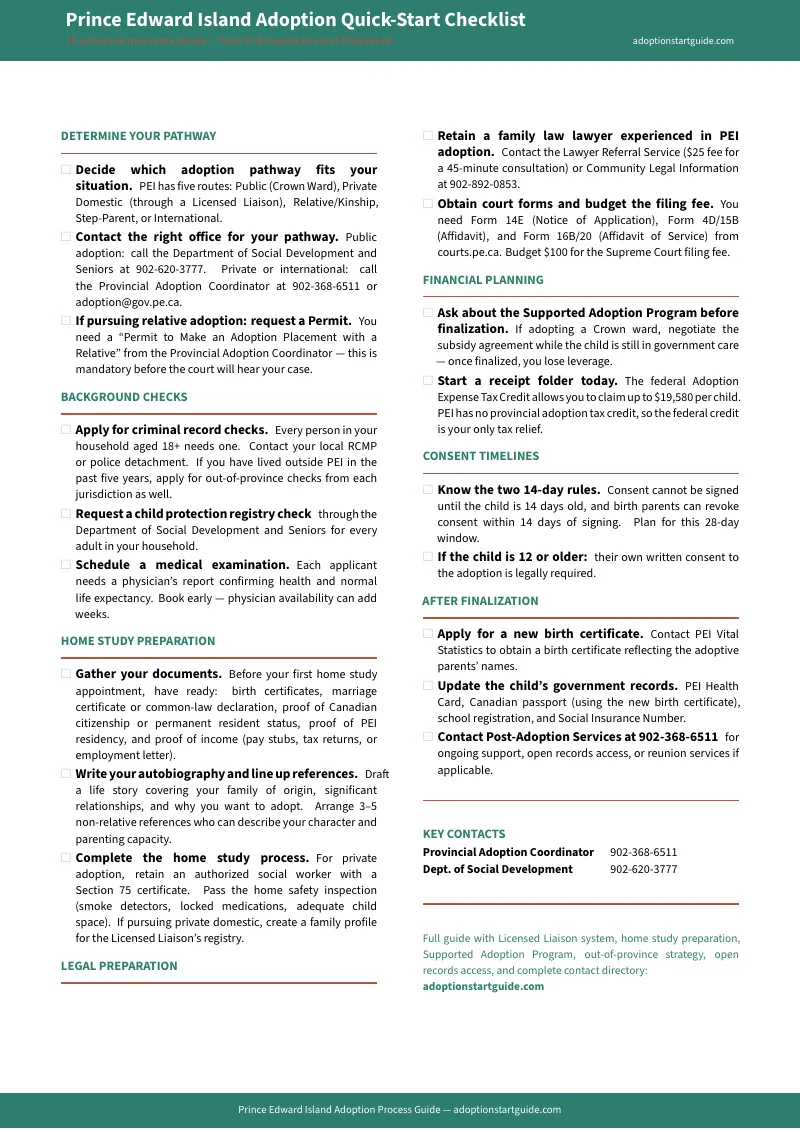
Download the Prince Edward Island Adoption Quick-Start Checklist for a one-page overview of the key steps from identifying your adoption pathway to court finalization. Free, no commitment. If you want the full roadmap with the Licensed Liaison guide, out-of-province agency strategy, Section 75 walkthrough, consent timeline, Supported Adoption Program negotiation, Mi'kmaq customary adoption framework, open records guide, and printable worksheets, click the button in the sidebar.
— less than fifteen minutes of a Charlottetown family lawyer's time
A single consultation with a private lawyer in Charlottetown starts at $200 to $400 per hour. Families routinely spend that first billable hour covering foundational questions this guide answers on page one — what the Licensed Liaison model is, how the Section 75 certificate works, what the two 14-day consent rules mean, whether the Supported Adoption Program applies to their situation. The Liaison Navigator doesn't replace your lawyer. It makes sure you don't pay your lawyer to explain the basics. You arrive at that first consultation ready to discuss strategy, not vocabulary. And for many relative and step-parent adoptions, where the legal process is straightforward once you understand the requirements, this guide may be the only resource you need beside your filing fees.