Saskatchewan has 462 foster homes for over 3,000 children in care. The Ministry website tells you to "call your regional office." It does not tell you which of the two entirely separate systems you belong in.
Saskatchewan runs a two-stream child welfare model. Stream one is the Ministry of Social Services — eight regional offices across the province handling non-Indigenous caseloads. Stream two is 17 or more First Nations delegated agencies, each with their own caseworkers, cultural protocols, and approval processes. If you call the wrong office, nobody will tell you for weeks. You will fill out forms, schedule an intake meeting, and then discover you need to start over with a different agency in a different building.
The Ministry website gives you the basics: eligibility, application steps, a phone number. What it does not give you is which of its eight regional offices covers your address, how the First Nations agencies interact with provincial licensing, or why the Criminal Record Check you ordered through your local police detachment is not the same as the Vulnerable Sector Search the Ministry actually requires. The Saskatchewan Foster Families Association is a genuine lifeline for licensed foster parents — but their mandate is advocacy and support for families already in the system. If you are still at the stage of figuring out whether to apply through MSS or the Saskatoon Tribal Council, the SFFA assumes a baseline of knowledge you have not built yet.
Generic Canadian foster care guides describe a process built for Ontario and BC. They mention the Adult Abuse Registry because Manitoba requires it — Saskatchewan does not. They do not know about the 17 delegated First Nations agencies that manage a significant share of Saskatchewan's caseload. They do not explain that PRIDE training is a 30-hour commitment held in Saskatoon, Regina, or Prince Albert — and if you live in Meadow Lake or La Ronge, you may need to travel and arrange lodging. A guide written for southern Ontario will tell you to contact your local Children's Aid Society. Saskatchewan does not have one.
The Two-Stream Roadmap: Your Plain-Language Guide to Saskatchewan Foster Care
This guide is built for Saskatchewan's specific system and nobody else's. Every chapter, every checklist, every phone number is grounded in the Child and Family Services Act, Bill C-92, the PRIDE training framework, and the on-the-ground realities of fostering in a province where 80% of children in care are Indigenous, caseworkers are stretched thin, and the nearest PRIDE session may be a four-hour drive. This is not a repurposed national handbook. It is the operational layer between the Ministry's website and what you actually need to know to get licensed and keep a child safe.
What's inside
- Two-Stream Navigation System — Saskatchewan's child welfare is split between provincial MSS and 17+ First Nations delegated agencies. This chapter maps every regional MSS office (Saskatoon, Regina, Prince Albert, North Battleford, Yorkton, Moose Jaw, La Ronge, Buffalo Narrows) and every First Nations agency — from Agency Chiefs in Spiritwood to Yellow Thunderbird Lodge in Yorkton — with phone numbers, jurisdictions, and clear guidance on which door to walk through based on where you live and who you want to foster. No more jurisdictional guesswork.
- Background Check Demystifier — Saskatchewan requires two separate clearances: a Criminal Record Check with Vulnerable Sector Search (through city police or RCMP — $40-$60, 2-8 weeks processing) and a Child Abuse Registry check conducted internally by the Ministry. This chapter explains the difference, walks you through the FOIP request process so you can see your own records before the Ministry does, and addresses the "youthful indiscretion" fear head-on. A standard police check is not sufficient. This chapter ensures you order the right ones.
- PRIDE Training Insider — PRIDE is 30 hours of mandatory pre-service training covering attachment, developmental delays, trauma-informed parenting, and supporting birth family relationships. This chapter breaks down every module so you know what is coming before you walk in. It covers scheduling realities — sessions run in Saskatoon, Regina, and Prince Albert, typically over several weekends — and what to do if you live hours from the nearest training site.
- Home Study Preparation — The home study is 3-6 visits from your caseworker over several weeks. They will inspect your home, interview every family member, and assess your emotional readiness. This chapter tells you what they are actually evaluating: your discipline philosophy, your understanding of trauma, your "range of acceptance," and your concrete plan for supporting a child's cultural identity. It includes the room-by-room physical standards — bedroom minimums, smoke detectors on every floor, CO detectors near fuel-burning appliances, locked medications, firearm storage with ammunition stored separately, and hot water at 120 degrees F.
- Foster Care Financial Breakdown — Per diem rates broken down by age group and region (Southern vs. Northern), clothing allowances, school supply funding, medical and dental coverage, Level of Care supplements for children with complex needs, and CRA tax treatment. This chapter also covers the financial reality: fostering is volunteer work, and per diems are designed to cover the child's basic needs — not provide income. It explains the "Northern Rates" that apply to remote communities where the cost of living is significantly higher.
- Supporting Indigenous Children — Over 80% of children in Saskatchewan's care system are Indigenous. This chapter covers your legal and practical obligations under the Child and Family Services Act and Bill C-92: maintaining connections to the child's First Nation, supporting language and cultural practices, facilitating Elder and community access, and understanding the history of the Sixties Scoop and residential schools that shapes current policy. For non-Indigenous foster parents, this chapter answers the question you are afraid to ask: "Will I be approved?" Yes — but with specific cultural obligations this chapter prepares you to meet.
- Navigating the System — MSS caseworkers are overworked and caseloads are heavy. This chapter gives you the escalation pathway when calls go unreturned, explains your rights as a foster parent (including advance notice before anyone is brought to your home), and covers the SFFA's advocacy role, the Saskatchewan Advocate for Children and Youth, and how to file a complaint when the system fails you or the child. It also covers working effectively with the "professional team" — the caseworker, the child's school, medical providers, and the birth family — when your phone is the only one that gets answered consistently.
Printable standalone worksheets included
- Licensing Timeline Tracker — Every milestone from first phone call through licence approval, with fill-in date fields. Print it, update it after every contact, and always know where you stand in the 6-to-12-month process.
- Home Safety Inspection Checklist — Room-by-room walkthrough of every physical requirement: bedroom minimums, smoke and CO detectors, firearm storage, medication locks, hot water temperature, and vehicle safety. Walk your house with this before the caseworker arrives.
- Document Organization Sheet — Criminal Record Check with Vulnerable Sector Search, Child Abuse Registry consent, medical clearance, income verification, insurance documents, pet vaccinations, references — every document in the order you need it, with processing time estimates so nothing becomes a bottleneck.
- Child Information Tracker — Health card numbers, medication schedules, caseworker contacts, school details, family visit logs, and incident notes in one printable sheet. When your caseworker rotates out and the new one asks you to start from scratch, this tracker ensures continuity for the child.
Who this guide is for
- Saskatoon and Regina families considering fostering — You have seen the news about children in care. You have the space and the stability. But the system feels opaque — MSS regional offices, First Nations agencies, PRIDE training schedules, two different background checks — and nobody seems able to give you a straight answer about what happens after you make that first call. This guide gives you the straight answer.
- Rural and agricultural families — You have a stable home on a quarter section outside Moose Jaw, Yorkton, or North Battleford. You have room and community. But the nearest PRIDE training is a three-hour drive, and you are not sure whether your well water and propane heating meet the Ministry's standards. They do — and this guide explains the specific rural requirements so you can prepare with confidence.
- Northern Saskatchewan families — You live in La Ronge, Prince Albert, or one of the northern communities. Children from your region are being sent south because there are not enough local foster homes. You want to help, but you need to understand how the process works when your regional office is in La Ronge and the nearest training session is in Prince Albert. This guide covers the northern-specific realities, including higher per diem rates and delegated agency pathways.
- Kinship and Person of Sufficient Interest (PSI) caregivers — A grandchild, niece, or community member's child is already in your care. You need to get formally recognized so you can access per diem payments and support services. You did not plan for this — you stepped in during a crisis. This guide walks you through the PSI pathway and the formal licensing process so you know your options.
- Non-Indigenous families willing to foster Indigenous children — You know the greatest need is for homes for Indigenous children. You want to help but you are concerned about getting the cultural obligations wrong. This guide gives you the practical framework — community connections, language support, Elder access, ceremony — so you can foster with cultural awareness rather than anxiety.
Why the free resources fall short
The Ministry of Social Services website publishes eligibility criteria and application steps. It tells you the what. It does not tell you the how — which background check to order first, what the caseworker is evaluating during the home study, how the two-stream system actually works in practice, or why your application stalls when you have filed everything correctly but to the wrong office.
The Saskatchewan Foster Families Association provides PRIDE training, peer support, and a helpline. Their resources are designed for families already in the system. If you are still trying to understand the difference between MSS and a First Nations agency, or wondering whether your rental apartment qualifies, the SFFA's publicly available materials assume you already know how the system works.
National foster care guides from Amazon describe a process built for provinces with a single intake system. They do not know about Saskatchewan's 17 delegated First Nations agencies, the two-stream jurisdiction model, the specific Vulnerable Sector Search requirement, or the PRIDE training logistics in a province where most sessions run in three cities. A guide written for Toronto is not a guide for Saskatoon.
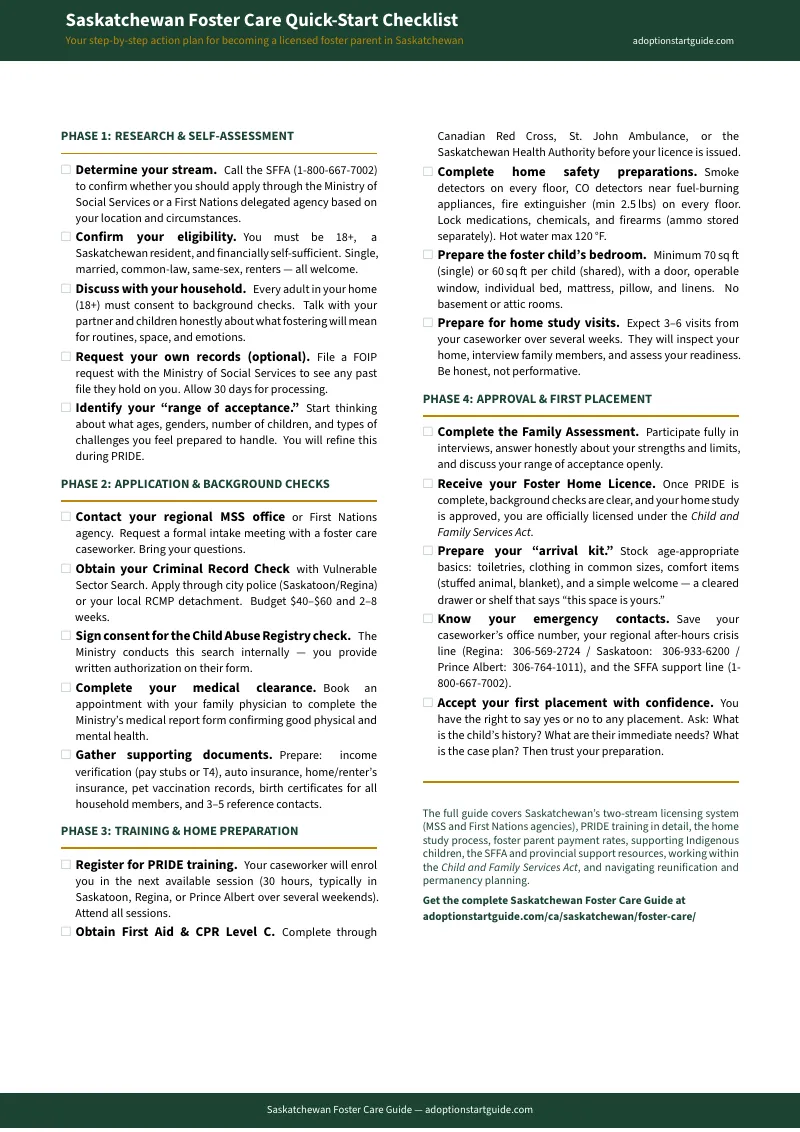
The free Quick-Start Checklist
Download the Saskatchewan Foster Care Quick-Start Checklist for a step-by-step overview of the licensing process, from first phone call through post-licensing obligations. Free, no commitment. If you want the full guide with the two-stream navigation system, background check demystifier, home study preparation, financial breakdown, and printable worksheets, click the button in the sidebar.
— less than one day's foster care per diem
The typical Saskatchewan applicant spends months piecing together the process from scattered government pages, SFFA brochures, and well-meaning advice from church groups and community organizations. This guide distils the most critical steps into a weekend-ready roadmap. A wrong-stream application — calling MSS when your neighbourhood falls under the Saskatoon Tribal Council — delays your approval by months. One guide prevents that.
If the guide does not deliver, reply to your download email at any time for a full refund. No forms. No justification required.