
35,549 families are waiting in the CARA queue. The average wait for a healthy infant is four years. And the system that's supposed to help you -- the CARINGS portal -- can delete your application over a misplaced hyphen in a filename.
You've been on the CARA website. You found the eligibility criteria, the list of Specialised Adoption Agencies, the FAQ that was last meaningfully updated in 2024. You found the CARINGS portal login page -- and maybe you've already registered, uploaded your Schedule VI documents, and started waiting. Or maybe you tried to register and the portal rejected your medical certificate because the file name contained a special character, and now you're wondering whether you've lost your place in the seniority queue.
You've read the Juvenile Justice (Care and Protection of Children) Act, 2015 and the Adoption Regulations, 2022. You've browsed Reddit threads where parents report wait times of two years, three years, four years -- and then someone else claims they got a referral in eight months. You've joined Facebook groups where people confuse HAMA adoptions (which only apply to Hindus, Buddhists, Sikhs, and Jains) with JJ Act adoptions (which apply to everyone). You've seen WhatsApp messages promising a "healthy infant in three months" that you're 90% sure are scams but 10% terrified might be the only way to avoid a four-year wait.
The information exists. It's scattered across the JJ Act 2015, the Adoption Regulations 2022, CARA circulars issued quarterly, the Model Foster Care Guidelines 2024, Supreme Court judgments, CWC orders that vary by district, and closed forum threads from parents who went through the system in 2019 under different rules. Piece it together yourself and you'll spend months reading documents written for social workers and district magistrates -- documents that explain the legal framework but never tell you what to do when the CARINGS portal crashes during your 30-day upload window, or how to evaluate a Child Study Report in the 48 hours before your reservation expires.
The CARA Navigation System -- from registration to Gotcha Day in one clear path
This guide was built for the problem every Indian family hits: a centralised adoption system run through a government portal, governed by legislation that changed fundamentally in 2022, reshaped again by the 2024 foster care guidelines, and administered by Child Welfare Committees and District Magistrates whose practices vary wildly from state to state. Every chapter, every checklist, every cost figure is grounded in the JJ Act 2015, the Adoption Regulations 2022, current CARA circulars, the Model Foster Care Guidelines 2024, and the real-world experience of families who have navigated this system.
What's inside
- CARINGS portal step-by-step with the "tech-proof" upload guide -- The portal is the single gateway to legal adoption in India. This chapter walks you through every screen: registration, Schedule VI document uploads, preference setting, and seniority tracking. It covers the filename errors that trigger rejections (the hyphen problem, the file-size limit, the naming convention that CARA's system actually accepts), the 30-day upload deadline that deletes your profile if you miss it, and exactly how to compress and name each document so your application survives the system's technical quirks. You should not have to re-register because of a filename.
- The 48-hour decision framework -- When CARA's algorithm matches you with a child, you get 48 hours to review the Child Study Report and Medical Examination Report and decide whether to reserve. Most parents have never seen a CSR before that moment. This chapter gives you a structured checklist: what the medical terminology actually means, which findings are common and manageable, which are red flags that need specialist consultation before you commit, and how to request additional information within the window without losing the referral. The 48 hours should be a decision, not a panic.
- Home Study Report preparation -- The HSR is where most families feel the most exposed. A social worker from your Specialised Adoption Agency visits your home, interviews you and your family members, and writes the report that determines whether you're "suitable." This chapter covers what social workers are actually trained to assess (it's not whether your house is spotless), the questions they commonly ask about motivation, finances, support systems, extended family acceptance, and how to address infertility history honestly without feeling like you're being judged for it. Preparation is not about performing -- it's about knowing what matters.
- Foster-to-adopt pathway under the 2024 guidelines -- The Model Foster Care Guidelines 2024 reduced the fostering period before adoption eligibility from five years to two. This is the single biggest change in India's child welfare system in a decade, and most prospective parents don't know about it yet. This chapter explains group foster care, individual foster care, kinship foster care, and the specific conditions under which a fostered child becomes legally free for adoption -- so you can evaluate whether this pathway gets you to permanency faster than the standard CARINGS queue.
- Immediate Placement and special needs pathways -- 65% of children in CARA's pool have functional needs. In 2024-25, only 328 of these children were adopted. The "Immediate Placement" section of the CARINGS portal lists children who are available now -- often because a previous match failed or the child has a medical condition that earlier families declined. This chapter explains how to access Immediate Placement, what "special needs" actually encompasses in CARA's classification, and why families who are open to older children or children with manageable conditions often bring a child home in months rather than years.
- Complete cost breakdown with scam red flags -- Legal adoption through CARA costs approximately Rs. 65,000 to Rs. 70,000 total: Rs. 6,000 for the Home Study, Rs. 50,000 for child placement (paid only after you accept the CSR), Rs. 8,000 for post-adoption follow-up visits, plus medical certificates. Registration is free. Any agent, facilitator, or WhatsApp contact asking for a "registration fee," a "speed-up charge," or a "donation" to an SAA above the regulated amount is running a scam. This chapter lists every legitimate cost line by line and every red flag that signals fraud.
- District Magistrate delay template letter -- Since 2022, adoption orders are issued by District Magistrates instead of civil courts. The intent was faster processing. The reality is that many DMs are overburdened and adoption orders sit unsigned for months -- which means your child can't get a birth certificate, can't be enrolled in school, and can't be added to your health insurance. This chapter includes a template letter for following up with the DM office, with the specific legal references that establish the timeline obligation.
- State-by-state comparison -- Maharashtra handles nearly 20% of all domestic adoptions. Some states have shorter waitlists, more active CWCs, and faster DM processing. This chapter compares major states on wait times, number of SAAs, CWC responsiveness, and the practical implications for your preference settings on the CARINGS portal. Your state preferences directly affect your seniority position -- this chapter helps you set them strategically.
- NRI and OCI adoption navigator -- Non-resident Indians and Overseas Citizens of India face additional requirements: a No Objection Certificate from their country of residence, authorisation from the Central Authority under the Hague Convention (where applicable), and compliance with both Indian adoption law and the receiving country's immigration rules. This chapter maps the dual-track requirements so NRI families know what both governments need before they start the process.
- HAMA vs. JJ Act comparison -- The Hindu Adoption and Maintenance Act applies only to Hindus, Buddhists, Sikhs, and Jains. The Juvenile Justice Act applies to everyone. If you're eligible for both, the legal implications are different -- HAMA creates a deemed biological relationship, while the JJ Act creates a legal parent-child relationship through a court order. This chapter explains when each applies, the inheritance implications, and why most families -- even those eligible for HAMA -- choose the JJ Act route through CARA.
- Four standalone printable tools -- The 48-Hour Decision Framework (print and have ready before your referral), the Document Checklist (track every certificate across all stages), the Cost Breakdown with Scam Red Flags (carry to any SAA meeting), and the DM Delay Template Letter (ready to fill in and submit).
Who this guide is for
- Married couples navigating CARA for the first time -- You've made the decision. You may have come through years of IVF. You may have always planned to adopt. Either way, you need the CARINGS portal to work for you, not against you, and you need to understand what happens at each stage before it happens to you.
- Single women exploring adoption -- Indian law permits single women to adopt. The eligibility criteria, the social worker's assessment lens, and the practical realities are different from those for couples. The guide covers your specific pathway, including the questions you'll face and how the seniority system works for single applicants.
- NRI and OCI families adopting from abroad -- You're managing two legal systems, two sets of documentation requirements, and a process that requires physical presence in India at multiple stages. The guide maps both tracks so you can plan trips, arrange leave, and avoid discovering a missing document after you've flown halfway around the world.
- Families of any religion -- Whether your motivation is spiritual, ethical, or simply the desire for a child, the legal process is the same under the JJ Act. The guide covers the HAMA option for Hindu, Buddhist, Sikh, and Jain families and explains when it applies, but the core process applies to every Indian family regardless of faith.
- Parents considering foster care as a path to adoption -- The 2024 guidelines created a real pathway from fostering to permanency. If the four-year wait feels impossible, this guide explains the foster-to-adopt route and the conditions under which it leads to legal adoption.
Why the CARA website and free resources aren't enough
The CARA website tells you the "what" -- the regulations, the eligibility criteria, the list of SAAs. It never tells you the "how-to" -- how to name your files so the portal accepts them, how to read a CSR in 48 hours, how to prepare for the home study, how to follow up with a DM who hasn't signed your adoption order in three months. It never tells you the "what-if" -- what if your HSR is rejected, what if the CWC in your district is demanding documents beyond what the regulations require, what if your seniority number keeps fluctuating because other parents are changing their preferences.
Books on Amazon.in are either 310-page paperbacks written before the 2022 regulatory overhaul, academic volumes priced at thousands of rupees that focus on policy theory rather than practical steps, or memoirs that inspire you emotionally but don't explain how to use the CARINGS portal. Facebook and WhatsApp groups give you peer support and anecdotal timelines -- they also mix up HAMA and JJ Act processes, share advice based on pre-2022 rules, and occasionally expose you to scam facilitators promising fast-track placements. Professional counselling through organisations like Families of Joy costs Rs. 1,500 per session. This guide gives you the foundation to navigate on your own -- and to ask the right questions if you do seek professional help later.
The free Quick-Start Checklist
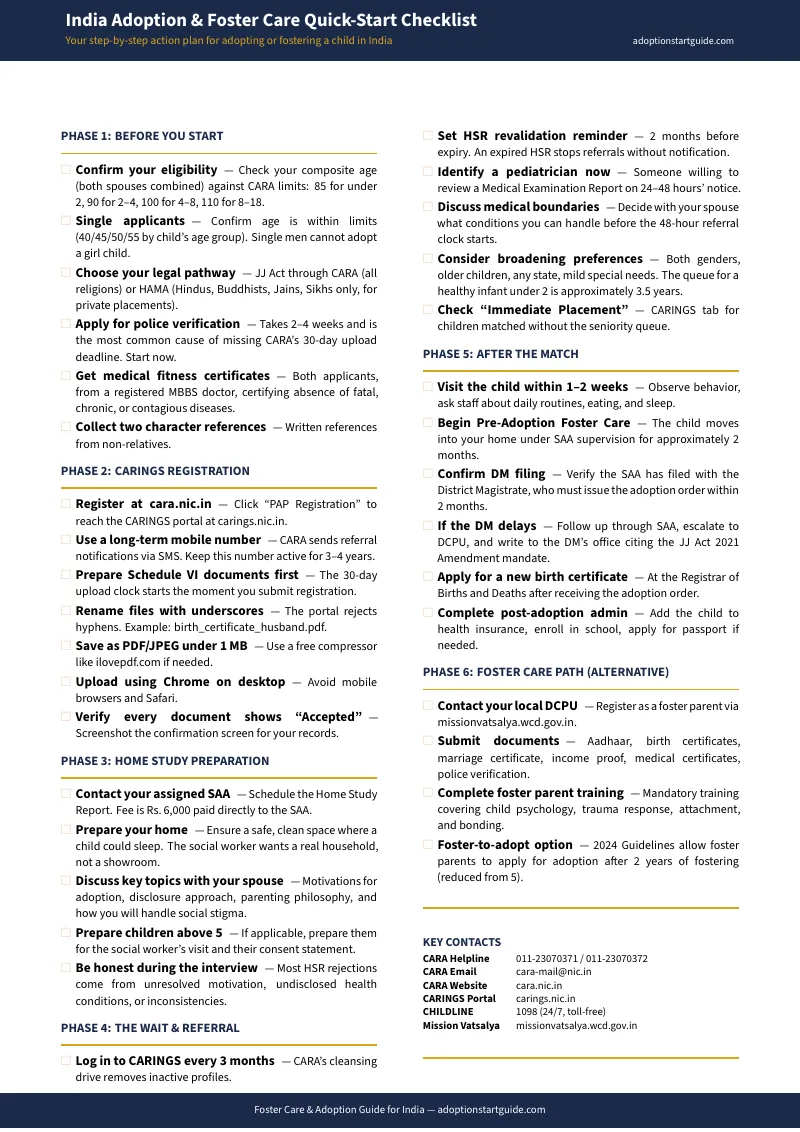
Download the India Quick-Start Checklist -- the key steps from CARINGS registration to child placement on one page. Free, no commitment. For the full guide with the CARA Navigation System, the 48-hour decision framework, the home study preparation, the foster-to-adopt pathway, and all the printable tools, click the button in the sidebar.
-- less than one per cent of the total cost of legal adoption in India
Legal adoption through CARA costs approximately Rs. 65,000 to Rs. 70,000 in regulated fees. A single professional counselling session costs Rs. 1,500. This guide costs a fraction of either -- and it covers the technical, legal, and procedural ground that neither the CARA website nor a counselling session can cover in the same depth. It doesn't replace your SAA or your social worker. It makes sure you don't lose months to a preventable portal error, a poorly timed preference change, or a scam that could have been spotted in five minutes. If it doesn't deliver what you need, you're covered by a refund guarantee, no time limit.