44 Care Order cases stuck in court for over a year. Over 50 children waiting for a foster home right now. And you can't find a single plain-language guide to how the system actually works.
You went to the FSWS website looking for a clear path forward. What you found was a bureaucratic maze split across three institutions that nobody explains in one place. The Foundation for Social Welfare Services runs the Fostering Service and the Adoption Service through Appogg. The Social Care Standards Authority accredits the private agencies and serves as Malta's Central Authority under the Hague Convention. And the courts — well, there are two of them, the Family Court for care orders and the Court of Voluntary Jurisdiction for adoption decrees, and figuring out which one handles your situation requires reading legislation that was written for lawyers, not families.
If you're considering fostering, the FSWS page tells you there's a mandatory 7-week training course and a Home Study assessment. It doesn't tell you what the social worker actually asks during those home visits, how to prepare your home without overthinking it, or what happens when the child you've been raising for two years is still in legal limbo because the Family Court hasn't finalised the Care Order. And it definitely doesn't explain the financial reality — that foster carers receive EUR 6,760 per year per child, that there's a tapered benefit if you later adopt your foster child, or that the government will reimburse up to EUR 12,000 of your intercountry adoption expenses.
If you're considering adoption, you discovered what most Maltese families discover too late: domestic adoption is nearly impossible. Only about four local adoptions are finalised in a typical year. Intercountry adoption is the realistic pathway, but the process involves choosing between the free state service and two private agencies, compiling a dossier that must be notarised, apostilled, and translated, getting medical clearance from Mater Dei Hospital, and navigating foreign court proceedings that can keep you abroad for weeks. The total cost ranges from EUR 13,000 to EUR 40,000, and no government page breaks that down line by line.
The Maltese Alternative Care Roadmap — every step, every institution, every euro, in one guide
This guide exists because the official information is technically correct but practically useless for a family trying to make the most important decision of their lives. It connects the laws (Chapter 602, Chapter 495, the 2026 Family Court Reform), the institutions (FSWS, SCSA, Appogg, the courts, NFCAM), and the financial support mechanisms into one coherent roadmap written for prospective parents, not policymakers.
Everything in this guide is specific to Malta. The correct institutions. The correct legislation. The correct financial figures as of 2026. No repurposed international handbook. No generic advice about "contacting your local authority."
What's inside
- The institutional map decoded — Who does what in Malta's alternative care system. FSWS and its Directorate for Alternative Care, the SCSA's role as Central Authority, the difference between the Family Court and the Court of Voluntary Jurisdiction, and what Appogg actually is (and isn't) now that it's been restructured. Understanding this map before your first phone call saves you from being bounced between agencies for weeks.
- The legal framework in plain language — Chapter 602 (the Minors Protection Act 2020), Chapter 495 (the Adoption Administration Act), and the 2026 Family Court Reform explained in terms that matter to you. What "concurrent permanency planning" means for your foster placement. What "dispensing with biological parent consent" requires for adoption. What the new dedicated child-protection judicial stream means for court delays. No legal jargon without translation.
- Home Study preparation guide — The Home Study is the single most important assessment in the process, and it terrifies most applicants. This chapter breaks down exactly what social workers evaluate — your motivation, your relationship stability, your parenting approach, your home safety, your support network — and how to prepare honestly without overthinking it. The families that struggle most are the ones trying to appear perfect.
- Financial support calculator approach — Every euro you can claim, with current 2026 figures. The EUR 6,760 annual fostering allowance (EUR 130/week). The EUR 12,000 intercountry adoption grant. The EUR 2,000 domestic adoption grant. The tapered foster-to-adopt benefit (80% in Year 1 down to 20% in Year 4). Child birth and adoption bonuses up to EUR 2,000. The EUR 500 Special Student Allowance. Fee waivers for apostilles. Free therapeutic services. Laid out so you can calculate your specific situation.
- The fostering pathway step by step — From your first call to the 1778 helpline through documentation, the 7-week training course, the Home Study, Board review and licensing, matching, and placement. Each step with what to expect, how long it takes, and what you can do to keep your file moving.
- The adoption pathway — domestic and intercountry — The honest reality of domestic adoption (about four per year). The foster-to-adopt pathway as the most realistic route to domestic permanency. The intercountry process through Malta's three accredited agencies (FSWS Adoption Service, Adoption Opportunities, Agenzija Tama), including dossier compilation, the Mater Dei medical review, travel to the source country, and court recognition back in Malta.
- Court delay survival strategies — 44 cases pending over a year, at least four over three years. This chapter doesn't pretend the problem doesn't exist. It explains why delays happen, what the 2026 reform is doing about it, and gives you practical steps to keep your file active — staying in contact with your social worker, engaging a family lawyer early, documenting the child's progress, and connecting with NFCAM for advocacy support.
- Biological family contact scripts — Maintaining contact with birth families is a legal requirement in fostering and increasingly common in open adoption. This is the most emotionally charged aspect of alternative care. The guide provides practical frameworks for setting boundaries, managing your own feelings, documenting visits, and communicating proactively with your social worker when contact is causing the child distress.
Who this guide is for
- Prospective foster carers — You want to open your home to a child in need. You need to understand the licensing process, the Home Study, the financial support, and the reality of court delays before you make that call to 1778.
- Couples and individuals considering adoption — You want a permanent family. You need to understand why domestic adoption is so scarce, how the intercountry process works, which agency fits your situation, and what the realistic costs and timelines are.
- Single applicants — Maltese law allows single individuals to foster and adopt. This guide addresses the specific eligibility requirements and practical considerations for single applicants throughout.
- Same-sex couples — Malta legalised civil unions in 2014 and marriage equality followed. You have the same legal rights as any other couple. The assessment focuses on your capacity to provide a stable, nurturing environment, not on your relationship structure.
- Kinship carers — You're a relative stepping in for a child in your extended family. The assessment process is modified for kinship care, and you receive the same financial support as non-relative foster carers. This guide covers the kinship pathway specifically.
Why the free resources aren't enough
The FSWS and Servizz.gov.mt websites contain the official information. But it's scattered across multiple portals, written in policy language designed for social workers, and structured around government procedures rather than your decisions. The fostering FAQ tells you that applicants need a clean police conduct certificate. It doesn't tell you that the Fedina Penali can take several weeks to process and that you should request it before your first meeting with a social worker.
NFCAM provides invaluable peer support — if you're already a foster carer. But it's an advocacy association with a modest membership, not a structured guide to getting through the process for the first time. And the private agency websites (Adoption Opportunities, Agenzija Tama) provide information about their own services. They don't compare themselves to the free state service or explain when paying agency fees makes sense and when it doesn't.
The Fostering Service Facebook page answers individual questions. This guide answers all of them in one place, in logical order, before you need to ask.
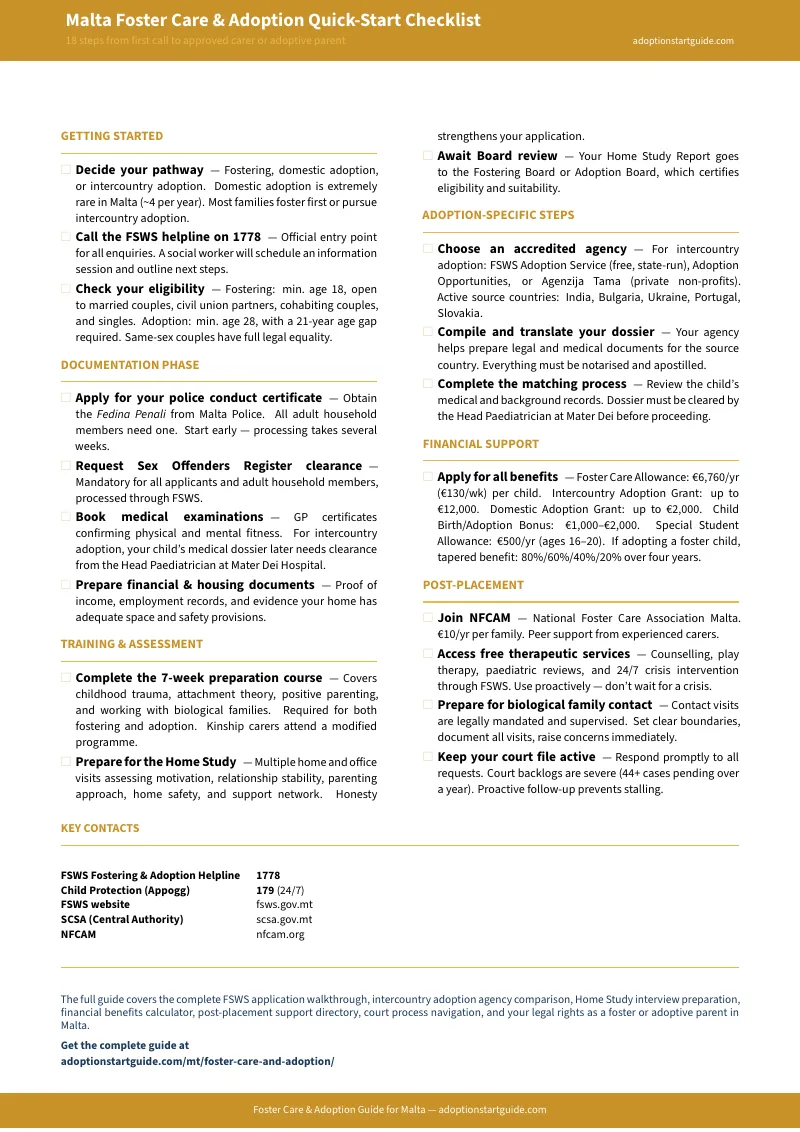
The free Quick-Start Checklist
Download the Malta Quick-Start Checklist for a two-page overview of the key steps from initial inquiry through to placement or adoption order. Free, no commitment. If you want the full guide with the institutional map, legal framework, Home Study preparation, financial calculator, court delay strategies, and biological family scripts, click the button in the sidebar.
— less than one family dinner out
An hour with a Maltese family lawyer costs EUR 100 or more. The intercountry adoption process alone can cost up to EUR 40,000 in agency fees, travel, and legal expenses. This guide doesn't replace a lawyer — but it gives you the knowledge to ask the right questions, avoid the administrative mistakes that add months to your timeline, and claim every euro of government support you're entitled to.
More than 50 children in Malta are waiting for a foster home right now. The financial support is substantial — EUR 6,760 per year in fostering allowances, up to EUR 12,000 in intercountry adoption grants. The legal protections are stronger than they've ever been, thanks to the 2020 and 2026 reforms. And the support services — free therapy, crisis intervention, peer networks through NFCAM — are there when you need them.
If the guide doesn't deliver, reply to your download email at any time for a full refund. No forms, no justification required.