
Your ten-year-old steals food from a full refrigerator. Your teenager flinches when you reach for a hug. And the state training that was supposed to prepare you never mentioned any of this.
You passed the home study. You completed the PRIDE training. You said yes to the child on the photolist whose profile mentioned "some behavioral challenges" and "benefits from structure." You meant it when you said you were ready.
Then the placement happened. And somewhere around week three, you realized that nothing you learned in training applies to the child actually living in your home.
The lying started first. Not about big things. About whether they brushed their teeth, whether they ate lunch at school, whether they broke the thing you can see is broken. You tried consequences. The lying got worse. You tried talking it through. They shut down completely, eyes on the floor, body rigid, as if waiting for you to hit them. You have never hit anyone in your life.
Then the food hoarding. Granola bars stuffed under the mattress. Bread in the backpack. You filled the pantry. You told them they could eat anything, anytime. It did not matter. The body remembers hunger longer than the mind does.
Your biological daughter started sleeping with the door locked. She did not tell you why. She just stopped bringing friends over. When you asked what was wrong, she said "nothing" in the same flat voice your adopted child uses when they are about to disappear inside themselves for three hours.
The caseworker said it would take time. Your mother-in-law said maybe the child "just isn't a good fit." The Facebook group said to try essential oils. And you sat in the car after drop-off and thought: I love this child, and I have no idea what I am doing.
That gap between your commitment and your capacity is not a character failure. It is a training failure. And it is exactly what this guide was built to close.
The Survival-to-Connection Framework
This is not a feel-good overview of older child adoption. It is the clinical and practical manual for families who have already said yes to the hardest version of parenthood and need to know what to do when love is not enough.
The guide is built on the Survival-to-Connection Framework: a structured approach that moves your family from the crisis of early placement through the long middle of testing, regression, and grief, and toward the stable attachment that 84 percent of parents who adopt children over age six say was worth every difficult day.
It draws on AFCARS data, the TBRI model from the Karyn Purvis Institute, attachment neurobiology, disruption research, and the lived experience of families who have walked this road. Every chapter connects the science to the specific situation you are facing at 9 PM on a Tuesday when nothing is working.
What's inside
- The First 18 Months, Phase by Phase — The honeymoon. The testing. The six-month wall where most disruptions happen. The regression that looks like your child is getting worse but actually means they feel safe enough to fall apart. A month-by-month breakdown of what to expect so you are never blindsided by a behavior that has a name and a known trajectory.
- Decoding Survival Brain Behaviors — Lying, stealing, food hoarding, defiance, emotional shutdown, property destruction. Each one explained through the neurobiology of trauma, with a specific response script that replaces the punishment-based approach that makes every one of these behaviors worse. When your child steals food from the pantry, the guide tells you exactly what to say and do instead of what your instincts are screaming.
- The Sibling Safety Blueprint — Room assignments, supervised-versus-unsupervised activity rules, crisis protocols, and "invisibility prevention" strategies so your biological children do not become collateral damage. Includes a written safety plan template you can fill out before the placement begins.
- TBRI's Three Pillars in Practice — Empowering (snack schedules, sensory regulation, hydration), Connecting (co-regulation, nonsense play, eye contact without demand), and Correcting (the "re-do" technique, proactive teaching, compromises that build trust). Not the theory. The daily implementation, with examples for ages 6-9, 10-13, and 14-17.
- Navigating the Adoption Triad — How to handle birth family contact, social media searches, loyalty conflicts, and the grief cycle that resurfaces at every holiday, birthday, and school family tree project. What to say when your child tells you they want to go back to their "real" mom. How to build a Life Book that honors their history without destabilizing your home.
- Preventing Adoption Disruption — The evidence-based predictors of disruption by age group, the early warning signs, and the specific interventions that research shows reduce the risk. Disruption rates reach 26 percent for teens placed at 15-18. This chapter is about making sure your family is not part of that statistic.
- Financial Support and Subsidy Negotiation — Title IV-E adoption assistance, state-specific subsidy rates, Medicaid continuation, Education Training Vouchers worth up to $5,000 per year for college, and the adoption tax credit. How to negotiate your subsidy agreement before signing, what to document, and how to request a rate increase when your child's needs change.
- Parental Wellbeing and Blocked Care — The clinical phenomenon where your own nervous system shuts down from the stress of parenting a child who cannot yet receive your love. Why you stop feeling empathy for the child you chose. How to recognize it, how to recover from it, and how to find an adoption-competent therapist who will not tell you to "try harder."
- The Older Child Adoption Toolkit — Printable checklists for pre-placement preparation, the first week home, the first month milestones, and the six-month safety check. Response scripts for the ten most common survival behaviors. A resource directory of adoption-competent therapist finders, support groups, and crisis hotlines.
Printable worksheets included
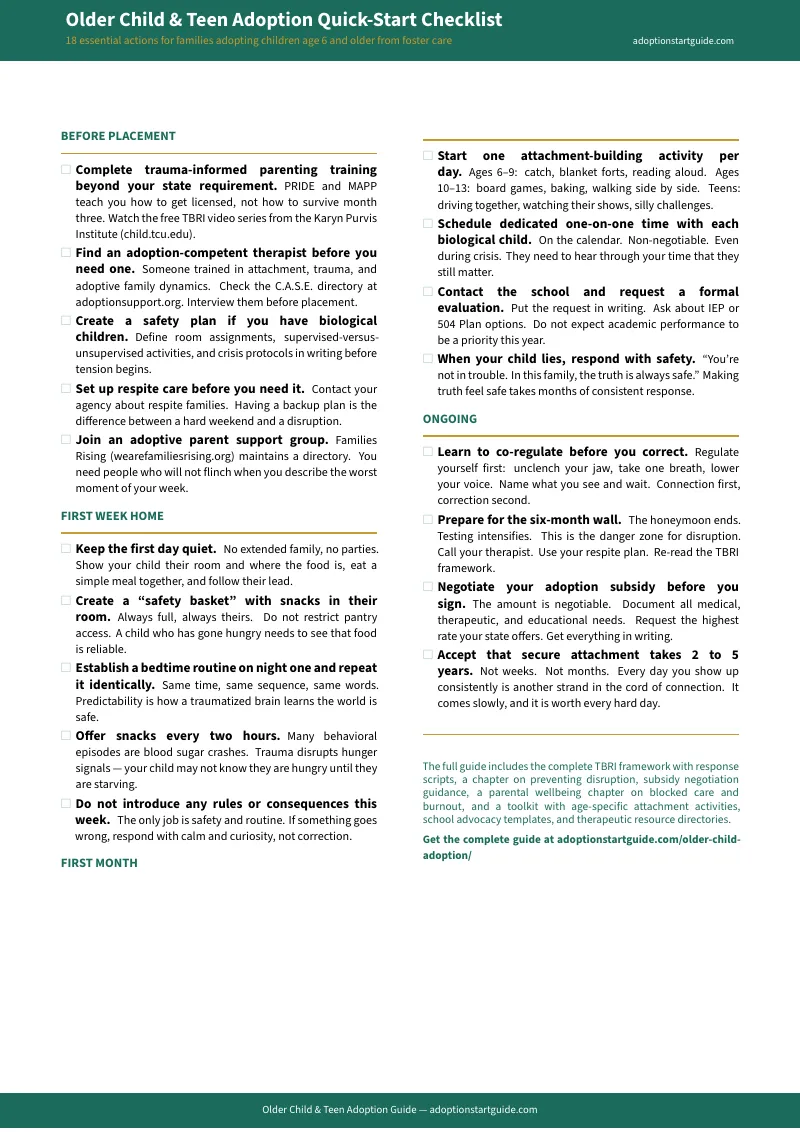
- Quick-Start Checklist — The 18 most important actions from pre-placement through the first year, organized by phase. Print it, pin it up, and check things off as you go.
- Survival Behavior Response Scripts — A two-page reference card with the exact words to say when your child lies, steals, hoards food, shuts down, destroys property, or becomes aggressive. Print it and keep it where you can reach it at 9 PM on a Tuesday.
- Family Safety Plan Worksheet — A fillable worksheet for room assignments, supervised-versus-unsupervised activity rules, escape routes, and crisis protocols. Complete it before placement begins.
- Attachment-Building Activities by Age — A one-page fridge sheet with specific connection activities for ages 6-9, 10-13, and 14-17, with the science behind why each one works.
- Therapeutic Resources & Crisis Directory — Crisis hotlines, adoption-competent therapist finders, support group databases, and a recommended reading list on a single printable page.
Who this guide is for
- Families in the pre-placement research phase — You are in PRIDE training or finishing your home study and you have realized that "some behavioral challenges" means something the class did not prepare you for. You want to be ready, not just qualified. This guide is the preparation your agency cannot give you.
- Families in the first year of placement — The honeymoon ended. The testing started. You are Googling things at midnight that you never imagined searching for. The guide meets you in the crisis with specific, immediate strategies you can use tonight.
- Families who pivoted from infant adoption — You wanted a baby. The waitlist was years. The cost was tens of thousands of dollars. You turned to foster care, and now you are parenting a child with a history, an identity, and a set of survival skills that traditional parenting books do not cover. This guide bridges the gap between the family you planned and the family you are building.
- Faith-motivated families — You felt called to the hard places. You believe every child deserves a family. You are also discovering that faith and intention do not automatically translate into the clinical skills required to parent a child whose brain was shaped by neglect and loss. This guide gives you the practical tools to match your conviction.
- Single parents and kinship caregivers — Grandparents, aunts, uncles, and single adults who stepped up when no one else would. You may not have a partner to share the load, but you can have a roadmap that tells you what to expect and what to do when the hard days come.
Why free resources fall short
AdoptUSKids teaches you how to find a waiting child. It does not teach you what to do when that child tests every boundary in your home for six months straight. The Child Welfare Information Gateway has fact sheets on attachment. It does not have a script for what to say when your twelve-year-old screams that you are not their real parent.
State agency training covers licensing requirements, the legal process, and an overview of trauma. It does not cover what happens at 2 AM when your teenager is destroying their room because a song on the radio reminded them of a birthday they spent in a group home. PRIDE training gets you qualified. It does not get you through the first 18 months.
The Etsy adoption binders give you pretty printables and milestone trackers designed for infant adoption. They do not address food hoarding, blocked care, or sibling safety planning for a child who learned to fight before they learned to read.
The Reddit threads and Facebook groups are brutally honest about the pain. They are not organized, not evidence-based, and not structured around the specific phase of placement you are in right now. You scroll through three years of posts looking for someone whose situation matches yours, and by the time you find them, you are too exhausted to apply what they said.
This guide is the structured synthesis: the clinical research, the practical strategies, the phase-by-phase timeline, and the printable tools, organized by the problem you are facing right now.
The free Quick-Start Checklist
Download the Older Child & Teen Adoption Quick-Start Checklist for the 18 most important actions from pre-placement through the first year, organized by phase and ready to print. Free, no commitment. If you want the full guide with the survival behavior scripts, sibling safety blueprint, TBRI implementation strategies, subsidy negotiation chapter, and complete toolkit, click the button in the sidebar.
— less than one hour of adoption-competent therapy
An adoption-competent therapist costs $150 to $250 per hour, and most families need one. This guide does not replace therapy. It makes sure you walk into that first session knowing the right questions to ask, the right framework to reference, and the right language to describe what is happening in your home. It also covers the dozens of situations that do not require a therapist at all, just a parent who knows what a survival behavior looks like and how to respond to it without making it worse.
43 percent of foster-to-adopt parents earn under $75,000. This guide was priced so that the families who need it most can actually afford it.
If the guide does not deliver, reply to your download email at any time for a full refund. No forms. No justification required.