
You want to adopt a child in the Philippines. The government wants you to understand RA 11642, navigate the NACC, pass a Home Study you've never seen, and somehow figure out the difference between administrative adoption, relative adoption, and the old judicial process that some lawyers still reference -- all while Facebook groups mix genuine advice with illegal baby-selling schemes in the same thread.
You went to the NACC website. You found the "Domestic Adoption" page and the documentary requirements PDF. It listed fifteen documents. It did not tell you that your NBI clearance expires after six months and needs to match the timeline of your RACCO application, that the psychological evaluation must come from a NACC-accredited psychologist (not just any licensed one), or that the medical certificate has a specific format the social worker will reject if your doctor improvises. It told you to attend a Pre-Adoption Forum. It did not tell you that the forum schedule depends on your RACCO's capacity, that some regions hold them quarterly while others run them monthly, or that you cannot proceed to the Home Study until you have the Certificate of Attendance and that single piece of paper controls your entire timeline.
While you waited for the next forum date, you searched online. You found a Facebook group called something like "Adoption PH" or "Legal Child Adoption Philippines." You found a couple who had been waiting eighteen months for a CDCLAA -- the Certificate Declaring a Child Legally Available for Adoption -- because the child's biological parents could not be located and the court abandonment proceedings were still crawling through the system. You found a lola in Mindanao who had been raising her apo for five years and didn't know that under RA 11642, relative adoption through the RACCO could formalize the arrangement administratively without going to court. You found a post from someone offering a "direct placement" of a newborn, with a phone number and a price. The comments were split between people warning it was trafficking and people sharing personal messages asking for the contact. You closed the tab.
Then you tried the accredited agencies. Kaisahang Buhay Foundation had a professional website and decades of experience placing children with families. But their orientation sessions are designed for parents who will adopt through KBF specifically, not for someone trying to understand the general NACC process. Generations Home offered journals and support groups, but again -- they recruit for their own programme. The information you need is the system-level picture: what the NACC process actually involves from inquiry to PSA birth certificate, how long each stage really takes, what the social worker is looking for in your Home Study, and what your options are when something goes wrong. No single agency explains that, because no single agency owns the whole process.
The Administrative Adoption Blueprint
This guide is built for how the Philippine adoption and foster care system actually works under RA 11642 -- the Domestic Administrative Adoption and Alternative Child Care Act that moved adoption from the courts to the NACC starting in 2022. Every chapter reflects current law, current NACC procedures, current RACCO operations, and the practical realities that the official documentary requirements PDF and the agency orientation materials systematically leave out. It is not a legal primer with "Philippines" in the title. It is the step-by-step operating manual for Filipino families navigating a system that was redesigned from scratch three years ago and is still finding its footing.
What's inside
- RA 11642 Decoded -- Courts Out, NACC In -- A plain-English breakdown of what changed when adoption moved from Family Courts to the National Authority for Child Care. If you started a judicial adoption petition before January 2022, the guide explains your options: continue in court or withdraw and refile administratively. If you're starting fresh, it maps the entire NACC framework so you understand why certain steps exist, what discretion the RACCO has, and where delays actually originate -- so you can prevent them instead of just enduring them.
- The Complete Application Roadmap -- RACCO Inquiry to PSA Birth Certificate -- The full chronological process: initial inquiry, Pre-Adoption Forum attendance, documentary preparation, Home Study Report (HSR), matching, Pre-Adoption Placement Authority (PAPA), six-month Supervised Trial Custody (STC), petition filing, Order of Adoption, and PSA birth certificate issuance. Each stage includes realistic timeframes (not the optimistic nine months the law promises, but the twelve to eighteen months most families actually experience), the specific documents you need at each step, and the common mistakes that force you to restart a stage.
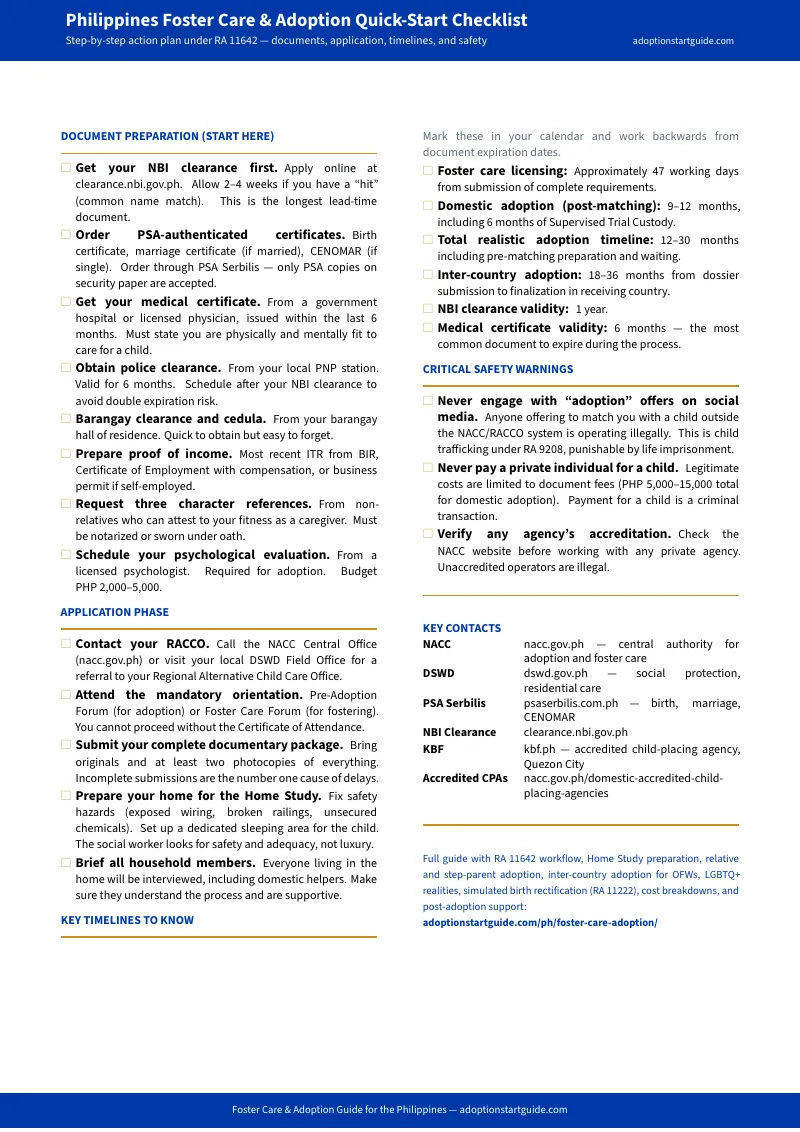
- Document Dossier Checklist with Validity Periods -- Every document the NACC requires, organized by the stage at which you need it, with the validity period and lead time for each. Your NBI clearance is valid for six months. Your CENOMAR from PSA takes two to four weeks. Your barangay clearance expires in six months. Your psychological evaluation must come from a NACC-accredited provider. The guide puts all of this in one checklist so you sequence your applications correctly instead of discovering that your earliest document expired while you were still waiting for the last one.
- Home Study Preparation -- What Social Workers Actually Look For -- The HSR is the single most consequential step in your application. The social worker evaluates your motivation, your marital relationship, your parenting readiness, your financial stability, your home environment, and your support network. The guide translates these from assessment criteria into the actual questions you will be asked, the answers that demonstrate insight and readiness (not perfection), and the common red flags that raise concerns -- like saying you want to adopt because you want to "save" a child, or because your marriage needs "something to bring you closer."
- Relative Adoption Fast-Track -- If you are already caring for a niece, nephew, grandchild, or any relative within the fourth degree of consanguinity or affinity, RA 11642 provides a streamlined "Relative Adoption Proper" pathway that skips the CDCLAA requirement. The guide covers the specific documentary differences, the abbreviated assessment process, and the legal effect of the Order of Adoption on inheritance, custody, and parental authority -- because legalizing an existing family bond should not require the same process as adopting a child you have never met.
- Step-Parent Adoption Under RA 11642 -- You married someone who already has a child. You want to legally adopt your stepchild. The guide covers the specific requirements: consent of the biological parent, the child's consent if over ten, the streamlined assessment, and the timeline. This pathway exists precisely so families like yours don't get trapped in a process designed for strangers adopting unknown children.
- Inter-Country Adoption and the OFW Path -- For Filipinos living and working abroad, the process runs through the Inter-Country Adoption Board (ICAB) and involves Hague Convention requirements, the $40,000 minimum annual income threshold, home study coordination between the receiving country's Central Authority and the NACC, and consular processing. The guide maps this parallel pathway -- from ICAB application through matching, STC in the Philippines, and visa processing -- with specific attention to OFWs who want to adopt a relative's child back home while working in the Middle East, Singapore, Hong Kong, or North America.
- Foster Care Application -- DSWD Pathway -- Not ready for permanent adoption? Foster care provides temporary family-based care for children who cannot stay with their biological parents. The guide covers DSWD foster care licensing, the foster parent assessment, placement types (emergency, short-term, long-term), the foster care subsidy, and how fostering can lead to adoption when reunification is no longer the plan. It also addresses the practical reality: what happens when you bond with a foster child and want to adopt, and what the legal pathway looks like.
- Simulated Birth Rectification -- RA 11222 -- If your family "simulated" a birth -- registered a child as your biological offspring when they are not -- you are not alone. This practice has been widespread in the Philippines for decades. RA 11222, now administered through the NACC, provides a path to rectify simulated births without criminal liability, as long as you file within the legal window. The guide explains who qualifies, what documents you need, the administrative process, and why acting now protects your family from future inheritance disputes and potential criminal charges.
- Cost Breakdown -- Every Fee, No Surprises -- A realistic accounting of what domestic adoption actually costs in the Philippines: NACC filing fees, NBI clearance fees, PSA document fees, psychological evaluation costs, medical examination costs, and any agency service fees if you work with an accredited CPA. The guide also covers what is free (the Pre-Adoption Forum, the CDCLAA process) and what should never cost money (the matching itself -- if anyone charges a "finder's fee" for a child, that is trafficking).
Print-ready standalone worksheets included
In addition to the full guide and the quick-start checklist, your download includes standalone printable PDFs you can use independently:
- Application Timeline Tracker -- Track every stage from RACCO inquiry through Order of Adoption with date columns and notes for your assigned social worker's contact details.
- Document Dossier Checklist -- Every required document with its validity period, the agency that issues it, estimated lead time, and a checkbox for completion -- organized by the stage at which you need it.
- Home Study Preparation Worksheet -- The assessment dimensions with key questions, space for your reflections, and common pitfalls to avoid. Review this before your social worker's first home visit.
- Financial Planning Worksheet -- Itemized cost estimates for each stage of the process, with a running total so you can budget realistically before you begin.
- Key Contacts and Resources -- NACC national office, your regional RACCO, ICAB, accredited CPAs, PSA offices, NBI clearance centers, and fill-in spaces for your social worker and lawyer's details.
Who this guide is for
- Filipino couples exploring domestic adoption for the first time -- You have been talking about this for years. You've browsed the NACC website, maybe called the RACCO, maybe attended a church group where someone shared their story. You need the end-to-end process laid out plainly -- the real timeline, the real costs, the real documents -- so you can move from "thinking about it" to actively preparing with clarity about what lies ahead.
- Kinship caregivers who are already raising a relative's child -- Your sister's anak, your apo, a pamangkin who ended up in your home because the biological parents could not provide care. The child has been with you for months or years, but legally, you have no parental authority. The guide shows you the relative adoption pathway that formalizes what already exists -- without the CDCLAA, without the full matching process, and often faster than you expect.
- OFWs who want to adopt while living abroad -- You're in Dubai, Singapore, Hong Kong, Riyadh, or Toronto. You earn well. You want to adopt a child from the Philippines -- perhaps a relative's child, perhaps through the inter-country system. The guide maps the ICAB pathway, the income requirements, the home study coordination between countries, and the consular steps so you know exactly what's possible before you spend months gathering the wrong documents.
- Step-parents who want to legally adopt their spouse's child -- The child already calls you Mama or Papa. You want the legal relationship to match the real one. The guide covers the specific step-parent pathway, which is shorter and simpler than the general adoption process, so you don't waste time preparing for requirements that don't apply to you.
- Singles considering adoption -- Philippine law allows single individuals to adopt, provided you meet age and income requirements. The guide addresses the specific eligibility criteria, the assessment considerations for single applicants, and the practical questions social workers tend to focus on -- like your support network and your plan for childcare.
- Families who simulated a birth and need to rectify it -- You registered someone else's child as your own biological child. It happened years ago, maybe decades. You know it was illegal, but you did it because the adoption process was impossible and the child needed a home. RA 11222 offers administrative rectification without criminal liability. The guide explains who qualifies, the filing window, and why acting now prevents inheritance and custody complications later.
Why the free resources fall short
The NACC website publishes the law, the IRR, and the documentary requirements list. These documents are technically accurate and completely overwhelming for a parent who just wants to know what to do first, what to do next, and how long it will take. The requirements PDF lists fifteen documents without explaining that three of them expire before you're likely to use them, that the psychological evaluation must come from a specific pool of accredited professionals, or that the medical certificate has a format your family doctor probably doesn't know about. The law explains the NACC's jurisdiction. It does not explain what happens when your social worker gets reassigned mid-assessment and your file sits in a drawer for three months.
Accredited agencies like Kaisahang Buhay Foundation and Generations Home provide excellent orientation and support -- for families adopting through their programmes. Their information describes their internal process, their waiting lists, their matching approach. If you're going through the general NACC pathway at your regional RACCO, their guidance covers a different experience than the one you'll actually have. They recruit for their agency. They do that well. But that is not the same as preparing you for the system.
Facebook groups give you real stories from real families, and that matters enormously. But the advice is unsorted, contradictory, and increasingly dangerous. Posts from families who adopted under the old judicial system describe a process that no longer exists. Posts offering "direct placements" of newborns are illegal. The line between genuine peer support and human trafficking schemes runs through the same comment section. You need a source that separates current law from outdated experience and legal pathways from criminal ones.
The free Quick-Start Checklist
Download the Philippines Quick-Start Checklist for the essential steps from RACCO inquiry through the adoption application -- including the document validity periods and Home Study preparation items that cause the most delays. Free, instant download, no commitment. If you want the full guide with the RA 11642 breakdown, the complete application roadmap, the document dossier with validity tracking, the Home Study preparation framework, the relative and step-parent fast-tracks, the OFW inter-country pathway, the foster care application process, the simulated birth rectification guide, and the standalone printable worksheets, click the button in the sidebar.
-- less than one psychological evaluation fee or a single NBI rush processing charge
One expired document forces you to restart a stage. One poorly prepared Home Study answer raises a flag that delays your matching by months. One wrong turn toward a Facebook "direct placement" scheme puts you at risk of trafficking charges and destroys your chance of ever adopting legally. Families who understand the NACC process before they enter it complete their dossier on schedule, pass the Home Study on their first attempt, and navigate the system with the confidence that comes from knowing exactly what happens next.
If the guide doesn't deliver, reply to your download email at any time for a full refund. No forms. No justification required.