You went to the info session. You're still not sure what the social worker actually wants to hear.
You sat through the fostering talk at Epworth or Boys' Town. You heard the stories. You saw the photos. You left knowing you want to do this — and not knowing how to actually pass the assessment. The brochures said "open your home." They didn't say what happens when two social workers arrive for a three-hour interview and start asking how you were disciplined as a child.
The MSF website lists the criteria. Married couple. Singapore Citizen or PR. No criminal record. It does not tell you what the home inspector is actually looking for beyond window grilles, how the SG Cares portal works step by step, or what questions the assessors ask about your marriage during the psychological interview. It does not explain why some couples sail through in four months while others spend a year waiting for a callback.
The agency websites are recruitment tools. They're designed to get you to attend the next info session, not to prepare you for what comes after. Reddit threads have honest stories from foster parents, but half the posts still mention income requirements that were removed in 2025. The MSF Handbook for Foster Parents exists — but it's written for people who already have a child placed, not for applicants trying to get through the front door.
There is a gap between deciding to foster and being approved. This guide fills it.
The Assessment-Ready System: From Application to First Placement
The Singapore Foster Care Guide is built for one purpose: getting you from "I want to foster" to "your first placement is confirmed" without the delays, confusion, and anxiety that come from piecing together information across five agencies, three government websites, and dozens of outdated forum posts.
The core structure is called the Assessment-Ready System — a preparation framework that maps every stage of the Singapore fostering process: choosing your agency, completing the SG Cares application, passing the home assessment, surviving the social worker interviews, and preparing your household for the first placement. Each stage includes what to expect, what to prepare, and what trips up applicants who go in without a plan.
What's inside
- The Agency Comparison Matrix — Singapore has five MSF-appointed fostering agencies: Epworth, Boys' Town, Gracehaven, Muhammadiyah Association, and PPIS. Each has a different cultural DNA, different support structures, and different specialisations. The guide compares them side by side — religious orientation, focus areas, training programmes, and what current foster parents say about working with each one — so you choose an agency that fits your family, not just the first one you found online.
- The SG Cares Application Walkthrough — Since August 2024, all applications go through the SG Cares Volunteer Management System using Singpass. The guide walks you through the portal step by step: what documents to upload, how to handle the co-applicant requirement, how to indicate your age and gender preferences, and the specific fields where applicants commonly stall.
- The Interview Preparation Guide — The social worker assessment involves multiple three-hour sessions covering your childhood, your marriage, your parenting philosophy, and your understanding of reunification. The guide breaks down the three core interview probes — the History Probe, the Conflict Probe, and the Reunification Probe — with the reasoning behind each line of questioning, so you understand what assessors are really evaluating and can prepare honest, thoughtful answers instead of guessing.
- The Home Safety Checklist — A room-by-room inspection guide calibrated to MSF's actual requirements for HDB flats and private homes. Window grilles for children under 13, locked medicine storage, safe electrical fittings, bed and personal space requirements, kitchen safety. Know exactly what the inspector will check so you fix everything once, not twice.
- The Financial Reality Map — The 2025 MSF fostering allowance ranges from $1,100 to $1,800 per month depending on the child's age and needs. Beyond that: the Medical Fee Exemption Card covers 100% of polyclinic and hospital bills. Childcare co-payment is $200/month after subsidies. Student care is $80/month. SPED school subsidies and post-secondary bursaries are available. The guide lays out every dollar so you can plan with actual numbers, not vague assurances.
- The Muslim Fostering Chapter — For Malay Muslim families, fostering intersects with specific religious considerations: Kifalah obligations, Mahram and modesty rules once a child reaches puberty, the Mufti's concessions for foster families, and cross-cultural placement requirements for non-Muslim families caring for Muslim children. This chapter draws on MSF and MUIS guidance so you know your rights and responsibilities clearly.
- The Children and Young Persons Act Decoder — The CYPA governs child protection in Singapore and shapes every aspect of the foster care system. The guide translates the relevant sections into plain English: what "care and protection" orders mean, how placement decisions are made, what your legal standing is as a foster parent, and how the reunification framework operates.
- Placement Preparation Protocols — What happens in the first 72 hours after a child arrives. How to handle school enrollment, medical appointments, and the initial adjustment period. What to expect from children who have been in residential care at places like Gladiolus Place or Boys' Town homes. How to manage contact with birth parents from day one.
Printable worksheets included
- Agency Selection Worksheet — Compare all five agencies on the factors that matter to your family: location, religious alignment, support services, specialisation. Fill it in and make the decision once.
- Home Safety Inspection Checklist — Room-by-room checklist matching MSF standards. Print it, walk your home, tick every item. Hand it to your spouse and walk the home again.
- Interview Preparation Worksheet — Structured prompts for the three core assessment probes. Work through these as a couple before the social worker arrives, not during the session.
- Monthly Budget Planner — Allowance, subsidies, co-payments, and out-of-pocket costs in one fillable sheet. See the real monthly picture before your first placement.
Who this guide is for
- Couples who've attended an info session and want to apply — You know you want to foster. You need to know how the application actually works, what the assessment involves, and how to prepare your home and your answers before the social worker calls.
- Singaporean families exploring fostering for the first time — You've read the MSF page. You've seen the Straits Times articles. You have questions the official sources don't answer: How long does it really take? What if we live in an HDB flat? What if we're not sure about teenagers? This guide answers those questions with current data.
- Malay Muslim families navigating religious considerations — The intersection of Islamic family principles and secular fostering regulations creates specific questions that neither MSF nor your mosque will answer completely. This guide addresses the Mufti's guidelines, Halal dietary obligations, and Mahram considerations in one place.
- Empty nesters and retirees considering fostering — The 2025 policy changes removed the minimum income and education requirements specifically to welcome families like yours. The guide explains what this means in practice and how your life experience is an asset in the assessment.
- Families considering both fostering and adoption — Fewer than 10 foster children are adopted in Singapore per year. The focus is reunification. If you're hoping fostering leads to adoption, you need to understand the realistic pathway before you apply, not after you've bonded with a child.
Why the free resources aren't enough
The MSF website is the definitive source for eligibility criteria. It tells you the rules. It does not tell you how to prepare for the assessment that determines whether you meet them. There's a difference between knowing you need window grilles and knowing every item on the inspector's actual checklist.
Agency websites are optimised for recruitment. They want you to sign up for the next talk, not to walk into the assessment already prepared. The information sessions cover the philosophy of fostering. They do not cover the SG Cares portal, the interview probes, or the home safety specifications.
Reddit and HardwareZone threads offer real stories from real foster parents. They also contain advice based on policies that changed in 2025, confusion about which agencies handle which cases, and the persistent myth that you apply to MSF directly. Peer experience is invaluable. Peer experience from three years ago can cost you months of delays.
The Singapore Foster Care Guide consolidates current 2025 regulations, all five agency profiles, the complete application process, interview preparation, home safety requirements, and financial planning into a single, structured resource. It's the preparation your agency assumes you'll figure out on your own.
The free Quick-Start Checklist
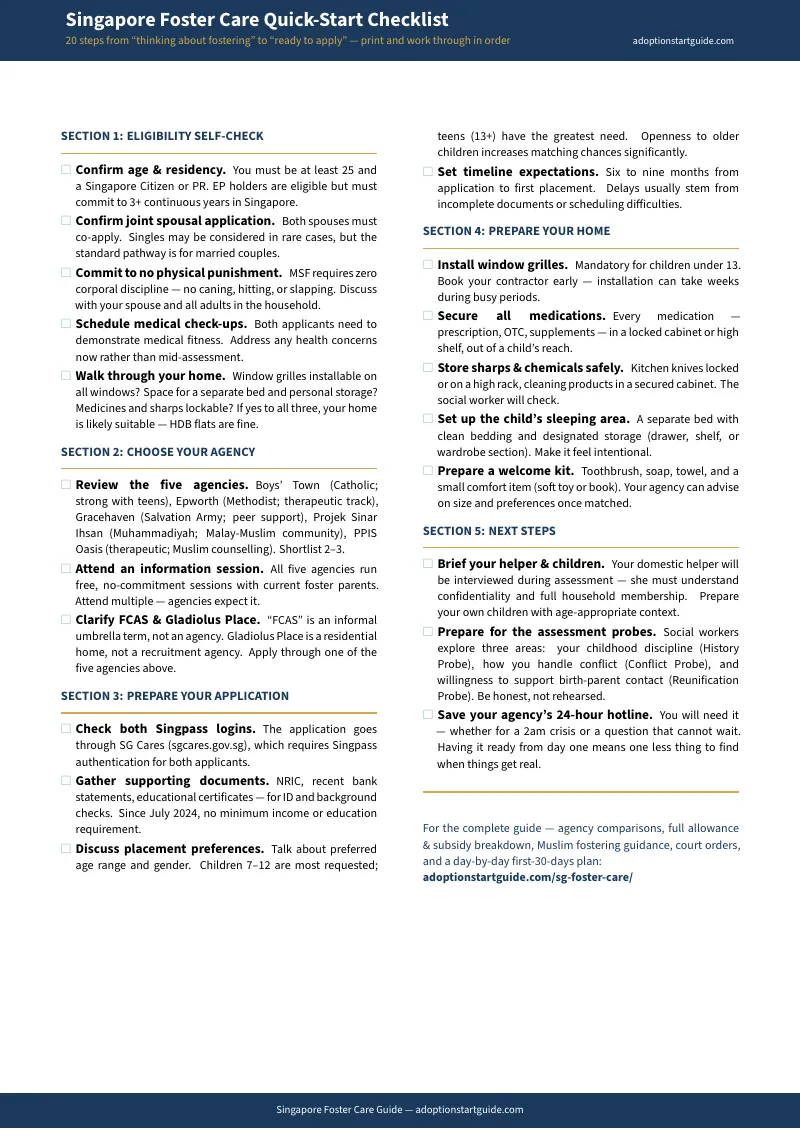
Download the Singapore Foster Care Quick-Start Checklist for a condensed overview of the eligibility criteria, application steps, and key milestones from enquiry to first placement. Free, no commitment. If you want the full Assessment-Ready System with interview preparation, agency comparisons, home safety audit, Muslim fostering guidance, financial planning tools, and printable worksheets, click the button in the sidebar.
— less than the cost of installing window grilles twice
One of the most common delays in the assessment process is failing the home safety inspection on the first visit and needing to schedule a re-inspection weeks later. A contractor visit to install window grilles in an HDB flat runs $200 to $500 depending on the number of windows. Getting it right the first time — grilles, locks, storage, electrical safety, everything — saves you money and, more importantly, months of waiting.
If the guide doesn't deliver, reply to your download email at any time for a full refund. No forms. No justification required.