
You've been thinking about adoption for a long time. You've researched the process, spoken to your partner, maybe attended an information evening. But every time you go to pick up the phone, you hesitate -- because the Prospective Adopter's Report will ask about your mental health history, your relationship breakdowns, and your motivations for adopting, and nobody has told you what the social worker is actually looking for.
England's adoption system is delivered through a patchwork of Regional Adoption Agencies, Voluntary Adoption Agencies like Barnardo's and Adoption UK, and some local authorities still running their own services. The government's First4Adoption website gives you a cheerful five-step overview. Adoption England runs information events. Mumsnet threads offer deeply personal accounts that range from inspiring to terrifying. None of them explain what happens during the two-stage assessment process in enough detail to actually prepare you -- or why the gap between your Registration of Interest and the adoption panel can stretch to eight months of scrutiny that nobody warned you about.
The information is scattered across the Adoption Agencies Regulations 2005, the Adoption Statutory Guidance 2013, the Adoption and Children Act 2002, First4Adoption fact sheets, RAA recruitment pages, and forum posts from adopters who learned the hard way. Piecing it together takes weeks of evenings. Getting the sequence wrong -- approaching an agency before understanding whether an RAA or VAA better fits your circumstances, or starting Stage 1 without knowing what the medical and DBS checks actually assess -- costs months of anxiety that could have been avoided.
Generic "UK adoption" guides describe a process that doesn't exist. Scotland has its own Adoption and Children (Scotland) Act and operates through a completely separate system. Wales has different regulations under Social Services and Well-being (Wales) Act provisions. Northern Ireland runs adoption through Health and Social Care Trusts. A guide written for "the UK" skips the England-specific two-stage framework, the RAA structure, and the Adoption Register that govern your actual journey.
The Approval Roadmap: Your Plain-Language Guide to Adoption in England
This guide is built for England's adoption system and nobody else's. Every chapter, every checklist, every reference is grounded in the Adoption and Children Act 2002, the Adoption Agencies Regulations 2005, the two-stage approval framework introduced in 2013, and the practical realities of navigating approval through a Regional Adoption Agency or Voluntary Adoption Agency. This is not a charity recruitment pack or an agency information booklet. It is the preparation layer that sits between what adoption services post online and what you actually need to know to get approved, matched, and ready for placement.
What's inside
- The Two-Stage Framework Explained -- Stage 1 (two months of statutory checks) and Stage 2 (four months of intensive assessment) are designed to run consecutively, but in practice they rarely hit the government's timeline targets. This chapter breaks down exactly what happens in each stage, what the social worker is assessing at each point, and how to prepare your evidence so neither stage feels like something being done to you.
- RAA vs VAA Decision Framework -- Regional Adoption Agencies merged local authority services to speed up the process and widen the pool of waiting children. Voluntary Adoption Agencies like Barnardo's, Adoption Matters, and Parents And Children Together offer an alternative route with different strengths. This chapter gives you the objective comparison: wait times, specialism areas, post-adoption support quality, training programmes, and the questions to ask at information events that reveal what the glossy website won't tell you.
- Prospective Adopter's Report Walkthrough -- The PAR is the document that goes to panel. Your social worker builds it from months of home visits, interviews, and written exercises. They will ask about your childhood, your relationship history, your fertility journey, how you handle loss, and how you understand the impact of early trauma on children. This chapter breaks down each section of the PAR, explains what assessors are actually looking for, and shows you how to organise your thoughts before the formal assessment begins -- so the conversations feel honest and productive rather than defensive.
- Adoption Panel Preparation -- A panel of professionals, independent members, and adoptive parent representatives reviews your PAR and asks you questions about contact with birth families, managing challenging behaviours, your understanding of why children need adoption, and your support network. This chapter covers the twenty most common panel questions, explains the recommendation process, and walks you through the Independent Review Mechanism if the panel's recommendation isn't what you expected.
- Matching and the National Adoption Register -- After approval, you enter the matching process. This chapter covers how Link Maker works, what the matching panel assesses, how to read a Child Permanence Report, what "fostering for adoption" (Early Permanence) means in practice, and the reality of matching timelines -- including why some approved adopters wait months while others are matched within weeks.
- Financial Support Mapping -- Adoption is free to the adopter, but the financial picture extends far beyond the approval process. Statutory adoption leave and pay, the Adoption Support Fund for therapeutic services, one-off settling-in grants, ongoing adoption allowances where applicable, and the Pupil Premium Plus for adopted children in school -- this chapter maps every financial support stream you are entitled to and explains how to access each one.
- Therapeutic Parenting Foundations -- Most children placed for adoption have experienced early trauma, neglect, or disrupted attachments. This chapter covers the attachment and trauma awareness that panels expect you to demonstrate, the parenting approaches that adoption support teams recommend, and how to prepare yourself and your existing children for the behavioural challenges that no information evening mentions in enough detail.
- Birth Family Contact and Letterbox -- Most adoptive families maintain indirect "letterbox" contact with birth parents, typically through annual letters. Some have direct contact arrangements. This chapter explains what the contact plan looks like in practice, how to navigate the emotions involved, what the letterbox exchange service handles, and when and how contact arrangements can be reviewed.
Printable standalone worksheets included
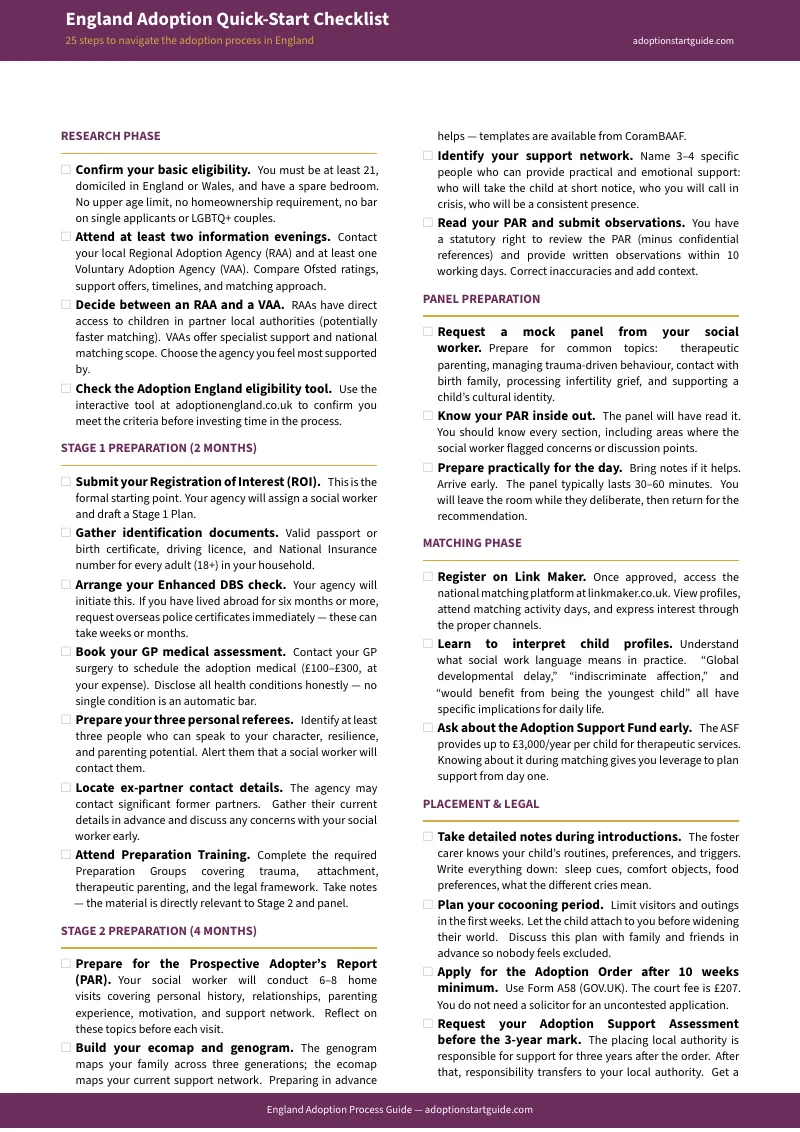
- Adoption Readiness Checklist -- Every action item from confirming your eligibility through researching agencies, preparing for the medical and DBS checks, and gathering the documents you need before Stage 1 begins. Print it, work through it at your own pace, and approach your first agency contact with clarity instead of anxiety. This is also the free lead magnet -- download it separately if you want to start here.
Who this guide is for
- Couples after fertility treatment -- You have been through IVF, IUI, or years of trying naturally, and you have arrived at adoption with grief and hope tangled together. You need to understand how the assessment addresses your fertility journey, what social workers are looking for when they ask about it, and how to talk about loss honestly without feeling like it will count against you.
- Single adopters -- You are single and wondering whether agencies take solo applicants seriously. They do -- single adopters are approved and matched across England. But the assessment will focus heavily on your support network, your childcare plans, and how you will manage the demands of a traumatised child without a partner to share the load. This guide covers what that assessment looks like in practice.
- LGBTQ+ couples -- Same-sex couples and LGBTQ+ individuals have been adopting in England since the Adoption and Children Act 2002. The legal framework is clear. But you may have questions about how agencies handle your application in practice, what the home study covers, and whether your experience will differ from heterosexual applicants. This guide addresses those questions directly.
- People worried about health, age, or DBS history -- A mental health diagnosis, a past conviction, a chronic health condition, being over 45. You assume one of these disqualifies you. In most cases, you are wrong. This guide explains what the medical assessment and Enhanced DBS check actually screen for, how the "proportionality" principle works, and where the real boundaries are.
- People choosing between RAA and VAA -- You have heard of Regional Adoption Agencies but you are not sure how they differ from Voluntary Adoption Agencies or whether your local authority still handles adoption independently. You want an objective comparison before you commit to a service that will assess your suitability to parent a child.
- People considering Early Permanence -- Fostering for adoption appeals to you because it means a child is placed with you earlier, but you are unsure about the legal uncertainty involved. This guide covers the Early Permanence pathway, the risks, the emotional reality, and how it interacts with the standard adoption approval process.
Why the free resources fall short
First4Adoption is the government's official information service. It provides a clear overview of the adoption process, eligibility criteria, and links to find your local RAA. But it is designed as a front door, not a preparation tool. It tells you that the assessment involves home visits and interviews. It does not tell you what the social worker writes down after those visits, what the PAR sections actually cover, or how to prepare for the questions about your childhood that feel more personal than anything you have discussed outside a therapist's office.
Adoption UK offers membership with access to forums, training, and support -- but their resources are weighted toward post-adoption life. If you are still in the research phase, trying to understand whether your antidepressant prescription or your partner's spent caution will be a problem, their materials assume you have already been through the system they don't explain.
Mumsnet and adoption forums provide the unfiltered emotional truth about the process. They are invaluable for understanding the human experience. But they are also full of outdated information, regional variations presented as universal rules, and worst-case stories that may not reflect how RAAs operate today. A thread from 2017 about a panel rejection does not account for the structural changes that Regional Adoption Agencies have introduced since then.
None of these resources give you a safe, private preparation space. Somewhere to understand the rules, organise your evidence, and work through the emotional preparation before you are sitting across from a social worker whose job is to assess every word. That is what this guide provides.
The free Quick-Start Checklist
Download the England Adoption Quick-Start Checklist for a step-by-step overview of the adoption process, from confirming your eligibility through the questions to ask at your first information event. Free, no commitment. If you want the full guide with the PAR walkthrough, panel preparation, RAA vs VAA comparison, matching guidance, financial support mapping, and therapeutic parenting foundations, click the button in the sidebar.
-- less than a single parenting book
The typical England adoption applicant spends months piecing together the process from scattered agency websites, First4Adoption pages, and forum threads that may or may not reflect current practice. This guide distils the most critical preparation into a weekend-ready roadmap. An application submitted to an agency that doesn't match your circumstances means starting the process again from scratch. A PAR assessment entered without understanding what the social worker is building toward turns an honest conversation into a guessing game. A panel appearance without knowing the standard questions turns what should be a formality into an ordeal. One guide prevents all of it.
If the guide doesn't deliver, reply to your download email at any time for a full refund. No forms. No justification required.