
You've been thinking about fostering for months. You have the spare room and the heart. But every time you go to click "Enquire," you hesitate -- because the Form F assessment will ask about your childhood, your ex-partners, and your finances, and nobody has told you what the right answers look like.
England has 152 local authorities and hundreds of Independent Fostering Agencies, each with their own fee structures, support packages, and Ofsted ratings. The Fostering Network website tells you fostering is rewarding. The IFA brochures promise 24/7 support and weekly fees of up to £450 per child. Your local authority's website gives you a phone number and a five-step overview. None of them explain what actually happens during the six months between your Registration of Interest and the fostering panel -- or why one in three enquirers drops out before they even submit an application.
The information is out there, scattered across the Fostering Services Regulations 2011, the National Minimum Standards, Fosterline fact sheets, agency recruitment pages, and forum threads from carers who learned the hard way. Piecing it together takes weeks. Getting it wrong costs months. Submitting your Registration of Interest to the wrong type of service -- an LA when an IFA would have matched your circumstances, or vice versa -- means starting the entire process again from scratch.
Generic UK fostering guides describe a process that doesn't exist. Scotland has its own legislation under the Looked After Children (Scotland) Regulations. Wales has Social Services and Well-being (Wales) Act requirements. Northern Ireland has the Health and Social Care Trusts. A guide written for "the UK" skips the England-specific regulations, allowance rates, and Ofsted framework that govern your actual journey.
The Form F Roadmap: Your Plain-Language Guide to Fostering Approval in England
This guide is built for England's regulatory system and nobody else's. Every chapter, every checklist, every reference is grounded in the Children Act 1989, the Fostering Services (England) Regulations 2011, the National Minimum Standards, and the practical realities of navigating approval through one of 152 local authorities or an Ofsted-registered IFA. This is not a charity recruitment pack. It is the operational layer that sits between what agencies post online and what you actually need to know to get approved and prepare for your first placement.
What's inside
- England's Legal Framework Decoded -- The Children Act 1989, the Adoption and Children Act 2002, the Children and Families Act 2014, the Staying Put duty, Special Guardianship Orders -- these aren't abstract policy documents. They determine whether a child in your care is under a Section 20 voluntary arrangement or a Section 31 care order, which directly affects your authority over school decisions, medical consent, and contact with birth families. This chapter explains what each law means for you in practice, not in legalese.
- LA vs IFA Decision Framework -- Local authorities place children directly but often pay lower fees and have stretched support teams. IFAs offer higher weekly fees (sometimes £450+ per child), dedicated supervising social workers, and 24/7 helplines -- but some carers worry about the ethics of "for-profit" care. This chapter gives you the objective comparison that neither side's brochure provides: fee structures, training quality, Ofsted ratings, support availability, and the questions to ask during your information evening that reveal what the glossy website won't tell you.
- Form F Assessment Walkthrough -- The Form F takes four to six months of home visits, interviews, and written evidence gathering. Your assessing social worker will ask about your childhood, your parenting philosophy, every significant romantic relationship, and how you handle conflict. They will contact your ex-partners for references. They will review your household finances. This chapter breaks down each section of the Form F, explains what the social worker is actually assessing, and shows you how to organise your thoughts and evidence before the formal process begins -- so the assessment feels like a conversation, not an interrogation.
- Fostering Panel Preparation -- The panel is the final stage before the Agency Decision Maker signs off on your approval. A group of professionals and independent members reviews your Form F and asks you questions about contact with birth families, managing challenging behaviours, allegations procedures, and your understanding of why children come into care. This chapter covers the typical questions, explains the recommendation process, and walks you through the Independent Review Mechanism if the outcome isn't what you expected.
- The Renter's Roadmap -- You do not need to own your home to foster in England. But you do need written landlord consent, a tenancy with enough security to demonstrate stability, and a spare bedroom that meets the National Minimum Standards. This chapter explains how fostering interacts with your tenancy agreement, why it does not create an HMO, and gives you the framework for the landlord conversation that removes the most common barrier for renters.
- DBS and Health Checks Demystified -- Every adult in your household needs an Enhanced DBS check. If something flags -- a spent conviction, a police caution from twenty years ago, a health condition on your GP report -- it is not an automatic disqualifier. This chapter explains what the Rehabilitation of Offenders Act exceptions mean for fostering, which health conditions require additional assessment, and how the "proportionality" principle works in practice.
- Financial Breakdown -- England's payment system splits into a child maintenance allowance (national minimum rates of approximately £168 to £268 per week depending on age) and a discretionary carer fee that varies enormously between services. Qualifying Care Relief through HMRC makes most fostering income effectively tax-free. Some local authorities offer set-up grants of up to £500. This chapter covers every payment stream, the tax relief calculation, what "Staying Put" means financially when a young person turns 18, and the costs that come out of your own pocket that nobody mentions in the recruitment adverts.
- Types of Fostering -- Short-term, long-term, emergency, respite, parent-and-child, kinship, and therapeutic fostering each carry different expectations, different payment structures, and different emotional demands. This chapter explains each type so you can identify where your family situation and capacity are the best fit before you choose a service.
Printable standalone worksheets included
- Approval Timeline Tracker -- Every milestone from initial enquiry through panel approval, with fill-in date fields and realistic processing times. Print it, update it after every social worker visit, and always know where you stand in the statutory timeline.
- Home Safety Checklist -- Room-by-room walkthrough of every requirement under the National Minimum Standards: smoke and CO alarms on every level, window restrictors on upper floors, locked medication storage, internet safety controls, fire escape plan, and the spare bedroom standards that go beyond "has a bed."
- Document Organisation Sheet -- DBS applications, GP medical form, identification for every adult, proof of address, financial summary, personal referee details, former partner contact information -- every document in the order you need it, with processing time estimates and notes on who initiates each one.
- Agency Comparison Worksheet -- Side-by-side comparison fields for up to four fostering services: Ofsted rating, weekly fee plus allowance, out-of-hours support, training programme, average time to first placement, and the questions to ask at each information evening.
Who this guide is for
- Couples whose children have grown -- Your house is quieter than it used to be. You have a spare bedroom, stable income, and the parenting experience that agencies value most. You have been to one information evening and now you have more questions than answers. You want the full picture before you commit to a process that will ask you to discuss your childhood with a stranger.
- Single professionals considering fostering -- You are single, employed, and wondering whether that counts against you. It does not. Single carers are approved and placed across England. But you need to understand how the assessment addresses your support network, childcare arrangements, and the practical question of being on call for a child while holding down a full-time job.
- Renters unsure about eligibility -- You have read contradictory information online. Some forums say you must own your home. Some agency websites mention it vaguely and move on. You want a clear answer about landlord consent, tenancy stability requirements, and the spare room standards -- so you know whether to start the conversation with your landlord or look for a different home first.
- People with a past they're worried about -- A spent conviction. A mental health diagnosis. A complicated family history. You assume it disqualifies you, or at least that it will make the assessment unbearable. In most cases, you are wrong. This guide explains what the DBS and health assessment actually screen for and how the system distinguishes between risk and lived experience.
- Kinship carers formalising an arrangement -- A grandchild, niece, or family friend's child is already in your care. You need to navigate the connected persons assessment to access the allowances, training, and support that formal foster carers receive. You are doing the hardest version of this work without any of the framework -- this guide gives you the roadmap.
Why the free resources fall short
The Fostering Network offers membership at £52 per year with legal protection and emotional support -- but their resources are built for approved carers already inside the system. If you are still trying to figure out whether your DBS history is a problem or what the Form F actually covers, their materials assume a baseline of knowledge you haven't built yet.
Skills to Foster is the mandatory pre-approval training course delivered during the assessment process. It covers attachment theory, safeguarding, and therapeutic care. But it happens after you have already submitted your application. The buyer of this guide needs information before they enter the system -- a safe space to understand the rules without being under the observation of a social worker who is assessing every word.
Agency information packs from IFAs like Capstone, Compass, and National Fostering Group are recruitment funnels. They emphasise the rewards and the weekly fee. They do not explain the impact on your birth children, the complexity of ex-partner references, the emotional weight of placement breakdowns, or the reality that your fostering allowance drops significantly when a young person turns 18 under Staying Put. They are brochures, not preparation.
The free Quick-Start Checklist
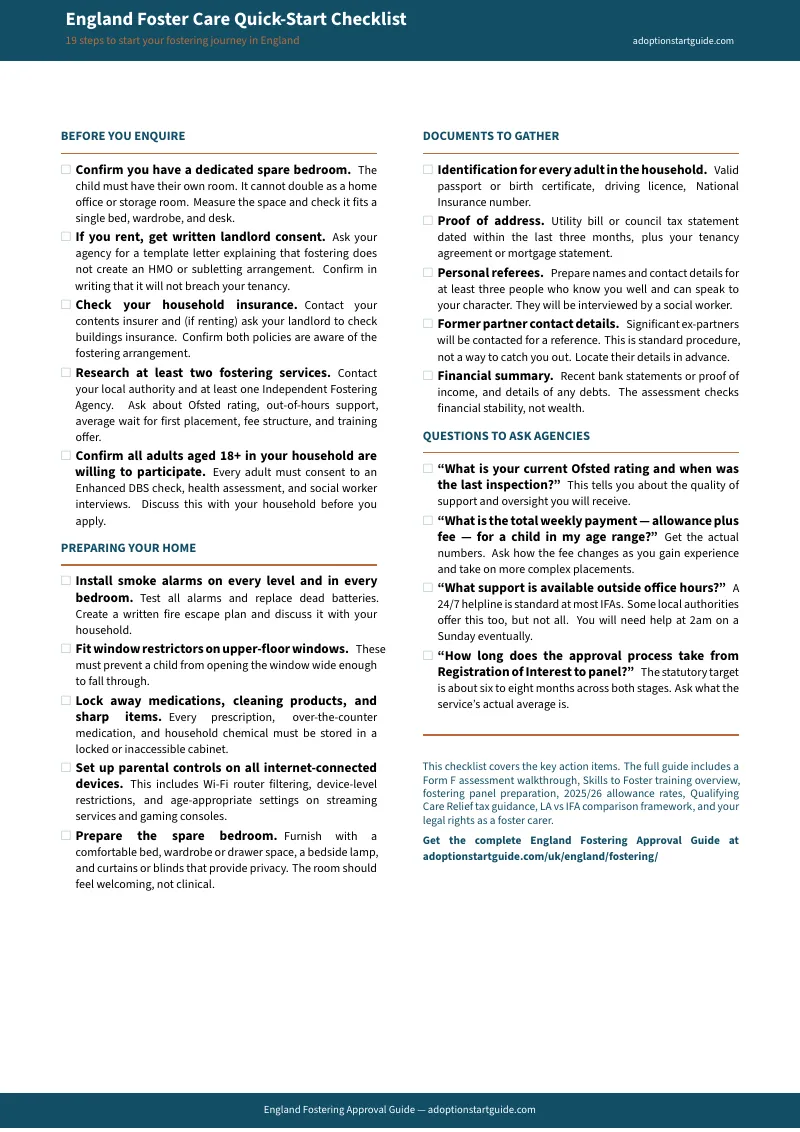
Download the England Foster Care Quick-Start Checklist for a step-by-step overview of the approval process, from spare room preparation through the questions to ask at your first information evening. Free, no commitment. If you want the full guide with the Form F walkthrough, panel preparation, LA vs IFA comparison framework, financial breakdown, and printable worksheets, click the button in the sidebar.
-- less than a single week's fostering allowance
The typical England applicant spends months piecing together the approval process from scattered agency websites, Fosterline fact sheets, and forum threads that may or may not reflect current regulations. This guide distils the most critical steps into a weekend-ready roadmap. A Registration of Interest submitted to the wrong type of service means starting over. A Form F assessment entered without understanding the ex-partner reference requirement catches you off guard at the worst possible moment. A panel appearance without knowing the standard questions turns a formality into an ordeal. One guide prevents all of it.
If the guide doesn't deliver, reply to your download email at any time for a full refund. No forms. No justification required.