
You visited adoptionandfostercare.hscni.net, phoned your local Trust's Gateway team, and came away with a folder of acronyms — RQIA, UNOCINI, AccessNI, Form F — and no explanation of how the pieces connect or what order to do them in.
Northern Ireland runs fostering through five separate Health and Social Care Trusts — Belfast, Northern, South Eastern, Southern, and Western — each with its own Gateway team, its own assessment timelines, and its own quirks in how it schedules the "Choosing to Foster" preparation course. The central HSC NI website presents a unified front, but the operational reality is that your experience depends on your postcode. A family in Bangor deals with the South Eastern Trust and its Grove Resource Hub. A family in Enniskillen deals with the Western Trust and its vast rural geography stretching to the Donegal border. Nobody maps these differences side by side, explains which Trust offers 24/7 out-of-hours support and which relies on the Regional Emergency Social Work Service, or tells you what to expect from your specific Gateway team before you pick up the phone.
Then there's the AccessNI check — the single most anxiety-inducing step in the entire process, and the one unique to this jurisdiction. This is not a DBS check. The Disclosure and Barring Service doesn't operate in Northern Ireland. AccessNI is administered by the Department of Justice NI, and the Enhanced Disclosure with Barred List Checks required for foster carers is the highest level of scrutiny available. Prospective carers with minor historical offences, filtered convictions, or simply a nervous uncertainty about what "non-conviction information" means spend months worrying about a form that, completed correctly with matching ID details, takes two to four weeks to process. But nobody walks you through the common ID rejection errors, explains the filtering rules that determine which old offences even appear on your certificate, or clarifies what "regulated activity" means for every adult in your household.
And underneath all of it runs a dimension that free resources never address directly: community identity. Northern Ireland's history means that the matching process considers religious and community background when placing children. Prospective carers in predominantly Catholic or Protestant areas worry about cross-community placements, about running into birth families at the school gates or the local shops, and about how the Trust handles the "religious persuasion" question that appears on Schedule 1 of the Foster Placement Regulations. The Children (NI) Order 1995 explicitly requires Trusts to have regard for racial and religious groups, but what that looks like in practice — in your town, with your Trust — is information you can't find on any government website.
The Five-Trust Approval System
This guide is built exclusively for Northern Ireland's HSC Trust system and the legislation that governs it. Every chapter, every checklist item, every legal reference is grounded in the Children (Northern Ireland) Order 1995, the Foster Placement (Children) Regulations (NI) 1996, the RQIA Minimum Standards for Fostering Services, and the real-world experience of navigating the five-Trust structure from first inquiry through to your first placement. Not a generic UK fostering overview. Not an England-focused guide that mentions Northern Ireland in a footnote. The operational layer between what the HSC NI website posts and what you actually need to know to reach fostering panel approval — under NI-specific legislation, through NI-specific administrative structures, with NI-specific cultural considerations.
What's inside
- Trust-by-Trust approval logistics — Which of the five HSC Trusts covers your area, who to contact first, what to expect from their Gateway team, and how each Trust structures the approval timeline. Belfast Trust handles high-density urban placements. The Western Trust covers the largest rural area with cross-border dynamics. The Northern Trust runs community-led recruitment under its "Team North" approach. Each one operates differently — this chapter maps the differences so you're not navigating blind.
- AccessNI Enhanced Disclosure decoded — The complete background check process written for foster carers, not employers. How to apply online through the NI Direct portal using your Trust-issued PIN, the £33 cost (usually covered by the Trust), the ID matching rules that cause the most common rejections, how the filtering system works for historical offences, what "non-conviction information" means in practice, and what every adult aged 18+ in your household needs to complete. The chapter that turns the most dreaded step in the process into a two-to-four-week administrative task.
- "Choosing to Foster" preparation course navigator — The mandatory six-session training course broken down session by session. What you'll cover on trauma and attachment, the legal framework, working with birth families, community identity, safeguarding, and panel preparation. What the trainers are observing about your participation. How to approach the group exercises without worrying about "right answers." The syllabus preview that prospective carers describe as the hardest piece of information to find before committing to the process.
- The Form F assessment guide — What your assessing social worker evaluates across 8 to 12 home visits during the Stage 2 assessment. How to prepare your autobiographical statement, what questions to expect about your childhood and relationships, what the panel will see in the Prospective Carers Report, and how to review the completed report before panel day. Preparation removes the fear that an intrusive process is designed to catch you out — it's designed to support you in.
- Financial support breakdown — Age-banded weekly maintenance allowances, skills-based fees for carers of children with additional needs, birthday and holiday allowances, clothing allowances, and how rates vary across Trusts. The tax relief available through the Qualifying Care Relief scheme. The full financial picture so you can plan your household budget before you apply — not after you're approved and wondering whether you can afford the additional child.
- Community identity guidance — How the matching process handles religious and community background in 2025. What cross-community placements look like in practice. Your rights regarding placement decisions. How to navigate birth family contact when the child comes from a different community. The section that addresses the elephant in every Northern Ireland living room with practical specificity rather than statutory generalities.
- Kinship and connected persons pathway — The accelerated route when a child you already know needs a placement. Temporary approval provisions, the assessment differences from stranger fostering, the Fostering Network's legal insurance for kinship carers, and the financial supports that make informal care arrangements sustainable. If a grandchild, niece, nephew, or family friend's child has been placed with you, this chapter maps the path to formal approval and funded support.
- Post-approval support and permanency pathways — Supervising social worker visits, annual reviews, the allegations procedure, NIFCA membership, the Fostering Network's Fosterline NI, out-of-hours emergency support, and the GEM leaving care scheme for young people aging out of the system. Plus the permanency options under the Adoption (Children) Act (NI) 2022: long-term fostering, adoption, Special Guardianship, and Fostering for Adoption.
Who this guide is for
- Anyone considering fostering in Northern Ireland who wants the full picture before their first call — You've been thinking about this for months or years. You've read the HSC NI website. You've browsed Mumsnet threads about assessments and come away more anxious than informed. This guide replaces months of fragmented research with one document that covers the entire process, end to end, in the language and legislation specific to this jurisdiction.
- Kinship carers already looking after a family member's child — A child has been placed with you through family arrangement or emergency social worker involvement. You need to formalise the arrangement, access Trust allowances and support services, and understand the assessment process that applies specifically to connected persons carers. The guide has a dedicated chapter for your situation.
- People worried about the AccessNI check or the assessment process — You have a minor historical offence, a health condition, a complex relationship history, or simply a fear of being "found out" as not good enough. This guide explains exactly how the Trust evaluates each of these factors — and why the things that worry you most are almost never automatic disqualifiers.
- Prospective carers confused by the five-Trust system — You live on the border between two Trust areas, or you've moved recently and aren't sure which Trust covers your new address. You've heard that some Trusts are better resourced than others and you want to know what your specific Trust offers before you apply. This guide maps all five.
- Foster carers from England, Scotland, or Wales who have moved to Northern Ireland — The legislation is different here. It's not the Children Act 1989. It's the Children (NI) Order 1995. The background check isn't a DBS — it's AccessNI. The training course isn't Skills to Foster — it's Choosing to Foster. If you're transferring your fostering experience to this jurisdiction, you need the NI-specific roadmap.
Why the free resources aren't enough
The HSC NI Adoption and Foster Care website provides the official entry point: an enquiry form, some carer testimonials, and a list of information evenings. It does not tell you the approval timeline for your specific Trust, what the Choosing to Foster sessions actually cover week by week, how to troubleshoot an AccessNI ID rejection, or what questions the fostering panel will ask.
The RQIA publishes inspection reports and minimum standards for fostering services. These are technical regulatory documents written for compliance officers, not prospective carers. They tell you what the Trust is supposed to provide. They don't tell you how to prepare for what the Trust will ask of you.
NIFCA and the Fostering Network provide advocacy, legal insurance, and peer support — essential resources once you're approved. But they're membership organisations designed to support existing carers, not to walk prospective carers through the approval process step by step.
Mumsnet and local Facebook groups offer emotional support and shared experience. They also offer outdated information, England-specific advice presented as if it applies across the UK, and anecdotal horror stories about "intrusive" assessments that reflect one person's experience and not the system's design. Crowdsourced guidance is well-intentioned and jurisdictionally unreliable.
National foster care books describe a generic UK process that glosses over the differences between England's local authority system, Scotland's Children's Hearings, and Northern Ireland's five-Trust HSC structure. A guide written for Birmingham won't help you in Belfast.
Standalone printable references included
In addition to the full guide, your download includes five standalone one-page reference cards designed to be printed and used at specific moments in the approval process:
- HSC Trust Comparison Card — All five Trusts side by side with coverage areas, key features, and Gateway contact points. Print before your first phone call.
- AccessNI Pre-Submission Checklist — ID matching rules, common rejection causes, and the complete application checklist. Keep beside you when filling out the online form.
- Choosing to Foster Session Navigator — What each of the six training sessions covers, and what the trainers are observing. Bring to every session.
- Form F Assessment Preparation Guide — The five assessment domains, autobiographical statement tips, and common panel questions. Review before each home visit.
- Financial Support Summary — Allowance rate tables, fee tiers, additional payments, and tax relief in one place. Use for household budget planning.
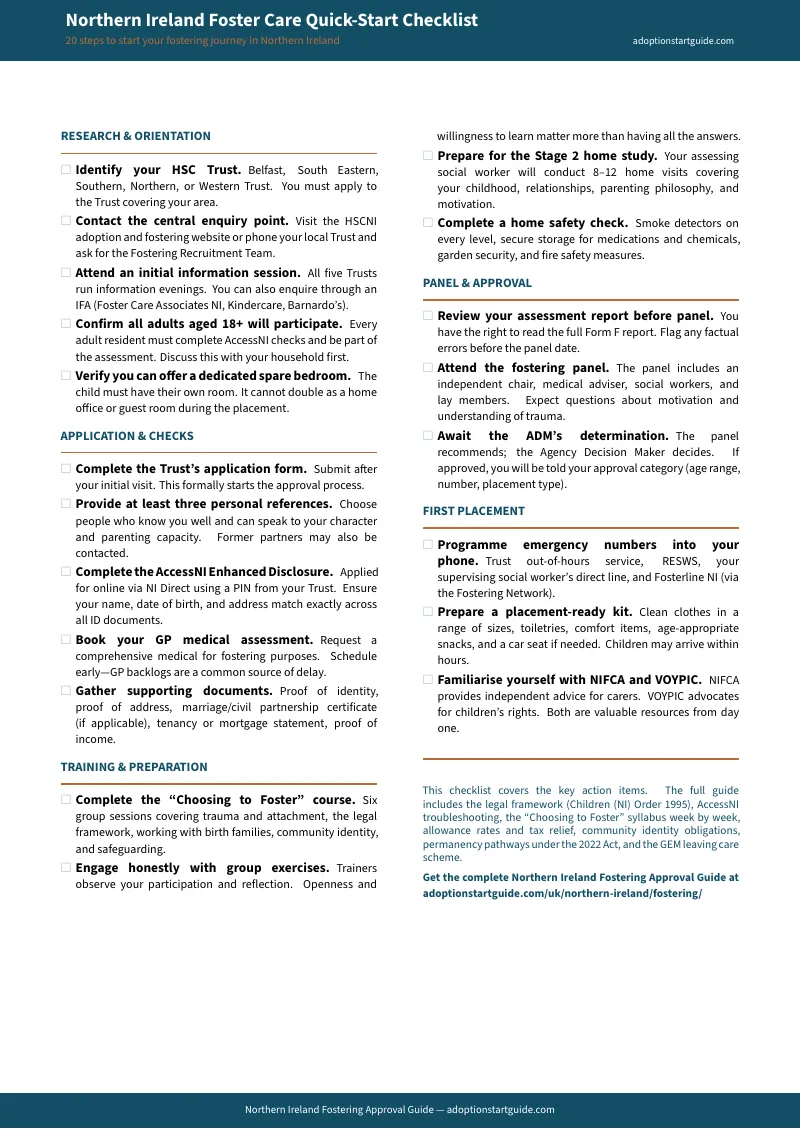
The free Quick-Start Checklist
Download the Northern Ireland Foster Care Quick-Start Checklist for a one-page action plan covering the key steps from first Trust contact through fostering panel approval. Free, no commitment. If you want the full guide with the Trust-by-Trust breakdown, AccessNI troubleshooting, Choosing to Foster syllabus, financial support tables, community identity guidance, kinship pathway, and post-approval support resources, click the button in the sidebar.
— Less Than One AccessNI Application Fee
The AccessNI Enhanced Disclosure costs £33. A GP medical assessment for fostering can run £100 or more if your practice charges a private fee. A single mistake on your AccessNI ID submission — a name that doesn't match exactly across documents — can delay your approval by months. This guide costs less than the administrative fees you'll encounter in the first week of the process, and it prevents the errors that turn a six-month timeline into a twelve-month ordeal.
If the guide doesn't deliver, reply to your download email at any time for a full refund. No forms. No justification required.