
You have the spare room and the willingness. What you don't have is a clear picture of what Scotland's fostering approval process actually looks like from the inside.
You've been thinking about fostering for a while. You've read your local council's website — more than once. You've scrolled through Facebook groups where carers in England describe assessment processes that don't match Scotland. You've searched "can I foster with a dog" and "fostering while working full-time" and got answers that might apply in Leeds or London but tell you nothing about how things work under the Children (Scotland) Act 1995.
You know Scotland is different. The Children's Hearing System. The PVG scheme instead of DBS. 32 local authorities with 32 different support packages. "The Promise" redesigning the entire care system. But nobody has explained what these differences mean in practice — not for a social worker, but for someone sitting at a kitchen table wondering whether they're the right kind of person to apply.
So you haven't clicked "Enquire Now." Not because you don't want to, but because the process feels like a black box and you're not sure what's on the other side of that button.
The Scottish Fostering Approval Roadmap
This guide exists because the information a prospective Scottish foster carer needs is scattered across 32 council websites, policy documents written for social workers, and UK-wide charity resources that gloss over everything that makes Scotland's system distinct. It takes all of that — the legislation, the assessment process, the Hearing system, the financial framework, the practical preparation — and translates it into a single roadmap written for the person who hasn't applied yet.
This is not a generic UK fostering guide with "Scotland" swapped in. It's built around Scottish legislation, Scottish institutions, and Scottish processes from the first page to the last.
What's inside
- The Complete Assessment Process — All 8 to 10 Home Visits Explained — What the social worker is actually evaluating at each stage. How the Form F report is structured. What "Skills to Foster" training covers and why the trainers are watching how you reflect, not whether you have all the answers. The specific questions Fostering Panel members ask and how to prepare for a 30- to 45-minute session that decides your future.
- The Children's Hearing System Decoder — Scotland doesn't use family courts to make decisions about children in care. It uses a welfare-based tribunal with trained volunteer panel members from the community. This chapter strips the jargon — Compulsory Supervision Orders, Relevant Persons, the Reporter, interim orders — and explains what actually happens in the room, what your role is, and how to speak so that your voice is heard alongside the legal professionals.
- PVG Scheme Explained (Scotland's DBS Equivalent) — The Protecting Vulnerable Groups scheme is not a one-off check. It's a membership scheme with continuous monitoring through Disclosure Scotland. This chapter explains how it works, what triggers a notification to your agency, how the 5-year membership cycle operates, and why it's fundamentally different from the DBS system your English friends describe.
- Local Authority vs. Independent Fostering Provider — The Real Comparison — Your local council prioritises in-house carers for matching. IFPs typically pay higher fees and offer more intensive 24/7 support. This chapter gives you an honest look at what each option means for your approval timeline, your fee levels, the types of placements you'll receive, and the quality of support you can expect — so you can make the decision that fits your circumstances.
- Scottish Recommended Allowance and Financial Reality — The SRA was supposed to end the "postcode lottery" of foster care payments. The reality is more complicated. This chapter breaks down the weekly minimum rates by age group (£170.67 for 0-4, £200.10 for 5-15, £258.40 for 16-18), explains the difference between the child's allowance and the carer's fee, covers tax relief and National Insurance treatment, and addresses the financial gap between placements that nobody talks about.
- Home Preparation and Safe Caring — Interlinked fire alarms (mandatory since February 2022). Carbon monoxide detectors for every room with a fuel-burning appliance. Gas Safety Certificate. Chimney sweep records. Secure medication storage. Garden hazards. The child's bedroom requirements. Your Safe Caring Plan and what it actually needs to contain. Everything your assessing social worker will check, organised as a walkthrough you can do before they arrive.
- Legal Orders and Permanence — Section 25 voluntary accommodation. Compulsory Supervision Orders. Permanence Orders under the 2007 Act. The difference between interim care and long-term fostering. What the Children (Care and Justice) (Scotland) Act 2024 means for 16 and 17-year-olds now coming through the care system. Each legal tool explained in terms of what it means for you as a carer — your rights, your responsibilities, and the decisions you can and cannot make.
- GIRFEC, SHANARRI, and Your Reporting Framework — Getting It Right For Every Child is not optional — it's the national approach that frames every professional conversation about a child in Scotland. This chapter explains the eight Wellbeing Indicators (Safe, Healthy, Achieving, Nurtured, Active, Respected, Responsible, Included) and shows you how to use them in your daily logs, review reports, and Hearing submissions.
- "The Promise" and Where Scotland's Care System Is Heading — The Independent Care Review heard from 5,500 care-experienced people and committed Scotland to transforming its care system. This chapter explains what "The Promise" means in practice: the language changes, the Hearing System redesign, the shift toward relationship-based care, and why the system is actively looking for carers who can provide the kind of warm, stable family environment that institutional processes have historically failed to deliver.
8 standalone printable tools
Every purchase includes standalone worksheets and reference cards you can print and use at each stage of the process — no need to flip through the full guide when you're sitting in an agency meeting or preparing for a Hearing:
- Children's Hearing Decoder — a one-page reference card to bring to Hearings
- PVG Scheme Reference — PVG vs DBS comparison and continuous monitoring explained
- LA vs IFP Comparison Worksheet — fillable side-by-side agency evaluation with interview questions
- Financial Worksheet — SRA rates, monthly budget planner, and tax relief reference
- Home Preparation Checklist — room-by-room safety walkthrough for before the social worker visits
- Legal Orders Reference — all six Scottish legal orders on one page
- SHANARRI Reporting Guide — fillable wellbeing indicators template for daily logs and reviews
- Agency Questions Sheet — 10 questions to ask any agency, with space to record answers
Who this guide is for
- You've been thinking about fostering for months or years — You have the spare room. You have the stability. But you haven't picked up the phone because you don't know what happens after you do. This guide walks you through every stage from initial enquiry to first placement so there are no surprises.
- You've visited your council's website but it didn't answer your real questions — Council fostering pages are designed to recruit, not to prepare. They tell you they need carers. They don't tell you what the 8 to 10 assessment visits involve, what the Fostering Panel will ask you, or how the Children's Hearing System works from a carer's perspective.
- You've read UK-wide fostering resources and found they don't match Scotland — If you've been reading about DBS checks, Ofsted, and family court — those apply in England. Scotland has PVG, the Care Inspectorate, and the Children's Hearing System. This guide covers your system, not theirs.
- You're deciding between your local authority and an IFP — This is one of the biggest decisions you'll make before you even apply, and the information available is heavily biased depending on who published it. This guide lays out the trade-offs so you can choose based on facts.
Why free resources fall short
The Scottish Government's mygov.scot page tells you the basic steps to apply. It doesn't tell you what the social worker is evaluating during those 8 to 10 home visits, or how to prepare your life history so you feel in control of the narrative rather than being interrogated. The Fostering Network publishes excellent resources for existing carers — but their "Thinking About Fostering" guides cover the whole UK and don't explain the Scottish specifics that trip up new applicants.
Local authority websites focus on the need for carers — the altruistic hook. They don't address the logistical and emotional hurdles that stop willing people from applying: the fear of being judged, the confusion about the Hearing system, the anxiety about PVG continuous monitoring, the strategic question of whether to go with your council or an IFP.
CoramBAAF publishes a "Thinking About Fostering" guide for £8.95. It covers the UK generically. It does not contain a Children's Hearing System decoder, PVG scheme walkthrough, Scottish Recommended Allowance breakdown, or Care Inspectorate grading guide — because those are Scotland-specific, and no other guide focuses exclusively on Scotland.
And then there are Facebook groups and Reddit. Rich in raw experience, but heavy on venting and light on accuracy. A new applicant reading those forums often ends up more anxious than when they started.
The free Quick-Start Checklist
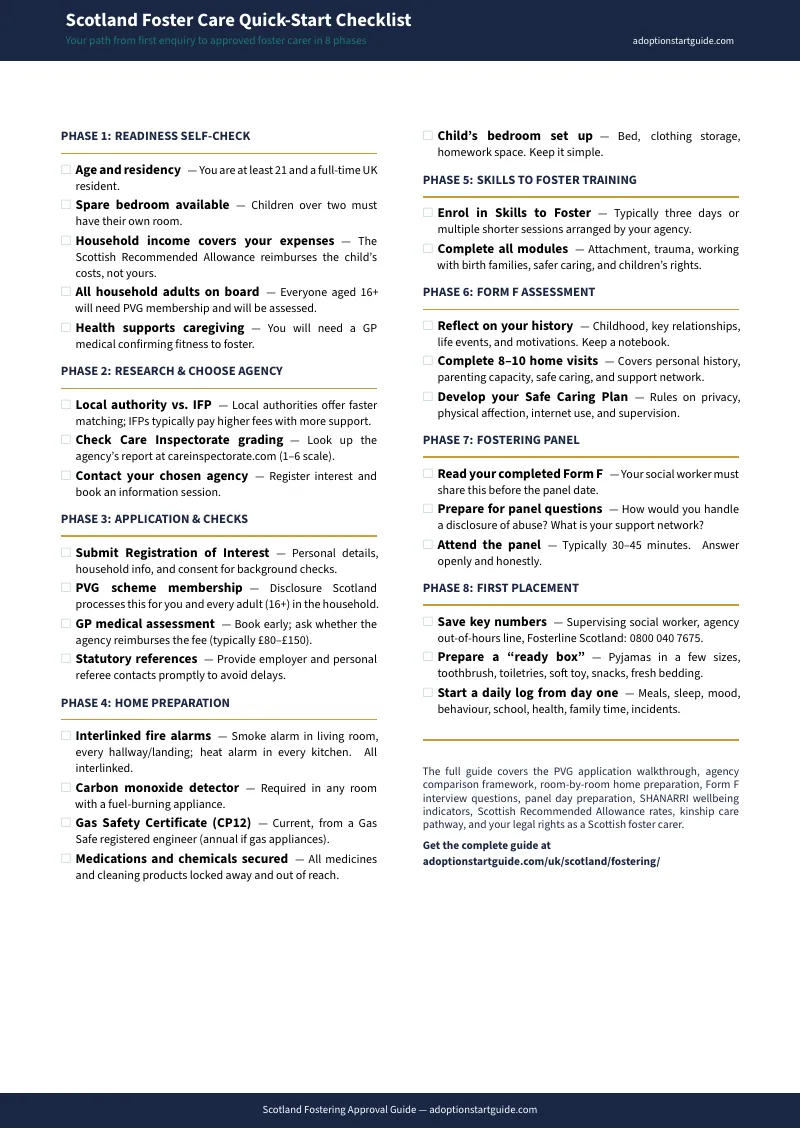
Download the Scotland Foster Care Quick-Start Checklist for a step-by-step overview of the approval process — from readiness self-check through first placement preparation. Free, no commitment. If you want the full guide with the assessment walkthrough, Children's Hearing System decoder, PVG scheme explanation, LA vs. IFP comparison, financial breakdown, home preparation guide, and legal orders reference, click the button in the sidebar.
— less than the GP medical fee your agency may not reimburse
The GP medical assessment for your fostering application costs £80 to £150. Some agencies cover it; many don't. A single guide that explains the entire Scottish fostering approval process — the assessment, the Panel, the Hearing system, the PVG scheme, the financials, the legal framework — costs less than that one appointment. One read-through moves you from "thinking about it" to "knowing exactly what to expect."
If the guide doesn't deliver, reply to your download email at any time for a full refund. No forms. No justification required.