
You want to foster in Wales. But every guide you find is written for England.
You've been thinking about this for months -- maybe years. You've scrolled through the Foster Wales website, watched a "Skills to Foster" video, maybe even followed a couple of IFA Facebook pages. But every time you try to get concrete answers, you hit the same wall: the information is either written for the English system (wrong legislation, wrong regulator, wrong standards) or it's a polished local authority recruitment brochure designed to inspire rather than prepare.
The Welsh fostering system is not the English system. Wales has its own legislation -- the Social Services and Well-being (Wales) Act 2014, not the Children Act 1989. Its own regulator -- Care Inspectorate Wales, not Ofsted. Its own training framework, its own financial structures, and, since March 2022, its own physical punishment law that applies to every household in Wales, including yours. If you're preparing for fostering using English resources, you're studying for the wrong exam.
Meanwhile, the questions that actually keep you up at night go unanswered. Will something from your twenties show up on the DBS and disqualify you? Will the social worker judge your three-bedroom semi in the Valleys as inadequate? Can you foster if you rent? What does the Form F assessment actually involve -- and how do you talk about past relationships and mental health without being caught off guard? What's the real difference between fostering through your local authority and going with an IFA? And how do the fostering payments actually work -- are they enough, and will your neighbours think you're "doing it for the money"?
The information to answer every one of those questions exists. It's scattered across the SSWBA 2014, CIW inspection standards, the Fostering Services (Wales) Regulations 2019, Foster Wales recruitment pages, the AWIF workbooks, HMRC guidance on Qualifying Care Relief, Reddit threads that mix up English and Welsh rules, and Mumsnet posts from 2018 that predate the punishment law entirely. Piece it together yourself and you'll spend weeks reading documents that each explain their corner of the system without ever mapping the full process in the order a Welsh applicant actually completes it.
The Welsh Fostering Roadmap
This is a complete guide to becoming an approved foster carer in Wales, built around the one problem every prospective carer in this country hits: navigating a system where the legislation, the regulator, the training framework, and the financial structure are all distinct from England's, but almost nobody explains those distinctions in practical terms. Not a government website designed to recruit rather than prepare. Every chapter, every checklist item, every financial figure is grounded in current Welsh law, CIW standards, and the real experience of carers who have been through the Welsh approval process.
What's inside
- The Welsh legislative framework explained -- The SSWBA 2014 replaced the Children Act 1989 in Wales and shifted the entire system from risk-focused to outcomes-focused. This chapter explains what that means for your daily recording, your conversations with social workers, and your role as a professional partner in the child's well-being -- not just a host providing a spare bedroom.
- The two-stage approval process decoded -- Stage 1 (initial enquiry, information evening, DBS checks, medical, references) and Stage 2 (the Form F assessment: in-depth interviews, home visits, parenting capacity evaluation) mapped step by step with realistic timelines. You'll know exactly what happens at each stage, what documents to have ready, and where the common delays occur -- so you can prevent the ones that are within your control.
- Foster Wales vs. IFA comparison -- Local authority carers under the Foster Wales banner get first priority for local placements and the National Commitment package. IFAs may offer more intensive therapeutic support and smaller caseloads. This chapter maps the trade-offs honestly -- placement priority, child profiles, fees, training, the Welsh Government's "eliminate profit" agenda -- so you can choose the route that fits your situation rather than the one with the better marketing.
- The 2022 punishment law explained for your household -- The Children (Abolition of Defence of Reasonable Punishment) (Wales) Act 2020 made Wales the first UK nation to ban all physical punishment of children. This applies to every child in your home -- fostered and biological. The chapter explains what the law covers, what it doesn't (rough-and-tumble play, physical restraint for safety), and the "Parenting: Give it Time" framework. Written for carers who need legal clarity, not a government leaflet.
- Financial support and tax relief -- The 2025/26 National Minimum Allowance rates by age group, local authority fee structures, the National Commitment financial package, Qualifying Care Relief (no tax on the first £19,360 + weekly per-child exemptions), and National Insurance treatment. This chapter covers what you'll actually receive, how the tax system works, and why the "doing it for the money" stigma has no basis in the financial reality of fostering in Wales.
- The Welsh language and the Active Offer -- If a child's first language is Welsh, every effort must be made to place them with a Welsh-speaking family. This chapter covers your rights and responsibilities under the Active Offer, the availability of Sgiliau Maethu (Skills to Foster) training in Welsh, and how non-Welsh speakers can support a child's language development as part of their well-being outcomes.
- Placement types guide -- Emergency, short-term, long-term, respite, parent-and-child, therapeutic, sibling groups, unaccompanied asylum-seeking children, and the When I Am Ready scheme (supporting care leavers 18-21). Each type explained with what it involves, who it suits, and the level of experience typically expected.
- Permanency pathways -- Foster to Adopt (Section 81 SSWBA), Special Guardianship Orders, and Connected Persons (kinship) fostering. The legal framework for each route, how they interact with long-term fostering, and when each option is appropriate.
- The AWIF induction preview -- The All Wales Induction Framework covers the first six months after approval: principles and values, health and well-being, professional practice, safeguarding, and health and safety. This chapter gives you a head start on all five modules so approval day feels like the beginning of a career you understand, not a cliff edge into the unknown.
- Safeguarding and mandatory reporting -- Wales introduced mandatory reporting of child abuse and neglect in 2024. This chapter covers your legal duty, the Wales Safeguarding Procedures, how to identify and report concerns, and what happens when an allegation is made against a carer -- the process, your rights, and the professional concerns protocol.
Who this guide is for
- Welsh residents who've been thinking about fostering but haven't made the call -- You've scrolled through Foster Wales, watched the videos, maybe attended an information evening. But the gap between "interested" and "applying" feels enormous because you don't know what the assessment actually involves. This guide closes that gap with the procedural detail the recruitment brochures leave out.
- People worried their past will disqualify them -- A minor incident decades ago, a period of poor mental health, a complicated family history. The Welsh system is strengths-based under the SSWBA 2014 -- it's looking for evidence of resilience and self-awareness, not a spotless record. The guide explains what the DBS check actually covers, what the medical assessment involves, and how to frame your life experience honestly during the Form F.
- Renters, single applicants, and same-sex couples -- You can foster if you rent (with landlord consent). You can foster as a single person. Same-sex couples are explicitly welcome. The guide covers the eligibility criteria directly, not as a footnote on the "traditional family" page.
- Families deciding between Foster Wales and an IFA -- The local authority route and the independent agency route offer genuinely different experiences. The guide compares them on placement priority, financial packages, training, support intensity, and the political context of the Welsh Government's direction -- so you choose based on facts, not sales pitches.
- Experienced carers transferring between agencies -- Transferring from an IFA to a local authority (or vice versa) in Wales involves a new assessment and a different regulatory context. The guide covers the transfer process and what changes.
- Welsh speakers wanting to foster through the medium of Welsh -- The Active Offer means you should never have to ask for Welsh-language services. The guide identifies what's available in Welsh and how your language skills affect matching.
Why the free resources aren't enough
The Foster Wales website is the best single source of fostering information in Wales. It covers the process clearly, the National Commitment is well-explained, and the local authority pages give you contact details and event schedules. It also reads like a recruitment campaign -- because that's its job. It tells you fostering is rewarding and that you'll be supported. It doesn't tell you what the Form F assessment actually asks about your childhood, your relationships, and your approach to discipline. It doesn't explain the financial structure in enough detail to answer the question your partner is quietly asking: can we afford this?
IFA websites compete for your application. They market their support packages, their training programmes, and their carer testimonials. They don't explain the placement priority system that means local authority carers are offered children first, or the Welsh Government's legislative drive to reduce for-profit involvement in children's care. They're selling, and what they're selling is often genuinely good -- but you need the full picture before you decide.
Reddit and Mumsnet give you emotional solidarity and honest stories from real carers. They also mix up the English and Welsh systems constantly. Advice about Ofsted inspections doesn't apply to you. Payment rates from English councils don't match Welsh NMA figures. References to the Children Act 1989 miss the SSWBA 2014 framework that actually governs your role. In a system where the legislation, the regulator, the training, and the financial structure are all Wales-specific, advice from the wrong jurisdiction doesn't just miss the mark -- it actively misleads.
Printable quick-start checklist included
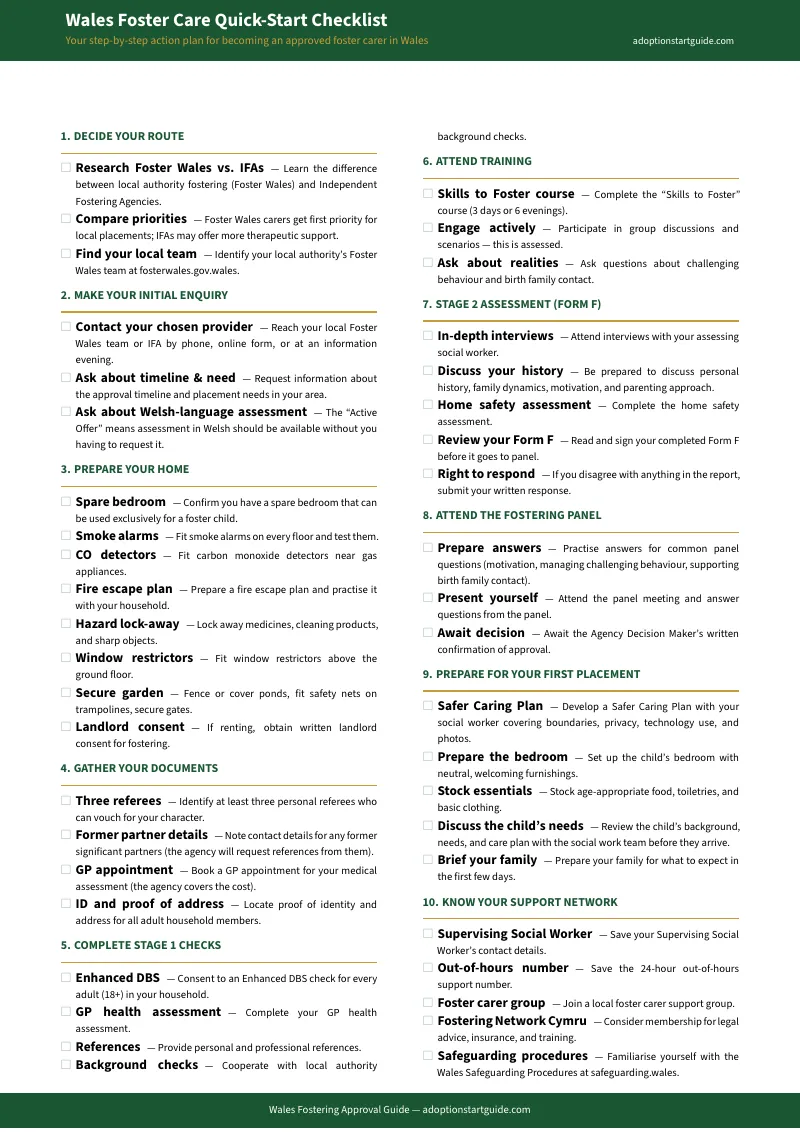
The guide comes with the Wales Foster Care Quick-Start Checklist -- a printable, step-by-step action plan covering every stage from initial enquiry to your first placement. Deciding your route, preparing your home, gathering documents, Stage 1 checks, Skills to Foster training, the Form F assessment, the fostering panel, placement preparation, and your support network -- all in the order the Welsh system expects you to complete them. Pin it to the fridge and tick items off as you go.
Five standalone printable tools
The guide also includes five standalone PDFs designed to be printed and used during your fostering journey:
- Foster Wales vs. IFA Comparison -- A one-page side-by-side comparison of the two routes, covering placement priority, fees, training, support, and the Welsh Government's policy direction. Print it, review it with your partner, and make the decision before your first call.
- Form F Preparation Guide -- What the Stage 2 assessment covers, what assessors look for in each section, and how to prepare. Review it before every assessment interview.
- Financial Planning Worksheet -- The NMA 2025/26 rates, Qualifying Care Relief tax relief calculations, and a fillable household budget planner so you and your partner can see the full financial picture on paper.
- Home Safety Checklist -- A room-by-room safety assessment with checkboxes for your spare bedroom, safety essentials, and safer caring plan items. Complete it before your social worker's home visit.
- Key Contacts and Resources -- A fillable contact sheet for your care team plus every key Welsh resource and website. Post it near your phone.
The free Quick-Start Checklist
Download the Wales Foster Care Quick-Start Checklist for a one-page overview of the key steps from initial enquiry to first placement. Free, no commitment. If you want the full guide with the legislative framework, the two-stage approval process, the Foster Wales vs. IFA comparison, the financial breakdown, and the AWIF induction preview, click the button in the sidebar.
-- less than what you'll spend on one placement-day's groceries
A fostering assessment takes four to six months. The decisions you make before it starts -- which route to choose, how to prepare your home, what documents to gather early, how to approach the Form F honestly and confidently -- shape the entire experience. The Welsh Fostering Roadmap doesn't replace your social worker. It makes sure you arrive at your first meeting already understanding the system, the legislation, and the process -- so every conversation moves you forward instead of catching you up.