
California has three adoption pathways, 58 county courts, and the highest private adoption costs in the continental United States. The state websites describe one process. The reality requires a different guide for each path you choose.
You started looking into adoption in California. Maybe you and your partner spent years on fertility treatments in the Bay Area and you're now researching private infant adoption through agencies like Adoptions Together or Families First, staring at orientation packets that quote $40,000 to $85,000 and wondering what exactly that buys you. Maybe you're a foster parent in LA County who just learned that DCFS changed your foster child's permanency goal to adoption and you suddenly need to understand the WIC Section 366.26 hearing, the JV-321 request form, and what "prospective adoptive parent" designation actually means after six months of bonding. Maybe you're a grandparent in Bakersfield who's been raising a grandchild since a crisis placement and you need legal permanency before the next school year. Maybe you're a same-sex couple who heard California is the most progressive state for LGBTQ+ adoption and discovered that progressive policy doesn't mean simple paperwork. Whatever brought you here, you went to the CDSS website and your county DCFS office looking for answers.
What you found was a system that scatters critical information across three separate legal frameworks. The California Department of Social Services describes agency adoption under Family Code Sections 8700-8720 but doesn't explain how that differs from independent adoption under Section 8800 or dependency adoption under Welfare and Institutions Code Section 366.26. The Judicial Council publishes forms — ADOPT-200, ADOPT-210, JV-321, AD 924 — but provides no guidance on which forms apply to your pathway, when each must be filed, or what happens if you file the wrong one. You read that birth parent consent becomes irrevocable after 30 days in independent adoption but that relinquishment in agency adoption becomes final after just 10 business days — and nobody explains why that distinction matters or how it changes your risk exposure. You discovered the $4,500 investigation fee for independent adoption but can't find a clear answer on whether the fee is waivable, what it covers, or why the agency pathway bundles it differently.
You probably also ran into the California-specific complications that trip up families here and nobody else. The AB 3176 ICWA compliance requirements that are stricter than federal law and can void a completed adoption years after finalization if tribal notice wasn't properly given. The AB 120 facilitator ban that took effect January 2024, reshaping the entire independent adoption landscape by prohibiting unlicensed intermediaries. The pool barrier requirement — a 5-foot fence with self-closing, self-latching gates around every pool and spa — that is the number one home study delay in Southern California. The requirement that an Adoption Service Provider must conduct the investigation in independent adoption cases, a role many families confuse with their attorney's. And the reality that the consent versus relinquishment distinction — two words that sound interchangeable but trigger completely different legal timelines, revocation windows, and court procedures — trips up even experienced family law attorneys who don't specialize in adoption.
National adoption guides on Amazon describe a generic process. California adoption attorneys charge $432 per hour in San Francisco, $398 in Los Angeles, $341 in San Diego, and $254 in the Central Valley. Your county DCFS office tells you about waiting children but not how to navigate the legal finalization. You're in the gap between wanting to adopt and understanding how California's system actually works — and nobody is meeting you there.
The Triple-Pathway Compliance System
This guide is built for California adoption and nobody else's. Every chapter, every checklist, every form reference is grounded in the current California Family Code, Welfare and Institutions Code, the 58-county Superior Court system, the CDSS regulatory framework, and the 2024-2026 legislative changes that most resources haven't caught up to. It covers the gap between what the state posts online and what you actually need to know to move from "considering adoption" to "decree entered" without rejected petitions, missed consent windows, or months of confusion about which pathway applies to your situation.
What's inside
- Triple-Pathway Decision Framework — California handles adoption through three distinct legal mechanisms: agency relinquishment (Family Code Sections 8700-8720), independent consent (Section 8800), and dependency adoption (WIC Section 366.26). Each has different forms, different timelines, different costs, and different revocation windows. This guide walks you through all three pathways from initial decision through Superior Court finalization, explains the legal and financial trade-offs, and helps you identify which path fits your situation — whether you're a foster parent whose child's permanency goal just changed, a couple pursuing private infant adoption, a relative formalizing kinship care, or a stepparent seeking legal parentage. You'll understand the relinquishment-versus-consent distinction before you sign anything.
- AB 3176 ICWA Compliance Navigator — California's implementation of the Indian Child Welfare Act is stricter than federal law. AB 3176 imposes an "affirmative and continuing duty" to inquire about a child's tribal membership from initial contact through finalization. The 11 specific "active efforts" requirements, the tribal transfer petition rights, and the placement preference hierarchy aren't optional — failure to comply can void your adoption years later. This chapter provides the inquiry protocols, tribal contacts for California's 109 federally recognized tribes, and the procedural safeguards that protect your finalization from collateral attack.
- Home Study Preparation by Region — California's home study requirements vary by pathway and by region. The Resource Family Approval (RFA) process for foster-to-adopt families differs from the CDSS investigation for independent adoption, which differs from the agency-conducted assessment for private placement. This chapter covers what social workers and investigators actually evaluate — including the pool barrier requirement (5-foot fence, self-closing gate, no climbable objects within 36 inches), firearm storage, medication security, bedroom standards, and the background check process for every adult in the household. Includes specific guidance for multi-unit housing common in LA and the Bay Area, rural properties in the Central Valley, and military families stationed in San Diego.
- 2024-2026 Legislative Updates — AB 120 banned unlicensed adoption facilitators effective January 2024 — if you're pursuing independent adoption, your entire search and matching process has changed. SB 381 gives adult adoptees unrestricted access to original birth certificates starting 2026. SB 1186 mandates the State Registrar issue new birth certificates within 11 weeks of receiving the adoption report, ending the near-year-long delays that left families unable to enroll children in school or obtain travel documents. This chapter explains what each law means for your adoption timeline and what steps to take now.
- The Consent and Relinquishment Timing Guide — In agency adoption, relinquishment becomes final 10 business days after filing with CDSS. In independent adoption, consent becomes irrevocable after 30 calendar days. In dependency adoption, parental rights are terminated by court order with appellate rights but no revocation window. These aren't abstract legal distinctions — they determine your emotional risk exposure, your financial commitment timeline, and the point at which your adoption becomes legally secure. This chapter maps each timeline with the specific forms (AD 884 for relinquishment, AD 924 for consent) and the exact calendar math.
- Financial Reality by Pathway — Private agency adoption in California runs $40,000 to $85,000. Independent adoption runs $15,000 to $45,000 but carries the $4,500 CDSS investigation fee. Dependency adoption through the county can cost under $2,500 with monthly Adoption Assistance Program payments that continue until the child turns 18 or 21. This chapter maps the full financial landscape for each pathway, including allowable birth mother expenses (pregnancy-related only, documented with written receipts), the federal adoption tax credit ($17,670 for 2026), employer adoption benefits, the non-recurring adoption expense reimbursement, Medi-Cal portability for adopted children, and the critical rule that your AAP agreement must be signed before finalization or you permanently lose eligibility for benefits.
- 58-County Superior Court Navigation — Your adoption petition is filed in the Superior Court of the county where you live. But each of California's 58 counties has its own clerk's office, local rules, filing conventions, and scheduling practices. LA County operates differently from San Francisco, which operates differently from Kern County, which operates differently from rural Alpine County. This chapter provides guidance on the ADOPT-200 petition, the investigation or report requirements by pathway, the hearing process, and the local conventions that determine whether your petition moves forward or sits in a queue.
Printable standalone worksheets included
- Adoption Process Checklist — Phase-by-phase overview of the entire adoption process organized by pathway (agency, independent, dependency), from initial decision through Superior Court finalization and post-adoption requirements. Print it and check items off as you go.
- Required Documents Checklist — Every form and supporting document organized by pathway and by phase: before agency contact, with your application, for the home study or investigation, for the court petition (ADOPT-200, ADOPT-210, AD 924), and for post-finalization (birth certificate, Social Security, Medi-Cal).
- Home Study Preparation Worksheet — The questions social workers and investigators will ask, organized by category: personal history, relationship dynamics, parenting philosophy, financial stability, support network, and home environment. Space to draft your responses before the interviews begin.
- ICWA Inquiry and Compliance Tracker — Document every ICWA inquiry step: initial questions asked, tribal notifications sent, responses received, active efforts documented. This tracker creates the paper trail that protects your finalization from collateral challenge years later.
- Consent/Relinquishment Timeline Calculator — Enter your pathway and key dates — the calculator maps your revocation window, filing deadlines, and the date your adoption becomes legally secure. Removes the calendar math anxiety that keeps families checking dates at 2 AM.
- AAP Negotiation Worksheet — If you're adopting through the dependency pathway, the Adoption Assistance Program payment is negotiable — but only before finalization. This worksheet walks you through the rate structure, special needs classifications, and the specific language to use in your agreement to protect benefits for the full duration.
- Key Contact Information Sheet — County DCFS office, assigned social worker, Superior Court clerk, adoption attorney, agency contact, Adoption Service Provider, pediatrician, school district, tribal ICWA coordinator (if applicable), and support group — all on one printable page.
Who this guide is for
- Foster-to-adopt families — You've been fostering a child through your county DCFS and the permanency goal has changed from reunification to adoption. You're somewhere between the WIC Section 366.26 hearing and the Superior Court adoption petition, and nobody has explained how those proceedings connect. The LA County "plunge" — a 46% decline in foster placements over five years — means fewer children entering the system but more complex cases for those who remain. You may have completed Resource Family Approval, but the legal finalization is a different process, and the AAP agreement you need to sign before the decree is entered determines your child's financial support for the next decade.
- Private infant adoption seekers — You've been quoted $40,000 to $85,000 by private agencies, or you're considering independent adoption at $15,000 to $45,000 and trying to understand what the AB 120 facilitator ban means for your matching options. You need to understand the consent-versus-relinquishment distinction, the allowable birth mother expenses rules, the $4,500 investigation fee, and the 30-day revocation window before you commit financially. Bay Area couples paying $432-per-hour attorneys shouldn't be spending their first billable hour learning "Process 101."
- LGBTQ+ couples — California's legal framework is among the most protective in the country for LGBTQ+ adoptive families, but protective law doesn't mean simple paperwork. Second-parent adoption, confirmatory adoption, and the specific protections (and limitations) of California's parentage statutes matter — especially if you travel to or might relocate to a state with less progressive recognition. You need a guide that explains what California law does and doesn't protect.
- Kinship caregivers and stepparents — A grandchild, niece, nephew, or stepchild landed in your care through a family crisis, a DCFS placement, or a marriage. You've been parenting without full legal authority, and you need permanency. You may qualify for an abbreviated home study, reduced investigation fees, and AAP subsidies that private adoption doesn't offer. Central Valley and Inland Empire families pursuing relative adoption are the largest segment of California adopters — and the least served by national guides.
Why the free resources fall short
The CDSS website describes each adoption pathway in broad strokes — enough to understand the concept, not enough to navigate it. It doesn't explain how the three pathways interact, which forms apply to which pathway, or the operational reality that the person guiding you through the process may change before you reach finalization.
Your county DCFS office focuses on child welfare, not adoptive parent education. They'll help you understand your foster child's case plan. They won't walk you through the ADOPT-200 petition, the investigation report requirements, or the specific steps between the Section 366.26 hearing and the Superior Court decree that actually makes that child your son or daughter.
The Judicial Council publishes forms — ADOPT-200, ADOPT-210, JV-321, AD 884, AD 924 — but without context. You can download a Petition for Adoption, but you won't know whether your situation requires a Consent to Adopt, a petition for relinquishment, ICWA notice to one of California's 109 federally recognized tribes, or all three. The forms assume you already know the process. If you did, you wouldn't be searching for help.
National adoption guides on Amazon describe a generic process that doesn't account for California's triple-pathway framework, the AB 3176 ICWA requirements that exceed federal standards, the AB 120 facilitator ban, the pool barrier rules, the consent-versus-relinquishment distinction, the $4,500 investigation fee, the 2026 SB 381 and SB 1186 reforms, or the reality that attorney rates vary by $178 per hour depending on whether you're in San Francisco or Fresno. A guide written for a national audience tells you to "work with your local court." In California, that means figuring out which of 58 Superior Court locations handles your case, which pathway's forms apply, and whether your case requires an Adoption Service Provider, a CDSS investigation, or both — and nobody has published that in plain language.
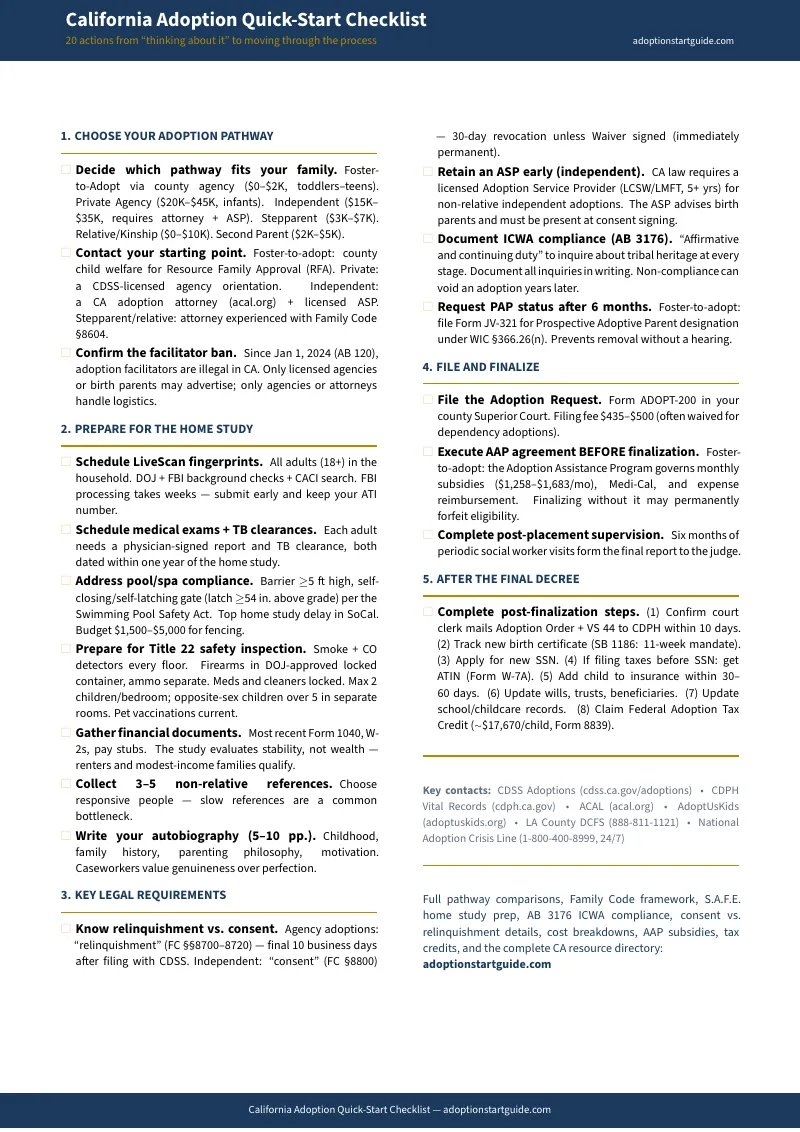
The free Quick-Start Checklist
Download the California Adoption Quick-Start Checklist for a phase-by-phase overview of the adoption process across all three pathways, from your initial decision through Superior Court finalization and post-adoption requirements. Free, no commitment. If you want the full guide with the Triple-Pathway Compliance System, AB 3176 ICWA navigator, home study preparation by region, 2024-2026 legislative analysis, financial breakdown by pathway, AAP negotiation guidance, and all seven printable worksheets, click the button in the sidebar.
— less than ten minutes of a California adoption attorney's time
One consultation with a California adoption attorney runs $254 to $432 per hour depending on where you live — and most of that first session is spent explaining the process you could have understood before you walked in. One rejected petition because of incorrect pathway forms delays your finalization by months. One misstep on AB 3176 ICWA compliance can void your adoption years later. One unsigned AAP agreement before finalization means permanently losing benefits that could total tens of thousands of dollars over the next decade. One guide prevents all of it.
If the guide doesn't deliver, reply to your download email at any time for a full refund. No forms. No justification required.