You've spent hours on ct.gov/dcf, attended an open house that felt like a recruitment pitch, and joined a Facebook group where half the advice contradicts the other half. You still don't know whether to call 1-888-KID-HERO or contact Wheeler Clinic first.
Connecticut runs foster care through a single state agency — the Department of Children and Families — but that simplicity is deceptive. DCF operates through 14 area offices from Stamford to Willimantic, each with its own caseload pressures and processing speed. Private agencies like Wheeler Clinic, Klingberg Family Centers, The Village, Family & Children's Agency, and Boys & Girls Village all follow the same DCF regulations but offer different levels of clinical support, geographic coverage, and placement pipelines. The state's own website publishes the regulations under C.G.S. section 17a-114 and the licensing standards in sections 17a-114-1 through 17a-114-25. It does not explain which path gets you licensed faster, what the social worker actually looks for during the home walk-through, or why your application stalls for months when you thought it would take four.
The TIPS-MAPP training alone requires a 10-week, 30-hour commitment that you must block before a single class session is scheduled. Miss one session and you wait for the next cohort — potentially adding months to your timeline. Meanwhile, every adult in your household aged 18 and older needs a State Police criminal history check, an FBI fingerprint clearance, a DCF Central Registry search, and a sex offender registry screen. Fingerprint processing takes four to eight weeks. That single bottleneck, started too late, is why licensing timelines stretch from four months to eight.
And the home study — the part that causes the most anxiety — isn't the white-glove inspection you're imagining. It's three to five visits over several weeks covering your childhood, your relationship, your discipline philosophy, your support network, and a physical walkthrough checking smoke detectors on every floor, carbon monoxide detectors near sleeping areas, hot water at 120 degrees or lower, every medication locked (including vitamins and Tylenol), firearms unloaded and stored separately from ammunition, and pool fences at four feet with self-closing gates latched at 54 inches. Nobody hands you the full list in advance. The regulations assume you'll figure it out.
The DCF Navigation System
This guide exists because the Connecticut foster care licensing process is not hard — it's fragmented. The information lives across the DCF website, CAFAP handouts, agency orientation packets, and the actual text of the Connecticut General Statutes. Nobody assembles it into a sequence. Nobody tells you that the DCF-vs.-private-agency decision changes everything downstream, or that the "Elimination of Barriers" policy means your rental apartment in New Haven qualifies even though nobody mentioned it at your open house. This guide does. Every chapter, every checklist, every statute reference is specific to Connecticut's DCF system and the 14 area offices that implement it.
What's inside
- DCF direct vs. private agency decision matrix — This is the question that orientation sessions don't answer clearly, and it's the single most consequential choice in the licensing process. DCF direct gives you the broadest placement pool and priority for foster-to-adopt. Private agencies like Wheeler Clinic, Klingberg, The Village, Family & Children's Agency, and Boys & Girls Village offer smaller caseloads, built-in clinical teams, and more intensive support — but narrower placement pipelines. This chapter compares each route by support level, placement type, geographic coverage, and the populations they serve best. Includes the five agencies mapped by region and specialty: therapeutic foster care, medically complex, behavioral health integration, and permanency planning. The comparison the system is designed not to give you.
- 10-step licensing timeline with delay points — From your first call to 1-888-KID-HERO through license approval, every step mapped with realistic durations. Not the optimistic timeline from the orientation brochure — the actual timeline including the four-to-eight-week fingerprint processing window, TIPS-MAPP class availability gaps, and the supervisor review that sits in a queue. Shows exactly where the common delays happen and what to do about each one so a four-month process doesn't become a seven-month ordeal.
- TIPS-MAPP training survival guide — The 30-hour, 10-session training curriculum broken down session by session: trauma impact, attachment and loss, discipline and behavior management, birth family connections, legal process, cultural competence, and the mutual assessment that determines whether you move forward. Covers the autobiography you'll write for the home study, the virtual-vs.-in-person format options, what happens if you miss a session, and the CPR/First Aid and Mandated Reporter certifications required alongside it. Walk into session one knowing exactly what the trainers are evaluating and how to prepare.
- Home safety inspection checklist — The licensing worker checks your home against the regulatory standards in sections 17a-114-1 through 17a-114-25. This chapter translates every regulation into a printable walkthrough: bedroom egress requirements (two means of exit per sleeping room), smoke and carbon monoxide detector placement, hot water temperature, medication lockbox standards (all medications including over-the-counter), firearm storage protocols (unloaded, locked, ammunition separate, trigger locks), pool and spa fencing, pet vaccination documentation, and lead paint concerns in Connecticut's older housing stock. Walk your home with this before the licensing worker arrives.
- Background check guide with variance process — State Police criminal history, FBI fingerprints, DCF Central Registry for household members 16 and older, sex offender registry. This chapter covers the specific disqualifying offenses under Connecticut law, the processing timeline, and — critically — the variance process. Not every criminal record is automatically disqualifying. The Commissioner of DCF has authority to grant waivers for non-violent offenses based on rehabilitation evidence. Most applicants don't know the variance exists. This chapter explains when it applies, how to raise past history early, and why disclosure is always better than discovery.
- Board rates and financial benefits breakdown — Connecticut's daily rates ($27.29 for ages 0-5, $27.60 for ages 6-11, $29.95 for ages 12 and up, $86.10 for medically complex), plus the pending legislative increases targeting $1,100 per month minimum. Covers HUSKY Health — the zero-premium Medicaid program that experienced foster parents call the "golden ticket" because it covers medical, dental, vision, behavioral health, and prescriptions better than most private insurance. Details on the clothing allowance, Care4Kids childcare assistance for working parents, the college tuition waiver at Connecticut state colleges and universities, respite care entitlements, and the tax-free status of board payments. The financial picture that the recruitment brochure outlines but never quantifies.
- Reunification, concurrent planning, and the foster-to-adopt pathway — Most children placed in your home will have a reunification case plan. That means your job is to support the child's return to their birth family — facilitating visits, communicating respectfully about birth parents, managing the emotional weight of attachment and separation. This chapter covers concurrent planning (Plan A reunification, Plan B adoption), visitation expectations and transportation responsibilities, the Sibling Bill of Rights, and the termination of parental rights timeline in Connecticut courts (typically 12-24 months). Written for families who need to understand the emotional reality before the first placement, not after.
- Continuum of Care Reform and Family First explained — Connecticut is moving children out of group homes and into family placements under CCR and FFPSA. Practically, this means the children placed in foster homes today may have more complex behavioral and emotional needs than in previous years. This chapter explains what CCR and Family First mean for you as a prospective foster parent, why the shift is happening, what additional training and support options exist through CAFAP and the private agencies, and how to prepare for higher-acuity placements without being overwhelmed by the prospect.
Printable standalone worksheets included
- Licensing Timeline Tracker — Every milestone from first call to 1-888-KID-HERO through license approval, with fill-in date fields. Print it, update it after every caseworker interaction, and always know where you stand in the four-to-six-month process.
- Home Safety Inspection Checklist — Room-by-room walkthrough of every regulatory requirement under sections 17a-114-1 through 17a-114-25. Walk your home with this before the licensing worker arrives.
- Document Organization Sheet — Form DCF-3031, background check releases, medical forms, financial disclosures, training certificates, reference letters, pet vaccination records — every document organized by phase with checkboxes and submission dates.
- Financial Planning Worksheet — Current board rates by age group and care level, HUSKY coverage summary, Care4Kids eligibility, clothing allowance, and the financial stability assessment in one printable sheet.
Who this guide is for
- Fairfield County professionals who want the efficient path — You make $100-plus an hour in Stamford or Greenwich. You don't have time to drive to Hartford, sit through a two-hour meeting that raises more questions than it answers, and then spend the next week calling the area office for clarification. You need the DCF licensing process mapped end to end with the agency comparison, the timeline, and the home inspection standards in one document. This guide replaces the scavenger hunt.
- Hartford and New Haven families close to the system — You live near a DCF area office. You see the foster care recruitment signs. You've been thinking about this for months, maybe years. The information isn't scarce — it's scattered. ct.gov/dcf has the regulations but not the roadmap. This guide gives you the step-by-step sequence that turns "I've been meaning to look into this" into a submitted application.
- Kinship caregivers navigating an emergency — A grandchild, niece, nephew, or close family friend's child has been removed or is about to be. You didn't plan to enter the DCF system — you're here because a child in your family needs you now. Connecticut allows emergency kinship placement for 45 to 90 days before full licensing is complete. This guide covers the kinship pathway, the expedited process, and the financial support you're entitled to so your placement is stable and funded.
- LGBTQ+ families building through foster care — Connecticut law explicitly prohibits discrimination based on sexual orientation, gender identity, or marital status in foster care and adoption. DCF is an affirming agency, and the private agencies follow the same non-discrimination protections. This is not theoretical — same-sex couples have been fostering and adopting in Connecticut for years. This guide addresses the specific concerns you bring to the home study and agency selection without assuming you need to be convinced the door is open.
- Faith-based families responding to a calling — You're connected through Catholic Charities of the Archdiocese of Hartford, an Episcopal parish in Fairfield County, or your congregation's foster care ministry. The motivation is clear. The DCF bureaucracy is not. This guide maps the licensing process so the paperwork and training don't derail the mission.
- Renters, apartment dwellers, and families in older homes — Connecticut law specifically allows renters to foster. You need a stable lease, adequate bedroom space, and a home that meets the safety standards — not a four-bedroom colonial in Glastonbury. This guide covers the "Bedroom Logic" for smaller spaces, landlord consent requirements, and the lead paint concerns specific to Connecticut's pre-1978 housing stock. Your New Haven apartment or Waterbury duplex may qualify. This guide tells you exactly what the inspector checks.
- Foster-to-adopt families — You're entering the system hoping to provide a permanent home. Connecticut uses concurrent planning — working toward reunification while simultaneously developing an adoption backup plan. This guide explains what "legal risk" placements mean, how the termination of parental rights process works in Connecticut courts, and what the foster-to-adopt pathway actually looks like when you're living it day to day with a child whose plan might still be "return home."
Why the free resources aren't enough
The DCF website (ct.gov/dcf) is a regulatory archive, not a guide. It publishes the Connecticut General Statutes, the licensing regulations, and the "Road to Fostering" PDF that CAFAP co-produced. It does not tell you which of the 14 area offices processes applications fastest, how to choose between Wheeler Clinic and Klingberg when DCF orientation won't compare them, or what the social worker is actually evaluating when they ask about your childhood during the home study. The website gives you the rules. It doesn't give you the strategy for navigating them.
CAFAP — the Connecticut Alliance of Foster and Adoptive Families — provides excellent post-licensing support, peer mentoring, and training. Their pre-licensing information largely mirrors what DCF already publishes. If you're looking for the decision matrix between DCF direct and private agencies, or a realistic timeline with specific delay points, CAFAP's materials won't get you there.
Facebook groups like "Connecticut Foster Parents" provide real talk from families in the system. They also provide conflicting anecdotes, outdated information, and a negativity bias driven by parents in crisis. A family in Fairfield County whose agency handled everything smoothly gives different advice than a kinship caregiver in Windham County who can't get their caseworker to return calls. Crowdsourced guidance is authentic and situationally contradictory.
National foster care books cover a generic process that doesn't account for Connecticut's 14 area offices, the specific TIPS-MAPP implementation, HUSKY Health coverage, the "Elimination of Barriers" policy, the Sibling Bill of Rights, or the post-Juan F. consent decree system that makes Connecticut's accountability structure different from most states. A guide written for Texas or California won't help you in Hartford.
The free Quick-Start Checklist
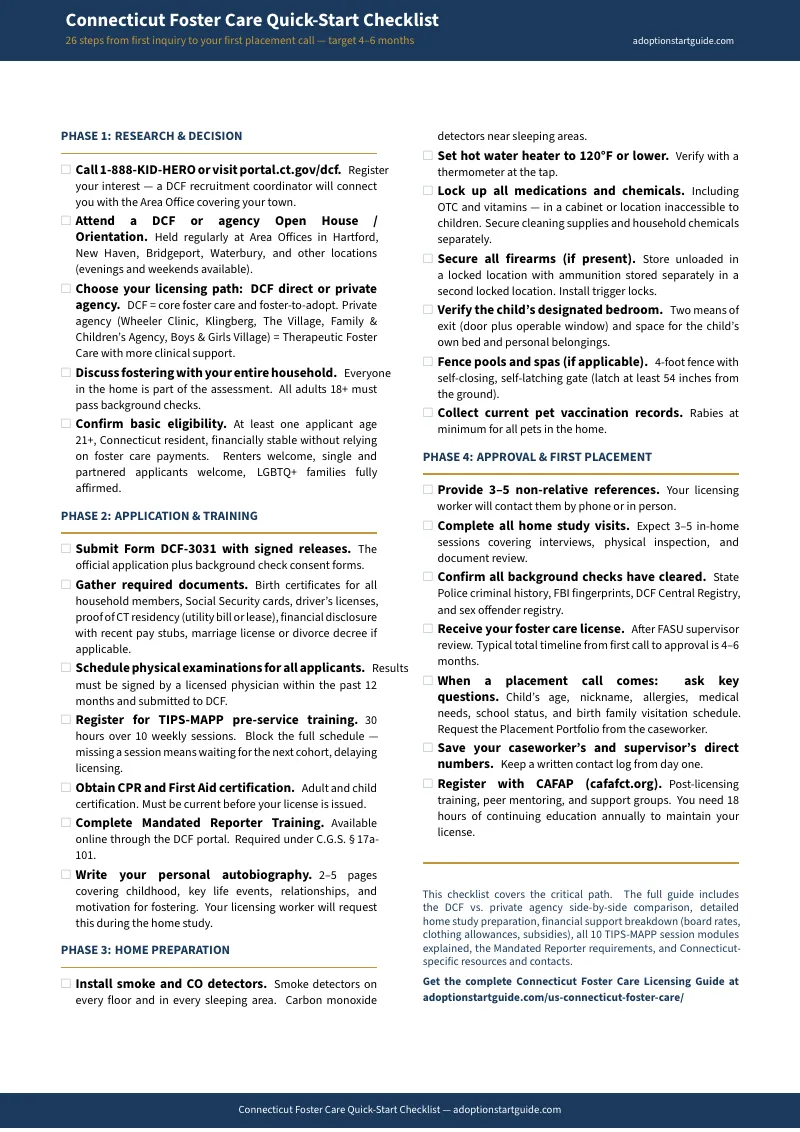
Download the Connecticut Foster Care Quick-Start Checklist for a one-page overview of the licensing process, from first call to 1-888-KID-HERO through license approval. Free, no commitment. If you want the full guide with the agency decision matrix, home inspection walkthrough, TIPS-MAPP survival guide, background check variance process, financial benefits breakdown, and all the printable worksheets, click the button in the sidebar.
— Less Than One Day of the Board Rate You'll Receive
A single day of the basic foster care board rate in Connecticut is $27 to $30. A medical physical for your household runs several hundred dollars. And every week your licensing is delayed by a missed fingerprint deadline, a skipped TIPS-MAPP session, or a failed home inspection is a week you're not providing a home to a child who needs one. This guide costs less than one day of the stipend you'll receive — and it prevents the mistakes that turn a four-month process into an eight-month wait.
If the guide doesn't deliver, reply to your download email at any time for a full refund. No forms. No justification required.