
Georgia has 159 counties, 14 DFCS regions, a pre-service training program most county websites describe incorrectly, and a home inspection code that no one has translated into plain English.
You searched "how to become a foster parent in Georgia" and found the DFCS website. It told you to call 877-210-KIDS. You called. Someone said your information would be forwarded to your county office within 24 hours. Two weeks later, you haven't heard anything. You called back and got a different person who gave you a different county number. You called that number and left a voicemail. Three days later, someone returned your call and told you the next IMPACT orientation is in eight weeks — and you can't start training without completing orientation first.
So you looked for information online. You found the fostergeorgia.com training schedule page and searched for your region. The schedule showed sessions months out. You noticed some regions had dates while others said "contact the regional lead." You emailed the lead. No response. You tried the direct county DFCS office. The person who answered wasn't sure when the next cycle starts and suggested you "check back in a few weeks."
Meanwhile, you found a private agency — Wellroot, Bethany Christian Services, FaithBridge, Georgia AGAPE. They responded faster, answered your questions, and seemed more organized. But nobody explained the actual difference: what you gain with a private agency, what you give up, and whether it affects the children you can be matched with through the SHINES database. The agency's website made it sound like the obvious choice, but you couldn't find a neutral comparison anywhere.
Then you tried to research the home inspection. You found references to "Rules Chapter 290-9-2" — the state's regulatory code for child-placing agencies. It's 37 pages of administrative language written for agency compliance officers, not families. Somewhere in those 37 pages are the bedroom space requirements, the pool safety rules, the firearms storage standards, and the carbon monoxide detector placement that your inspector will check. But extracting a practical checklist from that document would take a lawyer.
This is where most Georgia families stall. Not because they aren't committed. Because the system was designed for administrators, not for the families it needs to recruit.
The 159-County Licensing Navigator: Your Complete Georgia Foster Care Guide
This guide is built for how foster care licensing actually works in Georgia — the 159-county DFCS structure, the 14-region system with its own training schedules and placement priorities, the transition from IMPACT to NTDC pre-service training, the SAFE home study model, and the specific regulations under Rules Chapter 290-9-2 that determine whether your home passes inspection. Every chapter reflects current Georgia law under OCGA Title 49, the administrative code, and the operational realities that change from Gwinnett County to Valdosta to the coast. It is not a generic fostering handbook with "Georgia" in the title. It is the operating manual for this state's system — through your county, under current rules, with the agencies and training programs that serve your region.
What's inside
- 159-County Navigation System with 14-Region Directory — Georgia's foster care system is administered through 159 individual county DFCS offices organized into 14 regions, each with its own Caregiver Recruitment and Retention Team Lead. The guide includes contact information for every regional lead, explains the county-to-region mapping, and covers the Metro Atlanta experience (Regions 3, 13, 14) versus the rural reality in South Georgia (Regions 10, 11, 12) — because your county determines your training schedule, your caseworker's caseload, and how quickly your application moves.
- DFCS vs. Private Agency Decision Framework — A side-by-side comparison that no agency's website will give you. DFCS-direct means access to the full state placement pool but higher caseloads and slower communication. Private CPAs like Wellroot, Bethany Christian Services, FaithBridge, Georgia AGAPE, CHRIS 180, and StepStone offer smaller caseloads and more support but may have geographic or specialization limits. The guide covers what each path means for training, home study, placement matching, and ongoing support so you choose the right partner for your family.
- NTDC Pre-Service Training Breakdown — Georgia transitioned from the IMPACT curriculum to the National Training and Development Curriculum (NTDC) in 2024. The new program covers 34 hours of trauma-informed content that must be completed within 10 weeks. The guide explains the IMPACT orientation prerequisite, why your Letter of Intent must be submitted within 10 days, hybrid and virtual options for rural families who can't drive hours to a training site, and how to request a regional transfer when your county has no available seats.
- Rules Chapter 290-9-2 Home Safety Standards — The 37-page regulatory code translated into a plain-English checklist. Bedroom square footage minimums, smoke and carbon monoxide detector placement, fire extinguisher location, water safety requirements for homes with pools or near bodies of water, firearms and ammunition storage (separate and locked), unvented heater prohibitions, and every other item that can trigger a Corrective Action Plan or delay your licensing. Know what to fix before the inspector arrives.
- Background Check Walkthrough — Every adult household member age 18 and older must clear state GBI and federal FBI fingerprint-based criminal history checks, a Georgia child abuse registry screening, and potentially out-of-state registry checks. The guide explains which offenses are permanently disqualifying, which have time-limited bars, how the variance review process works for past records, and why out-of-state checks are the single biggest cause of delays in the Georgia system — start them immediately, even before your first orientation.
- Kinship and Relative Placement — For grandparents, aunts, uncles, and family friends pulled into the system unexpectedly when a child is removed. The emergency placement pathway, the expedited licensing track, how to secure the Enhanced Relative Rate (ERR) payments instead of the lower basic rate, and the legal protections that come with full foster care licensing versus informal custody arrangements. The guide covers every step from the emergency call to full licensure.
- PeachCare for Kids and Amerigroup Medical Coverage — Every foster child in Georgia receives Medicaid through PeachCare for Kids at no cost to the foster parent, managed by Amerigroup. No copayments for medical services, full preventive care coverage, and behavioral health services. The guide walks through enrollment, provider directories, how to handle prescription coverage, and how PeachCare connects to adoption subsidies if your family moves toward permanency.
- Foster Care Board Rates and Financial Realities (2024-2025) — Daily per diem rates by age group: $28.63 for birth to 5, $30.89 for ages 6-12, $33.60 for ages 13 and older. The initial clothing allowance, therapeutic add-on payments for children with higher needs, and the critical 45-day gap between your first placement and your first board payment that catches most new foster families off guard. The guide explains exactly what the stipend covers, what it doesn't, and how to prepare your household budget before you accept a placement.
- Military Family Guidance — Specific instructions for families at Fort Moore (Columbus), Fort Stewart (Savannah), and Robins AFB (Warner Robins) navigating PCS-related license transfers from other states, coordinating with Child and Youth Services for on-base support, and completing Georgia IMPACT/NTDC training on active-duty schedules.
- Foster Parent Rights and GCFPA Resources — Your rights under Georgia's Foster Parent Bill of Rights, how to file a complaint or grievance, the Georgia Certified Foster Parent Association (GCFPA) as a peer advocacy network, and faith-based and community support organizations including Georgia Baptist Children's Homes, Wellroot Family Services, and church-based orphan care ministries across the state.
Standalone printable tools included
The guide comes with 8 standalone PDFs you can print and use independently — no need to flip through the full guide when you're standing in your kitchen checking fire extinguishers or sitting at the county office filling out forms:
- Application Document Checklist — every document organized by licensing phase with checkboxes and date tracking
- Home Safety Inspection Checklist — room-by-room walkthrough of Rules Chapter 290-9-2 requirements
- 14-Region DFCS Directory — all regional leads with contact information
- DFCS vs. Private Agency Comparison Sheet — side-by-side decision framework plus 7 questions to ask every agency
- Financial Planning Worksheet — FY2025 board rates, self-sufficiency calculator, and 45-day gap budget planner
- Monthly Contact Log — reusable tracking sheet for caseworker visits, medical appointments, and school updates
- Key Contacts Reference Card — fridge-sheet with every phone number and website you need
- 4-Month Licensing Action Plan — the complete timeline with checkboxes from first inquiry to placement readiness
Who this guide is for
- Metro Atlanta families — You work in Gwinnett, Cobb, or Fulton County. You searched the DFCS website, called 877-210-KIDS, and got told to wait. You want a clear process that tells you what to do, in what order, and who to contact — so you can register for the next training cycle instead of spending weeks chasing voicemails across three overlapping Metro regions.
- Kinship caregivers in crisis — A child in your family was removed by DFCS and placed with you on an emergency basis. You need to know exactly what forms to file, what background checks to expect, how to get the Enhanced Relative Rate instead of the basic stipend, and what training requirements apply to relatives — this week, not after two months of orientations.
- Rural Georgia families — You live in South Georgia where IMPACT training runs infrequently and the nearest training site is an hour away. You need to know about hybrid and virtual options that your county office may not actively promote, cross-regional training transfers, and which private agencies serve your area.
- Faith-motivated families — Your church ran a foster care ministry drive, or you heard about Foster Georgia through Stand Sunday, Georgia Baptist Children's Homes, or Wellroot. You're ready to act on the calling. You need the administrative roadmap that turns conviction into licensure — the forms, the timelines, the home safety fixes — so your family's commitment doesn't stall in the 159-county bureaucracy.
- Military families — You PCS'd to Fort Moore, Fort Stewart, or Robins AFB and want to continue or begin fostering in Georgia. You need to understand how your out-of-state license transfers, what the Georgia-specific training requirements are, and how to coordinate with your installation's family support center.
Why the free resources fall short
The official DFCS website provides forms and policy documents designed for internal use, not for families navigating the system from outside. The fostergeorgia.com training schedule is the best public resource for training dates — but it only tells you when sessions happen, not how to prepare for them, what to do if your county has no seats, or how to move through the bureaucracy when your caseworker goes quiet.
Private agencies like Wellroot and Bethany Christian Services offer excellent orientations and support for families who choose their pathway, but they aren't positioned to give you a neutral comparison of the DFCS-direct versus private agency tradeoffs. Their job is to recruit for their network, not to help you decide whether their network is right for you.
National foster care books on Amazon cover the emotional journey of fostering — attachment, trauma-informed parenting, supporting reunification. Valuable, but they offer nothing on Georgia's 14-region DFCS structure, the transition from IMPACT to NTDC, the specific home safety standards under Rules Chapter 290-9-2, the PeachCare enrollment process through Amerigroup, or the 45-day payment gap that hits hardest in the state's rural counties where families have less financial margin.
The free Quick-Start Checklist
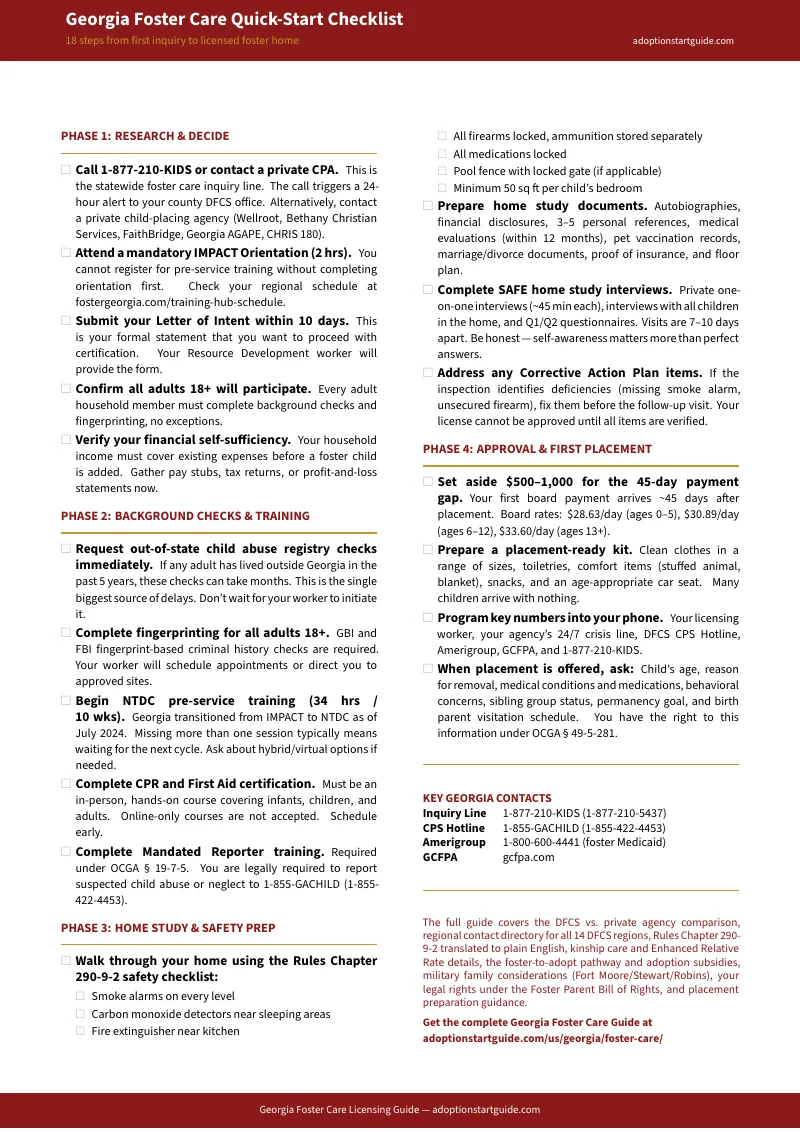
Download the Georgia Foster Care Quick-Start Checklist for the essential actions that get you from first inquiry to moving through the system — including the home safety items that cause the most inspection failures under Rules Chapter 290-9-2. Free, instant download, no commitment. If you want the full guide with the 159-county navigation system, the DFCS vs. private agency comparison, the NTDC training breakdown, the home safety code translated to plain English, kinship emergency procedures, PeachCare enrollment, board rates and the 45-day payment gap, military family guidance, and your rights under the Foster Parent Bill of Rights, click the button in the sidebar.
— less than the gas for one wasted trip to a county office
A single trip to a county DFCS office that's closed, understaffed, or doesn't have the orientation scheduled when you expected costs more in gas, time, and frustration than this guide — especially in rural South Georgia where distances between county seats can exceed an hour. Georgia family law attorneys charge $150 to $350 per hour. A one-hour consultation gets you general advice about your county — not a walkthrough of the 14-region system, not a DFCS-vs-CPA decision framework, not the home safety checklist your inspector uses, not the kinship placement procedures, and not the financial preparation strategy for the 45-day payment gap. This guide puts the entire Georgia foster care licensing process in your hands. Families who understand the system before they enter it register for training sooner, avoid the home inspection failures that delay licensing, and walk into their first meeting with their county DFCS worker prepared.
If the guide doesn't deliver, reply to your download email within 30 days for a full refund. No forms. No justification required.