
You visited humanservices.hawaii.gov, called the DHS intake line, and left with a stack of acronyms — CWS, HAR 17-1625, RCG, HANAI — and no explanation of how they connect or where to start.
Hawaii runs foster care through the Department of Human Services, Child Welfare Services, the Binti online licensing portal, Catholic Charities Hawaii as the primary training contractor, and separate CWS field offices on each island — five layers of bureaucracy that each assume you already understand the other four. DHS posts orientation dates. Catholic Charities runs the HANAI pre-service training. The RCG portal handles document uploads. And the licensing unit conducts the home study on a timeline that varies by island. Nobody maps how these pieces fit together, what order they happen in, or what to do when you live on Maui and the next training session is on Oahu.
The housing question alone stops more Hawaii families than any other single concern. You live in a two-bedroom apartment in Kailua or a multi-generational home in Waipahu, and you've heard foster care requires a private bedroom for each child. Hawaii Administrative Rules Title 17, Chapter 1625 actually allows shared bedrooms — same-gender siblings under age six can share a double bed, and 60 square feet per child in a shared room meets the standard. But nobody publishes the compliant layouts for small apartments, explains which waiver provisions apply to multi-generational homes, or clarifies what "detached building without supervision" means when your ohana has a converted garage. Families assume their home won't qualify and walk away from the process before they even apply.
Meanwhile, there's a deeper tension that free resources never acknowledge. If your family has practiced hanai for generations — the indigenous tradition of permanently moving a child's care to extended ohana — the formal DHS licensing process can feel like an unnecessary Western imposition on something your family has always handled without government paperwork. And yet, without that license, a grandparent caring for a grandchild through hanai receives no board stipend, no Med-QUEST coverage for the child, and no legal protections if the biological parent's situation escalates into a CWS case. Licensing doesn't replace hanai. Licensing funds it.
The Hawaii Licensing Roadmap
This guide is built exclusively for Hawaii's DHS system and nobody else's. Every chapter, every checklist, every form reference is grounded in current Hawaii Administrative Rules Title 17 Chapter 1625, DHS Child Welfare Services policy, the HANAI pre-service curriculum, and the real-world experience of families who have navigated licensing on Oahu, Maui, the Big Island, Kauai, and the rural communities in between. Not a national foster care overview. Not an agency orientation brochure. The operational layer between what the state posts online and what you actually need to know to get licensed — under current conditions, on current timelines, on your island.
What's inside
- Island-by-island licensing logistics — If you live on Oahu, DHS offices and in-person HANAI training sessions are accessible. If you live on Maui, the Big Island, Kauai, Molokai, or Lanai, the process looks fundamentally different. This chapter maps the CWS field offices by island, identifies which training components can be completed remotely through the Binti portal and hybrid sessions, and provides the scheduling workarounds that Neighbor Island families use to complete their 15 hours of HANAI training without flying to Honolulu for every session. The single most requested piece of information for families outside Oahu — and the one DHS doesn't publish in any consolidated form.
- Small home compliance strategies — Hawaii has the highest median housing costs in the nation, and most families don't live in four-bedroom single-family houses. This chapter walks through the HAR 17-1625 space requirements in detail: the 70-square-foot single-occupancy minimum, the 60-square-foot-per-child shared room standard, the bed configuration rules for different age groups, the privacy provisions for children over age five, and the specific prohibitions on sleeping in detached buildings, unfurnished attics, and converted spaces. Includes compliant layout examples for two-bedroom apartments, ohana units, and multi-generational homes so you know exactly what passes inspection before your licensing worker arrives.
- HANAI pre-service training navigator — The 15-hour "Hawaii Assures Nurturing and Involvement" training is mandatory for all resource caregiver applicants. This chapter breaks down the core competency areas — trauma and brain development, the Prudent Parenting standard, ambiguous loss, shared parenting with biological families, and cultural identity preservation — so you walk into each session prepared. Covers the session-by-session structure, the CPR and First Aid certification requirement, and what to expect during the home study interviews that follow training completion.
- Board rates, Med-QUEST, and financial support breakdown — Hawaii's board rates are among the highest in the country: $649 per month for ages 0-5, $742 for ages 6-11, and $776 for ages 12 and older, plus monthly clothing allowances. But families don't know about the Difficulty of Care supplement (up to $570 per month for children with specialized needs), the Geist Fund enhancement grants (up to $500 per year for hula lessons, sports, and extracurriculars), or the fact that Med-QUEST provides comprehensive medical, dental, and behavioral health coverage for every foster child at no cost to the caregiver. This chapter consolidates every financial support available so you understand the full picture before you apply — and so the "Paradise Tax" doesn't scare you away from a process that actually helps offset Hawaii's cost of living.
- Hanai-to-licensing cultural bridge — For families practicing hanai or informal kinship care, this chapter explains exactly how formal DHS licensing protects and funds the caregiving you're already doing. Covers the kinship care pathway from emergency placement to full licensure, the financial supports available to licensed kinship caregivers versus unlicensed relatives, the Med-QUEST enrollment process for children in your care, and the legal protections that licensing provides if a CWS case is opened. Written with deep respect for the hanai tradition — and practical clarity about why the state's framework, while bureaucratic, exists to support your ohana.
- Military family licensing and portability guide — Oahu's military installations — Schofield Barracks, Joint Base Pearl Harbor-Hickam, Marine Corps Base Hawaii — house thousands of families who want to foster but worry their license won't survive a PCS move. This chapter covers the 2023 Veterans Auto and Education Improvement Act provisions that mandate license portability for military spouses, the Interstate Compact on the Placement of Children (ICPC) transfer process, base housing coordination with the Housing Services Office, the Exceptional Family Member Program (EFMP) considerations, and the step-by-step transfer packet you'll need to take your Hawaii license to your next duty station. Federal law is on your side — this chapter shows you how to use it.
- Home study preparation guide — The home study is the most personal part of the licensing process, and the part that causes the most anxiety. This chapter covers what your licensing worker evaluates during the home visit, how to prepare your home environment, the autobiographical questions you'll be asked about your childhood, parenting philosophy, and motivation to foster, the reference letter requirements, and the background check and health clearance process for every adult in the household. Preparation eliminates surprise — and surprise is what causes families to freeze.
Printable standalone worksheets included
- Licensing Timeline Tracker — Every milestone from first DHS contact through licensing approval, with fill-in date fields. Print it, update it after every caseworker interaction, and always know where you stand in the 90-day licensing window.
- Home Safety Inspection Checklist — Room-by-room walkthrough of every HAR 17-1625 requirement. Walk your home with this before your licensing worker's visit.
- Document Organization Sheet — Background checks, health clearances, training certificates, reference letters, and financial disclosures organized by phase with checkboxes and submission dates.
- Financial Planning Worksheet — Current board rates by age group, clothing allowances, Difficulty of Care supplement, Med-QUEST coverage, and Geist Fund eligibility in one printable sheet.
Who this guide is for
- Neighbor Island families navigating an Oahu-centric system — You live on Maui, the Big Island, Kauai, Molokai, or Lanai. You've heard that HANAI training sessions happen on Oahu, your local CWS office schedules orientations infrequently, and the licensing process feels designed for Honolulu families. This guide maps every remote and hybrid training option, every island-specific CWS contact, and every workaround that Neighbor Island families use to complete licensing without relocating to Oahu.
- Native Hawaiian and Pacific Islander families honoring hanai — You've been caring for your grandchild, niece, nephew, or a family friend's keiki through hanai, and the idea of inviting CWS into your ohana feels wrong. This guide bridges the cultural gap — explaining how formal licensing provides financial support, medical coverage, and legal protections that sustain the hanai mission in today's economy. You're already doing the hardest part. Licensing makes sure you're supported while you do it.
- Military families stationed on Oahu — You're at Schofield Barracks, JBPHH, or Marine Corps Base Hawaii. You want to foster keiki during your tour but you're worried about what happens when you PCS. This guide covers the federal license portability protections, base housing coordination, EFMP considerations, and the ICPC transfer packet so fostering in Hawaii doesn't end when your orders change.
- Families in small apartments, ohana units, or multi-generational homes — Hawaii housing is expensive and compact. You've assumed your two-bedroom apartment or converted ohana unit won't qualify. This guide breaks down the actual HAR 17-1625 space requirements — shared room standards, bed configurations, and waiver provisions — with compliant layout examples that show exactly how small homes pass inspection.
- Kinship caregivers who need financial support now — A relative's keiki has been placed with you or is about to be. You need to understand the expedited kinship pathway, access the board stipend and Med-QUEST coverage you're entitled to, and get licensed so your placement is stable and funded. This guide has a dedicated chapter for your situation.
- Foster-to-adopt families — You're entering the foster system hoping to provide a permanent home. Hawaii prioritizes reunification under the federal Adoption and Safe Families Act, and concurrent planning requires emotional and legal preparation that orientation sessions don't cover. This guide explains how the transition from foster license to adoption works in Hawaii and what "concurrent" means in daily life.
- Faith-based families answering the call — You're connected through your church, the LDS ward in Laie, Catholic Charities, or a community outreach program. The calling is clear. The DHS bureaucracy, the HAR inspection standards, and the 15-hour HANAI training curriculum are not. This guide maps every step so the paperwork doesn't derail your mission.
Why the free resources aren't enough
The DHS website publishes forms, basic checklists, and orientation dates. It does not tell you the order in which to complete each step, what happens when your Neighbor Island training schedule doesn't align with your licensing timeline, or how to prepare for a home inspection in a 900-square-foot apartment when the rules reference bedroom minimums but don't show compliant layouts.
The RCG.Hawaii.gov Binti portal handles document uploads and licensing status tracking. It's a technical system, not a guide. It assumes you already know what documents to upload, in what order, and what your licensing worker expects to see when they review your file.
Catholic Charities orientation sessions are comprehensive — but they're provided after you've already committed to the process. They're designed to inspire you to continue, not to prepare you for the housing inspection, the financial disclosure, or the HANAI training sessions that come next. Families who attend orientation expecting a roadmap leave with motivation and no map.
Facebook groups — Hawaii Foster Parents, Hawaii Foster Care and Adoption — provide emotional support and island-specific advice that's sometimes accurate and sometimes outdated. A family who licensed on Oahu gives different guidance than a kinship caregiver on the Big Island who's navigating emergency placement without a caseworker who returns calls. Crowdsourced guidance is well-intentioned and situationally contradictory.
National foster care books describe a generic licensing process that doesn't account for Hawaii's HANAI training curriculum, the Binti portal, the hanai-to-licensing cultural bridge, the Neighbor Island logistics challenges, the HAR 17-1625 space requirements for small Hawaiian homes, or the military portability provisions that matter to a third of Oahu's population. A guide written for Texas or New York won't help you in Hawaii.
The free Quick-Start Checklist
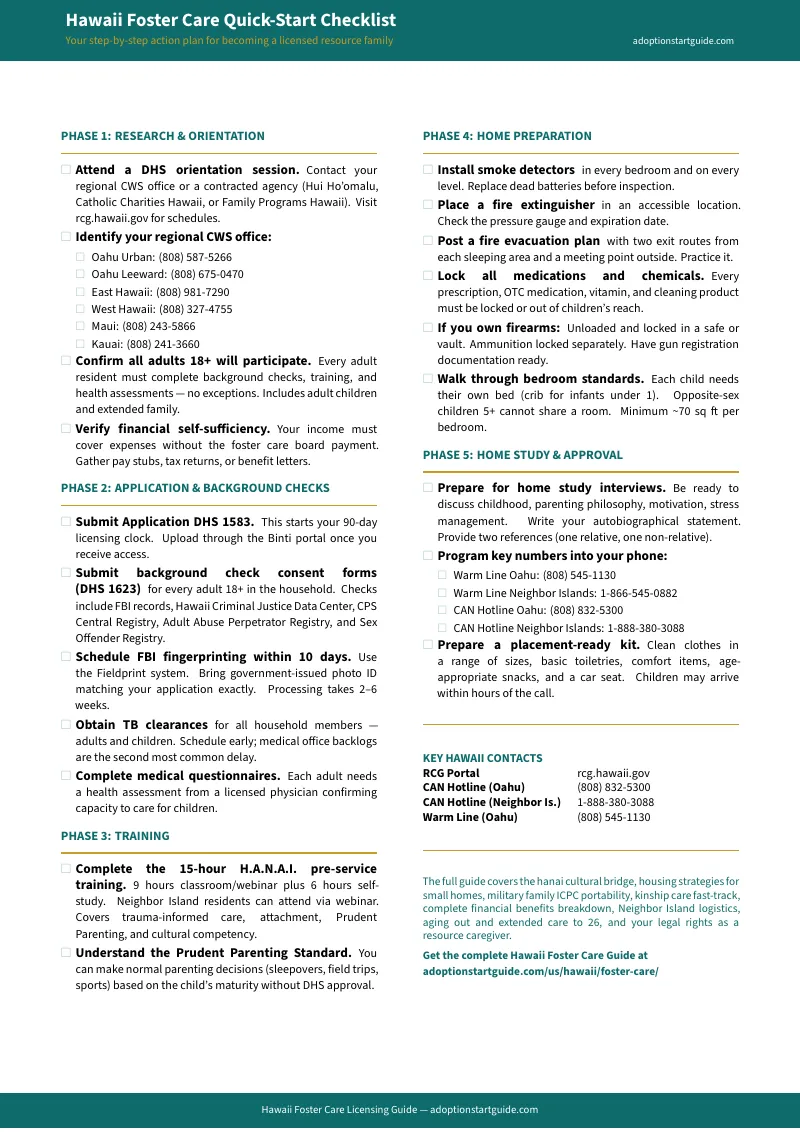
Download the Hawaii Foster Care Quick-Start Checklist for a one-page overview of the licensing process, from first DHS contact through licensing approval. Free, no commitment. If you want the full guide with the island-by-island logistics, small home compliance strategies, HANAI training navigator, financial support breakdown, hanai cultural bridge, military portability guide, and all the printable worksheets, click the button in the sidebar.
— less than one inter-island ferry ticket
One inter-island flight to attend a training session you could have completed remotely costs $150 or more. One month of missing board payments because your application stalled costs you $649 to $776. A home inspection correction notice because you didn't know the bedroom square footage rules delays your licensing by weeks. This guide costs less than a poke bowl — and it prevents the mistakes that turn a 90-day process into a six-month ordeal.
If the guide doesn't deliver, reply to your download email at any time for a full refund. No forms. No justification required.