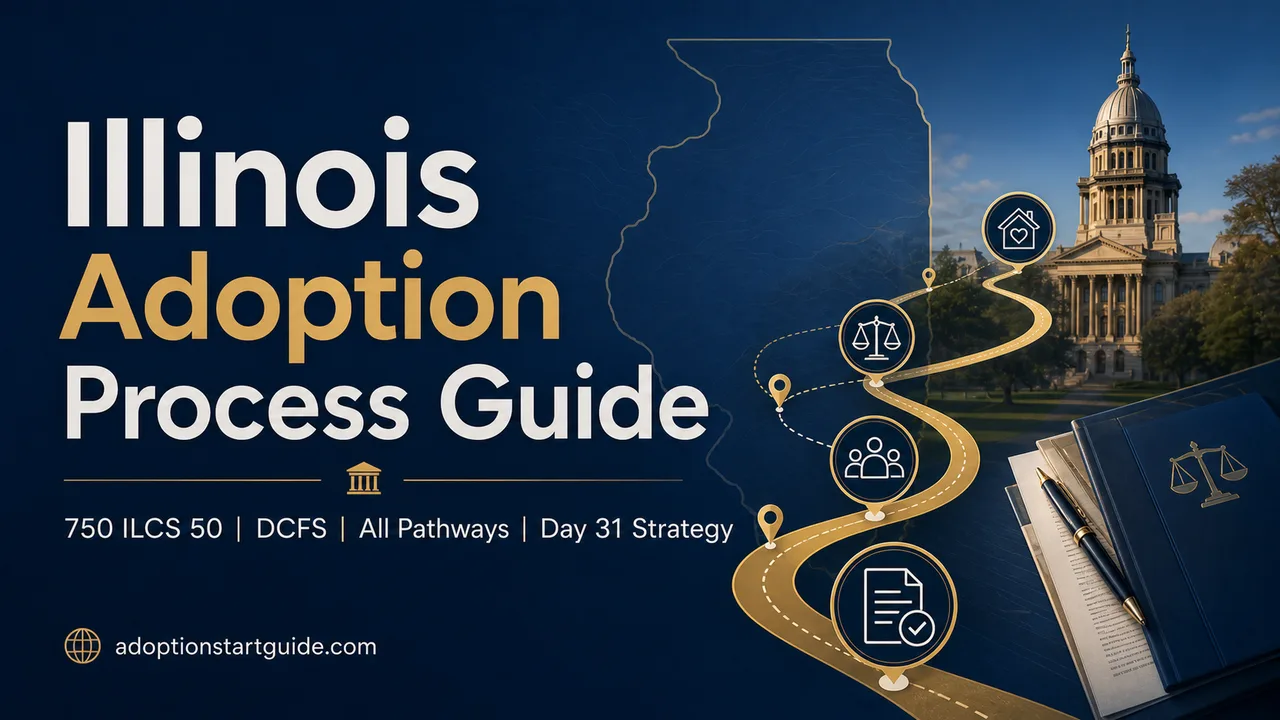
Illinois has eight adoption pathways, a 30-day Putative Father Registry window, and a 72-hour consent rule that most families learn about too late. This guide makes sure you don't.
You started looking into adoption in Illinois and ran into the wall. The DCFS website gave you forms and regulatory language. Catholic Charities gave you a warm overview and a phone number. Your cousin's friend adopted in 2018 and told you to "just get a good lawyer." Reddit gave you a thread from someone in Cook County who waited 14 months for a TPR hearing and another from a stepparent in Sangamon County who finalized in three months. You searched for the Putative Father Registry and found a state statute written for attorneys. You searched for the home study requirements and found Rule 402 -- 40-square-foot bedroom minimums, hot water temperature limits, locked ammunition storage rules, and a checklist that made your house feel like it needed a building inspection.
And somewhere in the middle of all that, you realized that Illinois adoption law is not one process. It is eight different processes, governed by two separate statutes -- the Illinois Adoption Act (750 ILCS 50) for voluntary adoptions and the Juvenile Court Act (705 ILCS 405) for children in state care -- with different costs, different timelines, different consent rules, and different court procedures depending on your county. A foster-to-adopt family in Cook County faces a completely different reality than a stepparent filing in DuPage. A grandparent pursuing kinship adoption under the new KIND Act has options that did not exist before July 2025. And anyone navigating an independent adoption needs to understand why searching the Putative Father Registry on day 5 instead of day 31 can leave a gap in legal protection that costs months of additional proceedings.
An adoption attorney in Illinois charges $350 per hour. Every hour you spend in that office asking "What is the Putative Father Registry?" or "How does the 72-hour consent rule work?" or "What documents do I need for the home study?" is an hour billed at a rate that adds up fast. Private adoptions run $12,000 to $40,000. Stepparent adoptions start at $1,500. Even foster-to-adopt families who pay nothing out of pocket still need to understand the system well enough to negotiate the Adoption Assistance Agreement before the judge signs the decree -- because after finalization, the state has no obligation to negotiate.
This guide does not replace an attorney. It makes sure you need fewer hours of one.
The Day 31 Adoption System: Your Complete Illinois Roadmap
This guide is built for the system Illinois families actually navigate -- the intersection of 750 ILCS 50, DCFS bureaucracy, POS agency casework, and Circuit Court procedures that vary from Cook County to Sangamon to Lake. Every chapter reflects current Illinois statutes, the 2025 KIND Act kinship provisions, DCFS licensing and subsidy programs, and the specific financial resources available to families in 2026. It is not a national adoption handbook with the state name swapped in. It is the operational layer between what DCFS posts online and what you actually need to know to bring your child home.
What's inside
- All Eight Adoption Pathways Compared -- Foster-to-adopt through DCFS ($0 with ongoing subsidies), licensed agency ($12,000-$40,000), independent/attorney-facilitated ($15,000-$35,000), stepparent ($1,500-$5,000), relative/kinship ($1,000-$5,000), adult adoption (under $2,000), same-sex (full legal parity on all pathways), and international readoption ($3,000-$8,000 for the Illinois portion). Realistic costs, timelines, legal requirements, and the 750 ILCS 50 and 705 ILCS 405 citations that govern each pathway so you choose the right track before spending money on the wrong one.
- The "Day 31 Strategy" for the Putative Father Registry -- Under 750 ILCS 50/12.1, an unwed father has 30 days after birth to register. Many families search the registry early and assume they are safe. If a father registers on day 29, that early search result is worthless. This chapter explains the exact timing strategy, why your attorney should wait until after day 30 to pull the search, and how this single decision can prevent months of additional legal proceedings. This is the detail that separates prepared families from ones who get blindsided.
- The 72-Hour Consent Rule and Irrevocability -- A birth mother cannot sign a valid surrender or consent until 72 hours after delivery. Once signed before a judge or authorized agency official, that consent is final and irrevocable -- Illinois has no "change of heart" window. This chapter covers the exact execution requirements, the critical difference between "surrender" (to an agency) and "specific consent" (to named individuals), the asymmetric rules for mothers versus fathers, and why the Specific Consent protection is the most important document in an independent adoption.
- Home Study Preparation Under Rule 402 -- Every background check (FBI fingerprinting, ISP/LEADS, DCFS CANTS registry for every adult household member), every medical exam (CFS-600 physician forms), and every physical safety standard (smoke detectors within 15 feet of bedrooms, 2-A:10-B:C fire extinguisher, medications locked, firearms unloaded in a separate locked safe, hot water at 115-120 degrees F, 40 square feet per child with an egress window). Includes the complete home safety walkthrough checklist and the documentation folder checklist -- autobiography, three reference letters, financial verification, employer letters, and medical clearances -- so nothing is missing when the social worker arrives.
- DCFS, POS Agencies, and the System That Actually Runs Your Case -- DCFS does not handle most casework directly. Purchase of Service agencies -- Catholic Charities, Lutheran Child and Family Services, Children's Home and Aid, Bethany Christian Services, JCFS Chicago -- manage your licensing, home visits, and paperwork. This chapter explains the chain of command, how to escalate when things stall, what to do when your caseworker changes mid-process, and the specific documentation habits that keep your case moving through a system with heavy caseloads and frequent turnover.
- The "Unfit Person" Framework for Contested Adoptions -- When a parent refuses to consent, the court must find them "unfit" by clear and convincing evidence under 750 ILCS 50/1. This chapter breaks down the statutory grounds (abandonment, desertion for 3+ months, habitual substance abuse, depravity, failure to protect, repeated incarceration), the case law that defines how courts interpret each ground, and how to assess the viability of your case before spending thousands on a contested hearing.
- The KIND Act (2025) Kinship Provisions -- Effective July 2025, the Kinship in Demand Act introduces separate certification standards for relatives, makes adoption and subsidized guardianship financially equivalent, and strengthens sibling placement requirements. This chapter covers how the KIND Act changes the calculus for grandparents, aunts, uncles, and other relatives choosing between adoption and guardianship -- and why that choice no longer has to be driven by financial penalties.
- Circuit Court Finalization Walkthrough -- How adoption petitions move through Illinois Circuit Courts, the 30-day petition filing deadline, what the Guardian Ad Litem investigates and how to cooperate effectively, the 6-month post-placement waiting period (and when it is waived), county-by-county filing fees (Cook $300-$600, DuPage $250-$450, Lake $250-$400, Sangamon $200-$350), and what happens at the finalization hearing -- the 15-to-30-minute proceeding, the questions judges ask, and why you should bring a camera.
- ICPC Interstate Compliance -- If your adoption crosses state lines, the Interstate Compact on the Placement of Children requires both states to approve before the child travels. This chapter covers the 7-to-14-day waiting period, why leaving the birth state early can result in dismissal of your adoption petition, and how to plan your timeline and budget so you are not stranded with a newborn in a hotel room.
- DCFS Adoption Subsidy and Financial Planning -- Monthly subsidy payments based on the child's needs level, continuous Medicaid coverage, up to $2,250 in legal fee reimbursement, the federal Adoption Tax Credit ($17,280 per child for 2025), employer adoption benefit programs, and grant organizations. Plus the rule that matters most: the Adoption Assistance Agreement must be signed before finalization. Once the judge signs the decree, your leverage is gone.
- Birth Certificate Access (HB 5428) and Adoptee Rights -- Illinois allows adult adoptees aged 21+ to request their original birth certificate through IDPH. This chapter covers the request process, birth parent preference forms, the Mutual Consent Voluntary Adoption Registry, and post-adoption contact agreements -- so you can support your child's identity and heritage as they grow.
- Agency, Attorney, and Legal Aid Directory -- DCFS statewide intake (1-800-572-2390), Catholic Charities, LCFS, Bethany Christian Services, Children's Home and Aid, JCFS Chicago, Adoptions of Illinois, The Baby Fold, the Illinois State Bar Association referral service, Legal Aid Chicago, Prairie State Legal Services, and Land of Lincoln Legal Aid. How to verify an agency's DCFS licensing status. What to look for when choosing an attorney experienced in 750 ILCS 50. The questions to ask before you commit.
Who this guide is for
- Families considering foster-to-adopt through DCFS -- You want to understand the POS agency system, the 30-hour training requirement, concurrent planning, and how to negotiate the adoption subsidy before you attend your first orientation. Whether you are in Chicago or Downstate, this guide covers the process from licensing through finalization.
- Couples or individuals pursuing private or independent adoption -- You need to navigate the placement process, the 72-hour consent window, the Putative Father Registry timing, attorney selection, and court procedures without spending hours at $350 per hour learning basic procedures you could have read in advance.
- Stepparents adopting a spouse's child -- You want to understand the streamlined process, whether you need consent from the absent parent or an unfitness finding, and the specific documentation required -- including when the 6-month waiting period is waived and when it is not.
- Grandparents and relatives raising a child -- You have been caring for this child and need a clear path to legal permanence. The KIND Act changed the landscape for kinship families in 2025, and this guide explains how -- including the new choice between adoption and subsidized guardianship without financial penalty.
- LGBTQ+ families building through adoption -- Illinois provides full legal parity, and Cook County courts have handled thousands of same-sex adoption petitions. This guide covers joint adoption, second-parent adoption, and the specific protections that secure both parents' rights.
- Foster parents whose child has become legally free -- You have been caring for this child through the TPR process and are ready to adopt. This guide covers the home study conversion, subsidy negotiation, and the finalization steps specific to families who have already been in the system.
Why not piece it together from free resources?
You could. DCFS posts forms and regulatory language online. The Illinois State Bar Association publishes a surface-level adoption overview. Reddit has threads from families in Chicago sharing experiences that may or may not reflect current law. Catholic Charities and LCFS each describe their own programs.
The problem is the same one every Illinois family hits: DCFS gives you forms, not strategy. The ISBA guide gives you an overview, not the operational details. Reddit gives you personal experiences filtered through memory and emotion, not the current statutory framework. No single free resource covers all eight adoption types, the Day 31 PFR strategy, the 72-hour consent mechanics, the Rule 402 home safety standards, the KIND Act kinship provisions, the ICPC interstate rules, county-by-county court procedures, the subsidy negotiation timeline, and the post-finalization paperwork sequence in one document. You end up with 30 browser tabs, conflicting advice from different years, and the persistent feeling that you are missing something important -- because in Illinois adoption, the thing you miss can cost you months of delay or thousands in unnecessary legal fees.
This guide consolidates everything into one reference. One document. One read-through to understand the full picture. One reference to keep open as you move through each phase.
Satisfaction guarantee
If the guide does not deliver what this page promises, email [email protected] for a full refund. No questions, no hassle.
-- Less Than 15 Minutes with an Adoption Attorney
A single consultation with an adoption attorney in Illinois costs $350 per hour or more. This guide covers every question most families spend that first meeting asking -- the adoption types, the costs, the consent rules, the PFR timing, the home study requirements, the court procedures -- for a fraction of the price. You will still need an attorney for your adoption. But you will walk into that first meeting prepared, focused, and ready to use their time on your specific legal situation instead of basic orientation.
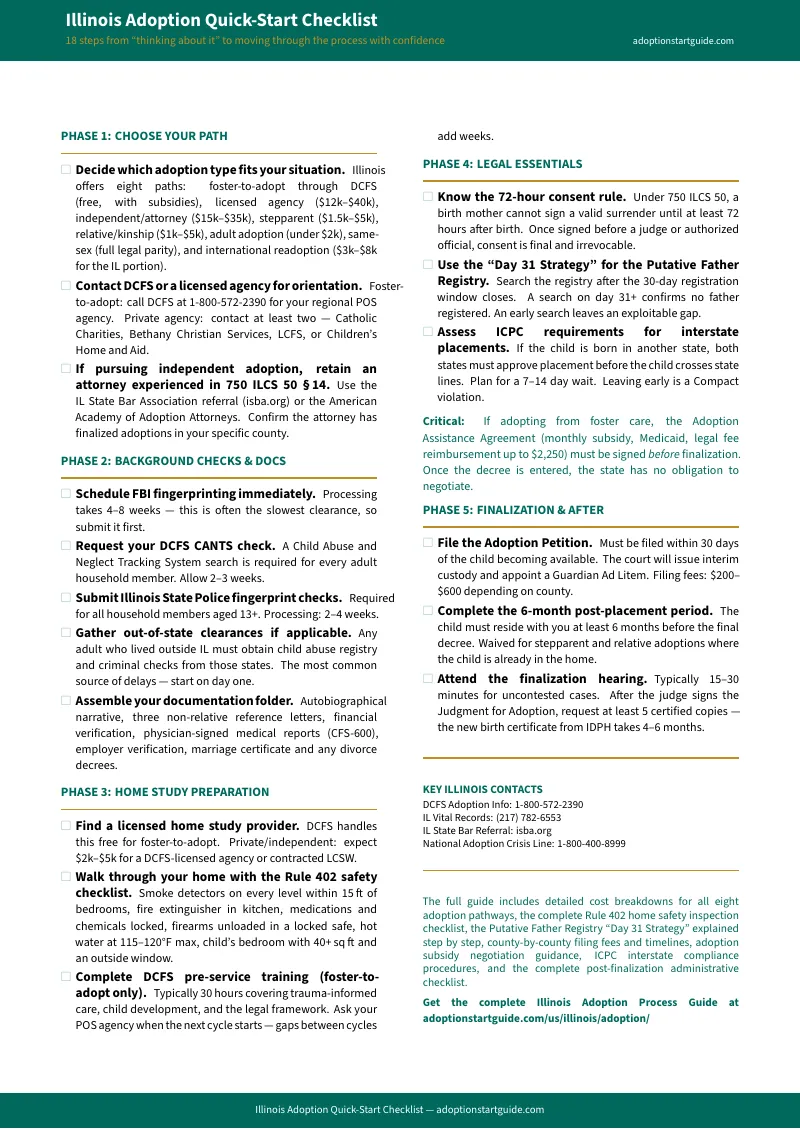
Download the free Illinois Adoption Quick-Start Checklist to see the 18 critical first steps. Or get the complete guide and start your adoption journey with the full picture from day one.