You want to adopt in Kentucky. The system wants you to figure it out from a 400-page DCBS manual.
You went to the Cabinet for Health and Family Services website looking for a clear explanation of how adoption works in Kentucky. What you found was the Standards of Practice Manual — a document written for caseworkers, not parents, buried in regulatory language about SRA approvals, Presentation Summary Packets, and DPP-195 forms. You clicked through to the Administrative Office of the Courts for the petition forms. The forms were there. Instructions for filling them out were not. You called your local DCBS office and got voicemail. You called again and were told your caseworker would call back. That was two weeks ago.
If you are a grandmother in Pike County who just took in your grandchild after your daughter's overdose, the stakes are not academic. You need to know tonight whether asking DCBS for help will trigger a removal, whether you can enroll this child in school without legal custody, and how to get the medical authorization to take them to a doctor tomorrow morning. Kentucky has roughly 55,000 children being raised by relatives — double the national average — and 75% of those kinship caregivers report that the state gave them zero guidance on how to navigate the system. You are not alone in feeling abandoned by the very bureaucracy that placed this child in your home.
The national adoption books on Amazon do not know what a DNA case is. They have never heard of the DPP-195 Presentation Summary Packet. They cannot explain why your foster child's case has been "stuck" for 14 months waiting for a Termination of Parental Rights filing, or what to do when the biological parent completes their case plan checklist but has not actually changed their behavior — and the court keeps granting continuances. And the faith-based agencies like Sunrise Children's Services provide excellent orientation, but their materials are designed to recruit you into their program, not to help you understand the DCBS pipeline independently.
Adoption attorneys in Louisville and Lexington charge $250 to $500 per hour. Every hour you spend in their office asking "What is a TPR?" or "How does the adoption subsidy work?" or "Can my caseworker really block the adoption?" is an hour you could have walked in already understanding. This guide does not replace an attorney. It makes sure you do not pay attorney rates for information that should have been free.
The Bluegrass Adoption Roadmap: Your Step-by-Step Guide Through Kentucky's System
This guide is built for the system Kentucky families actually navigate — the intersection of DCBS bureaucracy, Family Court proceedings, the DNA case pipeline, kinship placement policies, and faith-community resources that no national handbook covers. Every chapter reflects current Kentucky Revised Statutes (KRS Chapter 199 and 625), DCBS Standards of Practice, and the specific financial programs available to families in 2026. It is the operational layer between what CHFS posts online and what you actually need to know to bring your child home — through your pathway, under current law, in your part of the state.
What's inside
- DNA-to-Adoption Pipeline Mastery — Kentucky's Dependency, Neglect, and Abuse court process is the most common pathway to adoption in the state, and it is the one no national guide explains. This chapter walks you through the entire DNA case lifecycle: from the emergency custody order through the disposition hearing, case plan development, the "reasonable efforts" standard, the critical shift from reunification to adoption as the permanent plan, the Termination of Parental Rights filing under KRS 625.090, and the specific evidentiary standard — "clear and convincing evidence" — that the court must find. You will understand the Presentation Summary Packet (DPP-195), the SRA approval process, and exactly what needs to happen before a TPR petition moves forward. When your caseworker says "we're changing the goal," you will know what that means and what comes next.
- The KinFirst Kinship Roadmap — Kentucky's KinFirst policies are designed to keep children with family, but 75% of kinship caregivers say they were never told about the financial support they are entitled to receive. This chapter is the first clear guide for Kentucky's 55,000 kinship families to move from informal care to legal permanency — covering relative placement preference under KRS 620.090, the difference between temporary custody, permanent custody, and adoption, how to formalize your arrangement without risking removal of the child, and every financial benefit that formalization unlocks: the full foster care per diem, Medicaid, clothing allowances, and the adoption subsidy if you proceed to finalization.
- Cost-Reduction Framework and Hidden Subsidies — The Adoption Assistance Agreement is the single most important financial document in a Kentucky adoption, and most families do not realize it must be negotiated and signed before the finalization decree. Once the judge signs, your leverage disappears entirely. This chapter identifies the specific subsidies in Kentucky law that even some attorneys overlook: monthly maintenance payments based on the child's level of need, Medicaid continuation, non-recurring adoption expense reimbursement (up to $2,000), the federal adoption tax credit ($17,280 per child), Show Hope grants ($8,000-$12,000), Kentucky Baptist Foundation grants, and the critical rule about negotiating NAS/NOWS-related medical support into the agreement before it is too late.
- DCBS Escalation Toolkit — "My caseworker won't return my calls" is the most common complaint from Kentucky adoptive families. This chapter provides the escalation path that no DCBS manual publishes: how to document every interaction, when to contact the Service Region Administrator, how to file a complaint with the State Ombudsman, email templates for moving a stalled case out of your caseworker's desk, and your rights as a foster parent under KRS 620.350. When the system goes silent, this is your playbook for making it respond.
- All Adoption Pathways Compared — Foster-to-adopt through DCBS is free and includes subsidy payments. Private domestic infant adoption through a licensed agency runs $25,000 to $50,000. Independent adoption through an attorney costs $10,000 to $25,000. Stepparent adoption ranges from $500 to $3,000. Kinship adoption costs $500 to $2,000 when done through the DNA pipeline. This chapter lays out the realistic costs, timelines, consent requirements, and KRS citations for each pathway so you choose the right track before spending money on the wrong one.
- Home Study Preparation — Every background check (FBI fingerprinting, DCBS Central Registry check, local sheriff's records check, out-of-state clearances), medical exam, reference letter, and home safety requirement under the DCBS Standards of Practice. This chapter includes room-by-room safety inspection standards, firearm storage requirements, the specific documentation your R&C worker needs at each visit, and preparation strategies for families in Eastern Kentucky where DCBS offices are hours apart and caseworker turnover means your licensing worker may change mid-process.
- Family Court Finalization Walkthrough — Kentucky adoptions finalize in Family Court (formerly Circuit Court, Family Division). This chapter covers the petition filing requirements under KRS 199.470, the interlocutory order, the mandatory 90-day probationary period, the final order hearing, court filing fees by county, and what to expect in the courtroom — including the questions judges typically ask and the documents you must bring. Includes guidance on Jefferson County (Louisville) and Fayette County (Lexington) procedures, the two highest-volume adoption courts in the state.
- Post-Adoption Contact and Open Adoption Framework — In Kentucky's close-knit communities, particularly in families touched by the opioid crisis, "openness" with biological parents in recovery often starts informally — and informality leads to boundary violations. This chapter explains how to use Kentucky's Post-Adoption Contact Agreement provisions to formalize contact terms, protect your family's boundaries, and create an enforceable structure that serves the child's best interest.
- NAS/NOWS Medical and Educational Roadmap — Many children adopted through Kentucky's DNA pipeline were prenatally exposed to opioids. This chapter covers what Neonatal Abstinence Syndrome and Neonatal Opioid Withdrawal Syndrome mean for the child's medical care and educational needs, how to access Kentucky's "First Steps" early intervention program, the Medicaid-to-Adoption card that continues coverage, and how to advocate for an Individualized Education Program (IEP) — the step many adoptive parents wish they had taken during the finalization phase, not years later.
- Faith Community and Grant Resources — Kentucky's adoption ecosystem is deeply connected to the faith community. This chapter maps the key organizations and the specific financial support they offer: Southeast Christian Church's "A Home for Me" program and WRAP teams in Louisville, Lexington Baptist's "Families of Hope" resources, CarePortal connections through Immanuel Baptist, Orphan Care Alliance's life coaching and interest-free loans, Show Hope grants, and the Kentucky Baptist Foundation's adoption assistance. These are not vague referrals — they are specific programs with specific application processes.
Printable standalone worksheets included
- Adoption Timeline Tracker — Every milestone from initial inquiry through finalization, with fill-in date fields. Print it, update it after every DCBS contact, and always know exactly where your case stands in the pipeline.
- Home Safety Inspection Checklist — Room-by-room walkthrough of every DCBS safety standard, including firearm storage, medication lock-up, and the documentation your R&C worker will request. Walk your house with this before the inspector arrives.
- Caseworker Communication Log — Date, name, topic, and outcome fields for every DCBS interaction. When your caseworker changes — and in Kentucky, they will — hand this to the new one. It may prevent you from restarting work you already completed.
- Financial Planning Worksheet — Adoption subsidy calculations, per diem vs. subsidy comparison, grant tracking, and a side-by-side cost breakdown so you can see exactly what each pathway costs and what financial support is available.
Who this guide is for
- Foster families waiting on a TPR — You have been fostering this child for months or years. The goal changed from reunification to adoption. Now you need to understand the Presentation Summary Packet, the SRA approval process, and how to keep the case moving when the system stalls. This guide shows you the entire DNA-to-adoption pipeline so you stop feeling like a bystander in your own family's future.
- Kinship caregivers — especially grandparents in Eastern Kentucky — You took in your grandchild because there was no one else. You are raising them on a fixed income with no state support because nobody told you the support existed. This guide walks you from informal care to legal permanency and unlocks the financial benefits you have been missing.
- Couples pursuing private infant adoption — You are working with an agency or attorney in Louisville or Lexington. You need to understand birth parent consent timelines, revocation risks, the home study standards, and how to budget realistically for a process that costs $25,000 to $50,000 — including the grants and tax credits that can reduce your out-of-pocket costs significantly.
- Stepparents formalizing an existing family — You have been parenting this child for years. You want the legal status to match the reality. This guide covers the consent or TPR process for the non-custodial parent, the streamlined court procedure, and the specific forms you need to file without paying an attorney $2,000 for a process that should cost a fraction of that.
Why not piece it together from free resources?
You could try. The DCBS Standards of Practice Manual is online — all 400 pages of it, written in regulatory language for caseworkers, not families. The Administrative Office of the Courts publishes the petition forms, but not the instructions. Sunrise Children's Services has excellent training materials, but they are designed to recruit foster parents into their agency, not to help you navigate the broader DCBS system independently. Adoption Support for Kentucky (ASK) provides post-adoption peer support, but they do not cover the pre-adoption legal roadmap. The Orphan Care Alliance offers trauma training and small grants, but not the procedural details of how to move a case through Family Court.
Reddit and Facebook groups like "Kentucky Adoptive Families" give you raw experience — one family's caseworker story, another family's courtroom anecdote. But they are anecdotal, often outdated, and can lead to decision paralysis when three different people give three different answers about how TPR works.
The result is 30 browser tabs, a stack of contradictory advice, and the persistent feeling that you are missing something critical. In Kentucky adoption, the thing you miss — the unsigned subsidy agreement, the unescalated stalled case, the NAS medical support you did not negotiate into the adoption agreement — can cost you thousands of dollars or months of delay.
This guide consolidates it into one document. One read-through for the full picture. One reference to keep open as you move through each phase.
Satisfaction guarantee
If this guide does not deliver what this page promises, email [email protected] for a full refund. No questions, no hoops.
— Less Than 15 Minutes with a Kentucky Adoption Attorney
A single consultation with an adoption attorney in Louisville or Lexington costs $250 to $500 per hour. This guide covers every question most families spend that first meeting asking — the adoption pathways, the DNA pipeline, the consent rules, the home study requirements, the subsidies, the court procedures — for less than the cost of parking at the attorney's office. You will still need an attorney for parts of your adoption. But you will walk into that meeting prepared, focused, and ready to use their time on your specific situation instead of basic orientation.
Over 8,000 children are in Kentucky's foster care system. Roughly 55,000 are being raised by relatives with little or no state guidance. The system is overwhelmed, and the families inside it deserve better than a 400-page manual and a voicemail box. This guide is the bridge.
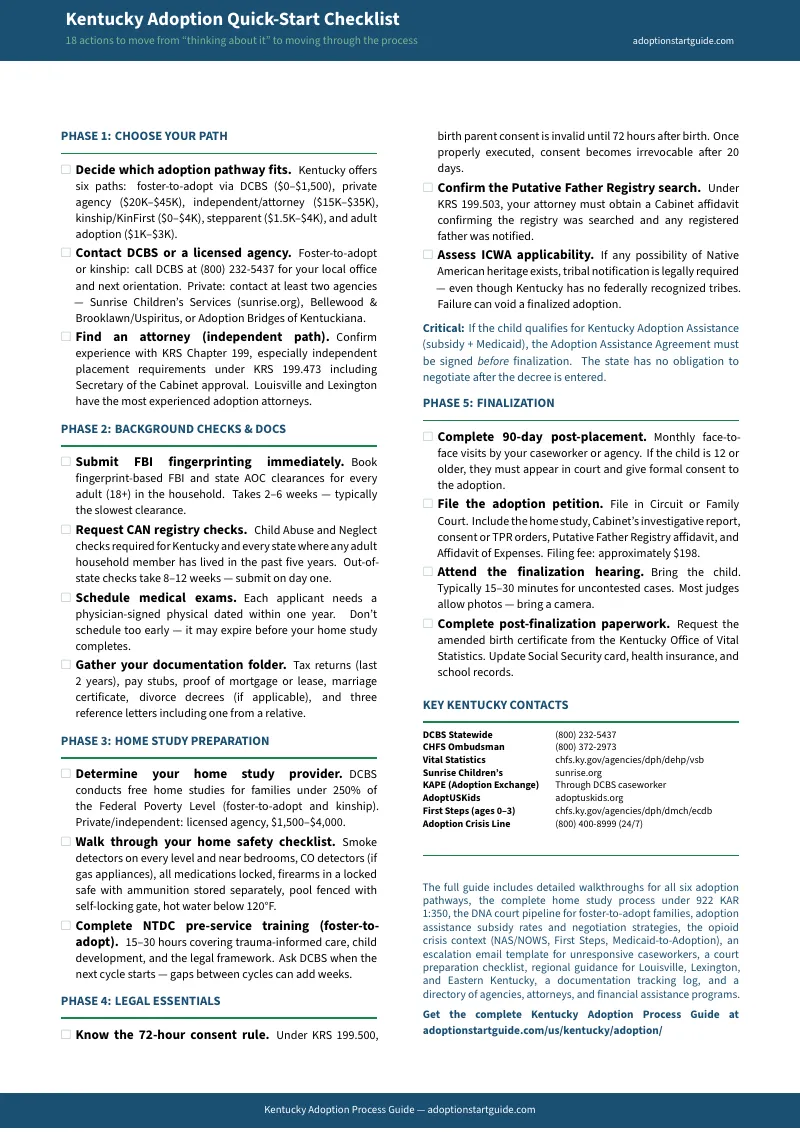
Download the free Kentucky Adoption Quick-Start Checklist to see the essential action items, or get the complete guide for the full Bluegrass Adoption Roadmap, financial optimization strategies, DCBS escalation tools, and every worksheet you need to move your adoption forward.