You want to foster in Michigan. And nobody will tell you whether to call the state or a private agency.
You searched "how to become a foster parent in Michigan" and landed on the MDHHS website. You found a phone number, a few PDFs, and a form called CWL-3889. You filled it out. Maybe someone called you back. Maybe they didn't — Wayne County's caseworkers carry 30 cases each, and your inquiry is sitting in a queue behind active child removals. You called a friend at church who fostered through Bethany Christian Services, and she told you her experience was nothing like the state process. Her worker had 19 families, not 30. Her training was called PRIDE, but when you searched for the PRIDE schedule, you couldn't find one — because Michigan switched to a new curriculum called GROW two years ago, and nobody updated the church newsletter.
Here is the part nobody explains: Michigan runs a hybrid system. You have the legal right to get licensed through MDHHS directly, or through any of dozens of private Child Placing Agencies — Bethany, Samaritas, Judson Center, D.A. Blodgett-St. John's, Catholic Social Services, Wellspring, U.P. Kids, and others. Each CPA sets its own training schedule, assigns its own caseworkers, and has its own religious or philosophical orientation. MDHHS doesn't compare them. The CPAs don't compare themselves to each other. Nobody compares either track to the state track. You are expected to make the most consequential decision of the entire licensing process — who will supervise your home, your training, and your placements for years — with no objective information whatsoever.
Then there are the fingerprints. Michigan requires Identogo electronic fingerprinting for every adult in the household, and the results are valid for one year. If you schedule them too early — before your training is done or your home study has started — they expire and you pay $40 to redo them. If you schedule them too late, your license application stalls while you wait for FBI clearance. The MDHHS website tells you that fingerprints are required. It does not tell you when in the process to schedule them so they don't expire before your license is issued.
Maybe you live in Detroit or Flint and your house was built in 1952. The fire safety inspection requires interconnected smoke detectors on every level and carbon monoxide detectors near sleeping areas. But nobody mentions the lead paint question — homes built before 1978 in Detroit have a near-certain probability of containing lead-based paint, and while MDHHS doesn't require formal abatement, the home study evaluator will flag peeling or chipping paint as a safety hazard. You don't need a $10,000 abatement. You might need a $200 paint job on two window frames. But if nobody tells you what the evaluator actually looks for, you spend three weeks panicking about the wrong thing.
Maybe you are a grandparent in Saginaw whose daughter just lost custody, and Children's Protective Services placed her kids with you on an emergency basis. Someone at the MDHHS office told you that you're an "approved" relative caregiver. But nobody explained the difference between "approved" and "licensed" — and the difference is money. Approved relatives receive a lower support rate. Licensed relatives receive the full foster care reimbursement of $312 to $373 per month per child, plus Medicaid, clothing allowances, and respite care. Becoming licensed while you already have the children in your home is a different process than licensing from scratch, and the MDHHS website does not distinguish between the two.
Maybe you are fostering a child who might have tribal ancestry, and someone mentioned ICWA. Michigan has 12 federally recognized tribes and its own state law — the Michigan Indian Family Preservation Act — that codifies ICWA requirements into the state system. You've heard stories about foster parents "losing a child to the tribe." What you haven't heard is how the Qualified Expert Witness process actually works, what tribal notification means for your specific case, and how dozens of Michigan foster families have built genuine partnerships with tribal child welfare offices. Nobody translates the legal requirements into what they mean for your daily life as a foster parent. They just let you stay scared.
The Michigan Licensing Navigator
This guide exists because Michigan's hybrid foster care system creates an information gap that neither the state nor any private agency has an incentive to fill. MDHHS won't tell you that a CPA might serve you better. Bethany won't tell you that MDHHS is free. Neither side will tell you how to time your fingerprints, what a Detroit fire inspector actually flags, or how to get licensed as a kinship caregiver who already has kids in the home. The Michigan Licensing Navigator is the impartial roadmap that the system itself refuses to provide.
What's inside
- CPA vs. MDHHS Decision Framework — An objective comparison of Michigan's dual-track licensing system. Private Child Placing Agencies typically carry 19 families per worker versus MDHHS's target of 30. CPAs offer more flexible training schedules and more personalized support, but some have religious requirements or placement preferences that may not match your family. MDHHS is the direct pipeline to the state system with broader placement options, but caseworker turnover and caseload volume mean slower response times — especially in Wayne and Genesee counties. This chapter maps both paths with honest trade-offs so you choose the right track before you invest months in the wrong one.
- Fingerprint Timing Strategy — Michigan Identogo fingerprint results expire after one year. Schedule them in month one and they could expire before your license is issued. Schedule them in month nine and your application stalls waiting for FBI clearance. This chapter gives you the exact window — relative to your training schedule and home study timeline — to schedule Identogo appointments so results are current when your license is approved. One correct scheduling decision saves you $40 in re-fingerprinting fees and weeks of delay.
- Michigan Home Safety Walkthrough — What the licensing worker actually checks during the home inspection, room by room. Interconnected smoke detectors on every level. Carbon monoxide detectors near sleeping areas. Locked medication and cleaning supply storage. Firearms secured in a locked container with ammunition stored separately. Pool and trampoline requirements. And the Detroit-specific concerns: lead paint in pre-1978 homes (what triggers a flag versus what requires remediation), sump pump wiring in basements used as living space, and Federal Pacific electrical panels that appear in thousands of Metro Detroit homes built between 1950 and 1980. Also covers the Upper Peninsula reality — wood-burning stove clearances, well water testing, and what happens when the nearest fire station is 45 minutes away.
- PRIDE-to-GROW Training Decoder — Michigan replaced PRIDE pre-service training with the GROW curriculum (Grow, Recognize, Obtain, Work). If you search online, half the resources still reference PRIDE. Church groups still call it PRIDE. Your neighbor who fostered in 2019 will tell you about PRIDE. This chapter explains what GROW actually covers, the minimum training hours required, what to expect at each session, and how CPA training schedules differ from MDHHS's schedule — because CPAs often offer evening and weekend sessions that the state does not.
- ICWA and MIFPA Plain-English Guide — Michigan's 12 federally recognized tribes and the Michigan Indian Family Preservation Act explained without legal jargon. What tribal notification means in practice. How the Qualified Expert Witness requirement works. What "active efforts" means versus "reasonable efforts." The specific tribes operating in each region of the state — Bay Mills and Sault Ste. Marie in the Upper Peninsula, Grand Traverse Band in the northwest, Saginaw Chippewa in the central region, Nottawaseppi Huron Band in the southwest. This chapter replaces fear with understanding, because the foster parents who build relationships with tribal child welfare offices have better outcomes for the children in their care.
- Kinship Licensing Pathway — The step-by-step process for relatives who already have children placed in their home and want to move from "approved" to "licensed" status. Why licensing matters: higher monthly reimbursement ($312-$373 per child), Medicaid eligibility, clothing allowances, respite care access, and priority standing in permanency hearings. This chapter covers the accelerated licensing process for kinship caregivers, the background check requirements for every adult in the household, and the home safety standards that apply even when the children are already living with you.
- Regional Agency Directory — Michigan CPAs organized by region: Metro Detroit (Judson Center, Catholic Social Services, Orchards Children's Services), West Michigan (Bethany Christian Services, D.A. Blodgett-St. John's, Catholic Charities West Michigan), Central Michigan (Wellspring, Samaritas), and the Upper Peninsula (U.P. Kids). Each listing includes the agency's religious affiliation (if any), geographic service area, placement specialties, and whether they handle foster-only, adopt-only, or both. Also includes the MDHHS county office contact information for families who choose the state track.
- Michigan Reimbursement and Financial Guide — Current foster care daily reimbursement rates by child age group. The Fostering Futures program for youth aging out. Clothing allowances, school supply reimbursements, and the annual holiday allowance. How to request a rate increase for children with higher needs. The adoption subsidy negotiation that must happen before finalization if your foster child's case plan changes to adoption. Tax implications — foster care reimbursements are not taxable income, but adoption subsidies have different rules. Covers the financial reality honestly, including what the reimbursement does and does not cover.
Printable standalone worksheets included
- Licensing Timeline Tracker — Every milestone from first orientation through license approval, with fill-in date fields organized for both the CPA track and the MDHHS track. Includes the fingerprint scheduling window, training session dates, home study visit dates, and document submission deadlines so nothing expires before your license is issued.
- Home Safety Inspection Checklist — Room-by-room walkthrough matching MDHHS licensing standards. Smoke detectors, CO detectors, medication storage, firearms storage, water temperature, outdoor hazards, pool barriers, and the region-specific items for Detroit housing stock, UP rural properties, and everywhere in between. Print it, walk your home, fix what needs fixing before the inspector arrives.
- Document Preparation Checklist — Every form, clearance, and supporting document required for a Michigan foster care license application — CWL-3889 application, Identogo fingerprint receipt, ICHAT background check, medical examination forms, reference letters, employment verification, fire inspection report, and the items that vary by CPA. Organized in submission order so you're not scrambling to locate documents the week before your home study.
Who this guide is for
- Metro Detroit families starting from scratch — You live in Wayne, Oakland, Macomb, or Washtenaw County and you've been going back and forth between the MDHHS website and private agency brochures for weeks. The CPA vs. MDHHS Decision Framework gives you the comparison neither side will provide, so you pick the right track and start moving forward instead of researching in circles.
- West Michigan families from faith communities — Your church held a foster care drive. You felt called. You contacted Bethany or Catholic Charities, and now you're wondering whether a faith-based CPA is the right fit or whether you should go through the state. The guide gives you an honest comparison — including the religious expectations that CPAs may have — so you choose based on facts, not just proximity to your congregation.
- Kinship caregivers who already have the kids — You are a grandparent, aunt, uncle, or older sibling who took in a relative's children when CPS got involved. You were told you're "approved" but you keep hearing that "licensed" means more support. The Kinship Licensing Pathway chapter walks you through the process of upgrading your status without disrupting the children who are already settled in your home.
- Upper Peninsula families — You live in Marquette, Houghton, or the Keweenaw and your nearest CPA is U.P. Kids. The guide covers what fostering looks like when the nearest court is a two-hour drive, when winter makes home visits unpredictable, and when the agency options that Metro Detroit families take for granted simply don't exist in your region.
- Dearborn and Arab American families — You want to foster or provide kinship care within the cultural framework of your community. The guide covers how to navigate Michigan's secular licensing requirements while maintaining religious and cultural practices — Halal dietary standards, faith preservation, and the culturally specific support organizations that can advocate alongside you during the process.
- Families concerned about ICWA — You've heard that fostering a child with tribal heritage means you could "lose the child." The ICWA/MIFPA chapter explains what actually happens in tribal notification cases, what the Qualified Expert Witness process involves, and how the 12 Michigan tribes participate in child welfare — so you make placement decisions based on understanding, not rumor.
Why the free resources fall short
The MDHHS website gives you forms and phone numbers. It does not tell you whether a private agency would serve you better, how to time your fingerprints, or what a Detroit home inspector actually flags versus what they ignore. CPA websites tell you why their agency is great — they won't tell you how they compare to the agency across town or to the state system. Church newsletters share personal testimonies that inspire you to start but don't prepare you for the six-to-twelve months of bureaucracy between your first phone call and your first placement.
Facebook groups like "Michigan Foster Parents" and "Fostering Michigan" are full of real parent experiences — and full of advice that was accurate in 2019 but is wrong in 2026. PRIDE training hasn't existed in Michigan for years, but experienced parents still call it PRIDE. The background check sequence has changed. The reimbursement rates have changed. The MiSACWIS data system that caseworkers use has changed. A guide written by someone who fostered five years ago is a guide that tells you how to navigate a system that no longer exists.
National foster care books on Amazon cover trauma-informed parenting and the emotional journey — both genuinely important. None of them explain Michigan's dual-track CPA system, the 12 tribal jurisdictions, the GROW curriculum, or the specific housing concerns in a state where half the housing stock in major cities was built before lead paint was banned. The Michigan system is different enough from every other state that a national guide is a starting point, not a solution.
The free Quick-Start Checklist
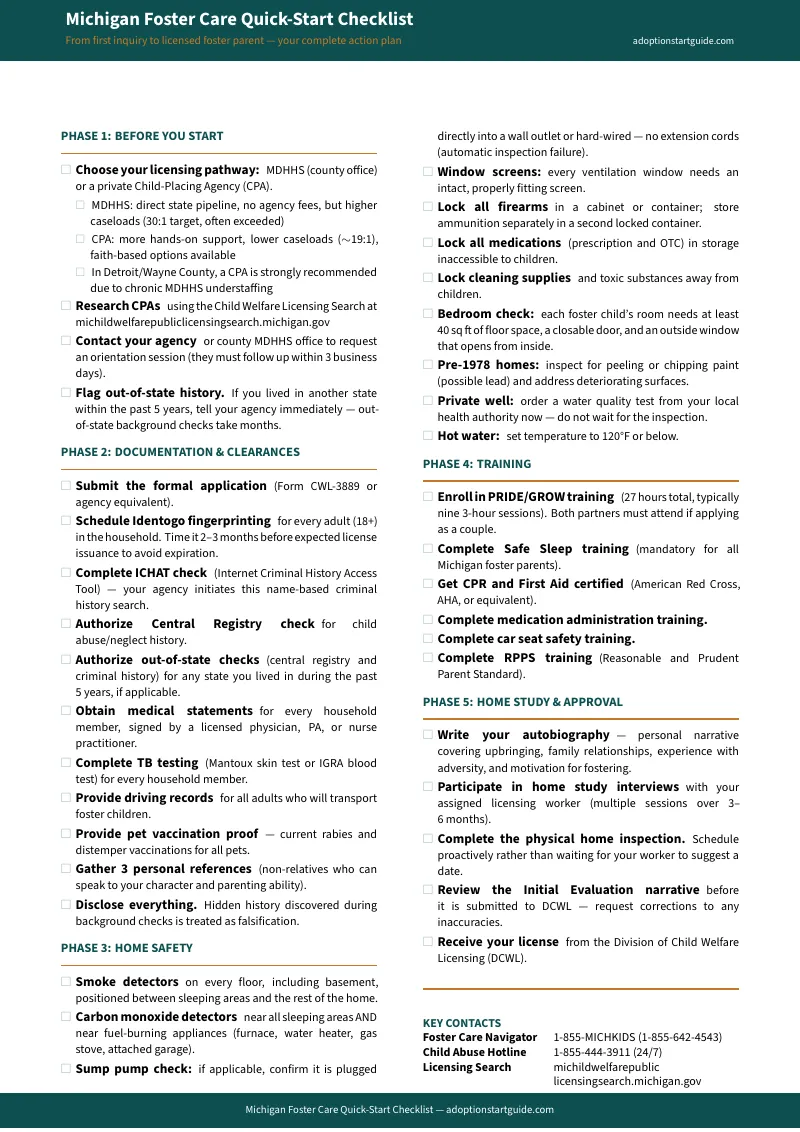
Download the Michigan Foster Care Quick-Start Checklist for a structured overview of the licensing process — from the CPA vs. MDHHS decision through home study preparation. Free, no commitment. It includes the key milestones, the document list, and the home safety essentials that every Michigan home needs before the inspection. If you want the full guide with the CPA Decision Framework, the Fingerprint Timing Strategy, the ICWA/MIFPA chapter, the regional agency directory, and the printable worksheets, click the button in the sidebar.
— less than one re-fingerprinting appointment
Identogo re-fingerprinting costs $40. A missed training session delays your license by a month. A failed home inspection because nobody told you about the CO detector requirement means rescheduling and waiting another four to six weeks. Twenty hours spent clicking through the MDHHS website, cross-referencing outdated Facebook posts, and calling agency numbers that go to voicemail is twenty hours you could have spent preparing your home and your family. This guide puts the entire Michigan licensing system — both tracks compared honestly, the fingerprint timing solved, the home safety standards mapped room by room, and the ICWA requirements translated into plain English — in your hands for less than the cost of a single re-fingerprinting fee. Families who understand the process before they enter it choose the right agency, schedule the right appointments in the right order, and get licensed without paying to redo steps they could have gotten right the first time.
If the guide doesn't deliver, reply to your download email at any time for a full refund. No forms. No justification required.