
Mississippi runs every adoption through two separate courts — and nobody tells you that until you're already in the wrong one.
You started with the MDCPS website. You were looking for a clear path to adoption in Mississippi. What you found was a collection of policy documents written for caseworkers. Dense administrative language about "permanency dispositions" and "TPR proceedings" with no explanation of what they mean for your family. A reference to Youth Court jurisdiction but no mention of what happens after Youth Court is done. You expected a roadmap. You got an internal compliance manual.
So you searched for "how to adopt in Mississippi" online. A national guide told you that birth mothers get 30 days to revoke consent. That's not Mississippi law. In Mississippi, consent cannot be signed until 72 hours after birth — and consent signed even one minute early is void under MCA § 93-17-5. Once properly executed, it is irrevocable. Someone on Reddit said you just need to file a petition in your county courthouse. They didn't mention that Mississippi splits adoption proceedings between Youth Court and Chancery Court, and that filing in the wrong court doesn't just delay your case — it can require you to start over entirely.
Then you tried the agencies. Canopy Children's Solutions has a polished website. Catholic Charities of Jackson lists their services. Bethany Christian Services describes their programs. What none of them will tell you is that under House Bill 1523, private faith-based agencies in Mississippi can legally refuse to serve LGBTQ+ families — and that there's no public list of which agencies apply this exemption and which don't. They won't explain the dual-court handoff. They won't mention the Olivia Y. consent decree that created two decades of federal oversight over Mississippi's child welfare system. They won't tell you that the Mississippi Band of Choctaw Indians has exclusive jurisdiction over adoptions on reservation lands, and that failing to notify the tribe can void your adoption years after finalization. They are marketing to you. They are not guiding you.
Meanwhile, a Mississippi Chancery attorney charges $250 to $350 per hour. A private agency adoption runs $15,000 to $40,000. An independent adoption costs $8,000 to $25,000. And foster-to-adopt — the pathway that costs families almost nothing out of pocket — has a transition from Youth Court to Chancery Court that nobody explains in one place.
The Dual-Court Adoption Navigator: Your Operational Guide to Adopting in Mississippi
This guide is built for Mississippi's actual adoption system — the dual-court one, not the simplified version on the state website. Every chapter addresses the specific statutes under MCA § 93-17, the operational differences between Youth Court and Chancery Court, the religious exemption landscape under HB 1523, and the tribal sovereignty requirements that national guides have no framework for. It's not a repurposed handbook from another state with "Mississippi" pasted in the header. It's the layer between what MDCPS publishes for its own staff and what you actually need to know to adopt — in your county, under the rules that apply right now, updated for the Pathway to Permanency Act 2023, HB 1395 records access effective July 2025, and the May 2026 motion to dismiss the Olivia Y. consent decree.
What's inside
- Complete Dual-Court System Explanation with Pathway Decision Tree — This is the chapter that prevents the most expensive mistake in Mississippi adoption. Youth Court handles abuse, neglect, and involuntary termination of parental rights. Chancery Court holds original exclusive jurisdiction over voluntary TPR and finalization of adoption petitions. Every adoption in this state crosses from one court to the other at some point — and the timing, paperwork, and attorney requirements change at the handoff. National guides treat this as a single-court process because most states operate that way. Mississippi doesn't. This chapter maps the exact transition points, tells you which court you file in first based on your pathway, and includes a visual decision tree so you never stand in the wrong courthouse wondering why the clerk won't accept your petition.
- All 7 Adoption Pathways Compared — Costs, Timelines, and Eligibility — Mississippi allows seven distinct routes to adoption: foster-to-adopt through MDCPS, private licensed agency, independent adoption, stepparent adoption, kinship adoption, adult adoption, and international readoption. Most families don't realize they have a choice until they're already months into the wrong pathway. This chapter lays out every pathway side by side — what each one costs, how long it takes, what the court requires, and who it's best suited for. Foster-to-adopt is near zero out-of-pocket. Private agency runs $15,000 to $40,000. Independent adoption sits at $8,000 to $25,000. Stepparent adoption can be filed pro se for under $500. You need this comparison before you talk to a single agency, because the agency will only tell you about the pathway they offer.
- 72-Hour Consent Rule and Putative Father Protections — Under MCA § 93-17-5, a birth mother cannot sign consent until 72 hours after the child is born. Consent signed even one minute before that 72-hour mark is legally void — not voidable, void. The A.D.R. v. J.L.H. exception adds additional complexity when the birth father is not the mother's husband. The putative father has 30 days after birth to register his interest, and failure to do so can terminate his rights. This chapter covers both timelines in detail: the hospital protocol during the 72-hour wait, the mechanics of consent execution, irrevocability once properly signed, and the putative father registration process that protects your adoption from a legal challenge surfacing months after placement.
- Home Study Preparation — Safety Checklist, Background Checks, Documentation — Mississippi's home study evaluates your home, your background, your finances, and your readiness to parent an adopted child. The background check includes both state criminal records and the MDCPS Central Registry. The home safety inspection covers firearms storage, medication lockup, pool barriers, and smoke detectors. The home study is valid for one year — after that, you pay for a new one. This chapter covers every section of the evaluation, every document you need organized before the social worker arrives, and the specific Mississippi requirements that differ from the generic national checklist your agency might hand you. The families who pass on the first visit are the ones who prepared with a Mississippi-specific list, not a federal template.
- ICWA and Choctaw Sovereignty Compliance — The Mississippi Band of Choctaw Indians has exclusive jurisdiction over child custody proceedings on reservation lands. This isn't optional compliance — it's constitutional law reinforced by the U.S. Supreme Court in Mississippi Band of Choctaw Indians v. Holyfield. If a child has any potential tribal affiliation and you fail to notify the tribe, your finalized adoption can be vacated years later. Under ICWA, birth parents have a 10-day consent window (not 72 hours), tribal notification follows specific placement preference requirements, and the evidentiary standard for TPR is "beyond a reasonable doubt" with qualified expert testimony. This chapter provides the tribal notification process, the placement preference hierarchy, the documentation requirements, and the specific steps that prevent a completed adoption from being unwound because someone skipped a federal requirement.
- HB 1523 Navigation for LGBTQ+ Families — Mississippi's Protecting Freedom of Conscience from Government Discrimination Act allows private faith-based adoption agencies to decline services based on sincerely held religious beliefs. This means an LGBTQ+ couple can be turned away from a private agency with no legal recourse under state law. There is no public registry of which agencies apply this exemption. This chapter provides screening questions to ask during your first agency call, identifies the public MDCPS foster-to-adopt pathway that does not carry religious exemptions, maps out-of-state agency partnerships that serve Mississippi families, and gives you a concrete strategy so you don't spend months in an intake process only to be declined at the home study stage.
- Chancery Court Finalization — Venue Rules, Mandatory Attachments, Priority Docketing — Every Mississippi adoption ends in Chancery Court. The petition must include specific mandatory attachments: the consent of the birth parents, the home study report, the Guardian Ad Litem's report, a physician's health certificate, and the background check clearance. Venue rules determine which county's Chancery Court hears your case — and getting the venue wrong means refiling in a different county. The Pathway to Permanency Act 2023 introduced priority docketing for adoption cases, meaning courts must schedule your hearing ahead of most other civil matters. This chapter tells you exactly what to file, where to file it, what the judge expects at the hearing, and how to use priority docketing to compress your timeline.
- Financial Support — Every Dollar Available to Mississippi Adoptive Families — This is the chapter that pays for the guide many times over. Mississippi adoption assistance rates range from $325 to $900 per month depending on the child's needs level. Medicaid coverage continues after finalization for eligible children. Mississippi reimburses up to $600 in non-recurring adoption expenses. The federal adoption tax credit provides up to $17,280 per child. Mississippi offers a state adoption tax credit of $10,000 for special needs adoptions and $5,000 for non-special-needs adoptions. This chapter includes a cost comparison table across all seven pathways, the adoption assistance rate schedule, the application process for each financial program, and the tax credit calculation so you can model your actual out-of-pocket cost before you commit to a pathway.
- Olivia Y. Consent Decree — Impact on Your Timeline — For over 20 years, Mississippi's child welfare system operated under federal court oversight due to systemic failures in foster care. The Olivia Y. consent decree affected caseloads, caseworker turnover, and administrative processing times across MDCPS. In May 2026, the state filed a motion to dismiss the decree, arguing substantial compliance. Whether the decree remains or is lifted, its legacy shapes the system you're navigating today — particularly if you're adopting through the foster-to-adopt pathway. This chapter explains what the consent decree means for your case, how it affects MDCPS processing times, and what changes to expect if the motion to dismiss succeeds.
- Records Access Under HB 1395 — Effective July 1, 2025, HB 1395 changes how adopted individuals access their original birth certificates and adoption records in Mississippi. This chapter covers who qualifies, the request process, contact preference forms, and what adoptive families should know now about conversations they'll have with their children later. Understanding the records landscape before finalization means you can make informed promises to birth families and prepare for the questions your child will eventually ask.
- Safe Haven Law — Mississippi's Safe Haven statute allows a parent to relinquish an infant at a designated safe haven location within specific timeframes without criminal prosecution. This chapter covers the legal framework, the connection to subsequent adoption proceedings, and what prospective adoptive families should understand about children who enter the system through this pathway.
- 7 Risk Areas with Specific Mitigations — The seven most common points of failure in Mississippi adoptions, each with the specific action that prevents it. From consent timing errors that void the entire proceeding to ICWA notification failures that can unwind a finalized adoption years later, from venue mistakes that force refiling to missed putative father registration deadlines. Each risk is paired with the exact step, form, or timeline that eliminates it.
7 standalone printable worksheets included
- Pathway Decision Tree — Answer five questions about your family situation, budget, and timeline, and the decision tree identifies which of Mississippi's seven adoption pathways fits. Print it and use it before your first agency call.
- Home Study Preparation Checklist — Every safety requirement, every document, every room-by-room item the social worker evaluates, organized so you can walk your home with a pen and check off each item before the visit.
- Court Filing Document Checklist — Every mandatory attachment for the Chancery Court petition, in the order the clerk expects to receive them, with checkboxes. Consent, home study, GAL report, health certificate, background clearance — nothing missing on filing day.
- Post-Finalization Checklist — New birth certificate request, Social Security update, insurance enrollment, school records transfer, tax credits, and every other post-decree task that families forget until it becomes urgent.
- Financial Planning Worksheet — Cost comparison across pathways, adoption assistance rate schedules ($325–$900/month), the $600 reimbursement, federal tax credit ($17,280), Mississippi state tax credit ($10,000/$5,000), and an expense tracker — every financial number in one printable sheet.
- ICWA Compliance Checklist — Tribal inquiry steps, notification requirements with the Choctaw registered agent contact, placement preferences, consent timelines, and documentation for cases involving children with potential Native American heritage.
- Agency and Attorney Screening Questions — Questions to ask adoption agencies during your first call (including the HB 1523 screening questions that surface religious exemptions before you invest in intake), plus questions for your adoption attorney about Chancery Court experience and dual-court navigation.
The guide also includes attorney interview templates and a Post-Adoption Contact Agreement (PACA) outline in the appendix chapters.
Who this guide is for
- Foster-to-adopt families navigating the MDCPS system — Your foster child's permanency plan just changed from reunification to adoption. The Youth Court TPR is moving forward, and now you need to understand what happens next: the transition to Chancery Court, the consent paperwork, the finalization petition, and the adoption assistance subsidy that can provide $325 to $900 per month after the decree is entered. MDCPS told you the process would be explained. What they gave you was a stack of policy documents and a caseworker with 40 other cases. This guide is the translation layer between what MDCPS publishes internally and what you need to do at each step.
- Families pursuing private domestic infant adoption — You're in Madison, Ridgeland, or on the Gulf Coast. You've contacted Canopy Children's Solutions or Catholic Charities of Jackson. You know the process costs $15,000 to $40,000 and takes 12 to 24 months. What you don't know is how the 72-hour consent rule actually works at the hospital, what happens if the putative father registers within 30 days, or how to structure the birth mother expenses within Mississippi's legal limits. This guide turns a process that agencies describe in reassuring generalities into a timeline with specific legal checkpoints you can track.
- Kinship caregivers in the Delta and rural Mississippi — A grandchild, niece, or nephew was placed with you because a parent couldn't provide safe care. You may be in Sunflower County or Washington County. You may be on a fixed income. The child is already in your home, but without a legal adoption decree you can't enroll them in school, consent to medical treatment, or access the financial support that would make this arrangement sustainable. A $250-per-hour Chancery attorney is not in the budget. This guide costs less than a single hour of that attorney's time and covers the kinship adoption pathway, the financial assistance programs, and the Chancery Court filing requirements specific to your situation.
- Stepparents formalizing an existing family — You've been parenting this child for years. You do the school pickups, the doctor visits, the bedtime routines. What you need is the legal recognition — the decree that gives you inheritance rights, medical decision-making authority, and the security that doesn't depend on your marriage lasting. You need to understand whether the absent biological parent's consent can be waived, whether you can file pro se in your county's Chancery Court, and what the home study requirement looks like for a child who already lives with you. This guide maps the stepparent pathway from petition to decree.
- LGBTQ+ couples navigating HB 1523 — You've already been turned away or you're bracing for it. You know Mississippi law allows private faith-based agencies to decline your application, and you don't know which agencies will and which won't until you're sitting in their office. You need a strategy, not a political argument. This guide identifies the public MDCPS pathway that doesn't carry religious exemptions, provides screening questions that surface an agency's position before you invest in their intake process, and maps alternative pathways so you can adopt in Mississippi without spending months discovering which doors are closed.
Why the free resources aren't enough
The MDCPS website publishes policies. Dense administrative documents written for caseworkers and compliance officers — not for families trying to understand whether they file in Youth Court or Chancery Court first. The site references the dual-court system without explaining the transition. It lists agencies without noting which ones apply HB 1523 exemptions. It mentions ICWA without explaining the Choctaw sovereignty implications specific to Mississippi. It's an institutional resource for professionals, not a planning tool for families.
The Mississippi Bar Association publishes a pamphlet titled "What Are the Steps in Adopting a Child?" It covers the basics — the age requirement of 21, the need for a physician's health certificate, the existence of a home study. Then it tells you to hire an attorney. That's not guidance. That's a referral.
Canopy Children's Solutions and Catholic Charities of Jackson have informational pages designed to bring you into their programs. They won't compare their fees to a competitor's. They won't explain that an independent adoption with your own attorney might be faster and less expensive. They won't mention HB 1523 if it applies to their own agency. They're selling a service, not providing neutral guidance.
US Legal Forms sells a Mississippi adoption document package for $59 to $149. You get blank templates with no guidance on how to fill them out, no explanation of the dual-court handoff, no instruction on GAL appointments, and no coverage of the 72-hour consent mechanics. A template without context is just paper.
National adoption books on Amazon cost $15 to $30 and don't know that Mississippi splits proceedings between two courts, that consent signed before 72 hours is void, that HB 1523 creates a legal landscape unlike any other state, or that the Mississippi Band of Choctaw Indians has exclusive jurisdiction that can void your adoption years after finalization. A book written for all 50 states cannot tell you any of this because Mississippi's system doesn't work like the other 49.
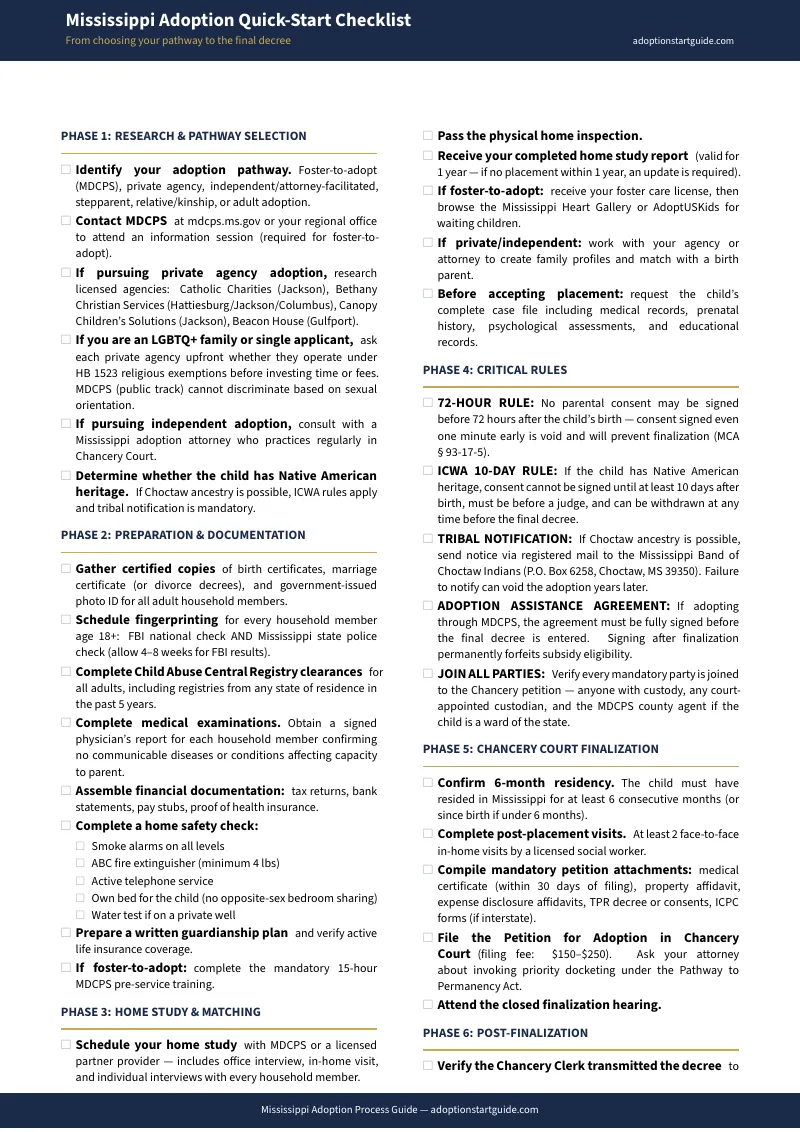
The free Quick-Start Checklist
Download the Mississippi Adoption Quick-Start Checklist for a one-page overview of the adoption process, from choosing your pathway through your Chancery Court finalization hearing. Free, no commitment. It covers what to do. If you want the full guide with the dual-court system explanation, all seven pathways compared, the 72-hour consent mechanics, HB 1523 navigation strategy, ICWA compliance protocol, financial support calculations, nine printable worksheets, and the Mississippi resources directory, click the button in the sidebar.
— less than one hour of attorney time to navigate a system that trips up families who don't prepare
Mississippi Chancery attorneys bill $250 to $350 per hour. A single consultation covers your specific questions but not the full landscape of pathways, timelines, financial programs, and legal pitfalls. This guide covers all of it — the dual-court system that no national resource explains, the 72-hour consent rule that voids improperly timed signatures, the HB 1523 reality that LGBTQ+ families need to navigate before their first agency call, the ICWA requirements that can unwind a finalized adoption if skipped, and the financial support programs that can offset thousands of dollars in costs. A consent executed one minute too early is void. A tribal notification skipped is an adoption that can be vacated. A venue filed incorrectly is a case that starts over. Each of these mistakes costs more than this guide — in money, in time, and in the emotional toll of a process that stalls when it didn't have to.
If the guide doesn't deliver what you need, reply to your download email at any time for a full refund. No forms. No justification required.