You attended the church foster care expo, felt the call, went home and searched "how to become a foster parent in Missouri" — and landed on the Children's Division website. An hour later you still couldn't figure out whether you're supposed to apply through your local CD circuit office or call one of the private agencies whose names keep popping up. Nobody told you there are two entirely different paths to the same license, or that choosing the wrong one for your county could cost you months.
Missouri runs foster care through the Children's Division (CD), a branch of the Department of Social Services, operating across more than 45 circuit offices from downtown St. Louis to the Bootheel Delta. But here's what the state website never makes clear: Missouri also contracts with private Partners for Children (P4C) agencies — KVC Missouri, Cornerstones of Care, FosterAdopt Connect — who recruit, train, license, and support foster families on the state's behalf. Both paths lead to the same state-issued license. The differences are operational: caseworker ratios, training flexibility, support services, and processing speed. No free resource compares them objectively because state workers are structurally discouraged from directing families to private agencies, and private agencies highlight only their own services. You're left paralyzed at the exact moment you need to move forward.
Meanwhile, Missouri's training program has changed. If you're searching for "STARS training" or "TIPS-MAPP" — the programs referenced in every generic foster care book on Amazon — know that Missouri retired those in favor of MO C.A.R.E. (Missouri Caregiver and Adoption Resource Education), a 30-hour, 10-session trauma-focused curriculum that is completely different in structure and content. The MACHS and IdentoGO fingerprinting system requires specific registration codes that vary by agency — use the wrong code and your background check results go to the wrong office, adding weeks of delay. And if anyone in your household lived outside Missouri in the past five years, Adam Walsh Act interstate checks can stall your entire application for months if you don't request them on day one.
More than 13,000 children are in state custody across Missouri. The system needs you. But the system was not built to guide you through itself.
The CD-to-License Roadmap
This guide is built exclusively for Missouri's Children's Division system and the P4C agency network that operates alongside it. Every chapter, every checklist, every contact reference is grounded in current Missouri Revised Statutes, the Child Welfare Manual, DSS administrative policy, and the on-the-ground realities of families who have navigated licensing across Missouri's 46 judicial circuits — from Jackson County in Kansas City to the rural Ozarks circuits where licensing workers drive two hours for a single home visit. Not a national foster care overview. Not a recruitment brochure from a private agency. The operational layer between what DSS posts online and what you actually need to know to get licensed — under current conditions, in your specific region, on a realistic timeline.
What's inside
- CD vs. P4C agency comparison matrix — This is the decision that no free resource explains well. The guide provides a clear, side-by-side comparison of licensing directly through your local Children's Division circuit office versus going through a private P4C agency like KVC Missouri, Cornerstones of Care, or FosterAdopt Connect. Caseworker ratios, training flexibility, support services, home study turnaround times, and placement coordination — laid out objectively so you can choose the right path for your county and your family situation before you commit to either one.
- MO C.A.R.E. training navigator — The 30-hour, 10-session curriculum that replaced STARS covers neurobiology of trauma, attachment theory, grief and loss, cultural competency, and Missouri-specific law including the 15-of-22-month termination rule. P4C agencies typically offer more flexible scheduling with evening, weekend, and virtual tracks. In rural circuits, classes may run only once or twice a year — miss one session and your license is delayed by six months. This chapter maps every delivery option, explains makeup session policies across adjacent counties, and tells you how to enroll before your application is even assigned so training runs concurrently with your background checks.
- MACHS and IdentoGO background check walkthrough — FBI fingerprints through IdentoGO, Missouri State Highway Patrol check, Family Care Safety Registry (FCSR) for every household member age 17+, Child Abuse and Neglect Registry (CANREG), Sex Offender Registry, Case.net judicial search, and Adam Walsh Act out-of-state checks. This chapter maps the entire clearance sequence, explains the specific registration codes you need (the single most common administrative error is using the wrong IdentoGO code), identifies which checks have the longest lead times, and tells you exactly what to request on day one to prevent the background check from becoming the bottleneck that stalls everything else.
- Home safety inspection prep — Your licensing worker inspects against Form CD-335, and Missouri-specific items catch families off guard: tornado evacuation plan posted visibly in your home, well water testing for rural properties, lead-based paint scrutiny for pre-1978 homes in the St. Louis and Kansas City metros, pool barrier requirements (a primary inspection failure point), firearm storage rules, mobile home skirting and exit requirements, and outbuilding security. Room-by-room walkthrough of every actual safety standard so you pass on the first visit — not the second.
- Financial breakdown with FACES portal navigation — Monthly maintenance rates by age and care level ($509 to $2,034/month), the difference between traditional, Level A, and Level B elevated needs rates, clothing allowances, $0.70/mile transportation reimbursement, childcare subsidies through DESE, respite care units, MO HealthNet Medicaid enrollment and the FACES data delays that can leave you covering out-of-pocket costs, the $5,000 Missouri state tax deduction for foster parents, and the federal dependent claim through Form CD-184. Everything the state pays and exactly how to ensure you actually receive it.
- Kinship and relative care pathway — Missouri operates under a KinFirst philosophy with a statutory placement preference order: grandparents first, then adult siblings, then other relatives. If you received a midnight emergency call from the Children's Division, a child may land in your home before you've completed any formal licensing. This chapter covers the difference between unlicensed kinship payments ($345-$455/month) and licensed rates ($509-$712/month), expedited licensing waivers for kinship providers, the shorter STARS for the Caregiver Who Knows the Child track (9 hours), and how to transition from emergency placement to full licensure so you qualify for every financial support available.
- Foster-to-adopt timelines and legal reality — Missouri courts are statutorily mandated to prioritize family reunification. Termination of Parental Rights under RSMo 211.447 requires that a child has been in care for 15 of the most recent 22 months. The 9-month preference rule under RSMo 210.565 grants you first consideration for adoption if you've cared for a child continuously for 9+ months. This chapter explains the dual-status Foster/Adoptive vendor registration in FACES, post-adoption subsidies ($325-$865/month depending on needs), the $10,000 Missouri adoption tax credit, and how concurrent planning works in daily life when you're bonded with a child whose primary plan is still reunification.
- Regional resource guide — Missouri's licensing experience varies dramatically by geography. St. Louis and Kansas City metros have dense P4C networks, frequent training, and faster processing. The Ozarks and Bootheel are resource deserts with sparse agency coverage, understaffed CD offices, and families who wait months for a licensing worker to visit. This chapter maps the major support organizations by region — Foster & Adoptive Care Coalition (St. Louis), KVC Missouri and Cornerstones of Care (Kansas City), CMFCAA and its "Trunk" clothing closet (Central), Coyote Hill and James River Church's Cherish Kids ministry (Springfield) — and tells you how to connect with the right people in your specific circuit.
Printable standalone worksheets included
- Licensing Timeline Tracker — Every milestone from first CD or P4C agency contact through final license approval, with fill-in date fields. Print it, update it after every interaction, and always know where you stand in the 120-day assessment window.
- Home Safety Inspection Checklist — Room-by-room walkthrough of every Form CD-335 requirement, including Missouri-specific items like tornado evacuation plans, well water testing, lead paint inspection triggers, and pool barrier standards.
- Document Organization Sheet — Application (Form CS-42), medical reports (Form CW-215), FCSR registration, IdentoGO fingerprints, discipline agreement (Form CD-119), foster family profile (Form CD-56), HIPAA assurance (Form CD-194), safe sleep agreement (Form CD-117), pet vaccination records, income verification, and insurance — organized by phase with checkboxes and submission dates.
- Financial Planning Worksheet — Current maintenance rates by age and care level, clothing allowance, mileage reimbursement rates, childcare subsidy eligibility, respite care units, tax deduction amounts, and the monthly budget pre-calculation so you know exactly what support is available before your first placement.
Who this guide is for
- St. Louis and Kansas City suburban families ready to act — You attended the church expo or information session, felt the urgency, and want to move forward. But between the CD vs. P4C decision, IdentoGO registration, MO C.A.R.E. scheduling, and the home study, you have no single map of the process from start to finish. This guide is that map — built for metro families with multiple agency options and faster processing timelines who need to make the right choice from the beginning.
- Kinship caregivers who got the midnight call — You're a grandparent in the Ozarks or a relative in the Bootheel who suddenly has a child in your home after an emergency removal. You need to understand the difference between unlicensed kinship payments and full licensed rates, how to navigate expedited licensing waivers, and how to qualify for every financial support available — tonight, not after a four-month orientation process. This guide has a dedicated chapter for your pathway.
- Foster-to-adopt families — You're entering the system hoping to provide a permanent home. Missouri prioritizes reunification, and experienced foster parents advise focusing on fostering for its own sake rather than treating it as a direct pipeline to adoption. This guide explains the TPR timelines, the 9-month preference rule, dual-status FACES registration, and what concurrent planning means in daily life when you're attached to a child whose primary plan is still return home.
- Military families at Fort Leonard Wood or Whiteman AFB — You've relocated to Missouri and need to transfer existing out-of-state credentials or start the licensing process from scratch in a new state. Interstate background checks, training reciprocity questions, and unfamiliar local agencies add friction. This guide maps the Missouri-specific requirements so military families aren't starting blind.
- Church ministry and CarePortal teams — Your congregation is mobilizing around foster care. Whether you're part of a Care Community at Resurrection Church in Kansas City, the Cherish Kids ministry at James River Church in Springfield, or a One Heart Family Ministries partnership in St. Louis, this guide helps your team understand the actual licensing process so church support translates into completed applications rather than well-meaning intentions that stall at the information-gathering stage.
- Rural Ozarks and Bootheel families — You live where P4C agencies are sparse, CD offices are understaffed, and training classes run once a year. Your farmhouse has well water. Your mobile home needs specific skirting and exit requirements. This guide addresses your reality directly — including how to find training in adjacent circuits, when to request out-of-state checks early, and how to work with a licensing system that wasn't designed for rural distances.
Why the free resources aren't enough
The Missouri DSS Children's Division website is a dense repository of legal manuals and policy documents — the Child Welfare Manual alone runs hundreds of pages. It publishes licensing requirements in bureaucratic language aimed at caseworkers, not families. The regional training calendars are frequently out of date. The contact directory lists retired workers and defunct phone numbers for rural county offices. The site does not tell you the order in which to complete these steps in your specific circuit, what happens when your licensing worker leaves mid-process, or how to choose between the CD and a P4C agency when nobody is permitted to recommend one path over the other.
Agency orientation sessions are recruitment events. KVC Missouri, Cornerstones of Care, and FosterAdopt Connect host them to communicate urgency and pull families into their specific network. You'll hear about 13,000 children in custody. You won't get an objective comparison of their agency against licensing directly through the state, or guidance on what to do if you pick the wrong path for your county.
Generic foster care books on Amazon reference national training models like PRIDE or TIPS-MAPP. They provide zero guidance on MO C.A.R.E., the MACHS fingerprinting system, the FACES portal, the CD vs. P4C decision, Missouri's 46 judicial circuits, or the regional realities that make licensing in rural Butler County completely different from licensing in suburban St. Charles County. A guide written for Ohio or Texas cannot help you in Missouri.
The free Quick-Start Checklist
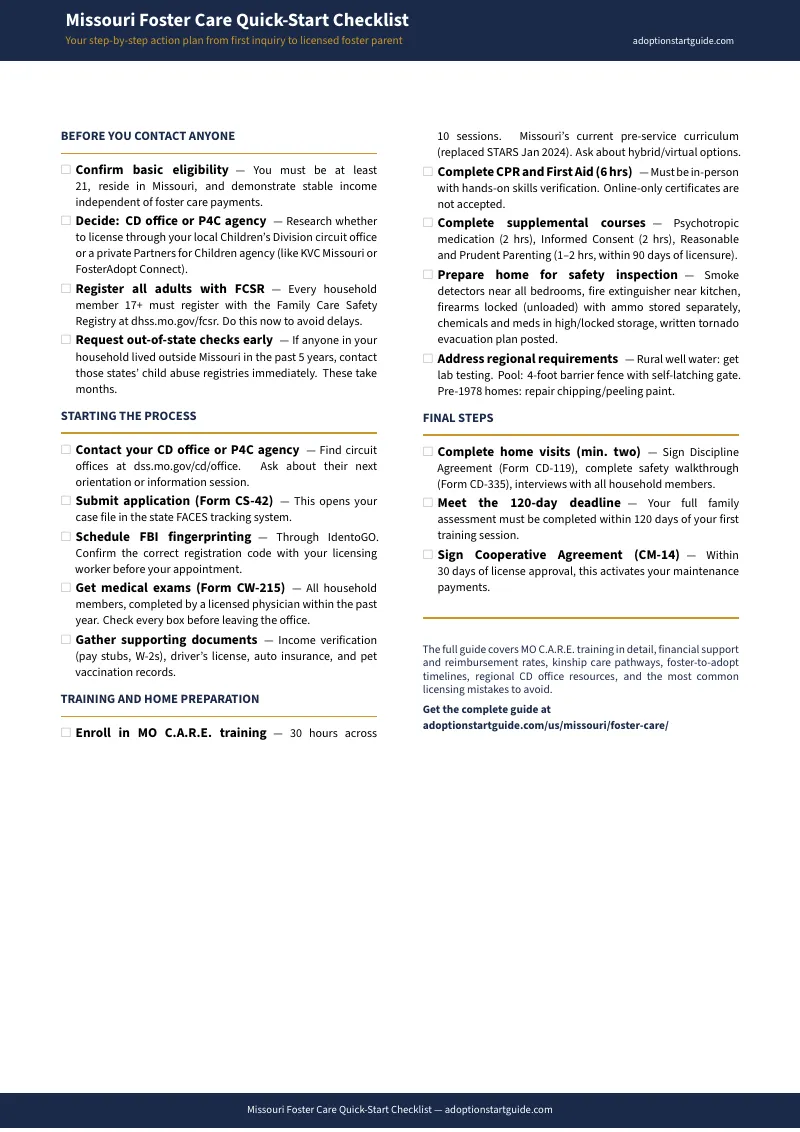
Download the Missouri Foster Care Quick-Start Checklist for a one-page overview of the licensing process, from first CD or P4C agency contact through final license approval. Free, no commitment. If you want the full guide with the CD vs. P4C comparison matrix, MO C.A.R.E. training navigator, background check walkthrough, home safety inspection prep, financial breakdown with FACES navigation, kinship pathway, foster-to-adopt legal timelines, regional resource guide, and all the printable worksheets, click the button in the sidebar.
— less than a single day's maintenance rate
Missouri pays $23.56 per day for a foster child aged 13 or older at the traditional level. Every week your licensing is delayed by a wrong IdentoGO code, a missed MO C.A.R.E. session, or an incomplete CW-215 medical form rejected by Central Office is a week you're not receiving that daily support — and a week a child spends without your home. This guide costs less than a single day's board rate, and it prevents the paperwork mistakes and decision paralysis that turn a four-month process into a year-long ordeal.
If the guide doesn't deliver, reply to your download email at any time for a full refund. No forms. No justification required.