You have been researching Nebraska adoption for weeks. You still cannot answer the one question that matters: what happens if the birth mother changes her mind?
You went to the DHHS website looking for a clear explanation of how adoption works in Nebraska. What you found was a page about foster care through Children and Family Services that explicitly states they are "not involved" in private, stepparent, or adult adoptions. You clicked through to the Nebraska Revised Statutes Chapter 43 and hit a wall of legislative language that reads like it was written for attorneys billing $250 an hour. You searched for "how to adopt in Nebraska" and got a page from American Adoptions that told you to call their 1-800 number. You called. They explained their program. You asked about independent adoption. They said they could not help with that.
You found Lutheran Family Services and learned they maintain a pool of only 25 families at a time. If you are not selected, you wait. Nebraska Children's Home Society has a thoughtful library on identity and grief in adoption, but nothing that explains the County Court filing process for someone who is not using their agency. Bethany Christian Services in Omaha has an office, but their website is designed to funnel you into their national program, not to help you navigate Nebraska law independently. The Reddit threads in r/AdoptiveParents have raw experience from real families, but three different people gave three different answers about whether birth father consent can be revoked after 48 hours, and two of the answers were about Ohio.
Meanwhile, the question that keeps you up at night is still unanswered. Nebraska has a 48-hour waiting period before a birth parent can sign consent. After those 48 hours, the consent is generally irrevocable. But nobody has explained what those 48 hours actually look like. Can you hold the baby? Who pays the hospital bill? What if the birth mother says yes at hour 47 and changes her mind at hour 49? And behind that question is the one about the Putative Father Registry — a 5-day window you had never heard of until last Tuesday that apparently has the power to unravel everything. You are spending $15,000 to $24,000 on this process and you cannot get a straight answer about the legal mechanism that determines whether your adoption is permanent.
The Chapter 43 Navigation System: A Complete Statutory Roadmap for Nebraska Families
This guide is built for the system Nebraska families actually navigate — the intersection of Chapter 43 statutory requirements, County Court procedures that vary between Douglas and Lancaster and rural counties, a Putative Father Registry with a strictly enforced 5-day window, ICWA compliance for Nebraska's tribal communities, and a home study process with background check thresholds that no national handbook explains correctly. Every chapter reflects current Nebraska Revised Statutes, DHHS policy, and the specific financial programs available to families in 2026. It is the operational layer between what the state posts online and what you actually need to know to bring your child home permanently.
What's inside
- The 48-Hour Rule and Hospital Protocol — Nebraska law prohibits birth parent consent until 48 hours after delivery. This chapter covers exactly what happens during that window: who has physical custody of the newborn, how hospital staff manage the placement, what communication is appropriate between adoptive and birth parents, the moment consent becomes legally executable, and why Nebraska's post-consent irrevocability is one of the strongest permanency protections in the country. You will stop losing sleep over "what if she changes her mind" because you will understand exactly when and how the law makes that impossible.
- The 5-Day Putative Father Registry Shield — Nebraska's Biological Father Registry gives an unmarried father 5 days after birth or notice to file an objection. If he does not file within that window, his parental rights can be terminated without his consent. This chapter explains the registry process, what happens when the putative father is incarcerated, the legal distinction between a putative father and an adjudicated father, and how to verify registry status before your adoption moves forward. This is the single most common cause of legal failure in Nebraska private adoptions — and the easiest to prevent when you understand the timeline.
- All Adoption Pathways Compared — Foster care adoption through CFS is free and includes monthly subsidy payments. Private agency adoption through LFS, NCHS, or Bethany runs $12,300 to $24,000. Independent attorney-facilitated adoption saves you the agency fee but requires a designated home study. Stepparent adoption costs $500 to $2,500 with a streamlined 6-month residency pathway. Relative adoption through kinship placement has its own set of rules. This chapter lays out the realistic costs, timelines, consent requirements, and Nebraska Revised Statute citations for each pathway so you choose the right track before spending money on the wrong one.
- 19-Section Home Study Walkthrough — The home study is where most Nebraska families feel the most exposed and the least informed. This chapter walks through every section of the study: family background, marriage stability, parenting philosophy, health and financial disclosures, references, and the physical home inspection. It covers the background check requirements — including why everyone in the home over 13 must clear the Nebraska Child Abuse and Neglect Central Registry and the Adult Protective Services registry, while those over 18 must also pass FBI fingerprinting and state criminal checks. Rural families in Kearney, Scottsbluff, and North Platte will find specific guidance on home study logistics when the nearest approved provider charges mileage for travel.
- NICWA Compliance for Nebraska Tribes — The Nebraska Indian Child Welfare Act requires specific notice to tribes when a child who may have Native heritage is the subject of an adoption proceeding. This is not a foster care technicality — it applies to private and independent adoptions if tribal heritage is suspected. This chapter covers the notice requirements for the Ponca Tribe, Omaha Tribe, Winnebago Tribe of Nebraska, and Santee Sioux Nation, the timelines for tribal response, and the consequences of failing to comply. Families who skip this step risk having a finalized adoption vacated years later.
- County Court Procedure — Nebraska adoptions are finalized in County Court, and the process varies by county. Douglas County (Omaha) has different local rules for filing and redaction of decrees than Lancaster County (Lincoln), and rural counties like Buffalo (Kearney) or Scotts Bluff operate differently still. This chapter covers the petition filing under Chapter 43, the required consents and attachments, the hearing procedure, what the judge will ask, and the decree redaction requirements under Nebraska Court Rule 6-1521. Walk into your hearing prepared instead of surprised.
- Cost Breakdown and Financial Assistance — Adoption in Nebraska is a $12,000 to $45,000 endeavor depending on the pathway, but families routinely miss available financial support. This chapter covers adoption subsidies for children adopted from foster care, the Nebraska Children's Commission tiered subsidy rates, the federal adoption tax credit, employer adoption assistance programs, and the specific grants available to Nebraska families. For foster-to-adopt families, the Adoption Assistance Agreement must be negotiated and signed before finalization — this chapter explains why that timing matters and how to negotiate the best terms.
- Independent Adoption Attorney Roadmap — For families who want to avoid the $12,000 to $24,000 agency fee, Nebraska law permits independent adoption facilitated by an attorney with a designated home study. This chapter covers how independent matching works, the legal requirements for birth parent counseling, the role of the attorney in filing the petition and managing consent documents, the ICPC process for interstate placements, and how to find a qualified adoption attorney in Nebraska. This pathway can save a family $20,000 — but only if you understand the statutory guardrails that keep it legal.
Printable standalone worksheets included
- Adoption Timeline Tracker — Every milestone from initial inquiry through County Court finalization, with fill-in date fields. Print it, update it after every call and appointment, and always know exactly where your case stands in the Chapter 43 process.
- Home Study Preparation Checklist — Section-by-section walkthrough of every home study requirement, including background check filing instructions, document gathering, and the physical home inspection standards. Walk your house with this checklist before the social worker arrives.
- Agency and Attorney Comparison Worksheet — Side-by-side evaluation form for comparing adoption providers on cost, wait time, services included, placement history, and the specific questions to ask each one before signing a contract.
- Financial Planning Worksheet — Cost tracking by pathway, subsidy rate calculations, tax credit eligibility, grant application deadlines, and a complete budget framework for every stage of the process.
Who this guide is for
- Couples pursuing domestic infant adoption — You have been through the fertility journey and you are ready to adopt. You need to understand the agency landscape in Nebraska, the independent alternative, the 48-hour consent window, and the Putative Father Registry — before you write a $5,000 check to an agency that may not be the right fit.
- Stepparents formalizing an existing family — You have been parenting this child for years. The 6-month residency requirement is met. Now you need the consent or TPR process for the absent biological parent, the County Court filing procedure, and the specific forms. You are trying to avoid the $3,000 to $5,000 attorney retainer for what you suspect is a straightforward process — and this guide will tell you whether it actually is.
- Grandparents and relatives in kinship placements — You got the call from DHHS. The child is with you. Nobody explained what comes next. This guide covers the transition from informal kinship care to legal adoption, the subsidies and Medicaid coverage you may be missing, and the specific steps to make this permanent.
- Foster-to-adopt families in the CFS system — You are fostering a child whose permanency goal has changed to adoption. You need to understand the TPR timeline, the consent process, the Adoption Assistance Agreement, and how to keep your case moving when the system stalls.
Why not piece it together from free resources?
You could try. The DHHS website has a page about adopting from foster care — but it explicitly says they do not provide guidance for private, stepparent, or independent adoptions. Lutheran Family Services has an excellent information packet about their infant adoption program — but it explains how to adopt through LFS, not how to adopt without them. Nebraska Children's Home Society publishes thoughtful articles on adoption identity and grief — but nothing on the County Court process for families navigating the system on their own. The Nebraska Judicial Branch self-help page has paternity forms but no cohesive adoption guide for non-attorneys.
Reddit threads in r/AdoptiveParents give you raw experience. One family's take on the 48-hour rule, another person's opinion about the Putative Father Registry, a third recommendation about an attorney in Lincoln. But the advice is anecdotal, often from other states, and can lead to expensive mistakes when someone in a Facebook group tells you consent revocation works in Nebraska the way it works in California. It does not.
The critical gap is this: no free resource combines the Chapter 43 statutory framework, the County Court procedure, the home study requirements with Nebraska-specific background check thresholds, the Putative Father Registry timeline, NICWA tribal compliance, and the financial assistance programs into one document written for Nebraska families. The result is 30 browser tabs, contradictory advice from three states, and the persistent feeling that you are missing something that could derail everything. In Nebraska adoption, the thing you miss — the unverified father registry, the unsigned subsidy agreement, the ICWA notice you did not send — can add months to your timeline or undo a placement entirely.
This guide consolidates it into one document. One read-through for the full picture. One reference to keep open as you move through each phase.
Satisfaction guarantee
If this guide does not deliver what this page promises, email [email protected] for a full refund. No questions, no hoops.
— Less Than 4 Minutes with a Nebraska Adoption Attorney
A single consultation with an adoption attorney in Omaha or Lincoln costs $250 or more per hour. This guide covers every question most families spend that first meeting asking — the adoption pathways, the consent timeline, the home study standards, the Putative Father Registry, the County Court process, the subsidies — for less than the cost of lunch. You will still need an attorney for parts of your adoption. But you will walk into that meeting prepared, focused, and ready to use their time on your specific situation instead of basic orientation questions you could have answered yourself.
Nebraska has 800 children waiting for permanency and only 392 successful adoptions from foster care last year. Lutheran Family Services maintains a pool of just 25 families. The agencies are at capacity, DHHS does not guide private adoptions, and the families trying to navigate Chapter 43 on their own deserve better than a statutory wall and a voicemail box. This guide is the bridge.
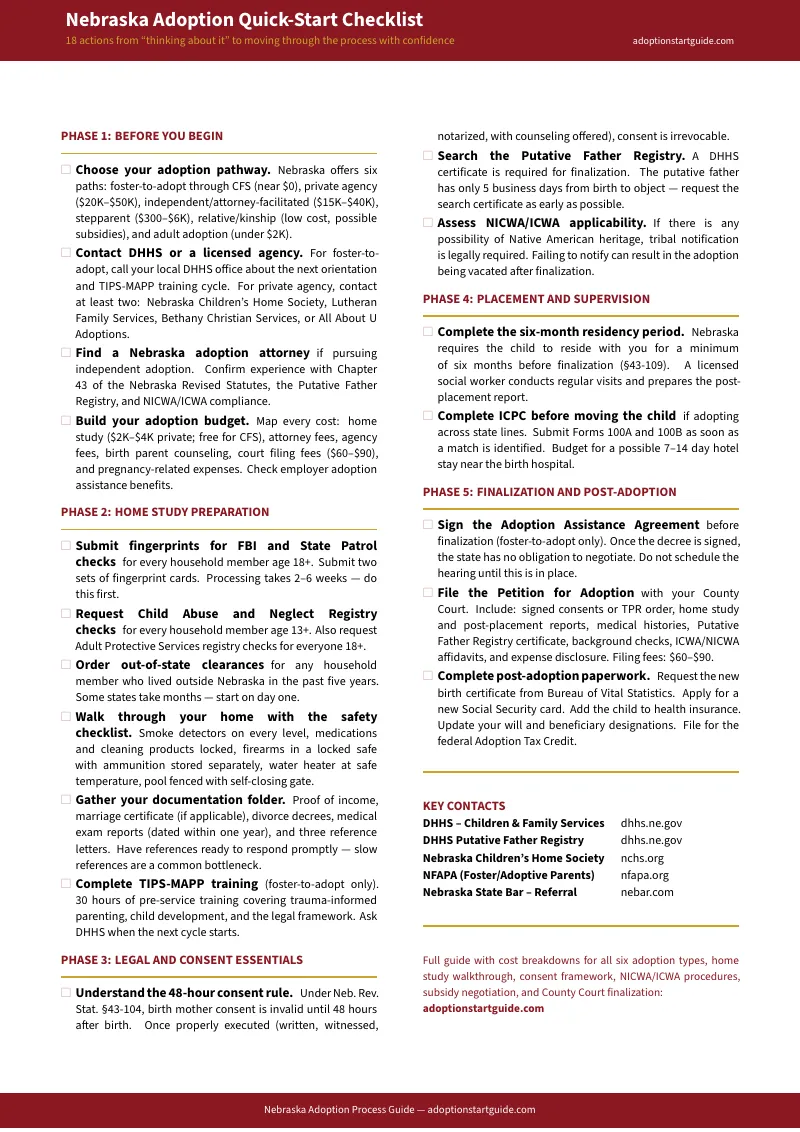
Download the free Nebraska Adoption Quick-Start Checklist to see the essential action items, or get the complete guide for the full Chapter 43 Navigation System, Putative Father Registry walkthrough, County Court procedure, financial optimization strategies, NICWA compliance guidance, and every worksheet you need to move your adoption forward.