
New Hampshire has 11 DCYF district offices, 30 pages of He-C 6446 administrative rules, a training registration system that changed in 2024, and a home inspection code that nobody has translated into plain English.
You searched "how to become a foster parent in New Hampshire" and found the DHHS website. It told you to email [email protected] or call (603) 271-4451. You emailed. A week later, you hadn't heard back. You called and left a voicemail at the Concord central office. Someone returned your call two days later and told you to contact your local district office. But which one? The website lists eleven offices from Berlin to Nashua, organized by geography, and nowhere does it say which one covers your town.
So you tried to figure out the requirements on your own. You found He-C 6446 — the administrative rules governing foster family care licensing in New Hampshire. Thirty pages of regulatory language written for compliance officers, not families. Somewhere in those thirty pages are the bedroom separation rules, the 36-inch combustible clearance requirement, the firearms storage standards, and the safe sleep policy that your inspector will evaluate. But extracting a practical checklist from that document would take a paralegal and an afternoon.
Then you found references to "PRIDE training" — except it's not called PRIDE anymore. The state transitioned to a new 23-hour curriculum through the Child Welfare Education Partnership (CWEP) at UNH, delivered in a hybrid format with online modules and live web-conferencing sessions. But the DCYF website still references PRIDE in places, the training registration moved to a new system, and cohorts fill up fast. You couldn't find a clear answer on when the next cycle starts or how to register.
Meanwhile, you came across private agencies — Waypoint, NFI North, Ascentria, Easterseals NH. They seemed more responsive than the state office, but nobody explained the actual difference between licensing through DCYF directly and going through a private agency. Would it change the children you could be matched with? The support you'd receive? The speed of the process? No neutral comparison existed anywhere.
This is where most New Hampshire families stall. Not because they aren't committed. Because the system was designed for administrators, not for the families it needs to recruit.
The DCYF Licensing Navigator: Your Complete New Hampshire Foster Care Guide
This guide is built for how foster care licensing actually works in New Hampshire — the 11-district-office system with its own staffing realities and response times, the CWEP pre-service training curriculum that replaced PRIDE, the He-C 6446 administrative rules that determine whether your home passes inspection, and the specific statutes under RSA 170-E and RSA 169-C that define your rights and responsibilities as a resource parent. Every chapter reflects current New Hampshire law, the administrative code, and the operational realities that change from Manchester to Berlin to the Seacoast. It is not a generic fostering handbook with "New Hampshire" in the title. It is the operating manual for the Granite State's system — through your district office, under current rules, with the agencies and training programs that serve your area.
What's inside
- 11-District-Office Navigation System — New Hampshire's foster care system runs through eleven DCYF district offices, each covering a defined geographic area: Berlin, Claremont, Concord, Conway, Keene, Laconia, Littleton, Manchester, Rochester, Seacoast (Portsmouth), and Southern (Nashua). The guide includes contact information for every office, explains the district-to-town mapping, and covers the Manchester-Nashua corridor experience versus the rural reality in the North Country — because your district determines your Resource Worker, your training access, and how quickly your application moves.
- DCYF vs. Private Agency Decision Framework — A side-by-side comparison that no agency website will give you. DCYF-direct licensing means your Resource Worker is a state employee and your support comes from the district office. Private agencies like Waypoint, NFI North, Ascentria Care Alliance, Easterseals NH, and Spaulding Academy offer smaller caseloads and more hands-on support but may have narrower placement criteria. The guide covers what each path means for training, home study, placement matching, and ongoing support so you choose the right partner before you start the process.
- CWEP Pre-Service Training Breakdown — New Hampshire requires 23 hours of pre-service training through the Child Welfare Education Partnership at UNH: 2 self-paced online hours plus 21 hours of live sessions (seven 3-hour classes via web conferencing), plus a mandatory Basic Medication Overview course. The guide explains the registration process, why missing a single session can push your licensure date back by months, and how North Country families can manage the logistics when training sessions require reliable internet or significant travel.
- He-C 6446 Home Safety Standards Decoded — The 30-page administrative code translated into a plain-English checklist. Bedroom separation requirements (children over age 1 separate from adults, opposite genders over age 5 separate from each other), the 36-inch combustible clearance rule that trips up the most inspections, smoke detector placement, fire extinguisher currency, firearms and ammunition storage (separate locked containers), medication lockup requirements, lead paint hazards in pre-1978 homes, and every other item on the fire inspection (Form 2361) and health inspection (Form 2360) that can delay your license.
- Background Check Walkthrough — Every adult household member must clear five separate checks: NH State Criminal Records, FBI national fingerprint-based check via Livescan, DCYF Central Registry, Sex Offender Registry, and local police. The guide explains which offenses are permanently disqualifying, which are subject to case-by-case review, and why out-of-state child abuse registry checks are the single biggest cause of delays — and how to start them on day one instead of waiting for your Resource Worker to initiate them.
- Kinship and Relative Care Pathway — For grandparents, aunts, uncles, and family friends pulled into the system when a child is removed. The priority placement framework under RSA 169-C:19-h, the critical difference between licensed and unlicensed kinship care (and why unlicensed means dramatically lower financial support), the Relative Caregiver Agreement (Form 2273), the Family Assistance Program (FAP), and the first-48-hours action plan that gets you from emergency placement to full licensing as fast as the system allows.
- Financial Support Breakdown with Real Daily Rates — Current DCYF daily rates by age and care level: General ($34.28 / $38.51 / $40.78), Specialized ($42.85 / $48.13 / $50.97), Emergency ($55.38 flat), Respite ($46.15 flat), and Crisis ($64.61 flat). Plus the Initial Clothing Allotment process, Foster Care Medicaid enrollment, respite care eligibility (14 days per year per child), tax implications under IRS Publication 4694, and an honest financial reality check that tells you what the daily rate actually covers and what comes out of your pocket.
- North Country Logistics Planner — A dedicated section for families in Coos County, northern Grafton County, and the Berlin, Conway, and Littleton catchment areas. Training access, travel distance planning, winter driving considerations, and strategies for managing the process when your nearest district office is 40 miles away and the next CWEP cohort requires reliable broadband for web conferencing.
- Opioid-Affected Child Care Guide — The majority of New Hampshire children in foster care are there because of neglect driven by substance use disorder. The guide covers neonatal abstinence syndrome (NAS) care strategies, trauma-informed parenting for children who experienced parental addiction, Level of Need assessments and how to request reassessment for higher support rates, and managing Family Time visits with parents in active recovery — the practical expectations that official DCYF materials leave vague.
- Foster Parent Rights Under New Hampshire Law — Your rights under the Reasonable and Prudent Parent Standard (RSA 170-G:20), the Foster Children's Bill of Rights (RSA 170-G:21), your right to information about a child's history before placement, your right to be heard in court proceedings, and practical strategies for navigating caseworker communication breakdowns — including when to escalate to the District Office supervisor and when to contact NHFAPA for advocacy support.
Standalone printable tools included
The guide comes with 8 standalone PDFs you can print and use independently — no need to flip through the full guide when you're walking through your basement checking the 36-inch clearance or sitting at the district office with your application packet:
- Application Document Checklist — every form organized by licensing phase (Form 1715, Form 2351, Form 2104, W-9, financial statement, and more) with checkboxes and date tracking
- Home Safety Inspection Checklist — room-by-room walkthrough of He-C 6446 requirements covering fire safety, bedroom standards, medication storage, firearms, lead paint, and water safety
- 11-District Office Directory — all DCYF district offices with addresses, phone numbers, and geographic coverage areas
- DCYF vs. Private Agency Comparison Sheet — side-by-side decision framework covering caseloads, training, placement matching, and 24/7 crisis support, plus questions to ask every agency
- Financial Planning Worksheet — current daily rates by care level and age, monthly income projection, initial placement budget, and a self-sufficiency calculator
- Monthly Contact Log — reusable tracking sheet for caseworker visits, medical appointments, school updates, and Family Time observations tied to Form 2278
- Key Contacts Reference Card — fridge-sheet with every phone number and website you need: your district office, DCYF recruitment, NHFAPA, CWEP, Waypoint, CASA, the abuse hotline, and 211 NH
- 4-Month Licensing Action Plan — the complete timeline with checkboxes from first inquiry through placement readiness, with built-in parallel tracks for background checks, training, and home preparation
Who this guide is for
- Manchester-Nashua corridor professionals — You work in healthcare, education, or social services in southern New Hampshire. You've seen the impact of the opioid crisis in your community and you're ready to act. You want a clear process that tells you what to do, in what order, and who to contact at your district office — so you can register for the next CWEP training cohort instead of spending weeks chasing voicemails and deciphering He-C 6446.
- Kinship caregivers in crisis — A child in your family was removed by DCYF and placed with you on an emergency basis. You need to know exactly what forms to file, how to get the full maintenance rate instead of the lower TANF grant, what the Relative Caregiver Agreement (Form 2273) means, and how the Family Assistance Program works — this week, not after three months of training.
- North Country rural families — You live in Coos County or northern Grafton where the nearest district office is in Berlin or Littleton and the next training cohort may require driving or stable internet for web conferencing. You need the logistics strategy that accounts for distance, weather, and the smaller support network available in rural New Hampshire.
- Single parents considering fostering — New Hampshire explicitly permits single adults to be licensed. You want confirmation that you qualify and a roadmap built for a household where one person manages the application, training, home preparation, and eventually the placement — without a partner to split the administrative load.
- Faith-motivated families — Your church community or a CASA volunteer's story moved you to consider fostering. You're ready to turn that conviction into licensure. You need the administrative roadmap — the forms, the timelines, the home safety fixes — so your family's commitment doesn't stall in the He-C 6446 bureaucracy.
Why the free resources fall short
The official DHHS website provides He-C 6446, basic FAQs, and a list of district offices — but it's a repository of legal documents, not a guide for families. It tells you the rules exist without explaining how to comply with them or what your inspector is actually evaluating when they walk through your home.
NHFAPA is excellent for current foster and adoptive parents — peer support groups, legislative advocacy, the annual conference. But for someone who hasn't started the process yet, it's overwhelming. There's no structured "here's step one, here's step two" onboarding for newcomers.
Private agencies like Waypoint and Ascentria offer responsive orientations and genuine support for families who choose their pathway. But they are not positioned to give you a neutral comparison of DCYF-direct licensing versus their own services. Their role is to recruit for their network, not to help you decide whether that network is the right fit.
Facebook groups like the Central New Hampshire Foster Adoptive Parent Support Group provide raw, real-time peer support — but they are also rife with misinformation about stipend rates, bedroom requirements, and the rules around co-sleeping and safe sleep. A well-meaning comment from another parent is not the same as the actual He-C 6446 standard.
National foster care books on Amazon cover attachment theory, trauma-informed parenting, and the emotional journey of fostering. Valuable, but they offer nothing on the 11-district DCYF system, the CWEP training registration process, New Hampshire's specific home safety standards, the daily rate structure, or the kinship care pathway under RSA 169-C:19-h.
The free Quick-Start Checklist
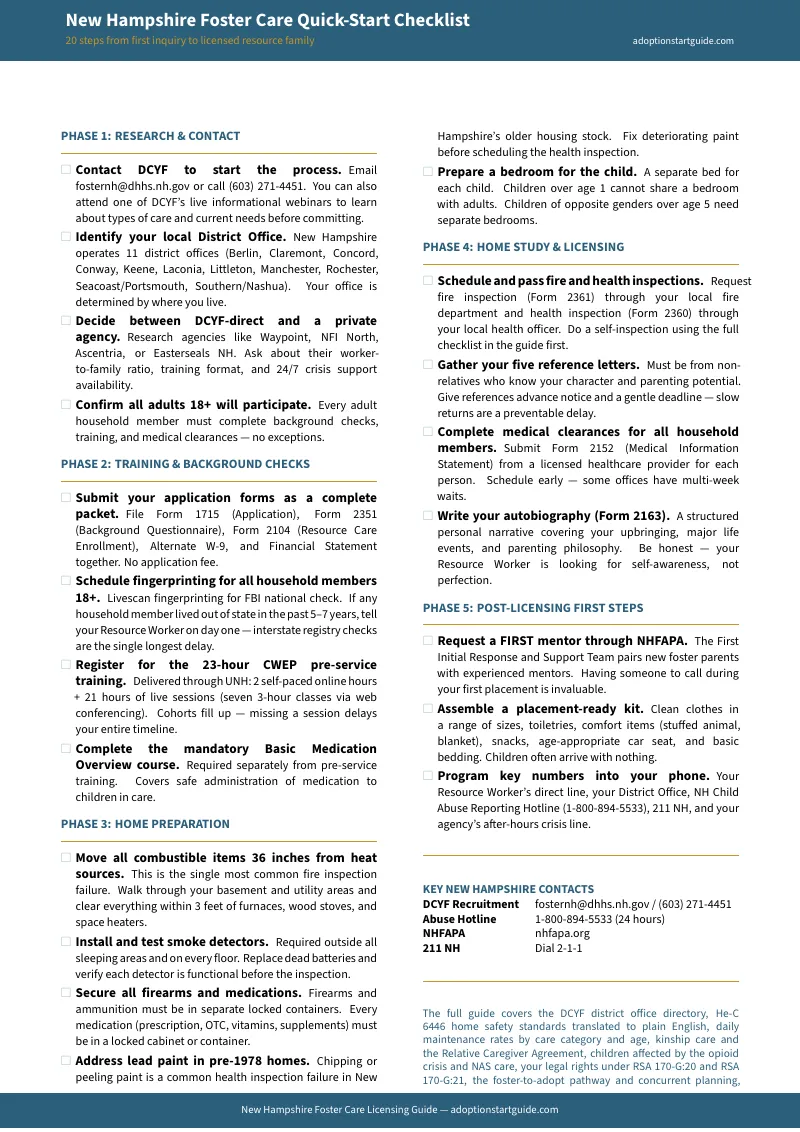
Download the New Hampshire Foster Care Quick-Start Checklist for the essential actions that take you from first inquiry to actively moving through the DCYF licensing system — including the home safety items that cause the most inspection failures under He-C 6446. Free, instant download, no commitment. If you want the full guide with the 11-district navigation system, the DCYF vs. private agency comparison, the CWEP training breakdown, the He-C 6446 home safety code translated to plain English, kinship care procedures, the full financial support breakdown with real daily rates, the North Country logistics planner, the opioid-affected child care guide, your rights under RSA 170-E and RSA 170-G:20, and 8 standalone printable tools, click the button in the sidebar.
— less than one day's General Rate stipend
A single day's General Rate for a school-age child is $38.51. The guide costs less than that — and it can save you the weeks of delay that come from a failed fire inspection, a missed training session, or an out-of-state background check that nobody told you to start on day one. New Hampshire family law attorneys charge $200 to $400 per hour. A one-hour consultation gets you general advice — not a walkthrough of the 11-district system, not a He-C 6446 home safety checklist, not the DCYF-vs-agency decision framework, not the kinship placement procedures, and not the financial breakdown with current daily rates. This guide puts the entire New Hampshire foster care licensing process in your hands. Families who understand the system before they enter it register for training sooner, avoid the home inspection failures that delay licensing, and walk into their first meeting with their Resource Worker prepared.
If the guide doesn't deliver, reply to your download email at any time for a full refund. No forms. No justification required.