New Mexico adoption runs through CYFD, 13 judicial districts, and 23 tribal nations. Nobody hands you a map that connects all three.
You attended a CYFD orientation — or maybe you called a private agency in Albuquerque and got a quote that made your stomach drop. Either way, you started searching for answers. The CYFD website gave you dense regulatory language about licensing requirements and background check procedures. The agency website gave you a polished overview of their program and a contact form. Reddit gave you one family's experience from 2019 and a warning about a caseworker who never calls back. And somewhere in the middle of all that, you came across the Indian Family Protection Act and realized that New Mexico has adoption laws that don't exist in any other state.
That is the moment most New Mexico families realize the gap between "wanting to adopt" and "knowing how to adopt in this specific state" is wider than they expected. The Children, Youth and Families Department handles foster licensing and the Putative Father Registry. The Children's Court — which is actually the district court sitting in a juvenile capacity — handles finalization across 13 different judicial districts, each with its own local procedures. The Indian Family Protection Act, signed into law in 2022, creates tribal notification requirements that go beyond federal ICWA and apply to any child who may be eligible for membership in one of New Mexico's 23 sovereign tribal nations. And if you're adopting a child across state lines, the ICPC office in Santa Fe has a 4-month administrative window that can leave you stranded in a hotel in another state while paperwork clears.
National adoption guides describe a generic process: find an agency, complete a home study, get matched, finalize. In New Mexico, the process forks depending on whether you're going through CYFD foster-to-adopt, a private licensed agency, an independent attorney-facilitated adoption, a stepparent petition, a kinship placement, or an adult adoption. Each fork has different costs, different timelines, different consent requirements, and different court procedures. A guide written for California or Texas will not mention NMSA 32A-5-21 (the 48-hour consent window), or NMAC 8.26.4 (the home study safety standards), or the fact that the subsidy agreement must be signed before the finalization decree — not after — or your negotiating leverage disappears entirely.
An adoption attorney in Albuquerque charges $250 per hour or more. Every hour you spend in that office asking basic procedural questions — "What is the IFPA?" "How does ICPC work?" "What documents do I need for the petition?" — is an hour you could have walked in already understanding. This guide does not replace an attorney. It makes sure you use one efficiently.
The IFPA Roadmap: Your Guide to Adoption in the Land of Enchantment
This guide is built for the system New Mexico families actually navigate — the intersection of state law, tribal sovereignty, CYFD bureaucracy, and court procedures that varies by judicial district. Every chapter reflects current New Mexico statutes, the 2022 IFPA requirements, CYFD's licensing and subsidy programs, and the specific financial resources available to families in 2026. It is not a repurposed national handbook with the state name swapped in. It is the operational layer between what CYFD posts online and what you actually need to know to bring your child home — through your pathway, under current law, in your part of the state.
What's inside
- IFPA and ICWA Navigation Framework — New Mexico's 2022 Indian Family Protection Act creates requirements that exist in no other state. This chapter explains when tribal notification is mandatory (within 24 hours of proceedings), what "active efforts" means in practice (a higher standard than "reasonable efforts"), how placement preferences work under NMSA 32A-28, and how the Cultural Compact process allows adoptive families and tribes to build ongoing cultural connections. Whether the child has confirmed tribal heritage, possible heritage, or no known connection, this framework tells you exactly what steps apply to your situation.
- All Six Adoption Pathways Compared — Foster-to-adopt through CYFD costs nothing and includes subsidy payments. Private agency adoption runs $20,000 to $50,000. Independent adoption costs $10,000 to $25,000. Stepparent and kinship adoptions range from $1,000 to $5,000. Adult adoption is under $2,000. This chapter lays out the realistic costs, timelines, legal requirements, and NMSA citations for each pathway so you can choose the right track before spending money or time on the wrong one.
- Home Study Preparation Under NMAC 8.26.4 — Every background check (FBI fingerprinting through IdentoGO, CYFD abuse and neglect registry, out-of-state clearances for every adult who has lived outside New Mexico), every medical exam requirement, every physical safety standard (thermostat at 65°F, smoke detectors on every level, ABC-rated fire extinguisher, medications locked, firearms in a separate locked safe with ammunition stored separately, pool with self-closing gate). This chapter includes the complete document checklist and — critically — strategies for families in Farmington, Roswell, Silver City, and other areas outside the Albuquerque–Santa Fe corridor where finding a CYFD-certified home study provider willing to travel is the first real challenge.
- The 48-Hour Consent Rule — Under NMSA 32A-5-21, a birth mother cannot sign valid consent until 48 hours after delivery. The consent must be executed before a judge or certified counselor. Once properly signed, that consent is irrevocable — revocable only upon a court finding of fraud. This chapter walks through the exact timing, who must be present, what happens with the Putative Father Registry search, and why this combination of a short waiting period and strong irrevocability provision provides significant legal certainty once the window closes.
- Children's Court Finalization Walkthrough — New Mexico's 13 judicial districts each handle adoption petitions with slightly different local procedures. This chapter covers the 60-day petition filing deadline for infants under one year (NMSA 32A-5-26), what the post-placement report must include and when it's due (60 days for children under one, 90 days for children over one), and what happens at the finalization hearing: the typical 15 to 30 minute proceeding, the questions judges ask, court filing fees ($132–$137 by district), and the photo policy most judges allow. Includes the 13-district reference table with primary court locations.
- ICPC Interstate Procedures — New Mexico shares borders with five states, and the ICPC office in Santa Fe manages all placements that cross state lines. The administrative limit is 4 months under NMAC 8.26.3.45, but real timelines depend on the sending state's processing speed and the completeness of your paperwork. This chapter explains the document flow, the common delay points, and how to plan your timeline so you are not making hotel reservations for an indefinite stay while waiting for a compact approval.
- CYFD Adoption Subsidy Guide — CYFD adoption assistance pays monthly maintenance based on the child's level of need, provides Medicaid coverage, and reimburses up to $2,000 in non-recurring legal and court costs. This chapter includes the rate structure, how to document special needs eligibility, and the rule that matters more than any other in this section: the Adoption Assistance Agreement must be signed before the finalization decree. Once the judge signs, the state has no obligation to negotiate terms. Do not schedule the hearing until this agreement is in place.
- Agency and Attorney Directory — CYFD statewide intake (1-855-333-SAFE), All Faiths/Unica Adoptions, La Familia–Namaste, Catholic Charities, All Ages Adoption Plus, and the NM State Bar Lawyer Referral Service. How to verify an agency's CYFD licensing status. What to look for when choosing an attorney experienced in NMSA 32A-5. Red flags that suggest an agency or attorney is not equipped for New Mexico's specific requirements — particularly around the IFPA.
- Open Adoption and PACA Framework — Post-Adoption Contact Agreements under NMSA 32A-5-35 are legally enforceable in New Mexico when included in the final decree. This chapter explains when a PACA makes sense, how the court evaluates whether the agreement serves the child's best interests (New Mexico presumes it does), how to negotiate contact terms, and the critical protection: litigation over the agreement cannot affect the validity of the adoption decree itself.
- Post-Finalization Paperwork Sequence — Amended birth certificate through the DOH Bureau of Vital Records in Santa Fe, new Social Security card application, insurance enrollment, sealed records access, and the NM adoption reunion registry. This chapter gives you the exact sequence so nothing falls through the cracks after the decree is signed.
- Federal Tax Credit and Financial Resources — The federal adoption tax credit is $17,280 per child for 2025. This chapter explains which expenses qualify, how the credit works for foster-to-adopt (no qualifying expenses required), the income phase-out thresholds, IRS Form 8839 filing instructions, employer adoption benefit programs, and grant organizations that provide funding to New Mexico families.
Who this guide is for
- Families considering foster-to-adopt through CYFD — You want to understand the licensing process, READI NM training requirements, concurrent planning, and how to negotiate the adoption subsidy before you attend your first orientation.
- Couples or individuals pursuing private or independent adoption — You need to navigate the placement order process, the 48-hour consent window, attorney selection, and court procedures without spending hours at $250+ per hour learning basic procedures.
- Grandparents and relatives raising a child — You have been caring for this child informally and need a clear path to legal permanence through kinship adoption. In New Mexico, kinship care is the cultural norm in many communities — but the legal formalities can feel overwhelming without a step-by-step guide.
- Stepparents adopting a spouse's child — You want to understand the streamlined process, the consent or TPR requirements for the non-custodial parent, and the mandatory counseling requirement for marriages under two years.
- Any family navigating tribal sovereignty and adoption — Whether the child has confirmed tribal heritage, possible heritage, or no known connection, you need to understand how the IFPA applies to your case and what steps to take.
Why not piece it together from free resources?
You could. CYFD posts their Resource Parent Handbook online. The NM Courts Law Library has the Adoption Law Resource Guide. Reddit has threads from families in Albuquerque sharing their experiences. Catholic Charities and La Familia each describe their own programs.
The problem is assembly. CYFD tells you the rules but not the strategy. The Law Library gives you the statutes but not the plain-English interpretation. Reddit gives you personal experiences but not the current legal framework. No single free resource covers all six adoption types, the IFPA, ICPC, subsidies, court procedures by judicial district, the consent timeline, the home study safety standards, and the post-finalization paperwork in one document. You end up with 40 browser tabs, conflicting advice, and the nagging feeling that you are missing something important — because in New Mexico adoption, the thing you miss can cost you months of delay or thousands of dollars in unnecessary legal fees.
This guide consolidates it all into one reference. One document. One read-through to understand the full picture. One reference to keep open as you move through each phase.
Satisfaction guarantee
If the guide does not deliver what this page promises, email [email protected] for a full refund. No questions, no hassle.
— Less Than One Hour with an Adoption Attorney
A single consultation with an adoption attorney in Albuquerque costs $250 or more. This guide covers every question most families spend that first hour asking — the adoption types, the costs, the consent rules, the home study requirements, the IFPA, the court procedures — for a fraction of the price. You will still need an attorney for your adoption. But you will walk into that first meeting prepared, focused, and ready to use their time on your specific situation instead of basic orientation.
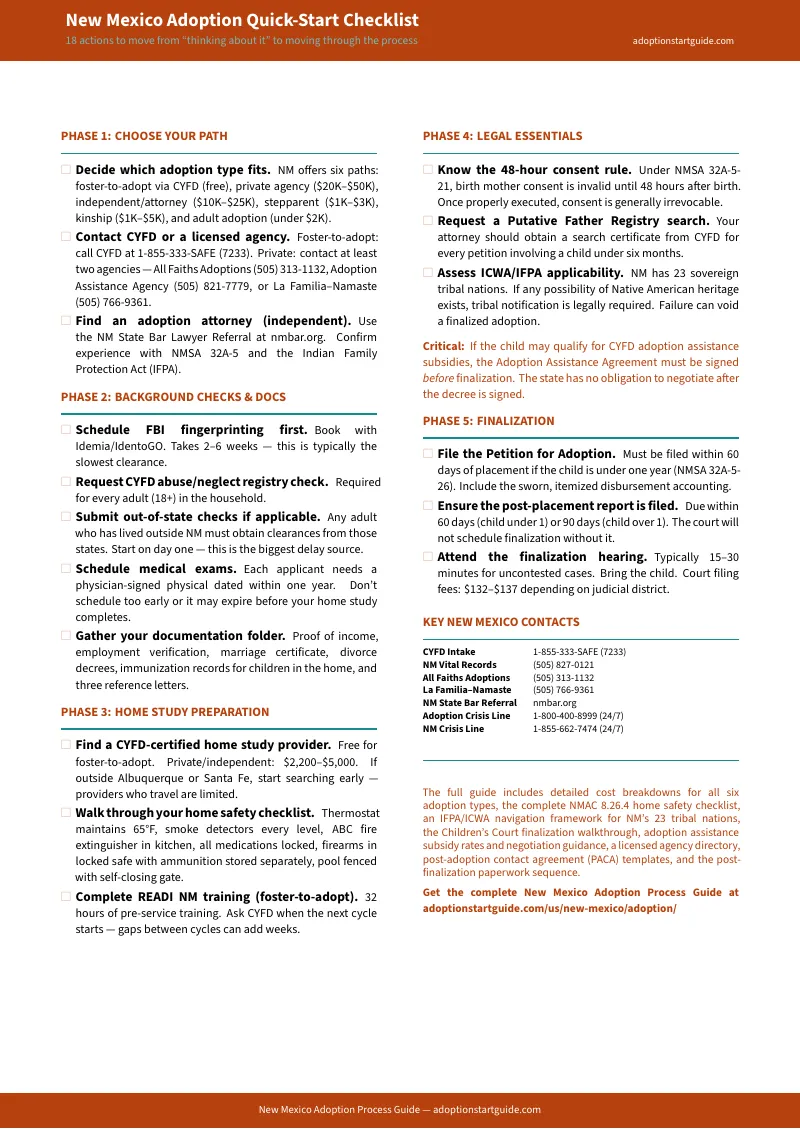
Download the free New Mexico Adoption Quick-Start Checklist to see the 18 critical first steps. Or get the complete guide and start your adoption journey with the full picture from day one.