You read the OCFS website, searched CourtHelp, joined the Reddit threads, and you still don't know whether to file in Family Court or Surrogate's Court.
New York runs adoption through OCFS, ACS, 57 county Departments of Social Services, private Voluntary Foster Care Agencies, the Department of Health Bureau of Vital Records, and two separate court systems with concurrent jurisdiction — six layers of bureaucracy that each assume you already understand the other five. OCFS posts eligibility rules. ACS contracts everything to VFCAs. CourtHelp lists form numbers without explaining which forms apply to your situation. And your county Surrogate's Court enforces formatting rules that differ from the county next door. Nobody maps how these pieces connect.
The dual-court system alone derails more New York adoptions than any other single factor. Both Family Court and Surrogate's Court have jurisdiction over adoptions under DRL Section 641, but they handle different types, move at different speeds, and their clerks expect different things. File a private-placement petition in a congested NYC Family Court and you're looking at 6 to 18 months of docket backlog. File in Surrogate's Court with a missing notarization or an incorrectly formatted affidavit and the clerk rejects your entire package — resetting the scheduling clock by months. Families don't know which court to use, what each court's local rules require, or how to avoid the clerical rejections that stall even attorney-prepared petitions.
Then there's the rule that makes New York unlike almost every other state: the non-intermediary restriction. Under DRL Section 116 and SSL Section 374, your attorney cannot match you with a birth parent. They cannot show your profile to an expectant mother who called their office. They cannot accept referrals from hospitals or social workers and pass them to you. Only OCFS-authorized agencies may perform placement services. If you're pursuing an independent adoption and someone — an attorney, a facilitator, a well-meaning friend of a friend who "knows someone" — arranges the introduction, you're in violation of state law, and your petition can be rejected. Families pursuing private-placement adoption need to understand exactly what they can and cannot do to self-match, and nobody explains this clearly.
And underneath all of it sits the consent revocation anxiety that keeps adoptive parents awake at night. Under DRL Section 115-b, extrajudicial consent — the kind signed in a hospital or attorney's office, not in front of a judge — triggers a 45-day window during which the birth parent can revoke. If they revoke and you oppose, the court holds a best-interests hearing with no presumption favoring either party. Forty-five days of legal uncertainty with a newborn in your home. Families don't know the difference between judicial and extrajudicial consent, don't know that judicial consent is immediately irrevocable, and don't know the strategic steps that reduce revocation risk.
The New York Court Navigation System
This guide is built exclusively for New York's adoption framework and nobody else's. Every chapter, every checklist, every statutory citation is grounded in current Domestic Relations Law Article 7, the Social Services Law, 18 NYCRR administrative regulations, and the county-level court realities of all 62 New York counties — from Manhattan Surrogate's Court to rural upstate Family Courts that sit only on certain days. Not a national adoption overview. Not an agency recruitment pitch. The operational layer between what OCFS, ACS, and CourtHelp post online and what you actually need to know to get from application to finalization decree.
What's inside
- Court routing guide for all 62 counties — This is where most New York families lose months. The guide maps which court handles which adoption type, county by county: Family Court for foster-to-adopt and kinship cases, Surrogate's Court for private-placement and adult adoptions, and the nuanced situations where either court works but local practice favors one. Covers NYC-specific guidance for Manhattan, Brooklyn, Queens, Bronx, and Staten Island — including which borough Surrogate's Courts have dedicated adoption parts with faster disposition timelines and which Family Courts are so backlogged that finalization takes over a year. For upstate families, explains how counties like Erie, Monroe, Albany, and Westchester handle their adoption dockets and how rural courts schedule adoption proceedings. The single most valuable section in the guide — it prevents the court-selection mistake that adds 6 to 12 months to your timeline.
- NYC apartment home study compliance — You do not need a house. You do not need a spare bedroom for an infant. Under 18 NYCRR, a child under 3 may share a bedroom with parents. The guide details the actual regulatory requirements for small apartments: safe sleeping space standards, window guard requirements for buildings with children under 10, lead paint inspection for pre-1978 buildings, medication and chemical storage, and what caseworkers are actually checking during the physical inspection versus what anxious families assume they're checking. Includes practical tips for one-bedroom and studio apartments — how to set up a dedicated nursery corner, when a room divider helps, and why square footage alone does not determine pass or fail. Written for families in Brooklyn walk-ups, Queens co-ops, and Manhattan studios who've been told their apartment is "too small" by people who don't know the regulations.
- DRL Section 116 non-intermediary compliance framework — New York's strict matching prohibition is the most legally dangerous area of independent adoption in the state, and the one where free resources provide the least guidance. This chapter explains exactly what your attorney can do (draft documents, provide strategic advice, review advertising, represent you in court) and exactly what they cannot do (show your profile to an expectant mother, accept referrals and pass them to you, represent both parties). Then it details what you can legally do to self-match: personal websites, social media, community networking, adoption networking sites, and lawful advertising. Covers the disinterested-person investigation requirement under DRL Section 115-d, the pre-placement certification process (Forms 22, 23, and 24), and the 18-month certification validity window that expires without warning if you're not tracking it.
- Consent and revocation risk management — The chapter families read first and re-read before every milestone. Covers judicial consent (executed before a judge, immediately and permanently irrevocable) versus extrajudicial consent (signed outside court, subject to a 45-day revocation window under DRL Section 115-b). Explains why birth mothers cannot sign consent before the child is born, the standard 72-hour post-delivery waiting period, the bold 18-point type requirements for extrajudicial consent documents, and what happens procedurally if consent is revoked — including the best-interests hearing standard where neither party has a presumptive advantage. Also covers birth father consent rules under DRL Section 111 and 111-a, the Putative Father Registry check (Form OCFS-3937), and the specific criteria that determine whether an unmarried father's consent is legally required.
- Complete cost breakdown with financial assistance mapping — Honest dollar amounts for every pathway: foster-to-adopt ($0 plus state-reimbursed legal fees up to $2,000), private agency ($15,000 to $45,000), independent placement ($20,000 to $35,000), stepparent ($1,500 to $5,000), and kinship ($1,500 to $5,000). Maps every financial assistance program: the federal adoption tax credit (up to $16,810 for 2024 on IRS Form 8839), NYS monthly adoption subsidies by age and region (metro rates of $1,102 to $1,318 per month, upstate rates of $959 to $1,154), specialized per diem rates for children with severe conditions (up to $3,816 per month), Medicaid coverage through age 21, and the Non-Recurring Expenses reimbursement. Includes the birth parent expense rules under DRL Section 115 — the 60-day pre-birth and 30-day post-birth temporal window, the itemized accounting requirement, and the judicial review that can reject undocumented payments.
- Child-Parent Security Act (CPSA) and second-parent adoption decision map — Critical for LGBTQ+ families, single parents by choice, and anyone building a family through donor conception or gestational surrogacy. Explains when a pre-birth Judgment of Parentage under the 2021 CPSA eliminates the need for adoption entirely (no home study, no background checks, no post-placement supervision) and when a confirmatory second-parent adoption is still legally necessary — specifically for interstate travel, international travel, pre-2021 arrangements, and situations where CPSA requirements weren't fully met. A clear decision framework, not a generic "consult a lawyer" disclaimer.
- Foster-to-adopt operational guide — How the public adoption pathway actually works in NYC versus upstate. In the five boroughs, ACS delegates everything to contracted VFCAs — the guide lists the major agencies (Spence-Chapin, Forestdale, MercyFirst, Good Shepherd Services, Catholic Guardian Services, HeartShare St. Vincent's, SCO Family of Services, Graham Windham) and explains the MAPP/GPSII training process. Upstate, you work directly with your county DSS. Covers concurrent planning (pursuing reunification and adoption readiness simultaneously), the 12-month statutory preference under SSL Section 374 for foster parents who've cared continuously for a child, and the involuntary termination of parental rights process under SSL Section 384-b — the four statutory grounds (abandonment, permanent neglect, mental illness, severe abuse) that must be proven by clear and convincing evidence.
- ICWA compliance for New York's tribal nations — New York is home to the Seneca Nation, Cayuga Nation, Oneida Indian Nation, Saint Regis Mohawk Tribe, Onondaga Nation, and Shinnecock Indian Nation. If a child has any potential Native American ancestry, the Indian Child Welfare Act establishes placement preferences and procedural requirements that override standard adoption rules. Failure to comply can result in the adoption being vacated years after finalization. This chapter covers the active inquiry requirement, formal notice procedures, tribal intervention rights, the placement preference hierarchy, and what "active efforts" means in practice.
Printable standalone worksheets included
- Document Checklist: Phase-by-Phase — Every required form organized across five phases (pre-placement certification, petition filing, pre-hearing, finalization day, post-finalization), with form numbers, checkboxes, and submission sequences. Covers Form 22 through Form DOH-4455 so your file arrives at the clerk's office complete on the first attempt.
- Court Routing Decision Worksheet — Answer five questions about your adoption type, county, and circumstances, and the worksheet maps you to the correct court with the specific local considerations for your venue.
- Birth Parent Expense Ledger — Structured tracking sheet with columns for date, expense category, amount, receipt status, and statutory compliance notes — built to match the financial disclosure affidavit requirements (Form 9-B and UCS-836) so every dollar is documented before judicial review.
- Home Study Preparation Worksheet — Interview preparation prompts, home safety walkthrough, and background clearance tracker (SCR, DCJS fingerprints, FBI fingerprints, Justice Center, out-of-state registry) with submission dates and processing timelines.
Who this guide is for
- NYC families navigating the ACS-VFCA maze — You live in the five boroughs. You contacted ACS and were told to call a VFCA. You called a VFCA and were put on an orientation waitlist. Meanwhile, you don't know if you should file in Brooklyn Family Court or Kings County Surrogate's Court, and you're terrified your one-bedroom apartment will fail the home study. This guide maps the NYC adoption system so you stop bouncing between agencies that assume you already understand the others.
- Upstate families working with county DSS — You live in a county where the DSS adoption unit is a small office with limited hours and infrequent orientations. You need the foster-to-adopt subsidy rates, the court routing for your county, and a clear timeline for the process — not NYC-centric guidance that doesn't apply to your situation. This guide covers all 57 upstate counties.
- Families pursuing independent private-placement adoption — You want to adopt a newborn and self-match with a birth parent. You've been told New York's non-intermediary rule is strict, but nobody has explained exactly what's legal and what's not. This guide gives you the DRL Section 116 compliance framework, the pre-placement certification process, and the birth parent expense rules so you match safely, pay legally, and file correctly.
- LGBTQ+ families and single parents by choice — You need to know whether a Judgment of Parentage under the CPSA covers your situation or whether a second-parent adoption is still necessary for full legal protection. This guide provides the decision framework for donor conception, gestational surrogacy, and every family structure New York recognizes.
- Stepparents and kinship caregivers — You're already raising this child. You need to formalize the legal relationship. This guide covers the simplified process (home study waivers, reduced costs, consent requirements) and the specific steps for dispensing with a non-consenting biological parent's rights under DRL Section 111.
- Families with an adoption attorney who want to save billable hours — New York adoption attorneys charge $200 to $500 per hour. Spending those hours asking about home study spatial requirements, background clearance sequencing, or birth certificate access rules is expensive. This guide is the prep manual that lets you enter your first consultation already educated, so every minute of attorney time goes toward complex legal execution instead of basic orientation.
Why the free resources aren't enough
The OCFS website outlines the agency foster adoption pathway, lists licensed voluntary agencies, and covers standard adoption subsidies. It completely ignores private-placement adoptions, does not explain how to self-match, and lacks step-by-step checklists. It's a program overview, not a guide.
ACS materials cover child protective processes, prevention services, and kinship foster placement within the NYC municipal system. They have no relevance to private infant placements, independent legal actions, or anything that happens outside the five boroughs.
The CourtHelp website defines legal terms, posts general eligibility guidelines, and provides blank PDF court forms. It's written in dense legal jargon, fails to explain the county-by-county procedural variations, does not map court filing timelines, and does not distinguish between the situations where Family Court is faster and the situations where Surrogate's Court is the right choice.
Reddit and Facebook groups provide authentic peer experiences and emotional support. They also spread legally inaccurate advice, outdated administrative information, and guidance that worked for one family's specific agency and county but is wrong for yours. A foster-to-adopt parent in Buffalo gives different guidance than a private-placement family in Manhattan, and both are presented as universal truth.
National adoption books describe a generic process that doesn't account for New York's dual-court system, the non-intermediary matching prohibition, the 45-day extrajudicial consent revocation window, the Child-Parent Security Act, the 62-county court variation, or the NYC apartment home study realities. A guide written for Texas or California won't help you in New York.
The free Quick-Start Checklist
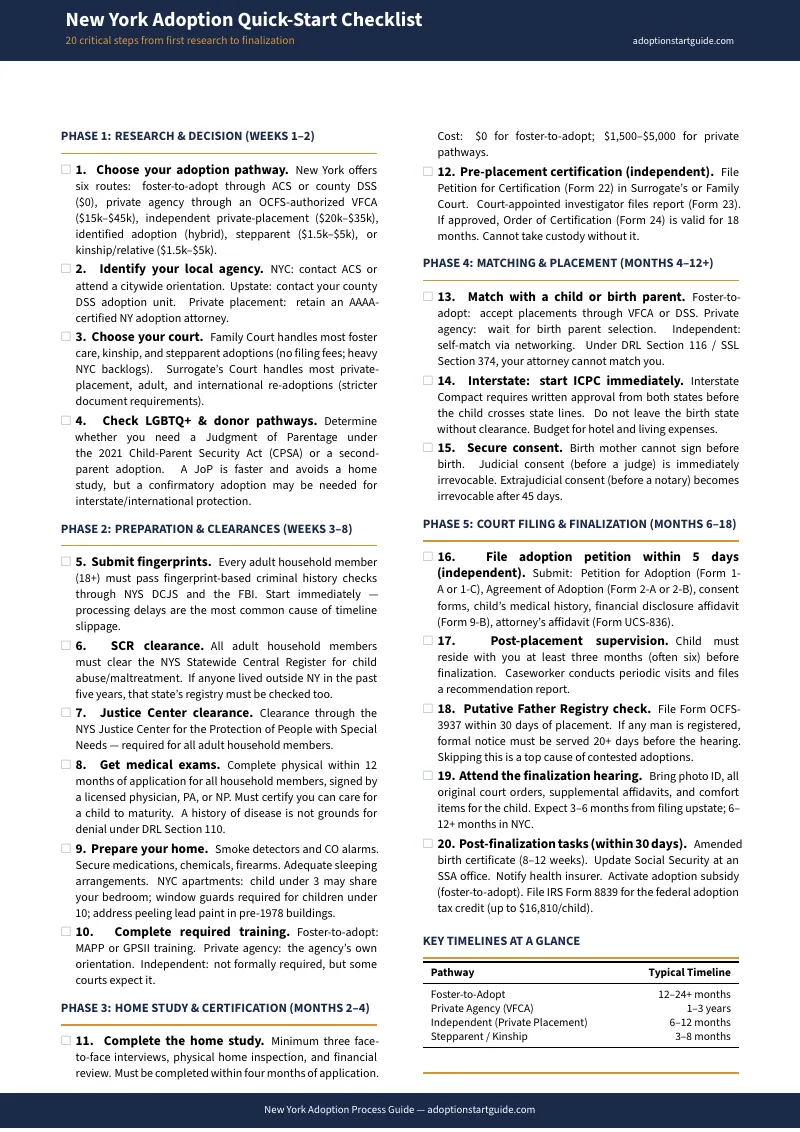
Download the New York Adoption Quick-Start Checklist for a one-page overview of the adoption process — the major milestones from initial pathway selection through finalization day, organized in the order New York's courts and agencies expect you to complete them. Free, no commitment. If you want the full guide with the court routing maps, the non-intermediary compliance framework, the NYC apartment home study guidance, the consent and revocation risk management chapter, the CPSA decision map, the cost breakdown with financial assistance, and all the printable worksheets, click the button in the sidebar.
— less than 5 minutes with a New York adoption attorney
New York adoption attorneys charge $200 to $500 per hour. A private agency placement runs $15,000 to $45,000. An independent placement runs $20,000 to $35,000. And every month your finalization is delayed by a court routing mistake, a clerk rejection, or a missing clearance document is a month of uncertainty with a child in your home whose legal status isn't final. This guide costs less than a single quarter-hour billing increment — and it prevents the mistakes that turn a 12-month process into a 24-month ordeal.
If the guide doesn't help, reply to your download email at any time for a full refund. No forms. No justification required.