
You've spent hours on okdhs.org, called the DHS hotline, maybe even attended an orientation at one of the contracted agencies. You still don't know whether to go through DHS directly or one of the seven Community-Based Organizations — and nobody at orientation explained why it matters.
Oklahoma runs foster care through the Department of Human Services, but DHS contracts most of its licensing and placement work to seven Community-Based Organizations: Lilyfield, TFI Oklahoma, Circle of Care, Anna's House, Saint Francis Ministries, Angels Foster Family Network, and Open Arms. Which CBO you choose determines who conducts your home study, who runs your training, and who calls you at 10 p.m. on a Tuesday asking if you can take a placement. DHS assigns CBOs by region across five Child Welfare Services districts covering all 77 counties — but nobody at orientation compares them. You're expected to pick one without understanding the differences in support level, placement volume, geographic coverage, or post-placement services.
The TIPS-MAPP pre-service training is 27 hours spread across multiple sessions. Miss one and you wait for the next cohort — potentially adding months in a state where training sessions in western Oklahoma and the panhandle are already sparse. The alternative, Deciding Together, is a one-to-one assessment that some families prefer but few know exists. Meanwhile, every adult in your household needs an OSBI state background check, FBI fingerprints, a DHS Central Registry search, a Joshua's List and Restricted Registry review, an OSCN court records check, and if you've lived in another state within the past five years, an interstate check. That's six separate background screenings per adult, each on its own processing timeline.
And the home study — governed by OAC 340:110 — covers far more than smoke detectors and locked medications. Oklahoma has specific requirements that trip up families in other states: firearms stored in separate locked containers with ammunition locked separately (not just a trigger lock), a written tornado evacuation plan (Oklahoma averages 62 tornadoes per year), stock pond barriers if you're on rural acreage, and agricultural hazard assessments for families near working farms. The licensing worker checks all of this. The DHS website publishes the regulations. It does not tell you what the worker is actually evaluating or how to prepare before the walkthrough, not after.
The DHS and CBO Navigation System
This guide exists because Oklahoma's foster care licensing process isn't hard — it's fragmented across DHS, seven contracted CBOs, five regional districts, 77 county offices, and 39 federally recognized tribal nations with their own child welfare systems. The information lives in OAC Title 340 regulations, CBO orientation packets, tribal ICWA guidelines, and scattered across okdhs.org in PDFs that haven't been updated since the Pinnacle Plan ended in March 2025. Nobody assembles it into a sequence. Nobody tells you that the DHS-vs.-CBO decision shapes your entire experience, or that kinship caregivers have a 120-day fast-track with a startup stipend, or that dual tribal-state certification through Cherokee, Choctaw, Chickasaw, or Muscogee (Creek) Nation opens placement options most families never consider. This guide does. Every chapter, every checklist, every regulatory citation is specific to Oklahoma's DHS system and the CBOs that implement it.
What's inside
- DHS direct vs. CBO decision matrix — This is the question that orientation sessions don't answer clearly, and it's the single most consequential choice in the licensing process. DHS administers the system, but Lilyfield, TFI Oklahoma, Circle of Care, Anna's House, Saint Francis Ministries, Angels Foster Family Network, and Open Arms each handle licensing, training, and placement differently across the five CWS districts. This chapter compares each CBO by region, support model, placement pipeline, specialty populations (therapeutic, sibling groups, teens), and post-placement services. It also covers the DHS direct pathway and when it makes sense. The comparison the system is designed not to give you.
- Step-by-step licensing timeline with Oklahoma-specific delay points — From your first call to the DHS hotline through license approval, every step mapped with realistic durations. Not the optimistic timeline from the orientation brochure — the actual timeline including background check processing across six separate databases, TIPS-MAPP scheduling gaps (especially in western Oklahoma and the panhandle where training deserts are real), and the supervisory review queue. Shows exactly where the common delays happen and what to do about each one so a four-month process doesn't become eight.
- TIPS-MAPP 27-hour training guide plus the Deciding Together alternative — The 27-hour pre-service training broken down session by session: trauma impact, attachment and loss, discipline and behavior management, birth family connections, legal process, cultural competence, and the mutual assessment. Also covers Deciding Together — the one-to-one alternative to group TIPS-MAPP that most orientation sessions mention in passing but never explain. Which format works better for your schedule, your learning style, and your geographic reality. Walk into session one knowing exactly what the trainers are evaluating.
- Home safety inspection checklist — OAC 340:110-5-60 — The licensing worker checks your home against Oklahoma Administrative Code standards that go beyond the national baseline. This chapter translates every OAC 340:110 regulation into a printable walkthrough: firearms in separate locked containers with ammunition locked separately, written tornado evacuation plan posted and practiced, stock pond barriers and fencing for rural properties, agricultural hazard documentation, smoke detectors, carbon monoxide detectors, hot water at 120 degrees or lower, all medications locked (including over-the-counter), bedroom square footage, and egress requirements. Walk your home with this before the licensing worker arrives.
- Background check guide for all six screenings — OSBI state criminal history, FBI fingerprints, DHS Central Registry, Joshua's List and Restricted Registry, OSCN court records, and interstate checks for anyone who lived outside Oklahoma in the past five years. This chapter covers the specific disqualifying offenses under Oklahoma law, the processing timeline for each check, and the rehabilitation review process. Six screenings per adult is the most in the region. Starting them all on day one of your application is the single most impactful thing you can do for your timeline.
- 2025 board rates and financial benefits breakdown — HB2030 daily rates by age group ($22.72 for ages 0-5, $25.42 for ages 6-12, $27.62 for ages 13-17), plus Difficulty of Care levels I through V adding $50 to $400 per month for children with higher needs. SoonerCare (Oklahoma Medicaid) covers medical, dental, behavioral health, and prescriptions for every child in care. Details on the clothing allowance, childcare assistance, kinship startup stipend, respite care, and the tax-free status of board payments. The financial picture the recruitment brochure mentions but never quantifies.
- ICWA compliance, tribal coordination, and dual certification — Oklahoma has 39 federally recognized tribes, more than any state except Alaska. If the child placed with you has tribal heritage — or if you're a tribal member yourself — ICWA (the Indian Child Welfare Act) applies and changes the legal framework, notification requirements, and placement preferences. This chapter covers ICWA compliance for non-Native families, the tribal-state dual certification pathway through Cherokee, Choctaw, Chickasaw, and Muscogee (Creek) Nations, and why dual certification expands your placement options significantly. Written for families who need to understand what ICWA means for them practically, not legally.
- Kinship fast-track and the post-Pinnacle Plan landscape — If a relative child needs you now, Oklahoma allows emergency kinship placement with 120 days to complete post-placement training and full licensing. The kinship pathway includes a startup stipend and modified home study. This chapter covers the fast-track process step by step. It also addresses the elephant in the room: the Pinnacle Plan federal oversight ended in March 2025, and the system is still rebuilding trust. What that means for new foster families entering the system today, what's changed, and what the increased investment in foster family recruitment signals for families considering licensing now.
Printable standalone worksheets included
- Licensing Timeline Tracker — Every milestone from first DHS contact through license approval, with fill-in date fields. Print it, update it after every caseworker and CBO interaction, and always know where you stand in the four-to-six-month process.
- Home Safety Inspection Checklist — Room-by-room walkthrough of every OAC 340:110 requirement including the Oklahoma-specific items: tornado plan, firearm storage protocol, stock pond barriers, and agricultural hazard documentation. Walk your home with this before the licensing worker arrives.
- Document Organization Sheet — Forms 04AF001E, 04AF004E, 04AD003E, 04AF010E, background check releases, medical forms, financial disclosures, training certificates, reference letters, and pet vaccination records — every document organized by phase with checkboxes and submission dates.
- Financial Planning Worksheet — Current HB2030 board rates by age group and DOC level, SoonerCare coverage summary, childcare assistance eligibility, clothing allowance, kinship stipend, and the financial stability assessment in one printable sheet.
Who this guide is for
- Oklahoma City and Tulsa metro families who want the efficient path — You live near a DHS office and have your pick of CBOs. That abundance of options is actually the problem — orientation sessions don't compare agencies, and the CBO you choose determines your training schedule, your licensing worker, your placement pipeline, and your ongoing support. You need the DHS-vs.-CBO decision matrix, the realistic timeline, and the home inspection standards in one document. This guide replaces the scavenger hunt across okdhs.org, CBO websites, and Facebook groups.
- Rural and western Oklahoma families facing the training desert — You're in Woodward, Guymon, or Altus, and the nearest TIPS-MAPP session is a multi-hour drive that may only run twice a year. This guide covers the Deciding Together one-to-one alternative, virtual training options, and which CBOs serve rural districts so you can plan around geographic reality instead of discovering the problem after you've already applied.
- Kinship caregivers navigating an emergency — A grandchild, niece, nephew, or family friend's child has been removed or is about to be. You didn't plan to enter the DHS system — you're here because a child in your family needs you now. Oklahoma allows emergency kinship placement with 120 days to complete post-placement training. This guide covers the fast-track pathway, the startup stipend, the modified home study, and the financial support you're entitled to so your placement is stable and funded.
- Native American families and tribal members — You're a member of one of Oklahoma's 39 federally recognized tribes, or the child you're considering fostering has tribal heritage. ICWA changes the legal framework and placement preferences. Dual certification through Cherokee, Choctaw, Chickasaw, or Muscogee (Creek) Nation expands your placement options but adds complexity. This guide explains the tribal-state coordination, ICWA compliance requirements, and the dual certification pathway without assuming you've already navigated either system.
- Military families at Tinker AFB and Fort Sill — You've been transferred to Oklahoma and want to continue fostering or start the process here. Interstate background checks, out-of-state training credits, and PCS-proof licensing are real concerns. This guide covers how Oklahoma handles military families, the interstate compact, and how to avoid starting from scratch every time you relocate.
- Faith-based families responding to James 1:27 — You're connected through your church's foster care ministry, the 111 Project, CarePortal, or a congregation that takes the James 1:27 mandate seriously. Oklahoma's faith-based foster care ecosystem is one of the strongest in the country. The motivation is clear. The DHS bureaucracy is not. This guide maps the licensing process so the paperwork and training don't derail the mission.
- Foster-to-adopt families — You're entering the system hoping to provide a permanent home. Oklahoma uses concurrent planning — working toward reunification while simultaneously developing an adoption backup plan. This guide explains what "legal risk" placements mean, how the termination of parental rights process works in Oklahoma courts, and what the foster-to-adopt pathway actually looks like when you're living it day to day with a child whose plan might still be "return home."
Why the free resources aren't enough
The DHS website (okdhs.org) is a regulatory archive, not a guide. It publishes OAC Title 340, the foster family application forms, and a general overview of the process. It does not tell you which CBO to choose across the five CWS districts, how to navigate the training desert in western Oklahoma, or what the licensing worker is actually evaluating when they walk through your home. The website gives you the regulations. It doesn't give you the strategy for navigating them.
The CBOs — Lilyfield, TFI Oklahoma, Circle of Care, Anna's House, Saint Francis Ministries, Angels Foster Family Network, and Open Arms — each provide orientation sessions and pre-licensing support. But they're recruiting for their own organization. They'll explain their process. They won't compare themselves to the other six agencies or tell you which one serves your county best for the population you want to foster. That comparison doesn't exist anywhere in the system. Until now.
Facebook groups like "Oklahoma Foster Parents" provide real talk from families in the system. They also provide conflicting anecdotes, outdated Pinnacle Plan-era information, and a negativity bias driven by parents in crisis. A family in Tulsa whose CBO handled everything smoothly gives different advice than a kinship caregiver in rural McIntosh County who can't get anyone to return calls. Crowdsourced guidance is authentic and situationally contradictory.
National foster care books cover a generic process that doesn't account for Oklahoma's seven CBOs, five CWS districts, 39 tribal nations, ICWA requirements, OAC 340:110 home safety standards (tornado plans, stock pond barriers, agricultural hazards), the HB2030 rate structure, or the post-Pinnacle Plan system that makes Oklahoma's foster care landscape different from any other state. A guide written for California or Texas won't help you in Oklahoma City.
The free Quick-Start Checklist
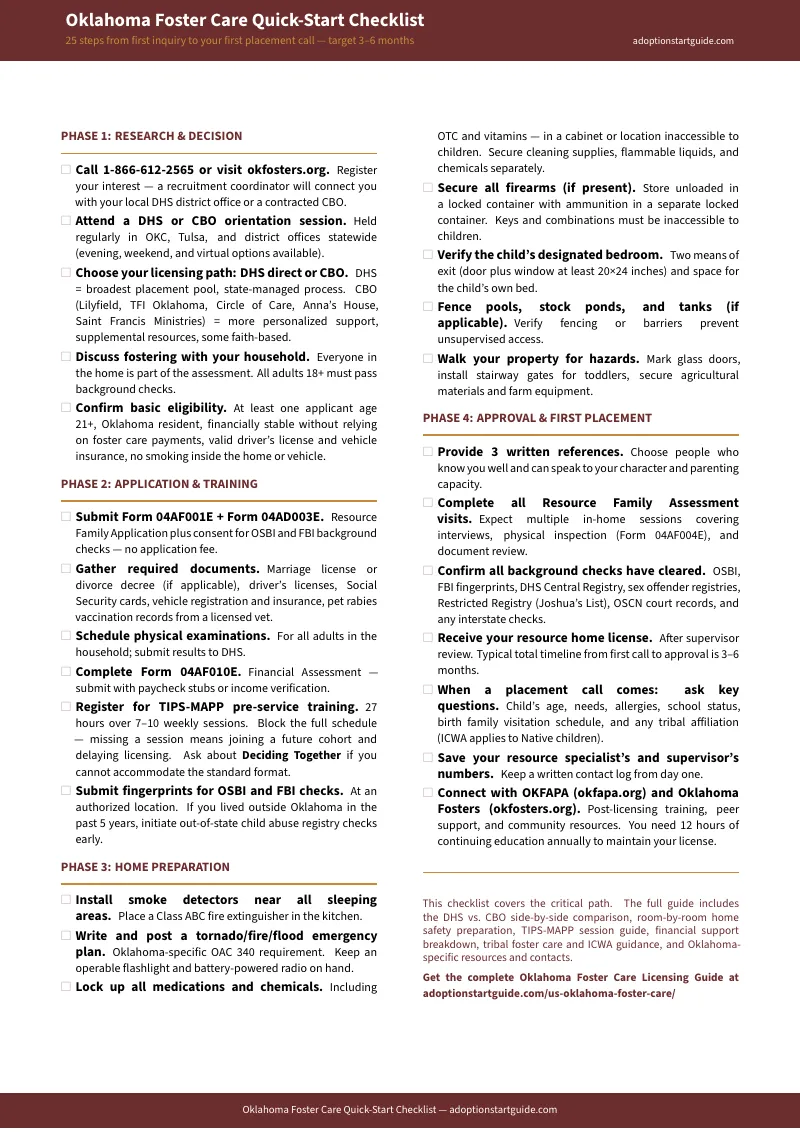
Download the Oklahoma Foster Care Quick-Start Checklist for a one-page overview of the licensing process, from first DHS contact through license approval. Free, no commitment. If you want the full guide with the CBO decision matrix, home inspection walkthrough, TIPS-MAPP and Deciding Together training guide, six-screening background check breakdown, financial benefits analysis, ICWA and tribal certification guide, and all the printable worksheets, click the button in the sidebar.
— Less Than One Day of the Board Rate You'll Receive
A single day of the basic foster care board rate in Oklahoma is $22 to $28. A medical physical for your household runs several hundred dollars. And every week your licensing is delayed by a missed background check, a skipped TIPS-MAPP session, or a failed home inspection is a week you're not providing a home to a child who needs one. This guide costs less than one day of the stipend you'll receive — and it prevents the mistakes that turn a four-month process into an eight-month wait.
If the guide doesn't deliver, reply to your download email at any time for a full refund. No forms. No justification required.