Oregon's adoption system runs through county Circuit Courts, a chronically understaffed state agency, and a set of statutes that nobody puts in chronological order for you.
You started on the ODHS website. You were looking for a clear path to adoption in Oregon. What you found was a page that says, in plain text, that the department "can't provide you with a 'packet of forms' to complete an adoption since each adoption is unique." No templates. No step-by-step walkthrough. No explanation of how to compile the exhibits your Circuit Court requires or how to properly serve documents to the ODHS Central Office within the mandatory 30-day window. Just a high-level definition of adoption types and a suggestion to consult an attorney.
So you searched deeper. A national guide told you how adoption works "in most states." Oregon is not most states. Oregon prohibits pre-birth consent. Oregon makes Post-Adoption Contact Agreements legally binding and court-enforceable under ORS 109.305 -- but only if they meet precise structural criteria that most families learn about after they've already signed an informal plan. Oregon enhances the federal Indian Child Welfare Act with its own state-level ORICWA, creating tribal inquiry requirements that apply specifically to nine federally recognized nations. And Oregon's consent irrevocability under ORS 109.301 requires six separate conditions to be met simultaneously -- physical custody, filed petition, appointed guardian, approved home study, medical history documentation, and proof of independent legal counsel for the birth parent. Miss one, and the consent remains revocable.
Meanwhile, the agencies are marketing to you. Open Adoption & Family Services provides outstanding emotional resources on open adoption -- but no legal filing instructions. American Adoptions has a polished Oregon landing page -- but it's built to funnel you into their proprietary infant matching program, not to explain independent or stepparent pathways. Reddit's r/adoption and r/Portland give you raw, honest accounts of ODHS wait times and caseworker responsiveness -- but users regularly confuse foster care guardianship with legal adoption, post incorrect ORS citations, and share regional advice that doesn't apply statewide.
Then you looked at costs. A Portland family law attorney charges $250 to $500 per hour. A private agency adoption runs $10,000 to $50,000. An independent adoption costs $5,000 to $15,000. And stepparent adoption -- the pathway that 342 Oregon families filed in FY 2024-25, making it the single largest adoption category in the state -- still requires background checks, court exhibits, and a filing process that trips up families who assume it's just a simple form.
The Oregon Adoption Compliance System: Every Pathway, Every Statute, Every Filing Step in One Document
This guide is built for Oregon's actual adoption system -- the one where each county Circuit Court has its own scheduling methods and document requirements, where the ODHS Background Check Unit processes Form CF 0249G on its own timeline, and where a home study completed through the state's free pathway can take over a year because ODHS prioritizes urgent foster care licensing over adoption-only placements. It covers every adoption pathway available under ORS Chapter 109 and Chapter 419B, organized in the chronological order the system expects you to complete each step. Not a repurposed national template. Not an agency's marketing material. The operational layer between what ODHS publishes for its own staff and what you actually need to know to get a final adoption judgment signed by an Oregon Circuit Court judge.
What's inside
- All Oregon Adoption Pathways Compared -- Costs, Timelines, and Legal Mechanisms -- Oregon allows domestic private agency adoption, independent attorney-led adoption, foster-to-adopt through ODHS, stepparent adoption, second-parent adoption, relative adoption, and international readoption. Most families don't realize they have a choice until they're months into the wrong pathway. This chapter lays out every route side by side -- what each one costs, how long it takes, what the court requires, and who it's designed for. Private agency runs $10,000 to $50,000. Independent adoption sits at $5,000 to $15,000. Foster-to-adopt is near zero out-of-pocket. Stepparent adoption can often be filed without a full home study under ORS 109.276. You need this comparison before your first agency call, because the agency will only tell you about the pathway they offer.
- Post-Adoption Contact Agreement (PACA) Drafting Guide Under ORS 109.305 -- Oregon pioneered open adoption in the Pacific Northwest, and PACAs are one of the state's most distinctive legal tools. But a PACA is only enforceable if it is explicitly approved by the court, incorporated into the final adoption judgment, and entered into by a relative with established emotional ties. Failure to comply with a PACA is not grounds to set aside an adoption -- it triggers mandatory good-faith mediation followed by civil contract enforcement. Most families learn these nuances after they've already signed an informal arrangement that has no legal weight. This chapter provides the exact structural requirements, a term sheet template for defining communication frequencies and visit boundaries, and the mediation protocol that protects both families.
- Consent Timing, Irrevocability, and the Six-Condition Lock Under ORS 109.301 -- Oregon prohibits pre-birth consent. The birth mother can only sign after the child is born. Once signed, consent becomes irrevocable only when six separate conditions are simultaneously met: physical custody of the child, filing of the adoption petition, appointment of a legal guardian, filing of an approved home study, receipt of the child's medical and genetic history, and documentation of independent legal counsel for the birth parent. Until all six are satisfied, consent remains revocable. The Certificate of Irrevocability and Waiver takes effect only after this threshold is crossed. This chapter maps every condition, explains the documentation required for each, and provides the audit checklist that ensures nothing is missed.
- The 60-Day Background Check Protocol -- If any adult in your household lived outside Oregon for more than 60 consecutive days in the past five years, they must submit to fingerprinted FBI checks and child abuse registry searches across every state of prior residence. This rule catches stepparent and relative adopters off guard -- even families who qualify for a home study waiver under ORS 109.276 must still complete the Oregon State Police criminal history check (Form CF 0249G), the ODHS Child Protective Services registry check, and the OSP processing fee. This chapter provides the exact forms, the agencies to contact for out-of-state registries, and the timeline management strategy that prevents your home study from expiring while you wait for background results.
- Oregon Indian Child Welfare Act (ORICWA) Compliance Checklist -- Oregon enhances federal ICWA with state-level requirements under ORS 419B.636. Petitioners must make a "good-faith effort" to determine if a child is an Indian child by consulting parents, extended family, and the child's potential tribe. If a child is an Indian child, the standard Certificate of Irrevocability under ORS 109.301 is completely invalid, relinquishment must be executed before a judge, and placement preferences must follow tribal priorities. This chapter provides contact information for Oregon's nine federally recognized tribes, a structured tribal inquiry log for documenting your good-faith efforts, and the compliance steps that prevent a completed adoption from being challenged years after finalization.
- Circuit Court Filing and Finalization Map -- Unlike states with unified family courts, every Oregon adoption ends in a county Circuit Court. Each county has distinct local rules, scheduling methods, and document submission requirements. The guide details how to file the adoption petition, how to serve copies on the ODHS Central Office within the mandatory 30-day window, the required court exhibits (including the child's medical and genetic history form CF 963 and Voluntary Adoption Registry notices), the $800 ODHS placement report fee alongside standard filing fees, and how to manage the finalization hearing -- including which counties allow WebEx appearances and which require you in the courtroom.
- ODHS vs. Private Home Study Routes -- The state-run home study through ODHS is free but chronically backlogged, with average wait times often exceeding a year because the department prioritizes urgent foster care licensing. Private licensed agencies charge $2,500 to $3,000 but deliver home studies in a few months with dedicated caseworkers who act as advocates. This chapter maps both pathways, explains how to qualify for the stepparent and relative home study waiver, and details what the home study evaluator actually assesses -- safety standards, background checks, financial stability, and interview preparation.
- LGBTQ+ Family Protections and Second-Parent Adoption Pathways -- Oregon's non-discrimination framework under the Oregon Equality Act and ORS 418.648(10) provides comprehensive protections for same-sex, unmarried, and gender-nonconforming individuals. Approximately 5.6% of Oregon's population identifies as LGBTQ+, and 23% of LGBTQ+ Oregonians are raising children. This chapter covers the legal mechanics of joint adoption, stepparent adoption, and second-parent adoption for non-biological parents, explains how to select LGBTQ+-affirming agencies and home study certifiers, and addresses the anxiety that LGBTQ+ families carry about potential bias during the evaluation process -- particularly in more conservative rural counties.
- Measure 58 and Birth Certificate Access Under ORS 432.240 -- Passed by Oregon voters in 1998, Measure 58 restored the right of adopted adults aged 21 and older to obtain their unaltered, original, preadoption birth certificate. This structural transparency is unusual among US states and means your child will have absolute legal access to this information upon turning 21. This chapter explains what adoptive parents need to know now -- how to prepare for conversations about identity and origins, and why establishing open, honest communication early in the adoption journey is essential.
- Complete Financial Breakdown -- Costs by pathway with hidden line items, the $800 ODHS placement report fee, OSP background check fees, county filing fees under ORS Chapter 21, home study waiver savings, foster-to-adopt subsidies and Medicaid continuation, the Federal Adoption Tax Credit, and a cost planning worksheet that models your actual out-of-pocket expense before you commit to a pathway.
Standalone printable tools included
- Oregon Adoption Chronology Tracker -- A visual flowchart mapping every milestone from first home study contact through Circuit Court finalization, with fill-in date fields so you always know where you stand in the process.
- ORS 109.301 Irrevocability Audit Checklist -- A tool to verify that all six statutory conditions are met before the Certificate of Irrevocability and Waiver takes effect. Print it and walk through it with your attorney.
- Oregon Tribal Inquiry Log -- A structured template for documenting good-faith efforts under ORICWA, including contact details for Oregon's nine federally recognized tribes and space to record inquiry dates, methods, and responses.
- PACA Term Sheet Template -- A planning worksheet for birth and adoptive parents to define communication frequencies, visit boundaries, and mediation steps before drafting the legal contract under ORS 109.305.
- ODHS Service Pack Checklist -- Every document that must be served on the ODHS Central Office within the mandatory 30-day window, organized with checkboxes and tracking fields.
- Home Safety Inspection Checklist -- Room-by-room walkthrough of Oregon's safety requirements for the home study evaluation, including firearms storage, medication lockup, and pool barriers.
- Agency and Attorney Screening Questions -- Questions to ask adoption agencies and family law attorneys during your first meeting, including LGBTQ+ affirming practices, fee structures, and experience with your specific pathway.
Who this guide is for
- Stepparents ready to formalize an existing family -- You've been parenting this child for years. You need the legal recognition that gives you medical decision-making authority, inheritance rights, and security that doesn't depend on your relationship status. With 342 stepparent adoption petitions filed in FY 2024-25, this is Oregon's largest adoption category -- and the one with the most families who assume the process is simple until they encounter the background check requirements, court exhibit filings, and the 60-day out-of-state rule that no one mentioned. This guide maps the stepparent pathway from petition to decree, including the home study waiver process under ORS 109.276.
- Families pursuing private domestic infant adoption -- You're in Portland, Eugene, Salem, or Bend. You've contacted Open Adoption & Family Services or Journeys of the Heart. You know the process costs $10,000 to $50,000 and takes 12 to 24 months. What you don't know is how Oregon's consent timing rules differ from the 48-hour and 72-hour rules other states use, how to structure a PACA that actually holds up in court, or what happens when the ODHS Background Check Unit takes longer than your home study's one-year validity window. This guide turns a process that agencies describe in reassuring generalities into a timeline with specific legal checkpoints you can track.
- LGBTQ+ couples securing parental rights through second-parent adoption -- Oregon's legal protections are among the strongest in the country, but protection on paper and confidence in practice are two different things. You need to know which agencies are genuinely affirming, how second-parent adoption petitions actually work in your county's Circuit Court, and what documentation secures the non-biological parent's legal relationship with the child. This guide provides the pathway, the statutory framework, and the practical steps -- not a policy statement, but an operational plan.
- Grandparents and relatives formalizing kinship care -- A family member can no longer provide safe care, and a child is already in your home. You may be in the Willamette Valley or rural Eastern Oregon. Without a legal adoption decree, you can't consent to medical treatment, enroll the child in school under your address, or access the financial support that would make this arrangement sustainable. A $250-per-hour Portland attorney is not in the budget. This guide covers the kinship adoption pathway, the home study waiver eligibility, and the Circuit Court filing requirements specific to your situation.
- Foster-to-adopt families navigating the ODHS system -- The reunification plan changed to adoption. Your foster child's caseworker said the process would be explained. What you received was a stack of ODHS policy documents and a caseworker managing dozens of other cases. This guide is the translation layer between what ODHS publishes internally and what you need to do at each step -- the TPR transition, the finalization petition, the adoption assistance subsidies, and the post-finalization checklist.
Why the free resources aren't enough
The ODHS Non-Departmental Adoption page publishes high-level legal definitions and explicitly states it cannot provide procedural guidance or form packets. It leaves parents with no templates, no filing walkthrough, and no explanation of how the background check connects to the home study connects to the adoption petition connects to the Circuit Court finalization. The page exists to define what adoption types are, not to help you complete one.
Open Adoption & Family Services provides outstanding resources on the psychology and ethics of open adoption. It does not explain how to draft a legally enforceable PACA under ORS 109.305, the mechanics of court enforcement, or how to navigate independent adoptions where OAFS is not the placing agency. It's emotional guidance without legal precision.
Reddit's r/adoption and r/Portland give you raw, unfiltered accounts of the process. Users share real wait times for background checks and honest reviews of local agencies. They also confuse guardianship with adoption, post incorrect ORS references, and share county-specific advice as if it applies statewide. It's peer experience without legal accuracy.
National adoption guides on Amazon cost $15 to $30 and don't know that Oregon makes PACAs court-enforceable, that ORICWA adds state-level tribal inquiry requirements beyond federal ICWA, that consent irrevocability requires six simultaneous conditions, or that each of Oregon's 36 counties has its own Circuit Court filing procedures. A book written for all 50 states cannot explain any of this because Oregon's system doesn't work like the generic model.
The free Quick-Start Checklist
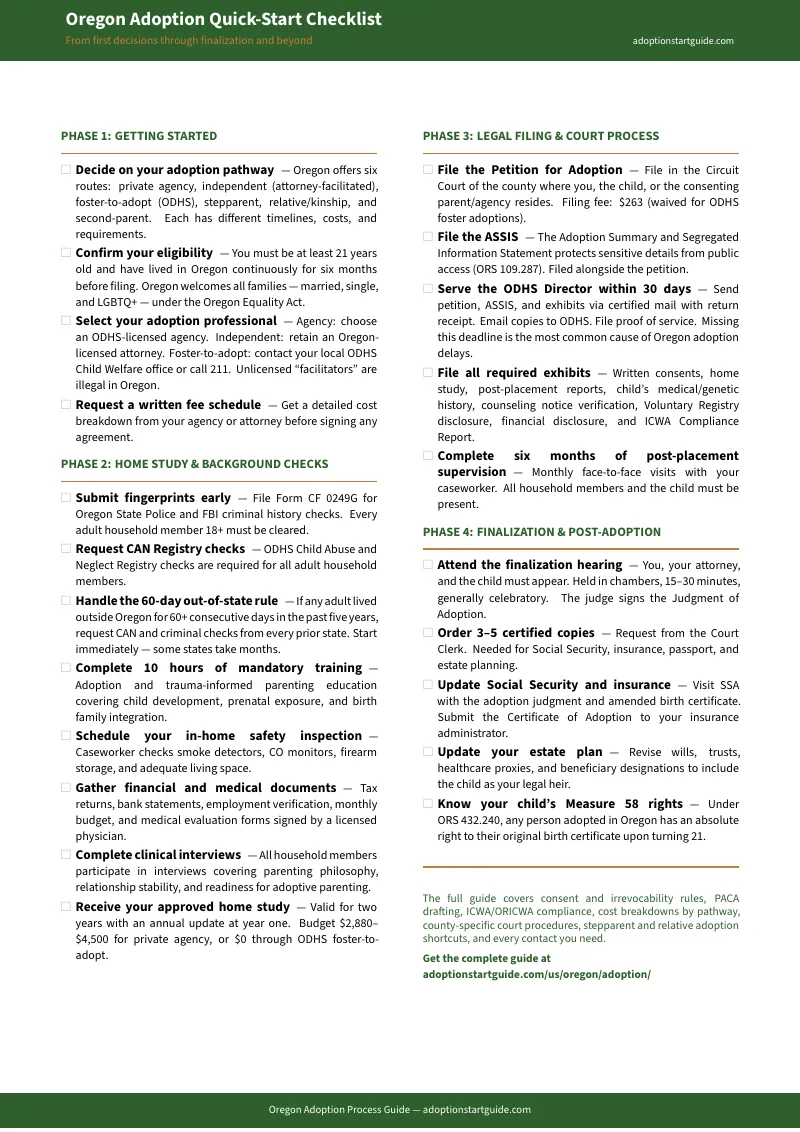
Download the Oregon Adoption Quick-Start Checklist for a one-page overview of the adoption process, from choosing your pathway through your Circuit Court finalization hearing. Free, no commitment. It covers what to do. If you want the full guide with every pathway compared, the PACA drafting guide, the consent irrevocability audit checklist, the ORICWA tribal inquiry log, the 60-day background check protocol, the Circuit Court filing map, seven printable worksheets, and the Oregon resources directory, click the button in the sidebar.
-- less than fifteen minutes of a Portland family law attorney's time
Oregon family law attorneys bill $250 to $500 per hour. A single consultation covers your specific questions but not the full landscape of pathways, timelines, financial programs, and legal requirements. This guide covers all of it -- the PACA enforceability rules that most families learn about after signing an informal plan, the consent irrevocability conditions that void your protection if even one is missing, the 60-day background check rule that catches stepparent adopters off guard, the ORICWA compliance steps that can unwind a finalized adoption if skipped, and the county-by-county Circuit Court procedures that no national resource explains. A consent missing one of six conditions is still revocable. A tribal inquiry skipped is an adoption that can be vacated. A PACA structured outside ORS 109.305 has no legal weight. Each of these mistakes costs more than this guide -- in money, in time, and in the emotional toll of a process that stalls when it didn't have to.
If the guide doesn't deliver what you need, reply to your download email at any time for a full refund. No forms. No justification required.