
You want to foster a child in Rhode Island. Then you discovered that DCYF calls it "certification" not "licensing," the Binti portal collects your information but doesn't explain what to do with it, there are five private agencies and nobody compares them, and the one detail everyone warns you about — the home inspection — turns out to hinge on a boiler shutoff switch and a lead certificate that no official resource mentions until after you fail.
Rhode Island runs a centralized foster care system through the Department of Children, Youth and Families. One agency, one set of regulations, one application process. That sounds simple until you realize it means a single overloaded agency managing every prospective family in the state, with a Support and Response Unit that fields your first call but can't tell you whether you should go through DCYF Direct or one of five contracted private agencies — Alliance Human Services, Family Service of Rhode Island, Child & Family, Boys Town New England, or Communities for People. Each track leads to different children, different support levels, and different daily rates. The DCYF website gives you 214-RICR-40-00-3 in regulatory language but never maps the steps in the order a family actually completes them.
Meanwhile, the details that determine whether you get certified in three months or nine are scattered across Rhode Island Code of Regulations, fire marshal bulletins, BCI processing offices, and word-of-mouth from foster parents in your specific region. When does the next MAPP cohort start — and what happens if you miss registration and wait three more months? Can you get your BCI results the same day or does it take 30 days? Does your pre-1978 home need a lead inspection certificate for children under six? If your sister's children just got placed with you through kinship, what's the difference between a verified kinship home and a fully certified resource family with $35–$95/day in support?
Most people who begin researching foster care in Rhode Island never complete the certification process. Not because they weren't qualified. Because the system gave them no coherent path from "I called the SRU" to "I'm certified and waiting for the placement call" — and after weeks of navigating between DCYF's Binti portal, regulatory PDFs, and outdated MAPP schedules, they quietly moved on.
The RI Certification Navigator
This is a complete, Rhode Island-specific foster care certification guide built around the central problem every family in this state hits: navigating a centralized system where DCYF handles everything but explains almost nothing in the order you need to hear it, five private agencies each offer a different experience, and the practical details that prevent delays are buried in regulations written for caseworkers. Not a national overview. Not a government code book. Every chapter, every checklist, every stipend figure is grounded in current DCYF policies, 214-RICR-40-00-3 standards, and the real-world experience of families who have been certified in this state.
What's inside
- DCYF Direct vs. Private Agency Decision Matrix — Rhode Island's biggest source of confusion isn't the paperwork — it's knowing which track you belong on. DCYF Direct serves children with lower-to-moderate needs (Tier 1–3 on the Level of Need scale). Private agencies like FSRI, Alliance, and Child & Family handle therapeutic foster care for higher-need children (Tier 4–5) with 24/7 crisis support and smaller caseloads. This chapter explains the fork: the concrete differences in support, daily rates, placement types, and ongoing expectations — and why starting on the wrong track wastes weeks before anyone redirects you.
- Private Agency Comparison Framework — Alliance Human Services specializes in behavioral health, medical fragility, and juvenile justice cases out of Cranston. FSRI uses the Trauma Systems Therapy model from their Providence headquarters. Child & Family serves youth in community settings across Providence and Middletown. Boys Town operates an evidence-based Family Teaching Model from Portsmouth. Communities for People supports intensive transitions from residential care. This chapter gives you the questions to ask each agency before you commit: average time to certification, next MAPP cohort date, 24/7 crisis support structure, caseload ratios, and placement specializations. Because the agency you choose determines who trains you, who conducts your home study, and who answers the phone at 2 AM.
- Background Check Golden Sequence — Every adult in your household needs a Rhode Island BCI criminal check, FBI fingerprinting, a CANTS (Child Abuse and Neglect Tracking System) central registry search, and out-of-state clearances for every state you've lived in during the past five years. This chapter gives you the exact sequencing so all results arrive within the same validity window. The critical insight: getting your BCI done in person at the Attorney General's office in Cranston (4 Howard Avenue) returns results the same day. The mail-in process takes 30 days. That one decision shaves a month off your timeline. Out-of-state Adam Walsh clearances take 4–8 weeks and are the number one cause of certification delays — start these on Day 1.
- TIPS-MAPP Training Roadmap — Rhode Island requires approximately 27–30 hours of pre-service training through the TIPS-MAPP curriculum, typically delivered across 9 weekly sessions. This chapter maps every session: the trauma and brain development module that changes how you understand behavior, the shared parenting session where you must embrace the reunification mandate, the autobiographical exercises where you'll discuss your own childhood and discipline history, and the mutual selection meeting where both you and your agency decide if the fit is right. Missing one session means waiting months for the next cohort. Both partners must attend every session. Knowing what's coming eliminates the anxiety that causes families to drop out mid-training.
- Home Safety Inspection Checklist — Rhode Island inspectors check for the boiler emergency remote shutoff switch that most families don't know exists. Water heater temperature must be at or below 120°F. CO detectors are required on every level. Medications — including over-the-counter vitamins and supplements — must be locked. Firearms must be in a locked safe with ammunition stored separately. Pre-1978 homes need a lead inspection certificate from the RI Department of Health for any child under six. This chapter gives you the room-by-room walkthrough against 214-RICR-40-00-3 standards, including the items that fail Rhode Island homes most often: the boiler shutoff, the lead certificate, expired fire extinguishers, and pool fencing that doesn't self-close.
- Home Study Preparation Guide — The Binti application collects your references and financial documents. The actual home study evaluates your motivation, your discipline philosophy, your understanding of trauma, your openness to reunification, and how your family members answer open-ended questions about household dynamics. This chapter covers the questions social workers are trained to explore during the autobiographical interview, how to prepare your three non-family references so they reinforce rather than contradict your application, and the specific areas assessed beyond the physical walkthrough.
- LON Tier Rates and Financial Reality — Daily maintenance rates of $35 to $95 depending on the child's Level of Need tier. RIte Care (Medicaid) for all foster children. Child Care Assistance Program (CCAP) subsidies. Clothing allowances. The out-of-pocket costs that catch families off guard: the BCI fee, the medical exam copay, the lead inspection if your home is pre-1978, the pool fencing if you have a backyard pool. This chapter gives you the real budget so the daily rate supports the child without straining your household.
- Foster-to-Adopt Pathway — When reunification fails and the court terminates parental rights, the foster parent has priority standing for adoption through DCYF and Adoption Rhode Island. This chapter covers concurrent planning, legal risk placements, the termination timeline, the adoption subsidy, and the finalization process through Family Court.
- Kinship Quick-Start Guide — When a relative's child is removed and placed with you overnight, you don't have months to research. This chapter covers the kinship verification process, the difference between verified and fully certified kinship homes, the expedited pathway through DCYF, and the financial gap between an unverified placement with no support and full certification with $35–$95/day in maintenance payments. Rhode Island places 73% of foster children with kin — if that's you, this chapter exists because you need answers this week, not next quarter.
Printable worksheets and checklists included
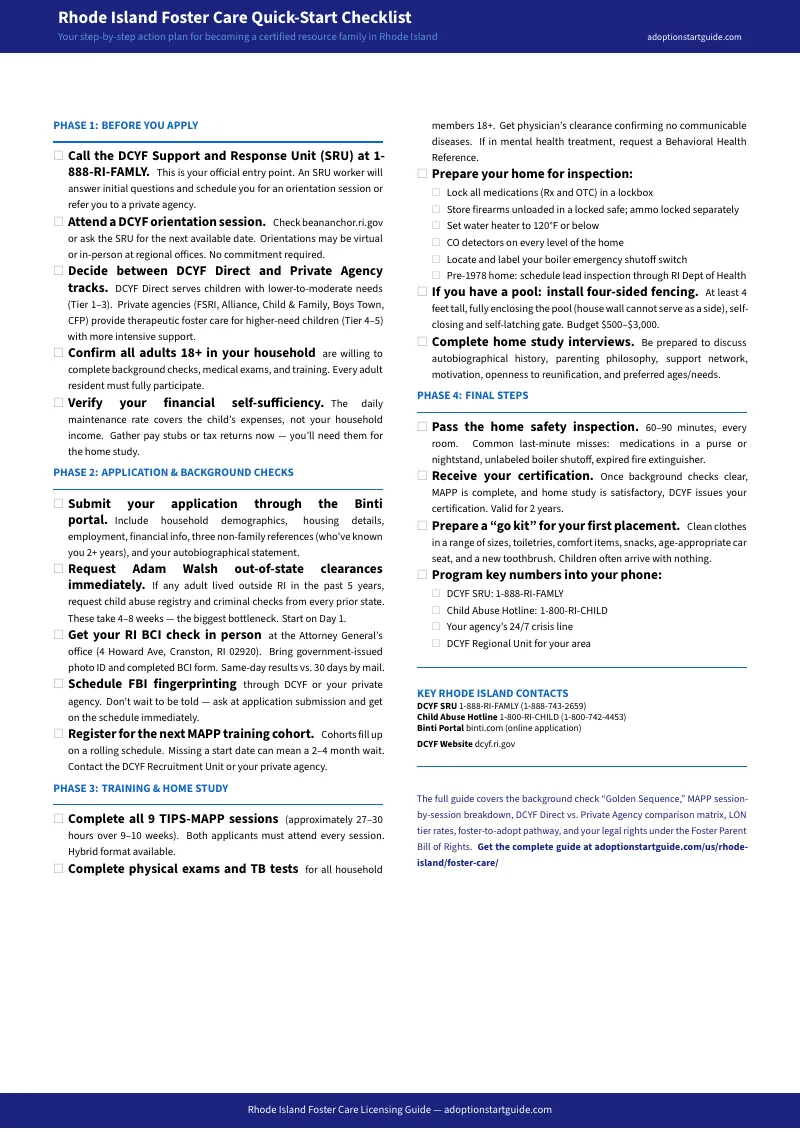
- Quick-Start Checklist — Every action item from your first call to the SRU to approved certification, in the order Rhode Island's system expects you to complete them. The track decision, agency contact, background check initiation, MAPP registration, home safety preparation, and document gathering — sequenced to prevent the most common delays.
- Home Safety Inspection Checklist — Room-by-room walkthrough against 214-RICR-40-00-3 standards. Print it, walk your home, and check every item before the inspector arrives.
- Background Check Tracker — Track all clearance layers (BCI, FBI, CANTS, out-of-state Adam Walsh) for each adult in your household with dates, costs, and status.
- Agency Comparison Worksheet — Side-by-side grid for evaluating the five private CPAs plus DCYF Direct with the questions that determine whether your process takes three months or nine.
- MAPP Session Tracker — All 9 sessions with date, time, and notes columns, plus your annual in-service training log for certification renewal.
- Financial Planning Worksheet — Pre-certification cost budget and daily maintenance rate reference with all Rhode Island benefit programs listed.
- Placement Call Questions — Fridge sheet with the questions to ask when DCYF or your agency calls about a placement, plus First 72 Hours reminders.
- Key Contacts Directory — Fillable contact sheet for your caseworker, agency, school, pediatrician, and respite provider, plus essential RI hotlines including 1-888-RI-FAMLY and 1-800-RI-CHILD.
- Document Checklist — Every document needed for your home study with checkboxes, validity periods, and reference contact fields.
- Certification Timeline — Visual timeline template mapping your path from first SRU call to certified resource family, with target weeks and date fields for every milestone.
Who this guide is for
- Families beginning the certification process — You've called the SRU or visited beananchor.ri.gov and attended an orientation, but you can't tell whether to go through DCYF Direct or a private agency, whether to schedule your BCI or register for MAPP first, or how the five agencies actually compare. This guide puts the steps in sequence and the track decision in context so you stop researching in circles and start making measurable progress toward certification.
- Working professionals managing the timeline — You have the income and the intention, but fitting 27–30 hours of MAPP training, multiple background check appointments, and a home study into a full-time work schedule requires precision. This guide shows you how to find evening and weekend MAPP cohorts, which steps can run in parallel, and how the Golden Sequence prevents your BCI from expiring while you're waiting on an out-of-state clearance.
- Single adults and same-sex couples — Rhode Island explicitly welcomes all household structures for foster care certification. The state's non-discrimination policy covers sexual orientation, gender identity, and relationship status. This guide confirms your eligibility, walks you through the process as it applies to your family structure, and helps you identify which private agencies are the strongest match.
- Kinship caregivers acting in an emergency — A grandchild, niece, or nephew was placed with you this week. You need to understand your options now: kinship verification, the expedited certification pathway, and the financial difference between an unverified placement with no support and full certification with $35–$95/day in maintenance payments. Rhode Island leads the nation in kinship placements — 73% of foster children are placed with relatives. The kinship chapter exists because you don't have months to figure this out.
- Potential adopters exploring the foster-to-adopt pathway — You're interested in adoption and know that foster-to-adopt can be the most affordable path. This guide covers the concurrent planning process, legal risk placements, the termination timeline, adoption subsidies, and how Adoption Rhode Island supports families through finalization in Family Court.
Why the free resources aren't enough
DCYF's website covers the certification process across dozens of pages written for departmental compliance, not for a family at their kitchen table trying to figure out where to start. The "Be An Anchor" campaign provides encouragement and a phone number, but it doesn't explain the pros and cons of each private agency, their current MAPP schedules, or their clinical specializations — because it's a recruitment portal, not a navigation tool. The Binti portal collects your application data efficiently, but it doesn't tell you that getting your BCI in person saves a month, that out-of-state checks should start on Day 1, or that your pre-1978 home needs a lead certificate before the inspector arrives.
Reddit threads and Facebook groups give you peer support and secondhand experience. They also mix advice from other states with Rhode Island's specific requirements, recommend skipping steps that aren't skippable, and offer guidance based on regulations that changed when DCYF restructured its LON tier system and daily rates. In a system where one missed MAPP cohort costs you three months and one expired background check means re-fingerprinting at your own expense, secondhand advice from the wrong state or the wrong track is worse than no advice at all.
The free Quick-Start Checklist
Download the Rhode Island Foster Care Quick-Start Checklist for a one-page overview of the key certification steps from your first call to the SRU to approved resource family status. Free, no commitment. If you want the full guide with the track decision matrix, the agency comparison framework, the background check Golden Sequence, the home study preparation guide, the LON tier financial breakdown, the kinship quick-start pathway, and the printable worksheets, click the button in the sidebar.
— less than one BCI background check
A single Rhode Island BCI check costs $5 in person. FBI fingerprinting runs additional fees per person. A missed MAPP cohort delays your certification by two to four months — and for kinship caregivers, every month without full certification is a month at no financial support instead of the $35–$95/day maintenance rate you're entitled to. The RI Certification Navigator doesn't replace your DCYF caseworker or your private agency. It makes sure you don't waste their limited time asking questions the guide already answers, and it makes sure you don't learn about the Golden Sequence, the track decision, or the boiler shutoff switch after it's already cost you time and money you won't get back.