
You've watched the DCS orientation video, called the regional office, maybe even browsed the Every Child TN website. You still don't know whether to license through DCS directly or through one of the private agencies — and nobody at orientation explained why that choice shapes everything that follows.
Tennessee runs foster care through the Department of Children's Services, but DCS isn't the only path to licensure. Private Child-Placing Agencies — Omni Visions, Youth Villages, Arrow Child and Family Ministries, Evergreen Life Services, Faith Homes — each handle training, home studies, and ongoing support differently across the six DCS regions. Which track you choose determines who conducts your home study, who runs your TN-KEY training cohort, and who answers the phone at midnight when a placement call comes in. DCS cannot recommend one agency over another. The agencies will not compare themselves to each other. You're expected to make the most consequential decision of the licensing process with no neutral information.
The TN-KEY pre-service training is approximately 30 hours spread across weekly sessions. In the West and Middle regions — Memphis and Nashville — cohorts fill up within days of being posted. In the Mid-West and Northeast regions, you might face a two-hour drive to the nearest training site, and cohorts may only run a few times a year. Miss the enrollment window and you wait months. Meanwhile, every adult in your household needs a local criminal records check, TBI/FBI fingerprints, a National Sex Offender Registry search, a Tennessee Department of Health Vulnerable Persons Registry check, and a DCS Internal Registry search. That's five separate background screenings per adult, each on its own processing timeline — and fingerprints alone can take up to 15 days, or longer during backlogs.
And the home study — governed by DCS Policy 16.4 — goes far deeper than smoke detectors and locked cabinets. Tennessee has specific requirements that trip up families who prepared using generic national guides: hot water at the tap cannot exceed 120 degrees Fahrenheit (factory defaults are 140), all firearms must be in a locked cabinet with ammunition locked separately in a different container (not a separate compartment in the same safe), all medications including daily vitamins must be locked and out of reach, and bedrooms for foster children cannot be in detached buildings, unfinished attics, or unfinished basements. The Policy 16 standards are buried in PowerDMS documents written for caseworkers. Nobody hands them to you in a family-friendly format before the inspection.
The DCS Licensing Roadmap
This guide exists because Tennessee's foster care licensing process isn't hard — it's scattered across DCS Policy Chapter 16 on PowerDMS, T.C.A. Title 37, the Every Child TN recruitment portal, six regional DCS offices, a dozen private agency websites, and the TFACTS management system that nobody explains to you until after you're licensed. The information exists. The sequencing doesn't. Nobody tells you that getting your medical exams too early means they expire before your fingerprints clear. Nobody tells you that TN-KEY cohorts in a neighboring region might start sooner than yours. Nobody gives you a neutral comparison of Omni Visions versus Youth Villages versus Arrow — the comparison the system is designed not to provide. This guide assembles every regulatory requirement, practical timeline, and strategic decision into one document, sequenced in the order that actually works.
What's inside
- DCS direct vs. private CPA decision framework — This is the question that orientation doesn't answer, and it's the single most consequential choice in the licensing process. DCS handles Standard/Level 1 placements with state-employed caseworkers. Omni Visions, Youth Villages, Arrow Child and Family Ministries, Evergreen Life Services, and Faith Homes each specialize in different populations — therapeutic care, medically fragile children, faith-based support, teen placements — with different caseworker ratios, training schedules, and on-call support models. This chapter compares each track and agency by specialty, geographic reach, support availability, and placement types so you can choose based on your family's goals rather than guessing.
- Step-by-step licensing timeline with Tennessee-specific delay points — From your first inquiry through license approval, every step mapped with realistic durations. Not the DCS target of 90 days — the actual timeline including TBI/FBI fingerprint processing windows, TN-KEY scheduling gaps across the six regions, and the home study queue. Shows exactly where the common delays happen: fingerprints that take weeks during backlogs, cohorts that fill up before you register, medical exams that expire because you sequenced them too early. The guide tells you which steps to run in parallel and which to hold until later so a four-month process doesn't become ten.
- TN-KEY 30-hour training decoded — The seven training domains broken down: Trauma and Brain Development, Attachment and Bonding, Separation and Loss, Supporting Birth Families, Managing Behaviors, Permanency Planning, and Working with the System. The Eco-Map exercise explained — what it is, why it matters, and how to complete it thoughtfully rather than as a checkbox. Private agency specialty training covered: Arrow's TBRI framework, Youth Villages' behavioral support model, Omni's clinical modules. Walk into Session 1 knowing exactly what the trainers are evaluating and why the self-assessment components exist.
- Home safety inspection checklist — DCS Policy 16.4 — Every requirement from the actual caseworker forms (CS-0676 and CS-0670) translated into a printable room-by-room walkthrough. Water temperature at the tap (120 degrees F maximum — test it with a thermometer, don't trust the dial), firearms in a locked cabinet with ammunition locked in a separate container, all medications locked including over-the-counter vitamins and supplements, fire extinguisher (minimum 2.5 lb) on every floor, carbon monoxide detectors if you have gas appliances, bedroom square footage minimums (65 square feet for the first child, 50 additional per child), and pool fencing with self-locking gates. Walk your home with this before the caseworker arrives.
- Background check guide for all five screenings — Local criminal records, TBI/FBI fingerprints, National Sex Offender Registry, Tennessee Department of Health Vulnerable Persons Registry, and DCS Internal Registry — with processing timelines, permanently disqualifying offenses under T.C.A. SS 37-5-511, the five-year felony window, and the Waiver Advisory Committee process for offenses that aren't permanent bars. If you've lived outside Tennessee within the last five years, the out-of-state registry check adds time — the guide covers how to initiate those requests early so they don't stall your home study.
- Board rates and financial benefits breakdown — Current daily rates by age group ($32.62 for ages 0-11, $37.40 for ages 12+), enhanced rates for special needs placements, TennCare coverage for all medical, dental, vision, and mental health with zero premiums and zero co-pays, childcare subsidies with waived co-pays for working foster parents, clothing allowances at initial intake and annually, the $15.37/day kinship rate and the path to the full rate within 120 days, and the personal allowance requirements ($1/day ages 0-12, $2/day ages 13-17). The financial picture the recruitment brochure mentions but never quantifies.
- The foster-to-adopt pathway, kinship care, and special situations — Concurrent planning explained: how Tennessee simultaneously works toward reunification while developing an adoption backup plan. Legal risk placements, the 12-month adoption preference for foster parents, TPR proceedings in Juvenile Court versus adoption finalization in Chancery Court. Kinship fast-track with expedited approval and the 120-day window to complete full licensure. Sibling placements, medically fragile children, teen placements, and ICPC interstate transfers. The full landscape of what your license makes possible.
- Your legal rights under the Foster Parent Bill of Rights — T.C.A. SS 37-2-415 gives you the right to full disclosure of a child's background, notice of all court hearings, participation in permanency planning meetings, the right to appear and be heard in Juvenile Court, and a written explanation if a child is removed from your home. This chapter covers those rights in plain language, plus your mandatory reporting obligations, the DCS discipline standards (no corporal punishment, period — even though Tennessee permits it in some public schools), and how to escalate when DCS doesn't return your calls within 72 hours.
Printable standalone worksheets included
- Licensing Timeline Tracker — Every milestone from first DCS contact through license approval, with fill-in date fields. Print it, update it after every caseworker interaction, and always know where you stand in the four-to-six-month process.
- Home Safety Inspection Checklist — Room-by-room walkthrough of every DCS Policy 16.4 requirement including the Tennessee-specific items that cause the most failures: water temperature, firearms and ammunition separation, medication storage, bedroom square footage, and fire safety equipment. Walk your home with this before the caseworker arrives.
Who this guide is for
- Nashville and Memphis metro families navigating high-volume regions — You live in the Middle or West region where DCS offices handle the highest caseloads in the state. TN-KEY cohorts fill up fast, caseworker response times can lag, and orientation sessions leave you with more questions than answers. You need the DCS-vs.-CPA decision framework, the realistic timeline, and the home inspection standards in one document — not scattered across tn.gov, PowerDMS, and a dozen agency websites.
- Knoxville, Chattanooga, and East Tennessee families — You're in the East or Northeast region where DCS handles fewer cases but training sites may require longer drives. The guide covers cross-region training options, virtual TN-KEY availability, and which CPAs serve your area so you can plan around geographic reality.
- Kinship caregivers who just got the call — A grandchild, niece, nephew, or family friend's child has been removed. You didn't plan to enter the DCS system — you're here because a child in your family needs you now. Tennessee allows expedited kinship placement with 120 days to complete training and full licensure. The guide covers the fast-track process, the reduced interim board rate, and what you need to complete to reach the full rate.
- Faith-motivated families responding to a church foster care ministry — Tennessee's faith community is the single largest recruitment engine for foster care in the state. Every Child TN partners with 11,500 houses of worship through the WRAP model. The calling is clear. The DCS paperwork is not. This guide maps the licensing process so the bureaucracy doesn't derail the mission.
- Foster-to-adopt families — You're entering the system hoping to provide a permanent home. Tennessee uses concurrent planning — working toward reunification while developing an adoption backup plan. This guide explains what legal risk placements mean, how the TPR process works, the 12-month adoption preference, and what the foster-to-adopt pathway looks like day to day when reunification is still the primary plan.
- Rural Tennessee families in the Mid-West or Northeast regions — You're in Jackson, Dyersburg, Cookeville, or Johnson City, and the nearest TN-KEY cohort might not start for months. The guide covers cross-region training, virtual options, CPA-led cohorts that may run sooner, and the cancellation list strategy that fills seats from dropped enrollments.
Why the free resources aren't enough
The DCS website (tn.gov/dcs) publishes Policy Chapter 16, the Foster Parent Handbook, and a general overview of the process. It does not give you a timeline that accounts for fingerprint processing delays, training scheduling gaps, or the sequencing that prevents your medical exams from expiring before your home study begins. The website gives you the regulations. It doesn't give you the strategy for navigating them.
The private agencies — Omni Visions, Youth Villages, Arrow, Evergreen, Faith Homes — each hold orientations and explain their own process. But they're recruiting for their organization. They'll describe their support model. They won't compare themselves to other agencies or tell you whether DCS direct licensing might be a better fit for your family's goals. That neutral comparison doesn't exist anywhere in the system. Until now.
Facebook groups and Reddit (r/Fosterparents) provide real talk from families in the system. They also provide conflicting anecdotes, outdated information, and a negativity bias driven by parents in crisis. A family in Nashville whose CPA handled everything smoothly gives different advice than a kinship caregiver in a rural Northeast county who can't get DCS to return calls. Crowdsourced guidance is authentic and situationally contradictory.
National foster care books cover a generic process that doesn't account for Tennessee's six DCS regions, the TN-KEY curriculum (which replaced PATH), DCS Policy 16.4 home safety standards (120-degree water, separate ammunition storage, bedroom square footage), the five-part TBI/FBI clearance sequence, the TFACTS system, or the faith-based WRAP support model that makes Tennessee's foster care landscape different from any other state. A guide written for Oklahoma or California won't help you in Tennessee.
The free Quick-Start Checklist
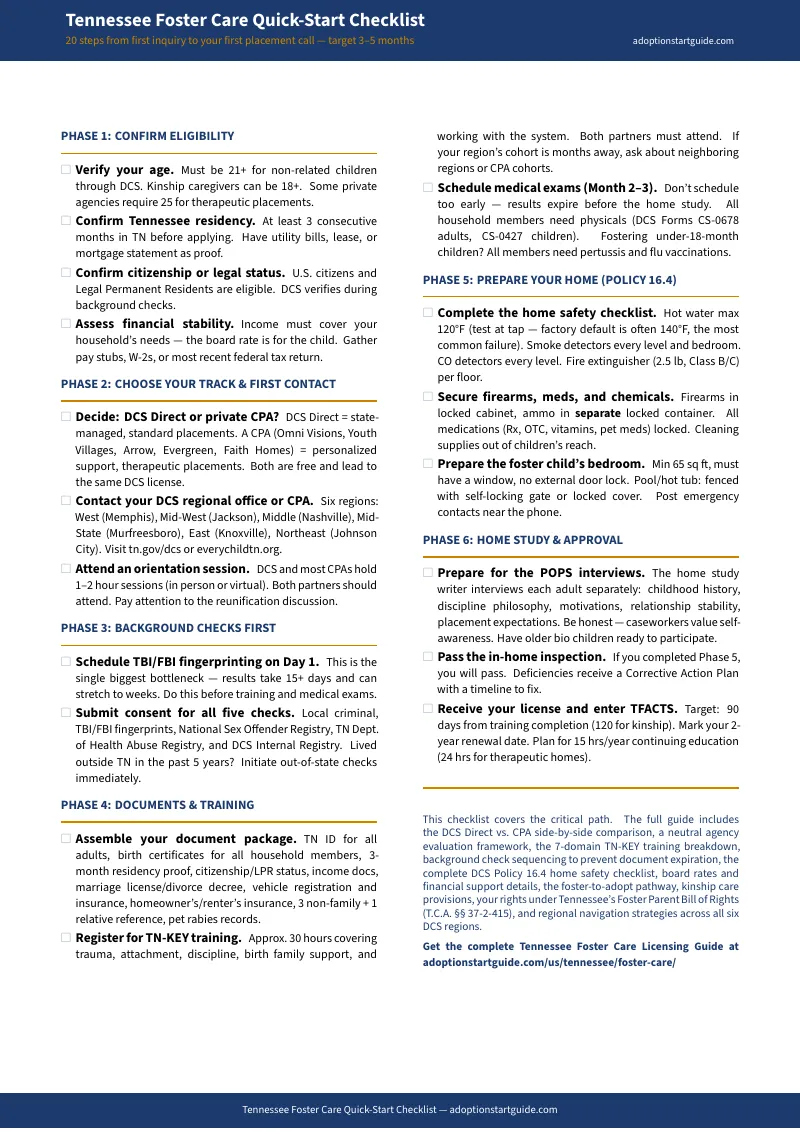
Download the Tennessee Foster Care Quick-Start Checklist for a one-page overview of the licensing process, from first DCS contact through license approval. Free, no commitment. If you want the full guide with the DCS-vs.-CPA decision framework, home inspection walkthrough, TN-KEY training guide, five-screening background check breakdown, financial benefits analysis, and all the printable worksheets, click the button in the sidebar.
— Less Than One Day of the Board Rate You'll Receive
A single day of the standard foster care board rate in Tennessee is $32 to $37. A household medical exam runs several hundred dollars. And every week your licensing is delayed by a missed TN-KEY cohort, a failed home inspection over a water heater set to 140 degrees, or fingerprints that bottleneck the entire process is a week you're not providing a home to a child who needs one. Tennessee has over 9,000 children in state custody and a 21.3% placement instability rate — 43rd in the nation. This guide costs less than one day of the stipend you'll receive, and it prevents the mistakes that turn a four-month process into a ten-month wait.
If the guide doesn't deliver, reply to your download email at any time for a full refund. No forms. No justification required.