You want to foster a child in Texas. The state wants you to figure out which of its ten regional contractors to call first.
You went to the DFPS website and found the "Get Started" page. It told you to contact a child-placing agency. You searched for agencies in your area and found a list of names you'd never heard of: 2INgage, OCOK, Texans Together, EMPOWER, Belong. No explanation of which one serves your county. No way to look up your zip code and get a straight answer. You called the DFPS hotline and were told your region has "transitioned to Community-Based Care" and that you need to contact the Single Source Continuum Contractor for your catchment area. You asked what that meant. They gave you another phone number.
If you live in Dallas, the contractor assigned to your region -- EMPOWER -- was placed under state receivership in March 2026 due to safety failures. The receivership is ongoing. New applicants in Region 3E are navigating a system that is being rebuilt while they try to enter it. If you live in Houston, Region 6A just went live with its SSCC in mid-2026. The rules for how Harris County processes applications changed months ago, and the DFPS website still describes the old process.
Meanwhile, you need to get fingerprinted. The state uses IdentoGO, and your agency gave you a six-digit Service Code to schedule the appointment. If you enter the wrong code -- and there are dozens of codes for different Texas state agencies -- your prints get routed to child care licensing instead of foster care. You won't find out for weeks. Then you pay another $38.54 to reprint and start over. The DFPS background check page doesn't list the correct codes for each CPA. Your agency's orientation packet might, if you can find it.
Then there's the home inspection. You read the TAC Chapter 749 minimum standards and found 80 pages of regulatory language about square footage, water temperature, firearms storage, and pool fencing. The single most common inspection failure in Texas is the pool fence. Most families have a three-sided fence where the house wall serves as the fourth side. Texas requires a dedicated four-sided fence that completely separates the home from the pool -- and the gate must be self-closing and self-latching. You won't find that distinction on any CPA recruitment page. You'll find it on your inspection report, after you fail.
The Texas Licensing Navigator: Your Complete Foster Care Verification Guide
This guide is built for how foster care licensing actually works in Texas in 2026 -- the Community-Based Care transition, the ten SSCC regions, the FACT background check system, the training curriculum differences between DFPS and private agencies, and the specific home safety standards under 26 TAC Chapter 749 that apply in this state and no other. Every chapter reflects current Texas law, the T3C reimbursement model, and the regional realities that vary from the Panhandle to the Rio Grande Valley to the Houston suburbs. It is not a generic fostering handbook with "Texas" in the title. It is the operating manual for this state's system -- through your region's contractor, under current rules, with the agencies and training programs that serve your county.
What's inside
- Region-by-Region SSCC Directory -- Texas is the only state where you can't just call the state agency and start the process. Your county determines whether you work with Saint Francis Ministries, 2INgage, OCOK, EMPOWER (under receivership), 4Kids4Families, Texas Family Care Network, Texans Together, or Belong. The guide maps every county to its SSCC or Legacy DFPS region, explains the CBC stage your area is in, and tells you exactly who to call on day one -- so you don't spend your first week bouncing between phone numbers that lead nowhere.
- FACT Background Check Walkthrough with IdentoGO Codes -- The Fingerprint-Based Applicant Clearinghouse of Texas routes your prints through the DPS, FBI, DFPS Central Registry, and Sex Offender Registry simultaneously. The guide walks you through the IdentoGO scheduling process with the correct Service Code for foster care (not child care licensing, not adoption, not DFPS employment), explains how the Universal Enrollment ID tracking works, covers out-of-state checks for anyone who has lived outside Texas in the past five years, and details the risk assessment process for past offenses -- what triggers it, what documentation to prepare, and what the DFPS Background Check Unit actually evaluates.
- Home Inspection Standards from 26 TAC Chapter 749 -- Every item your verifier inspects, decoded from regulatory language into a room-by-room walkthrough. The four-sided pool fence requirement and why three-sided fails. Firearms locked in a container with ammunition stored separately -- not just in a different compartment, in a separate locked container. Water heater temperature limits. Smoke and carbon monoxide detector placement by floor and sleeping area. Bedroom square footage minimums (40 sq ft shared, 80 sq ft private). Medication lockbox requirements for both prescription and over-the-counter. Trampoline insurance and safety net standards. Know exactly what to fix before your verifier walks through the door, not after.
- T3C Reimbursement Rate Tables -- Texas is transitioning from broad service levels to the Texas Child-Centered Care model, with specific Primary Service Packages based on the child's needs. The guide includes the current daily rates and family pass-through amounts for every T3C package -- Basic Support, Mental and Behavioral Health, Complex Medical Needs, IDD/Autism Spectrum, Human Trafficking Victim Support -- plus the legacy rates still in effect in regions that haven't transitioned. Reimbursement is not income, and the guide explains what it actually covers so your household budget reflects reality, not assumptions.
- STAR Health and the "3 in 30" Medical Protocol -- Every child placed in your home must complete three medical assessments within the first 30 days: a physical exam within 72 hours, a CANS assessment, and a Texas Health Steps check-up. The guide explains how to use Form 2085-B (Designation of Medical Consenter) to access care before the child's Medicaid ID card arrives -- because providers and pharmacies are required to serve children in foster care when this form is presented. Without it, you'll be asked to pay out of pocket for a foster child's prescriptions and appointments, then fight for reimbursement.
- Pre-Service Training Comparison -- DFPS Legacy regions use the National Training and Development Curriculum at around 19 hours. Private CPAs often require 30 to 50 hours using PRIDE, Pathways, or proprietary curricula, plus mandatory CPR/First Aid, psychotropic medication training, and medical consent certification. The guide compares what each major CPA in Texas requires so you choose your agency with full knowledge of the time commitment -- not the surprise of learning you owe 30 more hours after you've already started.
- Foster-to-Adopt Pathway and TARE -- If adoption is part of your plan, the guide covers concurrent planning, the Adoption Motivated by Safety framework, the permanency hearing timeline under federal ASFA rules, Termination of Parental Rights procedures in Texas District Courts, and how to use the Texas Adoption Resource Exchange to view children whose parental rights have already been terminated. Plus adoption assistance: monthly subsidies, continued Medicaid until age 18 or 21, the public university tuition waiver, and the one-time $1,200 legal cost reimbursement.
- Military Family Guidance -- Fort Cavazos, Joint Base San Antonio, and Fort Bliss families face questions that civilian applicants don't: whether privatized military housing (PPV) meets TAC Chapter 749 standards, how base housing pet and trampoline policies interact with state foster care requirements, how PCS orders affect an active verification, and whether Military OneSource consultations substitute for CPA-specific training. The guide addresses each of these so military families can move forward without waiting months for answers that their Family Readiness Group can't provide.
Who this guide is for
- Dallas-Fort Worth and Houston metro professionals -- You're a dual-income household with the time and motivation to foster, but you've spent two evenings on the DFPS website and still can't figure out whether to call the state, a private agency, or the SSCC for your region. You want a linear process that gets you from first inquiry to verified home without the runaround.
- Kinship caregivers in an emergency -- CPS placed your grandchild, your niece, or your neighbor's child with you, and you have a limited window to complete verification. You need to know which forms to file, which background checks to expect, and what training grace periods apply to relatives -- tonight, not after three months of orientations.
- Faith-motivated families -- Your church ran a foster care ministry drive and you felt called to serve. The church provided inspiration. The state provides regulation. You need the bridge between the two: the administrative roadmap that turns conviction into a verified home before your family's momentum stalls in the FACT system.
- Military families at Texas installations -- You've been through SERE, PCS, and a security clearance. A home study doesn't scare you. But you need to know whether your base housing qualifies, what happens if you receive orders mid-verification, and how the state's requirements interact with your installation's policies.
- Rural and West Texas families -- You live in a county where the nearest IdentoGO location is an hour away and pre-service training runs once a year. You need to know about online hybrid training options, cross-region attendance policies, and which CPAs serve your area -- because the metro-focused advice on most websites doesn't apply to you.
Why the free resources fall short
The DFPS website publishes a list of SSCCs by region but provides no tool for looking up your county or zip code to find your specific contractor. The "Get Started" page describes a process that only applies to Legacy regions -- if your county has transitioned to CBC, the instructions are wrong. IdentoGO's Texas page lists dozens of Service Codes for different state agencies but doesn't specify which code is for foster care licensing through a CPA versus DFPS direct. TARE posts profiles of waiting children but doesn't walk you through the foster-to-adopt pathway that leads to those children. CPA recruitment pages emphasize that training is "free" without disclosing the $300 to $700 in home preparation, fingerprinting, fire inspection, and TB testing costs that families pay before they're verified.
National foster care books describe a generalized process that doesn't account for Texas's ten-region SSCC model, the EMPOWER receivership in Dallas, the T3C rate transition, the FACT fingerprinting system, or the four-sided pool fence standard that fails more Texas home inspections than any other single item. A book written for Ohio or Florida will not tell you which CPA serves Williamson County, what happens when your SSCC is under receivership, or how to use Form 2085-B at a pharmacy that has never heard of STAR Health.
The free Quick-Start Checklist
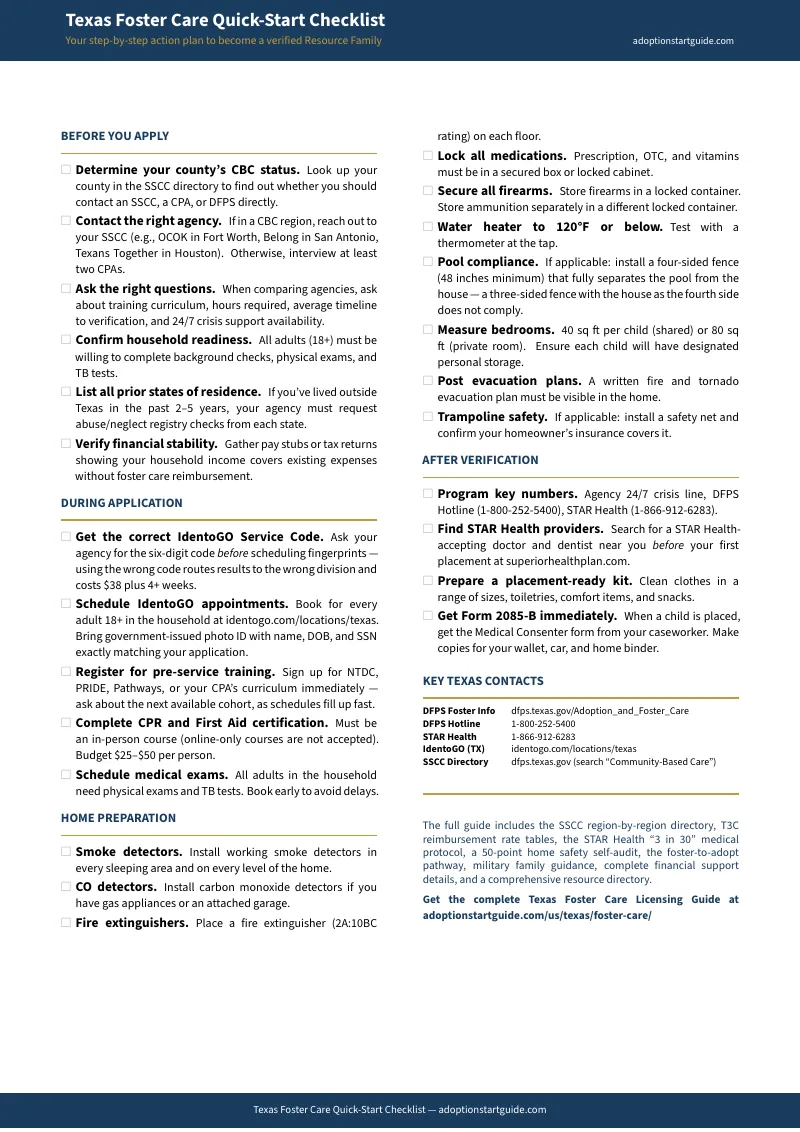
Download the Texas Foster Care Quick-Start Checklist for the essential actions that get you from first inquiry to moving through the system -- including the home safety items that cause the most inspection failures in the state. Free, instant download, no commitment. If you want the full guide with the SSCC county directory, the FACT background check walkthrough, the TAC Chapter 749 home standards decoded, the T3C rate tables, STAR Health and "3 in 30" medical navigation, pre-service training comparisons, the foster-to-adopt pathway with TARE, and the military family guidance, click the button in the sidebar.
-- less than a single IdentoGO reprint
One wrong Service Code at IdentoGO costs $38.54 and four weeks of delay. One failed pool fence inspection costs $500 to $2,000 to fix after the fact, plus the weeks it takes to schedule a re-inspection. One missed "3 in 30" medical appointment means you're paying out of pocket for a foster child's care because nobody told you about Form 2085-B. This guide puts the entire Texas foster care verification process in your hands for less than what most families spend on a single background check mistake. Families who understand the system before they enter it apply to the right agency on the first call, pass the home inspection on the first visit, and walk into their first placement prepared.
If the guide doesn't deliver, reply to your download email at any time for a full refund. No forms. No justification required.