Utah makes fostering sound simple. Then you meet R501-12, five DCFS regions, and a licensing process nobody mapped for you.
You went to fosterutah.gov looking for a clear path to becoming a foster parent. What you found was a recruitment pitch and a phone number. Call your regional DCFS office, they said. Attend an orientation. It'll all make sense. So you called. You sat through a 90-minute session that told you foster care matters — you already knew that — and left with a folder of forms, a vague reference to PRIDE training, and no idea what happens between today and a child arriving in your home. The orientation was designed to make you feel inspired. It was not designed to make you feel prepared.
Meanwhile, the system behind the curtain is more complex than anyone let on. Utah's foster care licensing is governed by R501-12 of the Utah Administrative Code — 47 sections of regulatory requirements covering everything from bedroom square footage to medication storage to the exact type of lock required on your pool gate. The Division of Child and Family Services handles placements, but the Office of Licensing conducts your home inspection — two separate state agencies with different priorities and different timelines. And your experience varies dramatically by region: Salt Lake and Northern Region offices process applications faster than the Southwest and Western regions, but nobody publishes that data. You're expected to figure it out after you've already committed months to the process.
National foster care books on Amazon describe a generic licensing process that doesn't match Utah's system. They don't know about R501-12, the DCFS/Office of Licensing split, PRIDE pre-service training requirements, or the five-region structure that shapes how quickly your application moves. A guide written for a national audience will tell you to "contact your local agency." In Utah, that could mean your DCFS regional office, a licensed child-placing agency, or a faith-based organization — and the right choice depends on where you live, your family's situation, and what types of placements you're open to.
The R501 Licensing Navigator: Your Strategic Guide to Utah Foster Care
This guide is built for Utah's foster care licensing system and nobody else's. Every chapter, every checklist, every recommendation is grounded in the current R501-12 Administrative Code, DCFS policy, Office of Licensing inspection standards, and the regional realities that determine whether your approval takes three months or nine. It's not a repurposed national handbook. It's the operational layer between what fosterutah.gov tells you and what you actually need to know to get licensed — in your DCFS region, under current conditions.
What's inside
- DCFS Region-by-Region Guide — Utah's five DCFS regions (Northern, Salt Lake, Western, Central, and Southwest) operate with different caseloads, different staffing levels, and different response times. Salt Lake processes the highest volume of applications. Southwest and Western regions cover vast rural territory with fewer licensing workers. This chapter gives you realistic, region-specific timelines and strategies so you can plan around your region's actual capacity rather than the state's generic "a few months" estimate.
- R501-12 Home Inspection Walkthrough — The Office of Licensing inspector arrives with a checklist derived from R501-12. Bedroom square footage minimums. Working smoke and carbon monoxide detectors on every level. Firearms unloaded in a locked container with ammunition stored separately. Medications — including over-the-counter — inaccessible to children. Hot water temperature at or below 120 degrees. This chapter is a room-by-room walkthrough of every R501-12 requirement, including the items that trip up Utah homes specifically: basement bedrooms without egress windows, wood-burning stoves without proper clearance, and the outdoor hazard rules that apply differently to rural properties with acreage.
- PRIDE/NTDC Training Breakdown — Utah requires pre-service training through the PRIDE Model of Practice or the newer National Training and Development Curriculum (NTDC). Most applicants know they need training. Nobody breaks down what each session covers, how many hours you need, how to schedule around work, or how couples can divide the workload when sessions conflict with shifts. This chapter gives you a session-by-session overview of the full training curriculum, what to expect in each module, and how to complete it without losing three months to scheduling conflicts.
- Background Check and Disclosure Strategy — Every adult in your household must clear BCI (Bureau of Criminal Identification) and FBI fingerprint checks, plus a child abuse registry screening. A clean record clears in days. A hit — even a decades-old dismissed charge — triggers a review process, and your response in the first 30 days determines whether it's a speed bump or a dead end. This chapter tells you how to prepare your disclosure and supporting documentation before you submit your fingerprints, so a routine flag doesn't derail your approval by months.
- Child-Placing Agency vs. DCFS Direct Licensing — You can get licensed directly through DCFS or through a licensed child-placing agency (CPA). CPAs — including faith-based organizations like LDS Family Services referral partners — often provide more hands-on support during the process and may specialize in certain placement types. But going through a CPA adds a layer between you and the state, and not all agencies serve all regions. This chapter maps the tradeoffs so you choose the path that actually makes sense for where you live and what kind of fostering you want to do.
- Financial Reality of Utah Foster Care — Utah's foster care reimbursement rates start at approximately $660 per month for basic care and increase with the child's assessed level of need. But the rate you receive depends on the child's service plan, not your expenses. This chapter breaks down every reimbursement tier, Medicaid coverage for foster children, the clothing and school supply allowance, respite care funding, the adoption subsidy if you move toward permanency, and the real out-of-pocket costs nobody mentions at orientation — transportation for birth family visits, childcare gaps during court dates, and the work disruption from Child and Family Team meetings.
- Kinship and Relative Placement Guide — When a child is removed and placed with a relative, you enter the system through the emergency side door. You may have a child in your home tonight and paperwork to file tomorrow. This chapter walks you through the kinship licensing process, explains the difference between a specified (unlicensed) placement and full licensure, shows you how to access financial support you're entitled to, and covers the expedited background check timeline for emergency kin placements.
- Indian Child Welfare Act (ICWA) and Tribal Considerations — Utah is home to eight federally recognized tribes, and ICWA imposes specific placement preferences and procedural requirements when a child may be a member of or eligible for membership in a tribal nation. This chapter covers ICWA compliance requirements for foster families, what the "active efforts" standard means in practice, and how tribal jurisdiction intersects with state DCFS proceedings.
Printable standalone worksheets included
- Licensing Timeline Tracker — Every milestone from initial inquiry through license approval, with fill-in date fields and your DCFS region's contact information. Print it, update it after every contact, and always know where you stand in the process.
- R501-12 Home Safety Inspection Checklist — Room-by-room walkthrough of every Office of Licensing requirement. Walk your house with this before the inspector visits.
- Document Organization Sheet — Application forms, BCI/FBI fingerprint receipts, health physicals, training certificates, vehicle registration, insurance verification, personal references — every document you need, in the order you need it.
- Financial Planning Worksheet — Monthly reimbursement rates by level of care, out-of-pocket cost estimates, Medicaid coverage summary, and adoption subsidy information in one printable sheet. Take it to your household budget conversation.
Who this guide is for
- First-time prospective foster parents — You've been thinking about fostering for months. Maybe you attended a DCFS orientation or heard about the need through your congregation, your community, or a friend who fosters. You went online and found fosterutah.gov, a phone number, and not much else. You need the system translated into plain language with a realistic timeline for your specific DCFS region.
- Kinship caregivers — A grandchild, niece, nephew, or family friend's child was placed with you on an emergency basis. The child is already in your home. You need to understand the difference between specified and licensed kinship care, navigate the background check process you never planned for, and get fully licensed so you can access the financial support and services that unlicensed placements don't receive.
- Military families at Hill AFB and Dugway — PCS orders, deployment cycles, and base housing add complications that civilian applicants don't face. This guide addresses how military-specific circumstances interact with Utah's licensing requirements, including what happens to your license if you receive orders out of state.
- Rural families outside the Wasatch Front — If you live in Carbon County, Iron County, or anywhere in the Western or Southwest DCFS regions, your licensing experience looks different from a family in Salt Lake City. Fewer licensing workers, longer drive times for home studies, and different community resource availability. The guide covers rural-specific realities that urban-focused resources skip entirely.
- Foster-to-adopt families — You're entering foster care with the hope of eventually providing a permanent home. Utah law prioritizes reunification with the birth family, and concurrent planning — preparing for both reunification and adoption simultaneously — requires preparation that orientations don't provide. This guide covers how the foster-to-adopt pathway works within Utah's system, including the legal timeline for termination of parental rights.
Why the free resources aren't enough
The fosterutah.gov website is a recruitment tool. It does an excellent job of telling you why foster care matters and how to express interest. It does not tell you which R501-12 requirements trip up the most applicants, how the five DCFS regions differ in processing speed, or what to do when your background check flags a dismissed misdemeanor from fifteen years ago.
DCFS orientation sessions are designed to inspire you to apply, not prepare you to succeed. You'll hear statistics about the 2,700 children in Utah's foster care system. You won't get a room-by-room checklist for passing the Office of Licensing home inspection or a strategy for completing PRIDE training around a full-time work schedule.
Your ward, your congregation, or your community group will offer emotional support and encouragement — and that matters enormously. But the family in your ward who fostered five years ago went through a different version of the training curriculum and may not know the current R501-12 requirements. Well-intentioned advice from someone else's experience can leave gaps in your preparation that the Office of Licensing inspector will find.
National foster care books describe a generic licensing process. They don't know about Utah's DCFS/Office of Licensing split, the five-region structure, R501-12 administrative code, PRIDE training requirements, or the specific cultural dynamics that shape fostering in Utah's communities. A guide written for a national audience will tell you to "contact your local agency." It won't tell you which agency, in which region, is actually taking new applications this quarter.
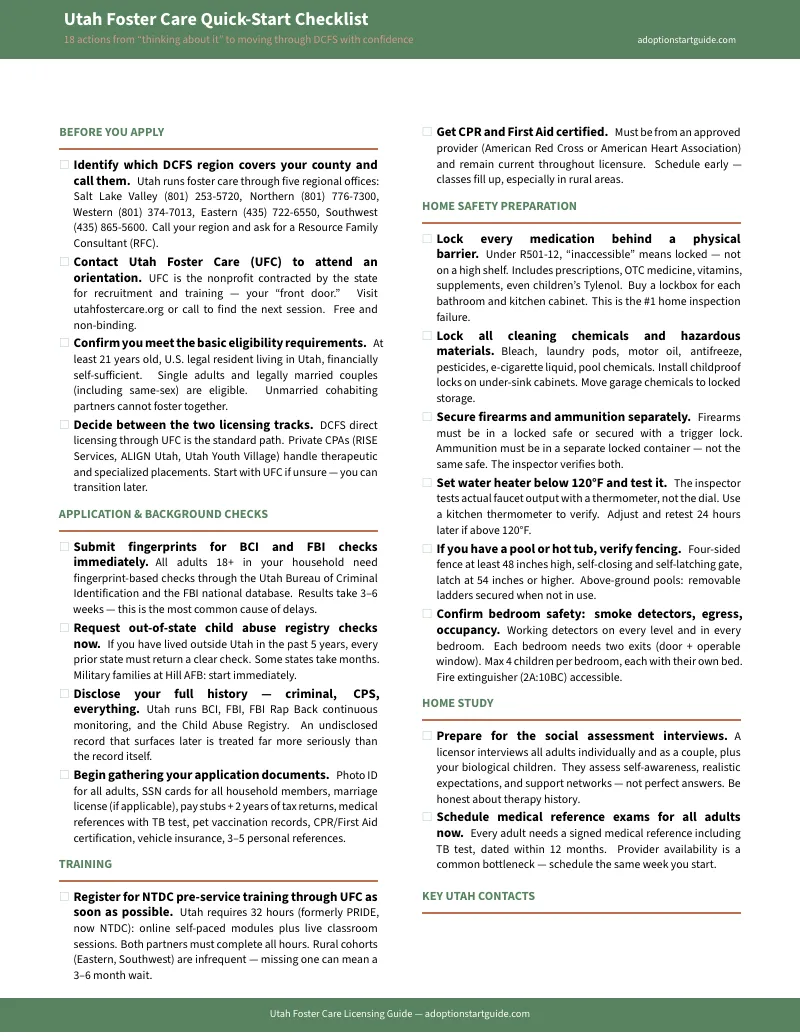
The free Quick-Start Checklist
Download the Utah Foster Care Quick-Start Checklist for a one-page overview of the licensing process, from initial inquiry through approval. Free, no commitment. If you want the full guide with the R501 Licensing Navigator, region-specific timelines, PRIDE training breakdown, financial analysis, and printable worksheets, click the button in the sidebar.
— less than one family dinner out
The typical Utah applicant spends weeks piecing together the licensing process from fosterutah.gov, DCFS phone calls, advice from other foster families, and trial and error during the home inspection. This guide distills the most critical decisions into a weekend-ready roadmap. A failed Office of Licensing inspection because of a basement bedroom without an egress window or an unlocked medicine cabinet delays your approval by months. One checklist prevents that. A background check flag you didn't prepare for burns your disclosure window. One chapter prevents that.
If the guide doesn't deliver, reply to your download email at any time for a full refund. No forms. No justification required.