
Vermont is an "agency desert." Most of the adoption advice you'll find online doesn't account for that — or for the law that changed in 2025.
You decided to adopt. Maybe you've been fostering a child through DCF for two years and the TPR just came through. Maybe you and your partner used assisted reproduction and want the non-biological parent legally recognized before something goes wrong. Maybe you married someone with a child three years ago and you've been "dad" since the first day — but the law doesn't know that yet. Whatever brought you here, you went looking for answers. What you found was a mess.
You searched "how to adopt in Vermont" and got blog posts from national sites describing a process that doesn't match your state. They reference "Probate Court" — which Vermont abolished in 2011. The correct filing location is the Probate Division of the Superior Court, and if you use the wrong name on your petition, the clerk's office will send it back. You found an adoption.org page listing Vermont agencies and discovered there are barely any — Lund in Burlington, Friends in Adoption in Middletown Springs, and a handful of smaller organizations. If you want to adopt an infant, you're almost certainly going interstate through ICPC, and nobody warned you about that.
You called an adoption attorney. The consultation was $250, and what you learned in that hour was that you need a home study, background checks, and "it depends." You could have found that on Google. What you couldn't find — anywhere — was a single resource that explains Vermont's complete adoption process under the current law, including the brand-new confirmatory adoption pathway that took effect in July 2025, with actual costs, actual timelines, actual forms, and the specific procedural traps that cause Vermont adoptions to stall or fall apart.
The Vermont Adoption Navigation System
This guide exists because Vermont adoption has a unique combination of problems. The state has fewer licensed agencies than almost any other in the country. The court system was reorganized in 2011, and outdated terminology still gets petitions rejected. A major new law — H.98, the Confirmatory Adoption Act — took effect in 2025, and most attorneys are still figuring out the forms. Rural home study requirements include things that families in other states never encounter: wood stove inspections on a 730-day cycle, private well water testing for arsenic and uranium, double-lock firearms storage. And if you're adopting an infant from out of state, Vermont's small ICPC office means processing delays that families in larger states don't face.
This guide translates all of it — the current Vermont Adoption Act (Title 15A), the 2025 H.98 confirmatory adoption law, and fifteen years of post-reorganization court practice — into a step-by-step process that a family can follow from "we want to adopt" to "the judge signed the decree."
What's inside
- Seven Adoption Pathways Compared — Foster-to-adopt through DCF ($0–$1,000), private agency ($30,000–$55,000), independent direct placement ($15,000–$35,000), stepparent/partner ($1,500–$5,000), confirmatory under H.98 (filing fees only), adult adoption, and international. Each pathway explained with realistic costs, timelines, and the specific legal requirements that differ between them. Most states offer five or six pathways — Vermont's confirmatory adoption path is genuinely new, and this guide is the only plain-language walkthrough that exists.
- Full H.98 Confirmatory Adoption Walkthrough — The 2025 law waives the home study, background checks, and residency waiting period for families who are already legal parents under the Vermont Parentage Act but want the added protection of an adoption decree. This chapter explains who qualifies, what documentation you need, which court form to file (Form 700-00131D), and why this matters for LGBTQ+ families and families formed through assisted reproduction — even if you think your legal parentage is already secure.
- Home Study Preparation Guide — The home study is the part of adoption that keeps families awake at night. This chapter explains exactly what the social worker evaluates — motivation, biographical history, financial stability, home safety, health assessments, and references — and walks you through Vermont's rural-specific requirements that surprise families who moved from other states. Wood stove inspection within the last 730 days. Private well water testing for arsenic, uranium, nitrite, manganese, fluoride, coliform, E. coli, and lead. Firearms stored unloaded in a locked safe with ammunition in a separate locked container. None of this is hard — but all of it takes weeks if you don't start early.
- Background Clearances and the FBI Bottleneck — Every adult in your home needs three clearances: FBI fingerprint check, VCIC state criminal background check, and DCF Child Protection Registry search. The FBI fingerprints take 8 to 10 weeks to process — the single longest bottleneck in the entire Vermont adoption process. This chapter walks you through scheduling, disqualifying offenses, the discretionary review process for non-violent offenses, and the 12-month validity window that can force you to redo clearances if your court date slips.
- Consent, TPR, and Birth Parent Rights — Vermont uses a 36-hour/21-day consent framework. The birth mother cannot sign consent until 36 hours after birth. Once signed, consent is revocable for 21 days for any reason — no questions asked. On day 22, it becomes irrevocable except for proven fraud or duress. Vermont has no Putative Father Registry — it uses a notice-based system, which means identifying and serving notice on a potential birth father requires a "diligent search" rather than a simple registry check. This chapter explains exactly what constitutes an adequate search and what happens when you can't find the father.
- ICPC Navigation for Vermont's Agency Desert — Because Vermont has so few local agencies, most families pursuing private infant adoption end up working with out-of-state agencies or birth mothers. That means ICPC — the Interstate Compact on the Placement of Children. Vermont's ICPC office is small, and processing delays are real. This chapter covers the timeline (private infant placements typically require 10–14 business days in the birth state, not 60–90 days), required documentation, and the strategy of engaging a local Vermont agency like Lund as your receiving-state contact early in the process.
- Court Process and Finalization — Vermont adoptions are finalized in the Probate Division of the Superior Court — not "Probate Court," which hasn't existed since 2011. The Family Division handles TPR in foster care cases. This chapter covers the petition filing (Form 700-00131), the verified accounting of expenses (Form 700-00138, due 10 days before the hearing), the 180-day minimum placement period before finalization, county-specific filing fees, and the Abenaki tribal considerations that apply to some Vermont cases.
- Complete Cost Breakdown and Financial Assistance — Realistic cost ranges for every pathway, plus every financial assistance program available: DCF adoption assistance subsidies ($522–$826 per month by age and need level), Medicaid continuation, the federal adoption tax credit ($17,280 for 2025, with $5,000 now refundable), employer benefits, and national grant programs. Vermont does not offer a state adoption tax credit — the federal credit is your primary financial tool.
- Post-Adoption Records and Birth Certificate Access — Vermont has granted unrestricted access to original birth certificates since July 1, 2023. Any adopted person 18 or older can request their original, unredacted birth certificate from the Department of Health. This chapter explains the process, contact preference forms for birth parents, and how to handle post-finalization administrative steps including Social Security updates and estate planning.
Appendices
- Vermont Adoption Agencies Directory — Lund Family Center, Friends in Adoption, NFI Vermont, and Families First in Southern Vermont — with locations, specialties, fee structures, and what to ask before committing. In a state with this few agencies, choosing the right one matters more than anywhere else.
- Court Filing Checklist — Every document required for your Probate Division petition: adoption petition (Form 700-00131), consents or TPR orders, approved home study, post-placement supervision reports, and the verified accounting of expenses.
- Common Pitfalls — The ten mistakes that delay or kill Vermont adoptions: the 8–10 week FBI fingerprint wait, using "Probate Court" instead of "Probate Division," rural property compliance surprises, ICPC gridlock from the small state office, expired clearances, missing the financial disclosure deadline, inadequate diligent search for birth fathers, ignoring Abenaki ICWA considerations, not getting enough certified copies, and skipping post-finalization steps.
- Questions to Ask Your Adoption Attorney — The specific questions that reveal whether your lawyer understands the 2025 H.98 law, has experience in your county's Probate Division, and can navigate the ICPC complications that come with Vermont's limited agency landscape.
- Key Vermont Contacts — DCF Family Services Division, ICPC office, Vermont State Police (VCIC checks), Department of Health Vital Records, Probate Division contact information by county, and Abenaki tribal contacts.
8 Printable Standalone Tools
Every tool prints as its own PDF — no flipping through the guide to find what you need.
- Home Study Document Checklist — All 16 required documents organized by category with done/date tracking columns. Tape it to your office wall and check items off as you gather them.
- Court Filing Checklist — Every document your Probate Division petition needs, including the financial disclosure deadline reminder.
- Adoption Pathway Comparison Card — One-page landscape reference comparing all six pathways on cost, timeline, control, child age, and financial support.
- Consent Timeline Reference — Visual quick reference for the 36-hour signing rule and 21-day revocation window with a fillable critical-dates table. Keep it during the consent period.
- Cost Breakdown Worksheet — Complete cost comparison across all pathways, DCF subsidy tiers, and federal tax credit details for budget planning.
- Vermont Contacts Directory — One-page fridge sheet with every key contact: DCF, ICPC office, Vital Records, Probate Division, and all five court form numbers.
- Attorney Interview Questions — 15 questions organized by category with note-taking lines. Bring this to your attorney consultation.
- Post-Finalization Action Plan — Eight steps to complete within 60 days of your final decree: birth certificate, Social Security, insurance, estate planning, and the tax credit.
Who this guide is for
- Families pursuing private or agency adoption — You've decided to adopt an infant through a licensed agency or independent attorney. In Vermont, that almost certainly means working with one of four local agencies or going out-of-state through ICPC. You need to understand how the agency desert shapes your options, what ICPC requires, and how Vermont's consent laws and cost structure work before you start writing checks.
- Foster parents ready to adopt — A child in your DCF placement has had parental rights terminated. You've been the primary caregiver for months or years. Now you need to understand the legal pivot from foster placement to adoption — how the Probate Division handles finalization, what "first consideration" means in practice, and how the adoption subsidy carries forward after the decree.
- LGBTQ+ families and families using confirmatory adoption — You're already a legal parent under the Vermont Parentage Act — through assisted reproduction, voluntary acknowledgment, or court order — but you want the belt-and-suspenders protection of an adoption decree. The 2025 H.98 law created a fast-track process specifically for you. This guide walks you through it step by step, including the specific form (700-00131D) and why you don't need a home study or background checks.
- Stepparents — You've been parenting this child for years. You want to make it legal. Then you learned about the consent requirement from the other biological parent, background checks for every adult in the household, and the 180-day placement period. The good news: Vermont may waive the home study if the child has lived with you for six months or more. This guide shows you the actual process and the specific stepparent petition form (700-00139).
Why free resources fall short
The DCF website publishes policy manuals written for caseworkers — not for families sitting at a kitchen table trying to figure out what to do first. The language is bureaucratic. The forms are scattered across the Vermont Judiciary website without a clear sequence. And the biggest problem: the court reorganization in 2011 means that half the instructions you find online — including some on state websites — still reference "Probate Court," a tribunal that no longer exists.
National adoption websites describe a generic process that doesn't account for Vermont's specific realities. They don't explain the agency desert. They don't mention the 730-day wood stove inspection requirement or the private well water testing that can delay your home study by a month. They don't cover the 2025 H.98 confirmatory adoption law — because most of them haven't updated their Vermont pages since it passed. And they definitely don't explain that Vermont's small ICPC office creates processing bottlenecks that families in New York or Massachusetts never encounter.
Vermont adoption attorneys charge $200–$400 per hour. An initial consultation tells you what you need for your specific situation. It doesn't walk you through the entire adoption framework so you understand where your situation fits before you start the billing clock. Two hours of basic orientation cost more than this entire guide — and you'll still need the attorney afterward.
The free Quick-Start Checklist
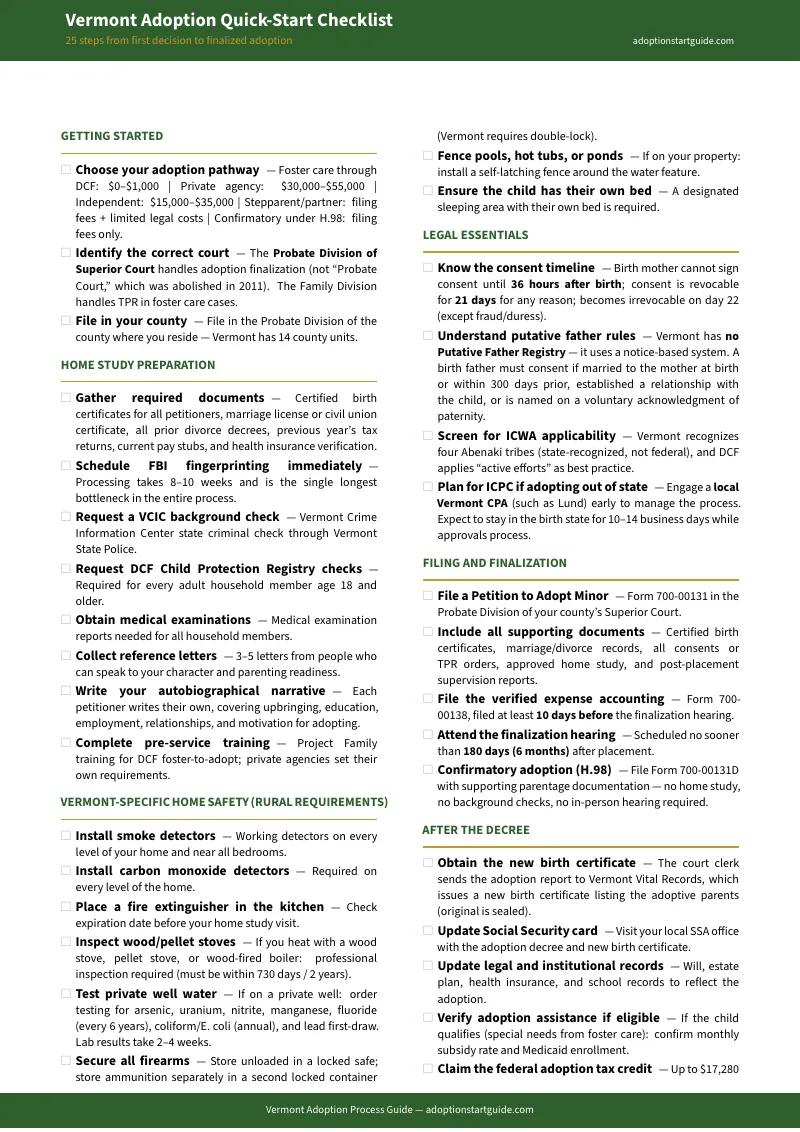
Download the Vermont Adoption Quick-Start Checklist for a 20-step overview of the process — from choosing your pathway through post-finalization. Free, no commitment. If you want the full guide with the seven-pathway comparison, H.98 confirmatory adoption walkthrough, agency directory, ICPC navigation strategies, rural home safety details, cost breakdowns, and attorney interview questions, click the button in the sidebar.
— less than one hour of a Vermont adoption attorney's time
A Vermont adoption attorney charges $200–$400 per hour. An FBI fingerprint check that you didn't schedule early enough delays your finalization by two months. A petition filed to "Probate Court" instead of the "Probate Division of the Superior Court" gets returned by the clerk. An inadequate diligent search for a birth father can overturn a completed adoption. A well water test you didn't know about stalls your home study for four weeks. One guide prevents all of these. One read-through saves you hours of billable attorney time explaining things you could have known before you walked in.
If the guide doesn't deliver, reply to your download email at any time for a full refund. No forms. No justification required.