You've decided to adopt in Washington State. Then you discovered that DCYF, the Superior Courts, and RCW 26.33 each assume you already understand the other two.
Washington is not like other states. There is no Putative Father Registry -- despite what half the national adoption websites claim. The state uses a notice-based system instead, and the rules change depending on whether the child is under or over one year old. A single missed notice to an alleged genetic parent can unwind an adoption years after finalization. The Indian Child Welfare Act applies to 29 federally recognized tribes in Washington, and the state's own WICWA statute demands "active efforts" -- a higher bar than the federal baseline -- with a "beyond a reasonable doubt" standard for terminating an Indian parent's rights. And after placement, Washington requires a six-month post-placement supervisory period before the court will sign a Final Decree. Most states finalize in 30 to 90 days.
You've already done the research. You've been on the DCYF website, where adoption information is scattered across dozens of pages, PDF forms, and publications like CWP_0114 that explain the rules but never tell you the order of operations as a parent. You attended an Amara AIM session, where the focus was trauma-informed care and dual licensure -- valuable, but agency-specific and silent on Superior Court filing procedures. You found the King County adoption packets, which give you forms but no guidance on how to fill them. You found Reddit threads where strangers confuse Washington's irrevocable consent rules with Oregon's revocation windows in the same comment and treat ICWA as something that only applies to foster care. And you found that adoption attorneys in Seattle bill $250 to $500 per hour.
The information exists. It's scattered across DCYF publications, RCW Chapter 26.33, WAC 110-148, WICWA provisions in RCW 13.38, King County adoption forms, tribal enrollment offices, and agency orientation packets. Piece it together yourself and you'll burn weeks reading documents that explain the statutes but never show you how the pieces connect.
The Evergreen State Adoption Navigator
This is a complete, Washington-specific adoption guide built around the problem every family in this state hits: navigating a system where DCYF, private agencies, the Superior Courts, and 29 tribal authorities each own a piece of the process but none of them explain how the pieces connect. Not a national overview. Not an agency brochure designed to funnel you into one program. Every chapter, every checklist, every cost figure is grounded in RCW 26.33, current DCYF policies, WAC home study requirements, WICWA compliance standards, and the real-world experience of families who have adopted in the Evergreen State.
What's inside
- Six-pathway comparison table -- DCYF foster-to-adopt, private agency (Amara, Olive Crest, Small World, Adoption Connections NW), independent adoption, kinship, stepparent, and adult adoption mapped side by side. Costs, timelines, eligibility, and the realistic wait for each pathway so you choose the right one before investing months in the wrong direction. Foster-to-adopt runs $0 to $2,500. Private agency fees range from $20,000 to $45,000. Independent adoption costs $8,000 to $40,000. Stepparent adoption runs $1,500 to $5,000. That decision deserves more than a caseworker's one-sentence summary.
- The putative father reality -- Washington does not have a centralized Putative Father Registry. A historical legislative attempt to create one was removed, and the state never adopted Article 4 of the Uniform Parentage Act. Instead, Washington uses a notice-based system for alleged genetic parents, and the rules differ based on whether the child is under or over one year old. This chapter explains what your attorney must do to conduct a diligent search, why the birth mother saying "there is no father" is not legally sufficient, and how to document every effort so your adoption is protected if a birth father surfaces during the 6-month post-placement period.
- ICWA and WICWA compliance guide for Washington's 29 tribes -- WICWA (RCW 13.38) requires "active efforts" -- documented, concerted, good faith attempts to engage the family and collaborate with the tribe. That is a significantly higher bar than the "reasonable efforts" standard in non-ICWA cases. If a court later finds that active efforts were not made or not documented, the adoption decree can be vacated. This chapter covers the "reason to know" standard, the tribal inquiry process, the placement preference hierarchy, the "beyond a reasonable doubt" TPR standard, and how to document compliance so your adoption is permanent. ICWA applies in private and independent adoptions too, not just foster care.
- Home study preparation with PNW mold and moisture focus -- In Western Washington, mold is the single most common cause of home study delays. WAC 110-148 requires homes to be "safe and sanitary," and licensors interpret that to include no visible mold and adequate ventilation. This chapter includes a Pacific Northwest environmental pre-check: bathroom ventilation CFM verification, water temperature calibration (120 degrees Fahrenheit maximum -- this is a pass/fail item), crawl space and basement inspection, window condensation assessment, foundation drainage, and the "double-lock" or "high-shelf" requirements for garden fertilizers and cleaning supplies. No national guide covers this because most states don't have this problem.
- The 6-month post-placement period explained -- Washington's six-month supervisory period is three to six times longer than most states. Families fear it as a window where the child can be "taken back." This chapter clarifies what the period actually is (a legal check, not a trial), what the post-placement reporter evaluates, what triggers removal (abuse/neglect, an unidentified birth father, or a missed ICWA notice -- not normal parenting struggles), and how to prepare for the three scheduled visits and individual interviews. Includes guidance on interlocutory orders and how county practices differ.
- Superior Court filing guide by county -- From King County's dedicated adoption paralegals and standardized form packets to Pierce County's military-heavy docket to Spokane's faith-informed judicial culture to smaller rural counties where there are no dedicated adoption staff. Filing requirements, the petition packet contents, the finalization hearing, and the process for obtaining an amended birth certificate through the Department of Health.
- Tax credit strategy for a no-income-tax state -- Washington has no state income tax and no state adoption tax credit. Your entire tax benefit depends on the Federal Adoption Tax Credit: up to $17,280 for 2025 with a new $5,000 refundable portion. For DCYF adoptions, the "special needs" designation means you can claim the full credit even with zero out-of-pocket expenses -- but you need the Special Needs Verification Letter from your Adoption Support Consultant. This chapter covers expense timing, carry-forward strategy, the phase-out thresholds, and employer adoption assistance programs common in the Seattle tech sector.
- DCYF Adoption Support Program navigator -- Monthly cash payments based on the child's level of need, Apple Health (Medicaid) coverage until age 18 or 21, non-recurring expense reimbursement up to $1,500, and specialized services. The Adoption Support Agreement is negotiated before finalization -- once the judge signs the decree without the agreement in place, your leverage drops. This chapter covers how to negotiate effectively, the tiered rate structure, annual reviews, and modification requests.
- Original birth certificate access and openness planning -- Since 2014, Washington adult adoptees (18+) can request their non-certified original birth certificate for $20. Birth parents can file Contact Preference Forms and nondisclosure declarations, but full secrecy is no longer guaranteed. This chapter explains how the 2014 law should inform your approach to openness from day one, including enforceable open adoption agreements under RCW 26.33.295.
- Stepparent, adult, and kinship adoption guides -- Stepparent adoption when the absent parent consents versus when you must petition for involuntary TPR under RCW 26.33.120. Adult adoption, which requires only the consent of both parties and a court filing. Kinship adoption for grandparents, aunts, uncles, and other relatives already caring for a child, including Kinship Core Training and the pathway from kinship foster care to permanent adoption.
Printable standalone worksheets included
The guide comes with printable standalone PDFs designed for real-world use:
- Pathway Comparison Card -- Six pathways side by side on one page. DCYF foster-to-adopt, private agency, independent, kinship, stepparent, and adult adoption. Costs, timelines, and the first steps for each route. Print it, sit down with your partner, and make the decision that shapes everything else.
- ICWA/WICWA Compliance Tracker -- Fillable tracker for documenting tribal inquiries, notice dates, active efforts, and tribal responses. Designed so your documentation meets the standard the Superior Court requires if compliance is ever challenged.
- Home Study Document Checklist -- Every document your home study provider will request, organized by category. Financial records, medical clearances, reference letters, WAC safety requirements, and the PNW environmental pre-check items. Nothing missing when the social worker arrives.
- Post-Finalization Action Plan -- Amended birth certificate through the Department of Health, Social Security update, insurance enrollment, the federal tax credit filing, and the DCYF non-recurring expense reimbursement claim. Every administrative step after the decree, in order, with contacts and processing timelines.
Who this guide is for
- Seattle and King County tech families exploring private adoption -- You work in tech, you research everything before you commit, and you've already compared Amara, Small World, and three other agencies. But none of them explained the putative father system, the Superior Court filing process, or how the federal tax credit works in a no-income-tax state. This guide fills the gap between agency orientation and legal reality.
- JBLM military families pursuing foster-to-adopt -- You're stationed at Joint Base Lewis-McChord and you know a PCS could happen during the 6-month post-placement period. This guide covers the DCYF pathway, Military OneSource resources, DoD adoption reimbursement, TRICARE coverage from date of placement, and what happens if you receive orders before finalization.
- Spokane and Eastern Washington faith-based families -- Your church community talks about adoption as a calling. The legal process speaks a different language -- TPR hearings, ICWA compliance, and Superior Court filings. Agencies like Olive Crest and Adoption Connections NW are your entry points, but this guide covers the full legal framework they don't.
- Olympic Peninsula and rural kinship caregivers -- You've been raising a grandchild, niece, or nephew after a family crisis. You lack legal custody. This guide covers the kinship adoption pathway, the TPR process when a parent has abandoned the child, and the DCYF subsidies most kinship families don't know they qualify for.
- Stepparents adopting a spouse's child -- The absent parent hasn't been involved in years. RCW 26.33.120 governs the conditions for involuntary TPR. This guide walks you through the home study waiver, the consent or TPR process, and the finalization hearing.
- LGBTQ+ families -- Washington legalized same-sex marriage in 2012, and all couples have equal standing in adoption proceedings. Whether you're pursuing private agency, foster-to-adopt, or second-parent adoption, the legal requirements are the same. This guide covers them without assuming a heteronormative family structure.
Why the free resources aren't enough
The DCYF website covers the foster-to-adopt pathway. It explains orientations, Caregiver Core Training, and regional contacts. But it provides minimal guidance on private, independent, or kinship adoption. If you're not fostering first, DCYF has little for you. And even within foster-to-adopt, the information is scattered across dozens of pages and PDF publications with no unified sequence.
Agencies like Amara and Olive Crest provide high-quality education, but their materials are agency-specific. Amara's AIM session focuses on dual licensure and trauma-informed care. Olive Crest emphasizes therapeutic support. Neither explains the putative father system, the Superior Court filing process, or how to claim the federal tax credit. They are focused on placement, not navigation.
National adoption books discuss "state adoption laws" without explaining that Washington has no Putative Father Registry, that WICWA demands active efforts above the federal ICWA baseline, or that the 6-month post-placement period is three to six times longer than most states. They mention home studies without covering PNW mold inspections. They reference "revocation periods" that don't apply here because Washington's consent is irrevocable once properly executed.
Reddit and Facebook groups give you emotional support and anecdotal experience. They also confuse Washington law with Oregon and California statutes in the same thread, spread the myth that ICWA only applies to children living on reservations, and offer advice based on other states' timelines. In Washington, where 29 tribes have jurisdiction and the post-placement period runs six months, that confusion has consequences.
Seattle adoption attorneys charge $250 to $500 per hour. A single orientation consultation costs $300 to $600. Families routinely spend their first billable hour covering foundational questions this guide answers in Chapter 1.
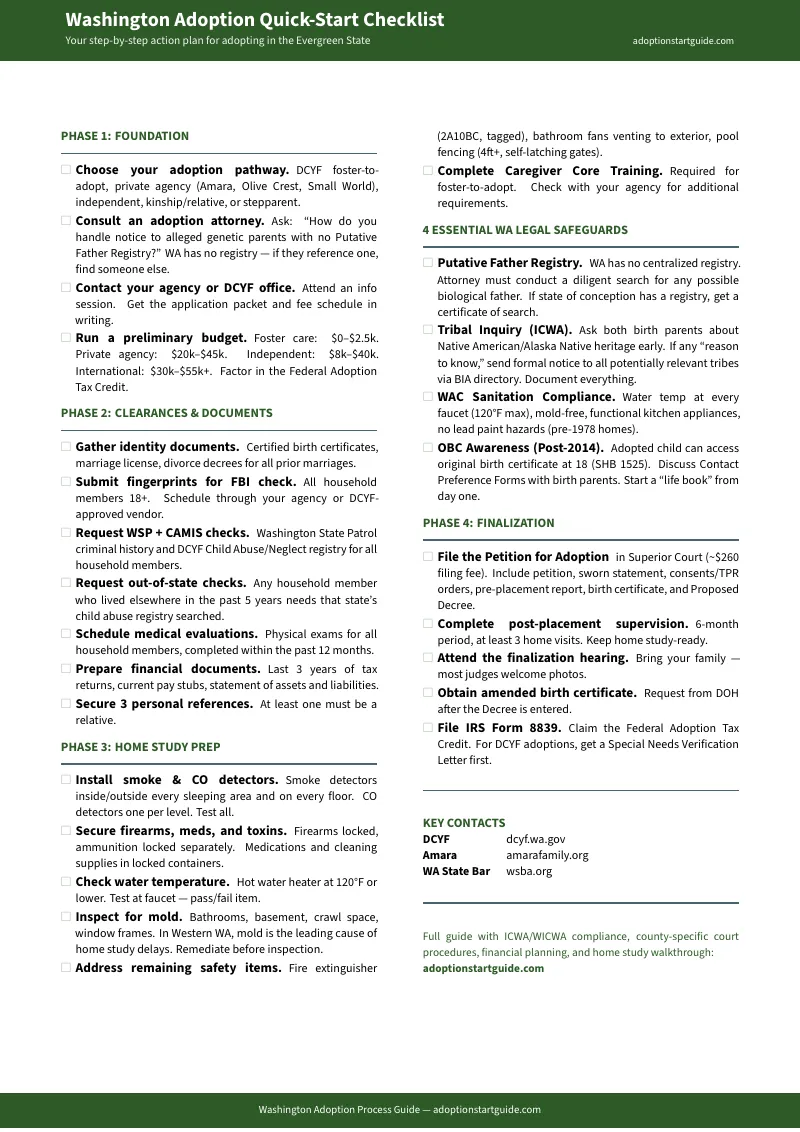
The free Quick-Start Checklist
Download the Washington Adoption Quick-Start Checklist for a one-page overview of the key steps from first inquiry to finalization. Free, no commitment. If you want the full guide with the six-pathway comparison, the putative father system explained, the ICWA/WICWA compliance guide, the PNW home study preparation, and all the printable worksheets, click the button in the sidebar.
-- less than one minute of a Seattle adoption attorney's time
The average adoption attorney in Seattle bills $250 to $500 per hour. A single orientation consultation runs $300 to $600. Families routinely spend their first billable hour covering foundational questions this guide answers in Chapter 1. The Evergreen State Adoption Navigator doesn't replace your attorney. It makes sure you don't pay your attorney to teach you the basics of Washington adoption law.