You are raising someone else's child because the opioid crisis came to your family. The state handed you the child but not the instructions.
You went to the Department of Human Services website looking for a clear explanation of how to adopt in West Virginia. What you found was a maze of BCF policy documents written for caseworkers, links to WV Code Chapter 48 in statutory language, and a phone number for your local DHS office that rang six times and went to voicemail. You searched for "how to adopt a grandchild in West Virginia" and got a page from AdoptUSKids that told you to call the state. You already called the state. You drove to the county office. The person at the desk told you to talk to your caseworker. Your caseworker has not returned your call in 11 days.
In West Virginia, 83% of open child abuse and neglect cases involve substance abuse. The state has one of the highest rates of children in foster care per capita in the country — roughly 18.7 per 1,000 children, up from 11.5 in 2011. If you are a grandmother in Kanawha County who got a call from the NICU because your daughter's baby was born withdrawing from opioids, you are not browsing adoption resources out of curiosity. You are looking tonight because tomorrow morning you need to know whether you can take this baby to a pediatrician, whether you can enroll a toddler in Head Start without legal custody, and whether cooperating with BCF means you could somehow lose the child you are already protecting. You are dealing with the hospital, a social worker, and a family in crisis — and the state expects you to figure out the Circuit Court process on your own.
The national adoption books on Amazon do not know what a BCF Multidisciplinary Treatment Team meeting is. They have never heard of the 15/22 month ASFA timeline that determines when TPR must be filed. They cannot explain what happens when a birth parent enters a recovery program after the petition is filed and the court grants a continuance — or what "legal abandonment" actually means under WV Code when the absent parent is incarcerated. The attorney websites from Pence Law Firm and Klie Law Offices show up in your search results, but their pages are designed to get you to call for a $250-per-hour consultation, not to explain the process. And Children's Home Society and Mission WV have orientation information for prospective foster parents, but their materials stop at certification — they do not walk you through what happens after the child is in your home and you are trying to make it permanent.
Nobody publishes a plain-language guide to what Neonatal Abstinence Syndrome means for your family after the baby leaves the NICU. Nobody tells you whether your well water and wood-burning stove will fail a home study. Nobody explains how a kinship placement actually becomes an adoption under West Virginia law — not in theory, but the specific steps, the specific court, and the specific forms. That gap is not an inconvenience. For families on fixed incomes who cannot afford to make $250-per-hour mistakes, it is the difference between permanency and limbo.
The Mountain State Permanency Roadmap: Your Step-by-Step Guide Through West Virginia's Adoption System
This guide is built for the system West Virginia families actually navigate — the intersection of BCF bureaucracy, Circuit Court proceedings, the opioid-driven kinship pipeline, NAS medical realities, and rural home study standards that no national handbook covers. Every chapter reflects current West Virginia Code (Chapter 48 and Chapter 49), BCF policy, and the specific financial programs available to families in 2026. It is the operational layer between what the Department of Human Services posts online and what you actually need to know to bring your child home permanently.
What's inside
- BCF-to-Finalization Pipeline — West Virginia's child welfare system runs through the Bureau for Children and Families, and the adoption process is governed by the Circuit Court — not Family Court. This chapter walks you through the entire pipeline: from the initial removal and emergency placement through the MDT (Multidisciplinary Treatment Team) meetings, the case plan and "reasonable efforts" determination, the critical shift from reunification to adoption as the permanency goal, the Termination of Parental Rights filing under WV Code 49-4-604, and the evidentiary standards the court applies. You will understand how the 15-month and 22-month ASFA timelines work, what the MDT must recommend before the department consents to adoption, and exactly what happens at each stage so you stop feeling like a passenger in your own family's case.
- Kinship-to-Adoption Roadmap — Forty-three percent of West Virginia's foster children are placed with relatives, and most of those kinship caregivers say they received zero guidance from the state on how to move from temporary caregiver to legal parent. This chapter is the first clear guide for West Virginia's kinship families to navigate that transition — covering relative placement preference, the difference between informal care, temporary custody, certified kinship foster care, and adoption, how to formalize your arrangement without triggering a removal, and every financial benefit that formalization unlocks: the certified kinship foster rate ($600-$790 per month), Medicaid coverage through Mountain Health Promise, clothing allowances, and the adoption subsidy once you finalize.
- NAS Survival and Development Guide — No free West Virginia resource provides a comprehensive guide for families caring for an opioid-exposed infant. This chapter covers the clinical reality of Neonatal Abstinence Syndrome: what to expect in the NICU, the Finnegan scoring system hospitals use to assess withdrawal severity, the sensory management techniques (vertical rocking, tight swaddling, low stimulation) that help during the acute phase, feeding challenges and high-calorie formula guidance, and the long-term developmental trajectory based on peer-reviewed research — including the evidence that with stable parenting and early intervention, children born with NAS can thrive. Includes how to access West Virginia's Birth to Three early intervention program and IMPACT WV resources.
- Circuit Court Walkthrough — In West Virginia, adoptions must be filed in Circuit Court, not Family Court. This distinction confuses families, attorneys, and even some caseworkers. This chapter covers the petition filing requirements under WV Code 48-22, the six-month residency requirement, the consent and relinquishment standards (including the 72-hour rule for birth parent consent), the "diligent search" requirement for putative fathers under 49-4-114, the role of the Guardian ad Litem, and what to expect in the courtroom — including the questions the judge will ask and the documents you need to bring. Filed in your county Circuit Court, not in Charleston.
- Rural Home Study Preparation — The persistent fear among West Virginia families that their rural home will disqualify them from adoption is based on myth, not BCF policy. This chapter provides the actual standards from BCF Policy 14.6: what inspectors look for in homes with private wells (including shock chlorination preparation), septic systems, wood-burning stoves, and shared bedrooms. Sleeping arrangement rules (own bed required, four-child maximum per room, opposite-sex children over five cannot share), the safety kit requirements (smoke detector, fire extinguisher, working flashlight), firearm storage standards, medication lock-up, and the specific documentation your home finding worker needs at each visit. Walk your house with this chapter before the inspector arrives.
- Cost-Reduction Framework and Hidden Subsidies — The Adoption Assistance Agreement is the most important financial document in a West Virginia adoption, and it must be negotiated and signed before the finalization decree. This chapter covers monthly maintenance payments by age tier ($790 for ages 0-5, $851 for ages 6-12), non-recurring adoption expense reimbursement (up to $1,000 per child), Medicaid continuation through Mountain Health Promise, the federal adoption tax credit ($17,280 per child with up to $5,000 partially refundable), and the special needs designation that makes most West Virginia foster care adoptions eligible for the credit even without direct expenses. When a $250 filing fee and a signed subsidy agreement are the difference between financial stability and years of struggle, this chapter pays for itself.
- All Adoption Pathways Compared — Foster-to-adopt through BCF is free and includes subsidy payments. Private agency adoption runs $20,000 to $40,000. Independent adoption through an attorney costs $8,000 to $20,000. Stepparent adoption ranges from $500 to $2,500. Kinship adoption through the BCF pipeline costs $500 to $1,500 in court fees. This chapter lays out the realistic costs, timelines, consent requirements, and WV Code citations for each pathway so you choose the right track before spending money on the wrong one.
- TPR and Birth Parent Recovery Framework — In West Virginia, a parent's failure to maintain contact while incarcerated or in a drug recovery facility is not considered voluntary abandonment. This single provision of WV law creates enormous confusion and anxiety for kinship and foster families waiting on a TPR. This chapter explains how West Virginia courts balance a birth parent's right to recovery with the child's right to permanency, the grounds for involuntary termination under WV Code 49-4-604, the improvement period process, what happens when a birth parent completes the checklist but has not actually changed their behavior, and how to advocate in MDT meetings when you believe the case should move toward adoption.
- Post-Adoption Contact and Open Adoption — In West Virginia's close-knit communities, especially in families where the opioid crisis created the adoption in the first place, "openness" with biological parents in recovery often starts informally. Informality leads to boundary violations. This chapter explains how to structure post-adoption contact, protect your family's boundaries, and navigate the emotional reality of raising a child whose birth parent may be your own son or daughter.
Printable standalone worksheets included
- Adoption Timeline Tracker — Every milestone from initial BCF contact through Circuit Court finalization, with fill-in date fields. Print it, update it after every caseworker interaction, and always know exactly where your case stands.
- Home Safety Inspection Checklist — Room-by-room walkthrough of every BCF safety standard, including well water preparation, firearm storage, medication lock-up, and the documentation your home finding worker will request.
- Caseworker Communication Log — Date, name, topic, and outcome fields for every DHS interaction. When your caseworker changes — and West Virginia's turnover rate makes this likely — hand this to the new one. It prevents you from restarting work you already completed.
- Financial Planning Worksheet — Adoption subsidy calculations, kinship foster rate tracking, grant applications, tax credit eligibility, and a side-by-side cost breakdown for each pathway.
Who this guide is for
- Grandparents and kinship caregivers — You took in your grandchild, your niece, your nephew — because there was no one else. You are raising them on Social Security or a working-class income, and nobody told you that financial support exists or how to access it. This guide walks you from informal care to legal permanency and unlocks the subsidies and Medicaid coverage you have been missing.
- Foster-to-adopt families waiting on a TPR — You have been fostering this child for months or years. The permanency goal changed from reunification to adoption. Now you need to understand the MDT process, the ASFA timeline, and how to keep the case moving when the system stalls. This guide shows you the full BCF-to-finalization pipeline so you stop feeling like a bystander in your own family's future.
- Families caring for a baby with NAS — You brought home an infant from the NICU and nobody gave you a manual for what comes next. The crying, the tremors, the feeding struggles — and behind all of it, the fear that prenatal exposure means permanent damage. This guide gives you the clinical evidence, the survival techniques, and the early intervention resources so you can parent with knowledge instead of anxiety.
- Stepparents formalizing an existing family — You have been parenting this child for years. You want the legal status to match the reality. This guide covers the consent or TPR process for the non-custodial parent, the streamlined Circuit Court procedure, and the specific forms you need to file.
Why not piece it together from free resources?
You could try. The DHS website has BCF policy documents — written in regulatory language for caseworkers, not families. Legal Aid WV has a useful overview page on adoption law, but it covers the statute in broad strokes without the procedural detail of how to actually move a case through the BCF system and into Circuit Court. Children's Home Society and Mission WV provide orientation for prospective foster parents, but their materials are designed to recruit you into their programs, not to help you navigate the state system independently. AdoptUSKids tells you to call the state hotline. You already called.
Reddit threads in r/Fosterparents and r/Adoption give you raw experience — one grandmother's BCF story, another family's NAS survival tips. But they are anecdotal, often from other states, and can lead to decision paralysis when three different people give three different answers about how TPR works in West Virginia specifically.
The critical gap is this: no free resource combines the BCF process, the Circuit Court procedure, the NAS clinical guidance, the rural home study standards, and the financial subsidies into one document written for West Virginia families. The result is 30 browser tabs, a stack of contradictory advice, and the persistent feeling that you are missing something critical. In West Virginia adoption, the thing you miss — the unsigned subsidy agreement, the unescalated stalled case, the NAS-related medical support you did not negotiate into the adoption agreement — can cost you thousands of dollars or months of delay.
This guide consolidates it into one document. One read-through for the full picture. One reference to keep open as you move through each phase.
Satisfaction guarantee
If this guide does not deliver what this page promises, email [email protected] for a full refund. No questions, no hoops.
— Less Than 15 Minutes with a West Virginia Adoption Attorney
A single consultation with an adoption attorney in Charleston or Huntington costs $250 to $500 per hour. This guide covers every question most families spend that first meeting asking — the adoption pathways, the BCF pipeline, the consent rules, the home study requirements, the subsidies, the Circuit Court procedures — for less than the cost of parking at the attorney's office. You will still need an attorney for parts of your adoption. But you will walk into that meeting prepared, focused, and ready to use their time on your specific situation instead of basic orientation.
West Virginia has one of the highest rates of children in foster care in the country. Forty-three percent are placed with relatives who say the state gave them no guidance. The system is overwhelmed, the caseworkers are overloaded, and the families inside it deserve better than a voicemail box and a link to WV Code Chapter 48. This guide is the bridge.
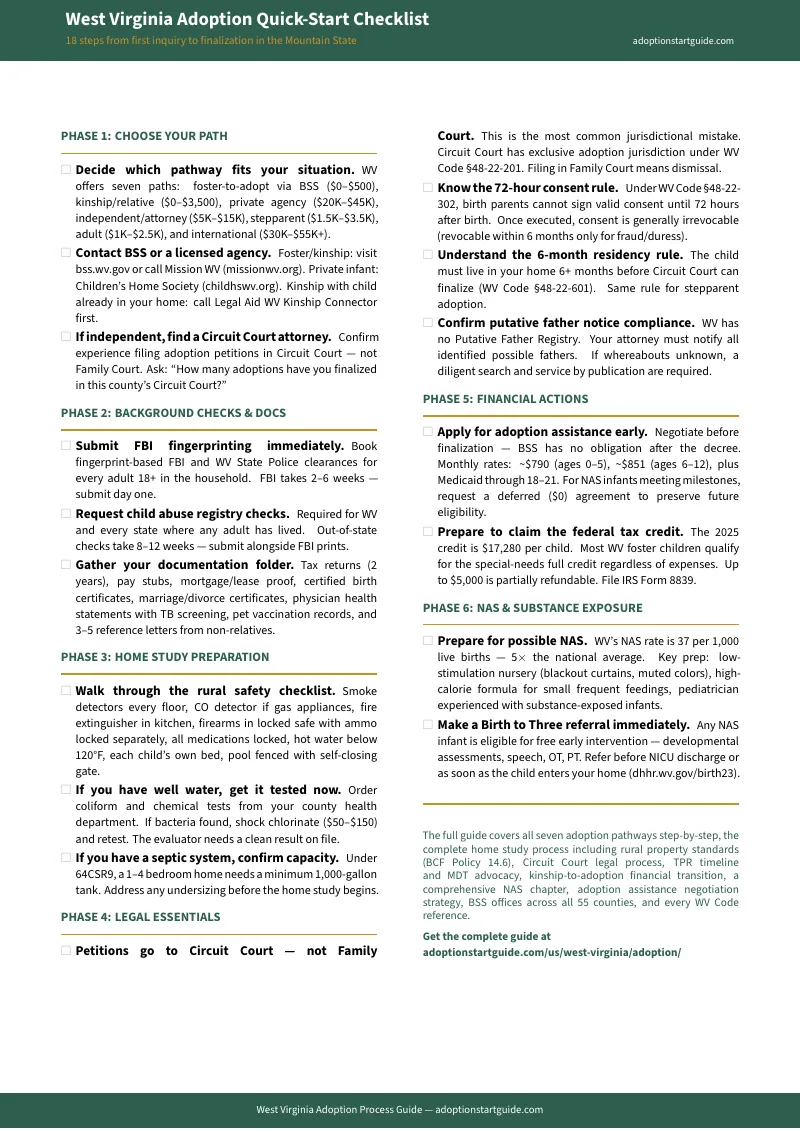
Download the free West Virginia Adoption Quick-Start Checklist to see the essential action items, or get the complete guide for the full Mountain State Permanency Roadmap, NAS clinical guidance, financial optimization strategies, BCF escalation tools, and every worksheet you need to move your adoption forward.