
Wyoming has almost no local adoption agencies. The state provides zero self-help court forms. And if Wind River is involved, the legal rules change completely.
You decided to adopt in Wyoming. Maybe you've been fostering a child through DFS and reunification just failed. Maybe you and your spouse found a birth mother in Colorado and now someone mentioned "ICPC" and a mandatory ten-day hotel stay. Maybe you married into a family three years ago and want to legally adopt your stepchild -- but you called the courthouse in Natrona County and they told you there's no standard petition form. Draft your own.
So you went online. You found national adoption websites that describe a generic process -- home study, background checks, court hearing -- as if Wyoming works like California or Texas. They don't mention that Wyoming has fewer private adoption agencies than most states have counties. They don't explain that when you adopt a child from another state, you must physically stay in that state for seven to ten days while the ICPC offices process paperwork, at a cost of $1,800 to $5,000 in hotels, meals, and lost wages. They definitely don't explain that if the child has any connection to the Eastern Shoshone or Northern Arapaho tribes, the Indian Child Welfare Act raises the legal standard for terminating parental rights to "beyond a reasonable doubt" -- the same standard used in criminal trials.
You called an attorney. The consultation was $281 per hour. What you learned was that you need a home study and that "it depends on your situation." You could have found that on Google. What you couldn't find -- anywhere -- was a single resource that explains the entire Wyoming adoption process with the specific legal requirements, actual costs, court filing procedures, and the rural realities that affect families in Cheyenne, Casper, Sheridan, and everywhere in between.
The Wyoming Adoption Navigation System
This guide exists because Wyoming families face a combination of challenges that no national adoption resource addresses. The state's limited agency infrastructure means you become your own project manager -- coordinating between DFS, out-of-state agencies, home study providers, and District Court clerks who each assume you already know what the others require. This guide is the coordination layer that connects every moving part into one sequential process.
What's inside
- Six Adoption Pathways Compared -- DFS foster-to-adopt ($0-$2,500), private agency ($30,000-$50,000), independent attorney-led ($8,000-$20,000), stepparent ($1,500-$5,000), kinship, and adult adoption. Each pathway with realistic Wyoming costs, timelines, and the specific trade-offs that matter when your nearest adoption agency is a three-hour drive. Most families don't realize that independent adoption is explicitly legal in Wyoming and can cost one-third of the agency route -- or that DFS foster-to-adopt covers your home study, training, and most legal costs at zero charge.
- Rural Home Study Preparation -- National home study checklists assume city homes with municipal water, gas heating, and a fenced suburban yard. Your Wyoming property has a private well, a wood stove, a gun safe, livestock in the back forty, and an irrigation ditch running through the east pasture. This chapter covers exactly what the social worker evaluates on a rural property: well water potability testing through the DEQ "Know Your Well" program, wood stove guard requirements with 36-inch combustible clearances, firearm storage standards for every weapon including air rifles and bows, septic system documentation, and outbuilding access controls. It tells you what to fix before the visit, not after the social worker writes it up.
- ICPC Interstate Process Guide -- If you're adopting a baby from Colorado, Utah, or any other state, this chapter is your survival manual. It explains the seven-to-ten-day mandatory stay in the sending state, what to pack (two weeks of infant supplies, all legal documents, your attorney's direct line), how to budget for the wait ($100-$200 per night plus meals, car rental, and lost wages), and the exact sequence of approvals required before you can cross state lines with your child. One mistake in the ICPC packet adds days to your stay and hundreds to your bill.
- Wind River ICWA Compliance -- A plain-language guide to the Indian Child Welfare Act as it applies in Wyoming. The "active efforts" standard (not just "reasonable efforts"), the "beyond a reasonable doubt" burden for terminating parental rights, mandatory tribal notice via registered mail, placement preference hierarchies, and the qualified expert witness requirement. This chapter explains what these legal standards mean in practice so you can work with the Northern Arapaho ICWA Program and Eastern Shoshone Social Services with confidence instead of confusion.
- District Court Filing Without Standard Forms -- Wyoming provides no self-help adoption forms. This chapter covers what your petition must include under W.S. section 1-22-104: the signed petition itself, criminal and psychiatric affidavits, the child's medical history, consent documents or TPR orders, your completed home study, and the State Registrar vital records form. County-specific norms for Laramie, Natrona, and Teton counties. The $160 filing fee. Whether to file pro se or hire an attorney -- and how to walk into an attorney's office with a complete file so you're not paying $281 per hour for basic orientation.
- Consent and Putative Father Registry -- In Wyoming, birth parent consent can be signed at any time after birth with no mandatory waiting period. Once signed and acknowledged, consent is irrevocable except for proven fraud or duress. The Putative Father Registry is the safeguard that prevents an unknown biological father from contesting your adoption months after placement. This chapter explains when and how to search the registry, the 30-day notice window for registered fathers, and what happens when a father fails to register.
- Federal Adoption Tax Credit Optimization -- The maximum credit for 2025 is $17,280 per child. In a state with no income tax, this federal credit is your primary financial offset. This chapter covers MAGI phase-out calculations, the new partial refundability rules (up to $5,000 refunded even with zero tax liability), five-year carry-forward strategy, and which expenses qualify -- including ICPC travel costs, legal fees, home study fees, and birth mother expenses. DFS special needs adoptions qualify for the full credit regardless of actual spending.
- Post-Finalization and Records -- Filing the Report of Adoption with Vital Statistics, obtaining the new birth certificate, understanding that original records are sealed under Wyoming law, and how the Confidential Intermediary program works for future contact between adoptees and biological families. This chapter gives your adoption long-term value beyond the courthouse steps.
Printable standalone worksheets included
- Home Study Document Checklist -- Every document organized by category: identification, legal, clearances, medical, financial, and references, with date-tracking columns. Print it and work through it before your social worker asks for anything.
- Court Filing Checklist -- Every document required for your District Court petition, mapped to the statutory reference under W.S. section 1-22-104, with conditional items for ICPC, stepparent, and ICWA cases.
- Expense Tracking Worksheet -- Track every dollar from day one. Category codes, payee fields, and a running total designed to feed directly into your Federal Adoption Tax Credit claim on IRS Form 8839.
Who this guide is for
- Families pursuing private or independent adoption -- You've decided to adopt an infant through the Wyoming Children's Society, an out-of-state agency, or an independent attorney arrangement. You need to understand how consent works, what the ICPC wait actually involves, and how to prepare a District Court petition in a state that provides no fill-in-the-blank forms. The difference between knowing the ICPC timeline before you book your hotel and learning about it in a hospital parking lot in Denver is the difference between a planned expense and a financial crisis.
- Foster parents ready to adopt -- A child in your DFS placement has had parental rights terminated. You've been the primary caregiver. Now you need to understand how the legal process shifts from foster care to adoption -- what "first consideration" means, how to negotiate your adoption assistance agreement before finalization (not after, when you've lost leverage), and how the monthly subsidy carries forward.
- Stepparents -- You've been parenting this child for years. The legal adoption seems straightforward until you learn about the Putative Father Registry search, the requirement that the biological parent either consent or have their rights terminated, and the fact that there's no standard court form for your petition. This guide shows you the actual process so your attorney meeting is productive, not exploratory.
- Kinship caregivers -- A grandchild or relative was placed with you through DFS or family arrangement. You assumed the adoption would be simple because you're family. It's simpler -- but you still need a home study, background checks, and court approval. This guide explains which requirements apply to you and which have waiver provisions.
Why free resources fall short
The Wyoming DFS website covers foster care licensing and publishes policy manuals written for caseworkers, not for a parent sitting at a kitchen table trying to figure out what to do first. It says nothing about private adoption, the ICPC process, or how to file a petition in District Court.
National adoption websites -- American Adoptions, ConsideringAdoption.com -- describe a generic process that works in states with dozens of agencies and standardized court forms. Wyoming has neither. They mention ICWA in a paragraph; this guide devotes an entire chapter to it because Wind River makes it a daily reality here, not a footnote.
Wyoming adoption attorneys charge $281 or more per hour. An initial consultation covers your specific situation. It does not walk you through the entire framework so you understand where your situation fits before the billing clock starts. Two hours of basic orientation costs more than this guide -- and you'll still need the attorney afterward for the actual legal work.
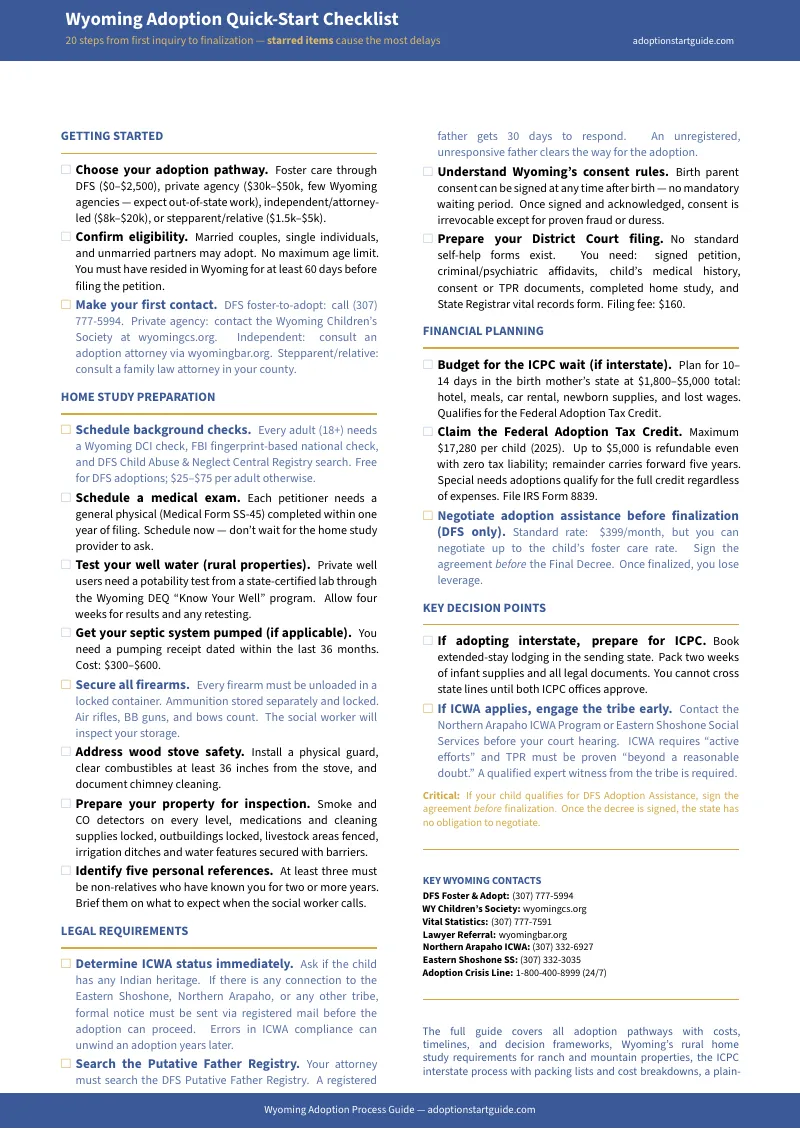
The free Quick-Start Checklist
Download the Wyoming Adoption Quick-Start Checklist for a 20-step overview of the process -- from choosing your pathway through post-finalization. Free, no commitment. If you want the full guide with pathway comparisons, rural home study preparation, the ICPC survival guide, Wind River ICWA compliance, District Court filing procedures, tax credit optimization, and the complete Wyoming resource directory, click the button in the sidebar.
-- less than fifteen minutes of a Wyoming adoption attorney's time
A Wyoming adoption attorney charges $281 or more per hour. A failed home study because you didn't know about the well water test delays your finalization by weeks. An incomplete ICPC packet adds days to your out-of-state stay at $150 per night. A missed Putative Father Registry search can unravel a completed adoption. One guide covers all of this. One read-through saves you hours of billable attorney time explaining things you could have known before you walked in.
If the guide doesn't deliver, reply to your download email at any time for a full refund. No forms. No justification required.