You want to foster a child in the ACT. The system just changed completely, the agency you would have called last year no longer exists in the same form, and nobody can give you a straight answer about which provider to choose or what the assessment actually involves.
You went to the ACT Government website and found the fostering page. It told you about "Next Steps for Our Kids 2022-2030" and the new "Preferred Provider Panel." It mentioned the Children and Young People Act 2008. It listed some agencies you could contact -- Barnardos Australia, OzChild, Key Assets. It did not tell you how these agencies differ from each other, which one matches your situation, or what happened to the ACT Together consortium that used to run everything. It did not explain whether the agency you choose affects your training, your support level, or your chances of getting a placement. It told you to register your interest. You filled in a form. Someone would be in touch.
While you waited, you searched "foster care Canberra reddit." You found carers describing a system in transition -- the ACT Together model that ran from 2016 to December 2024 replaced by something nobody could quite explain yet. You found a carer who described fighting for support "all the time," requesting things that should have been straightforward and waiting weeks for decisions that needed to go through the Community Services Directorate. You found someone who loved the child in their care but felt the agency had disappeared once the placement was made -- the information sessions were warm and encouraging, the follow-through was not. You found a thread where a Canberra carer talked about running into the birth family at Belconnen Westfield and having no guidance on how to handle it. You closed the tab and sat with the weight of it.
Then you looked into the Working with Vulnerable People registration. You knew you needed one through Access Canberra. You didn't know that every adult in your household needs one too -- your partner, your adult child who moved back after uni, anyone who stays overnight regularly. You didn't know that the ACT's WWVP scheme classifies offences into Class A and Class B categories, where Class A means automatic exclusion and Class B requires "exceptional circumstances" to overcome. Your partner mentioned something from their twenties -- a minor charge, long spent. You couldn't tell them whether it would matter. Neither could the ACT Government website.
Meanwhile, you learned that the mandatory training covers trauma-informed care, brain development, the impact on your existing children, and the PACE model. Good. But nobody told you what comes after training -- the assessment process where a social worker visits your home multiple times, writes your life story, interviews your referees, evaluates your relationship, your motivations, your capacity for grief when a child leaves. You're an APS professional used to being the one who writes the assessments. Nobody prepared you for being on the other side of the clipboard.
You asked a colleague who once considered fostering whether to go with Barnardos or OzChild. They said they'd started with ACT Together three years ago and had no idea the system had changed. Someone in a Canberra Facebook group recommended Key Assets. Someone else said it doesn't matter because the Director-General of CSD holds parental responsibility regardless of which agency you're with. Someone posted a link to the same ACT Government page you started on. The advice was well-meaning, out of date, and contradictory.
The ACT Carer Navigation System: Your Independent Guide to Foster Care in the Australian Capital Territory
This guide is built for how the ACT foster care system actually works in 2026 -- after the end of the ACT Together consortium, under the new Preferred Provider Panel, within the "Next Steps for Our Kids 2022-2030" strategy. Every chapter reflects current ACT law under the Children and Young People Act 2008, the specific agency landscape in Canberra, and the operational realities that CSD compliance pages and agency brochures systematically leave out. It is not a national fostering handbook with "Australian Capital Territory" in the title. It is the operating manual for this territory's system -- built for the way Canberra actually works, where your caseworker might be someone you see at the APS morning tea and the birth family lives two suburbs away.
What's inside
- Post-ACT Together Provider Comparison -- From 2016 to December 2024, the ACT Together consortium led by Barnardos alongside OzChild and the Australian Childhood Foundation was your only entry point. That's over. Under the Preferred Provider Panel, Barnardos, OzChild, and Key Assets now operate independently with different models of care, different caseloads, different after-hours support capacity, and different specialisations in emergency, respite, and long-term placements. The guide compares what matters -- not brochure language but caseworker-to-carer ratios, crisis response times, respite availability, and training approaches -- so you choose a provider based on substance, not whichever agency's information session happens to fall on a convenient Thursday evening.
- WWVP and Background Check Household Walkthrough -- The ACT's Working with Vulnerable People registration through Access Canberra extends to every adult in your household and regular overnight visitors. The guide explains the application process for each person, the Class A and Class B offence categories, what triggers a risk assessment, how "spent" convictions from decades ago interact with the WWVP scheme, typical processing times, and how to handle the screening conversation with reluctant household members. Because the awkwardness of asking your partner's adult child to submit to a background check is a real barrier that no agency information session addresses.
- Assessment Preparation for the ACT Process -- The ACT assessment involves multiple home visits, referee checks, a home environment evaluation, medical reports, and the written life history that becomes part of your permanent file. The guide decodes what assessors are actually evaluating at each stage: relationship stability, emotional regulation, capacity for grief when reunification happens, flexibility around age and gender preferences, and your understanding of developmental trauma. It includes a preparation framework for the life history so you can be thorough without feeling like you've surrendered your entire past to a stranger -- particularly important in a city where the assessor may share professional circles with you.
- CSD vs. Agency Authority Decoder -- The most persistent source of confusion in ACT foster care is the split between the Community Services Directorate (through Child and Youth Protection Services) and the contracted agencies. The Director-General of CSD holds parental responsibility for the child. The agency manages your day-to-day support. The carer does the actual parenting. The guide explains where each authority begins and ends, what decisions you can make independently under a Specific Parental Authority (SPA), what needs agency sign-off, what requires CSD approval, and why getting permission for a school camp can take three weeks when you need an answer by Friday. Understanding this structure before your first placement prevents the "bureaucratic no-man's-land" that burns out carers faster than anything the child does.
- 2026 Carer Subsidy Breakdown -- The ACT's carer subsidy rates, additional allowances for children with complex needs, establishment payments for initial clothing and supplies, and one-off expense claims. The guide provides current figures by age bracket, explains what each payment category covers, clarifies that these are reimbursements and not income, details what the agency "really" covers versus what you'll absorb yourself, and addresses the financial reality honestly -- because carers who enter the system expecting the allowance to cover the actual cost of raising a child in one of Australia's most expensive cities are the ones who leave the system fastest.
- Small-City Privacy and "Family Time" Navigation -- In Canberra, two degrees of separation is generous. The guide addresses how to manage birth family contact ("Family Time") in a city where you might run into the biological parents at Civic, at Belconnen Westfield, at the school pickup, or at a work function. It covers how Family Time visits are structured in the ACT, how to prepare a child before and stabilise them after contact, what information you're legally required to share, how to maintain your family's safety, and the specific "School of Origin" principle that may mean daily commutes across the city to maintain the child's educational stability. This is the chapter that addresses the fear most prospective Canberra carers won't say out loud.
- Enduring Parental Responsibility (EPR) Roadmap -- EPR is the ACT's pathway to providing a permanent home without formal adoption. It transfers the Director-General's parental responsibility to you until the child turns 18, the agency withdraws involvement, and the carer subsidy continues. The guide explains the permanency assessment process, the Application Review Committee (ARC), the Childrens Court proceedings, the "12-month rule" before an EPR application can be made, cultural identity obligations, and how to manage the transition from supervised foster care to what is effectively a "forever home" with state financial support. If permanency is your goal, this chapter is the reason you'll refer back to this guide for years.
- Aboriginal and Torres Strait Islander Child Placement Principle -- First Nations children are over 12 times more likely than non-Indigenous children to be in out-of-home care in the ACT. The system prioritises cultural permanency through the Aboriginal and Torres Strait Islander Child Placement Principle. Non-Indigenous carers who receive an Aboriginal or Torres Strait Islander child need to understand Cultural Plans, the role of Aboriginal Community Controlled Organisations (ACCOs), the "Our Booris, Our Way" review findings, and how to facilitate a child's connection to Country, community, and heritage. The guide explains these requirements with the depth they deserve -- because meeting them with genuine respect rather than compliance anxiety is what the children actually need.
Who this guide is for
- APS professionals and dual-income Canberra households -- You work full-time, probably in the public service, and you've been wondering whether fostering is compatible with a demanding career. You've heard the system needs carers, but every resource you've found assumes you're available during business hours. The guide explains how OOSH care, the respite system, and flexible placement types work together so you can provide a stable home without leaving the career you've built.
- Families in Gungahlin, Tuggeranong, Belconnen, and the Inner North -- You have a spare bedroom in an established Canberra suburb and you've been thinking about fostering for months. You've browsed the ACT Government website and maybe attended one online information session that felt too general. You need the independent comparison that tells you which agency fits your suburb, your work schedule, and your family -- not the one that's running the next recruitment campaign.
- Kinship carers who just received a placement -- CYPS placed your grandchild, your niece, or a family connection with you. You have limited time to understand your rights, the carer subsidy you're entitled to, the training requirements, and the ongoing obligations. The guide covers the kinship pathway specifically -- because the process for relatives is different from the general foster care pipeline, and nobody hands you a manual at the door.
- People who want permanency, not temporary care -- You want to provide a forever home. The ACT doesn't let you skip to that. Enduring Parental Responsibility comes through the Childrens Court after the system has attempted reunification and the child has been in your care for at least 12 months. The guide explains how this pathway works, what the realistic timeline looks like, and how to prepare emotionally and legally for a process that starts with temporary care and a child whose case plan goal may still be "restoration."
- Single applicants and LGBTQ+ individuals and couples -- You don't need a partner to foster in the ACT. The assessment process evaluates your support network differently when you're doing it alone, and LGBTQ+ applicants have full legal standing. The guide addresses how the assessment handles these circumstances, what agencies look for in your personal support structure, and how to prepare for questions specific to your situation.
Why the free resources fall short
The ACT Government publishes the Carer Handbook -- a 100-plus page policy document that covers legislation, financial entitlements, and trauma-informed care frameworks. It is thorough, bureaucratic, and written for carers who are already in the system. It does not tell you how to get through the door. Agency websites like Barnardos' and OzChild's explain their own models of care because they're recruiting for their own caseloads. None of them will tell you that a different provider on the Panel might be a better fit for your suburb, your work hours, or your care preferences. They're recruitment tools dressed as information resources.
The ACT Together information sessions that existed until 2024 have been replaced by individual agency sessions -- each designed to funnel you into that agency's pipeline. Reddit threads and Canberra Facebook groups provide raw, emotional accounts from current and former carers, some from the ACT Together era, some from last month, frequently contradictory and impossible to verify against the post-2024 system. A carer who went through the process in 2022 is describing a system that no longer exists -- the consortium model, the old training structure, the previous provider arrangements. National foster care guides describe a generalised Australian process that doesn't account for the ACT's unique city-state dynamics, the post-consortium transition, the WWVP scheme (which differs from NSW's WWCC), the specific CSD-and-agency authority split, or the reality of fostering in a city of 470,000 where privacy is a structural challenge rather than an occasional inconvenience.
The free Quick-Start Checklist
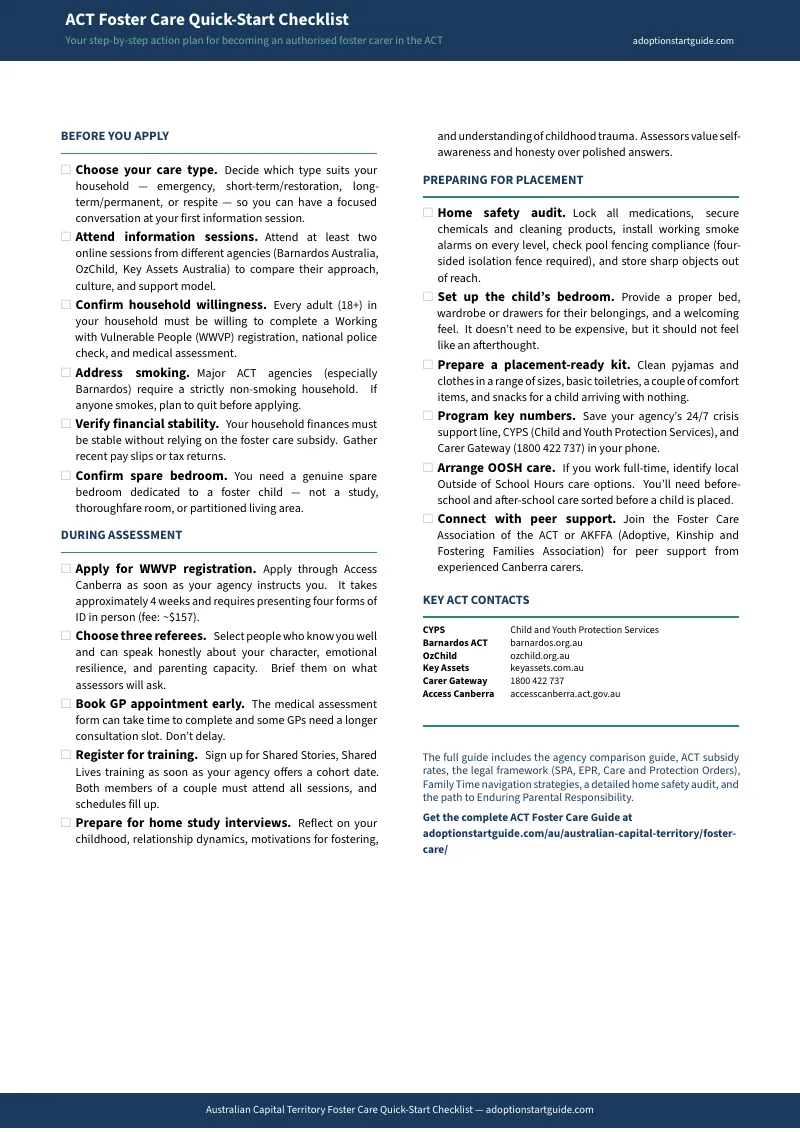
Download the Australian Capital Territory Foster Care Quick-Start Checklist for the essential steps from first enquiry through the new Provider Panel -- including the household screening requirements and home safety items that cause the most delays. Free, instant download, no commitment. If you want the full guide with the post-ACT Together provider comparison, the WWVP household walkthrough, the assessment preparation framework, the CSD vs. agency authority decoder, the 2026 carer subsidy breakdown, small-city privacy and Family Time navigation, the EPR permanency roadmap, and the Aboriginal cultural permanency chapter, click the button in the sidebar.
-- less than the WWVP registration fee you'll pay at Access Canberra before the process even begins
One wrong agency choice means months invested in a provider whose support model doesn't match your needs -- and in a system with only a handful of providers, switching mid-process is not straightforward. One incomplete WWVP application for a household member stalls your entire assessment. One misunderstanding about the CSD-and-agency authority split -- believing your agency caseworker can approve decisions that actually require the Director-General -- sets you up for weeks of frustrated waiting over things that should take a phone call. This guide puts the ACT's complete foster care process in your hands for less than the cost of a single working lunch in the Parliamentary Triangle. Families who understand the system before they enter it ask the right questions at their first agency meeting, pass the home assessment with confidence, and walk into their first placement prepared.
If the guide doesn't deliver, reply to your download email at any time for a full refund. No forms. No justification required.