
You've decided to adopt in New South Wales. Then you discovered that DCJ centralised all local adoption services in 2024, the Adoption Act 2000 requires a Supreme Court order, and "dual authorisation" means you might spend years as a foster carer before adoption is even on the table -- and no single resource explains how these pieces fit together.
You've been on the DCJ website. You found the "Thinking about Adoption" factsheet -- eight stages listed in clinical prose that tells you the sequence but never explains the unspoken criteria for suitability. You found the "Adoption Fees and Costs" sheet, which lists departmental charges but omits the legal fees, the medical exams, and the months of unpaid leave. You found Adopt Change, which gives an excellent national overview but can't tell you that Anglicare and Family Spirit no longer handle local adoption in NSW -- DCJ took that in-house in mid-2024. And you found Facebook groups where people mix up NSW's Open Adoption with Victoria's Permanent Care Orders, recommend agencies that no longer exist, and offer timeline estimates from 2018.
The information exists. It's scattered across the Adoption Act 2000, the Children and Young Persons (Care and Protection) Act 1998, DCJ factsheets written for caseworkers, Supreme Court Practice Note SC EQ 13, Barnardos brochures, AIHW statistical reports, and closed Essential Baby forum archives that went offline in 2020. Piece it together yourself and you'll burn months reading documents that explain the rules in department language but never tell you what to do first, second, and third as a prospective parent.
The DCJ Decoder
This guide was built for the problem every NSW family hits: a system run by one department, finalised by the Supreme Court, governed by legislation designed around the forced adoption legacy, and reshaped by a 2024 centralisation that most families haven't heard about yet. Every chapter, every checklist, every cost figure is grounded in the Adoption Act 2000 (NSW), the Adoption Regulation 2015, current DCJ policies, Supreme Court practice directions, and the real-world experience of families who have adopted in this state.
What's inside
- The 2024 centralisation explained -- DCJ is now the sole provider of local adoption services in NSW. Anglicare and Family Spirit no longer handle infant adoption. For out-of-home care adoption, Accredited Adoption Service Providers like Barnardos still operate -- but for local voluntary adoption, you deal directly with DCJ's Open Adoption and Permanency Services (OAPS). This chapter maps exactly who you contact, when, and for what -- so you stop calling agencies that can't help you.
- Four-pathway comparison table -- Local voluntary adoption (fewer than 20-30 placements per year across all of NSW), open adoption from out-of-home care through dual authorisation, intercountry adoption through Hague Convention partners, and intrafamily adoption for step-parents and relatives. Costs, timelines, eligibility, and realistic wait expectations mapped side by side so you choose the right pathway before investing months in the wrong one.
- The Adoption Act 2000 in plain English -- Section 8's paramountcy principle, Part 2's placement principles including the Aboriginal Child Placement Principle, Part 4's Adoption Plan requirement, Part 5's consent framework with the mandatory 30-day revocation period, and Part 8's information access rights that ended sealed records. The Act was written in response to NSW's forced adoption history. This chapter explains what the legislation requires in practice so you work with it instead of being surprised by it.
- Dual authorisation decoded -- The most common adoption pathway in NSW requires you to be trained and assessed as both a foster carer and an adoptive parent simultaneously. You enter a child's life with "restoration" as the formal goal. Only after restoration is ruled out -- which can take years -- does adoption become possible. This chapter explains the Permanency Support Program hierarchy, the Section 90 application process, and the emotional reality of "guarded attachment" so you know what you're committing to before you sign up.
- The Supreme Court process step by step -- NSW is the only state where adoption orders are made by the Supreme Court. Practice Note SC EQ 13 governs the filing. You need affidavits, a Section 91 Court Report, a signed Adoption Plan, and evidence of consent or a dispensation order. This chapter covers every document, the hearing itself, the Minute of Order, the Memorandum of Adoption, and the new birth certificate that follows.
- Complete cost breakdown by pathway -- Local adoption DCJ fees total approximately $3,401. Intercountry adoption totals $30,000 to $50,000 or more when you add overseas authority fees, travel, visa costs, and legal representation. Plus the costs nobody itemises: medical exams ($200-$500 per applicant), time off work for training sessions and home visits, and the loss of foster carer allowances when an adoption order is made.
- The Adoption Plan guide -- The Supreme Court will generally not make an adoption order without an Adoption Plan in place. This chapter covers what goes in the plan, how to negotiate contact arrangements with birth families, how to address cultural and heritage connections, and what the judge expects to see.
- Intercountry adoption navigator -- NSW works with Chile, Colombia, the Philippines, Thailand, Taiwan, and South Korea. China closed in August 2024. Latvia closed in November 2024. Each country has its own eligibility criteria layered on top of NSW and Commonwealth requirements. This chapter maps all three layers so you know where you stand before you pay a dollar.
- Identity rights and the Integrated Birth Certificate -- Part 8 of the Adoption Act ended sealed records. Adult adoptees can access their original birth certificates. The Integrated Birth Certificate, introduced in 2020, lists both birth parents and adoptive parents on a single document. This chapter covers records access, contact statements, and how to support your child's identity development from day one.
- Post-adoption support directory -- PARC (Post Adoption Resource Centre) for specialist counselling, Jigsaw NSW for peer support and search assistance, Adopt Change for national advocacy, Barnardos for OOHC services, and therapeutic services for trauma-informed parenting. Organised by what each service actually provides, not just their name.
- 90-day action plan -- Week-by-week steps from "seriously considering" to "formally in the system." When to apply for your Working with Children Check (allow 4-8 weeks), when to schedule medical exams, when to call OAPS, and when to submit your Expression of Interest.
Who this guide is for
- Post-IVF couples exploring adoption for the first time -- You've been through years of treatment. You've made the decision -- and maybe you're still processing whether adoption feels like a "second choice." It isn't. But you need the procedural clarity to match the emotional commitment you've already made. The guide maps your pathway before you commit to the wrong one.
- Foster carers pursuing permanency -- The child in your home has had restoration ruled out. You need to understand how the Section 90 application works, what the permanency hierarchy means for your case, and whether adoption or guardianship is the right legal outcome. The guide explains the transition from carer to legal parent.
- Step-parents who need legal standing -- You've been parenting this child every day. You want the birth certificate, the medical authority, the inheritance rights. NSW's Supreme Court requires you to demonstrate that a Parenting Order under the Family Law Act would not adequately provide for the child's welfare. The guide walks you through the legal test and the full court process.
- Families considering intercountry adoption -- The triple-layer eligibility system -- NSW, Commonwealth, and partner country -- feels impenetrable. The guide maps all three layers so you don't discover you're ineligible after investing years and tens of thousands of dollars.
- Single applicants navigating the system alone -- NSW permits single-person adoption. In practice, you may face a longer wait and harder questions during assessment. The guide covers what assessors are actually looking for and how to present your application when you don't have a co-applicant.
Why the free resources aren't enough
The DCJ website covers adoption in practitioner language -- eight stages listed in sequence with no explanation of the unspoken suitability criteria, the real timeline, or the financial planning you need to do before Stage 1. The "Thinking about Adoption" factsheet still references the dual authorisation model and OAPS but never explains what that initial phone call actually involves or what the caseworker is assessing. Adopt Change provides a national overview but doesn't address the 2024 centralisation, the Supreme Court filing process, or the Section 90 application that foster carers need for OOHC adoption. Barnardos and Carers for Kids NSW explain foster care pathways but can't map the legal transition from carer to adoptive parent.
Reddit and Facebook groups give you emotional support and anecdotal experience. They also mix up NSW's Open Adoption with Victoria's Permanent Care Orders, recommend agencies that DCJ stopped contracting in 2024, and offer advice based on processes that predate the centralisation. In a system where fewer than 30 local infant placements happen per year across the entire state, secondhand advice from the wrong jurisdiction or the wrong year is worse than no advice at all.
Printable standalone worksheets included
The guide comes with printable standalone PDFs designed for real-world use:
- Pathway Comparison Card -- All four NSW adoption pathways on one page. Local voluntary, out-of-home care, intercountry, and intrafamily. Costs, timelines, eligibility, and the first steps for each route. Print it, sit down with your partner, and make the decision that shapes everything else.
- Document Checklist -- Every document DCJ and the Supreme Court will request, organised by stage. Criminal checks, Working with Children Checks, medical reports, financial records, reference contacts, and home safety requirements. Nothing missing when the assessor arrives.
- Adoption Plan Preparation Worksheet -- Questions to discuss with your partner before you negotiate contact arrangements with the birth family. What information will you share, how often, and through what channel. The worksheet that makes sure you walk into the negotiation with a position, not a blank stare.
- Post-Finalisation Action Plan -- New birth certificate from NSW Registry of Births, Deaths and Marriages, Medicare updates, Services Australia registration, passport application, and every administrative step after the Supreme Court order, in sequence with contacts and processing times.
The free Quick-Start Checklist
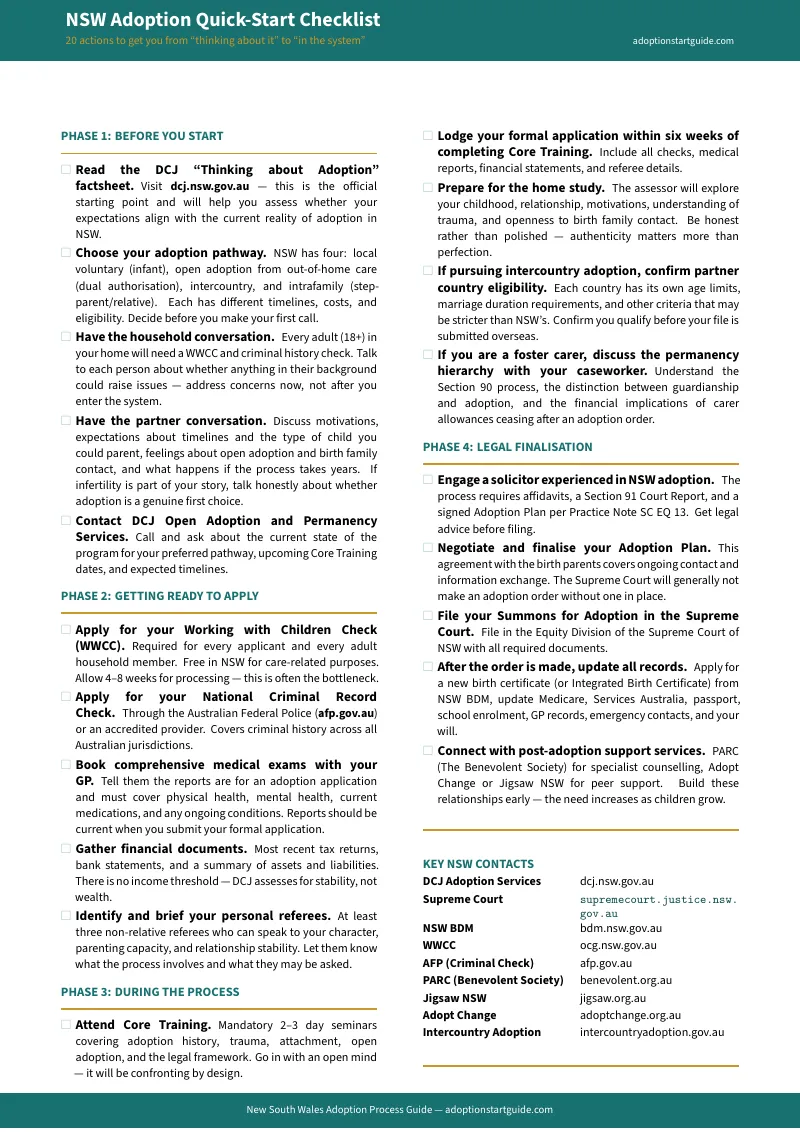
Download the New South Wales Adoption Quick-Start Checklist for a one-page overview of the key steps from first enquiry to Supreme Court finalisation. Free, no commitment. If you want the full guide with the DCJ Decoder, the four-pathway comparison, the Supreme Court process guide, the Adoption Plan worksheet, and all the printable tools, click the button in the sidebar.
-- less than a single hour of a Sydney family lawyer's time
The average family lawyer in Sydney charges $350 to $600 per hour. That's $700 to $1,200 of billable time before your lawyer addresses your actual case. The Supreme Court process costs $2,000 to $5,000 in legal fees for an uncontested matter. The DCJ Decoder doesn't replace your lawyer. It makes sure you don't pay your lawyer to teach you the basics of NSW adoption law. And it makes sure you don't discover the 2024 centralisation, the 30-day consent revocation period, or the dual authorisation requirement the hard way. If the guide doesn't deliver what you need, you're covered by a refund guarantee, no time limit -- no questions, no risk.