You see the kids in Darwin. You hear the sirens in Alice Springs. You've been on the Territory Families website for an hour and you still don't know how to start.
You decided to foster. Maybe it was the Four Corners report. Maybe it was the child at your school who went into residential care because there weren't enough family-based homes in Darwin. Maybe you're a kinship carer who got the call on a Wednesday night and the child is already in your spare room. Whatever brought you here, you went to the Territory Families website looking for a straight answer about what happens next.
What you found was a recruitment pitch. "Give a child a brighter future." "All you need is a spare room and a big heart." Then, when you dug deeper, a link to the SAFE NT portal for the Ochre Card, a reference to the Fostering Families training, and the phrase "contact the Department of Children and Families to express your interest." No timeline. No document list. No explanation of the assessment process that will examine your childhood, your marriage, and your household's capacity to care for a child who has experienced trauma, removal, and loss that most adults cannot fathom.
So you downloaded the Kinship and Foster Carer Handbook. All 100-plus pages of it. It covers everything from Essential Information Records to Travel Policy and the Care Concern process. It's written from a risk-management perspective for carers who are already approved. For someone still at the "considering" stage, reading it feels like being handed the instruction manual for a machine you haven't been allowed to switch on yet.
Then you tried the Facebook groups and the Carer Gateway forum. You posted your question and got two kinds of responses: horror stories about caseworkers who never return calls and a system that is "permanently overwhelmed," or encouraging replies from agency recruitment pages that made fostering sound like signing up for a feel-good programme. Neither gave you what you actually need: a plain-language walkthrough of the NT system, in what order, with the cultural and geographic realities of the Territory built in from the first page.
The Territory Navigation System
This guide is built for the Northern Territory foster care system and nobody else's. Every chapter, every checklist, every reference is grounded in the Department of Children and Families (DCF) policy, the Care and Protection of Children Act, the Aboriginal and Torres Strait Islander Child Placement Principle, and the operational realities of fostering across Darwin, Palmerston, Katherine, Alice Springs, Tennant Creek, and the 68 remote communities in between. It covers the gap between what the government publishes online and what you actually need to know to get from "interested" to "approved" without a rejected Ochre Card application, a blindsided assessment interview, or months of silence from a system running on empty.
What's inside
- Ochre Card Accelerator — The Working With Children Clearance is your first administrative hurdle, and the one most likely to kill your momentum. The SAFE NT portal won't let you save your progress. You have to complete the entire application in one sitting. One missing identity document means starting over. Processing takes 3 to 12 weeks. This chapter lists the exact four identity documents you need, the common pitfalls that cause the SAFE NT portal to reject applications, and the difference between the $84 employee fee and the $8 volunteer concession, so you submit once and move on.
- Assessment Preparation for the Territory — The Fostering Families assessment involves multiple home visits examining your background, your family dynamics, and your capacity for trauma-informed care. Most prospective carers don't drop out because they fail. They drop out because they don't know what the assessor is looking for. This chapter translates the assessment competencies into plain English: what "Signs of Safety" means in practice, what scenarios they'll present, and how to prepare your household so the process builds your confidence instead of dismantling it.
- ATSICPP Cultural Safety Guide — Roughly 90 percent of children in NT out-of-home care are Aboriginal or Torres Strait Islander. If you are a non-Indigenous carer, the Aboriginal and Torres Strait Islander Child Placement Principle is the defining framework of your fostering experience. This is not a compliance checkbox. This chapter provides practical, non-judgmental guidance on fulfilling the five elements of the ATSICPP — Prevention, Partnership, Placement, Participation, and Connection — including how to facilitate visits to Country, engage with Aboriginal and Islander Child Care Agencies, and support a child's cultural identity without fear of getting it wrong.
- The FIFO and Shift-Worker Strategy — If you work a fly-in-fly-out roster or rotating shifts, the conventional wisdom says fostering isn't for you. That's wrong. Respite care — short-term placements from a weekend to several weeks — is built for exactly your schedule. This chapter explains how to structure respite around your roster, what the Department requires for FIFO households, and how to apply for respite placements that give full-time carers the break they desperately need while giving a child stability during your time home.
- Allowance and Payment Breakdown — The NT provides a fortnightly tax-free carer allowance, but the difference between the base rate, the $200 Establishment Payment, Intensive Needs Loading, and ad hoc reimbursements is rarely explained until after approval. This chapter lays out the current payment structure, what each tier covers, and how to access the Establishment Payment for initial costs like bedding, car seats, and clothing without fighting the system for reimbursement.
- Geographic Support Map — What a family in Darwin's northern suburbs experiences is fundamentally different from what a family in Katherine or Tennant Creek faces. Darwin and Palmerston have proximity to the DCF head office and the major NGOs (Anglicare NT, Key Assets, Lifestyle Solutions). The Big Rivers region, Central Australia, and the Barkly have fewer support options, limited after-hours crisis support, and internet connectivity that makes eLearning modules a cruel joke. This chapter maps the five regions so you plan for support based on where you actually live, not where the system assumes you do.
- Agency Comparison — You don't have to go through DCF directly. Anglicare NT, Key Assets, and Lifestyle Solutions are contracted to recruit and support foster carers, often with dedicated Placement Support Officers, smaller caseloads, and 24/7 on-call access. This chapter compares the options across all regions so you make an informed choice before committing.
- Kinship Care Pathway — If a grandchild, niece, nephew, or community child was placed with you after a DCF removal, you're already caring for the child under an emergency arrangement. You didn't choose this timeline. This chapter explains provisional approval, which requirements can be fast-tracked for kinship placements, and how to access allowances and support without navigating the full standard assessment from scratch.
- "First 48 Hours" Emergency Placement Guide — Short-notice placements are the norm in the NT, not the exception. This chapter covers exactly what you need in the house when a child arrives with little or no warning: practical essentials, the "Essential Information Records" the Department is legally required to provide but often forgets in the rush of a first-night placement, and how to handle a child who is frightened, angry, or silent.
Printable standalone worksheets included
- Ochre Card Document Checklist — Every identity document you need to complete the SAFE NT application in one sitting. Print it, gather the documents, and submit once.
- Home Safety Self-Assessment — Room-by-room walkthrough of the physical requirements for an NT foster care household: smoke detectors, pool fencing, medication storage, sleeping arrangements, and property safety for tropical conditions.
- Assessment Interview Tracker — All assessment sessions listed with space to record dates, topics covered, and your notes. Bring it to every visit.
- Required Documents Checklist — Every form and supporting document organised by stage: before your first enquiry, with your application, during assessment, and for ongoing compliance.
- Care Team Contact Sheet — DCF caseworker, agency support worker, child's school, GP, paediatrician, therapist, respite provider, FKCANT contact, and crisis line numbers — all on one printable page.
- ATSICPP Connection Planner — A practical worksheet for planning how you will maintain and strengthen a child's connection to family, community, culture, and Country. Covers language, food, ceremonies, community visits, and AICCA engagement.
Who this guide is for
- Darwin and Palmerston families ready to stop researching and start acting — You've visited the Territory Families website, maybe downloaded the Handbook, and mentioned fostering to your partner. But the process feels opaque, the cultural considerations feel overwhelming, and the information gap between "interested" and "approved" has kept you waiting for months. You need someone to lay out the NT system in plain language and tell you what to do this week.
- FIFO workers and shift workers — Your roster means you're home for two weeks and gone for two. You assumed that disqualified you. It doesn't. Respite care is built for exactly your schedule, and the Territory is desperate for respite carers.
- Non-Indigenous carers navigating the ATSICPP — You want to foster an Aboriginal child but the weight of the Stolen Generations history makes you hesitate. You're not sure if you're "allowed" or how to support a child's cultural identity without causing harm. This guide treats the ATSICPP as a tool for connection, not a barrier to entry.
- Kinship carers who got the call — A child in your family was removed by DCF and placed with you. The child is already in your home. You didn't plan for this. Now you need to understand provisional approval, access allowances, and navigate a system you never expected to enter.
- Regional and remote families — You have the home, the stability, and the conviction, but you live in Katherine, Tennant Creek, or a community where the nearest NGO office is hours away. The need for foster homes in your region is acute. This guide shows you what support is actually available where you live.
Why the free resources fall short
The Territory Families website is a recruitment tool. It tells you fostering is "rewarding" and "life-changing" and invites you to express interest. It does not tell you what the assessor is evaluating, why the SAFE NT portal will reject your Ochre Card application if you don't have the right combination of four identity documents ready before you start, or how the Establishment Payment works for emergency placements. It is designed to get you into the pipeline, not to prepare you for what's inside it.
The Kinship and Foster Carer Handbook is the opposite problem. At over 100 pages, it covers the Care and Protection of Children Act, Essential Information Records, Travel Policy, and the legislative framework behind every decision. It is a risk-management document for approved carers. For someone who hasn't started the assessment, it's a wall of policy-speak that makes the system look even more intimidating than it already feels.
The NGO information packs from Anglicare NT, Key Assets, and Lifestyle Solutions are recruitment material. They highlight 24/7 on-call support and dedicated Placement Support Officers. They gloss over the high caseloads, the caseworker turnover, and the systemic challenges that the Royal Commission documented. Prospective carers report that these packs make fostering seem "too easy," which paradoxically increases distrust in the process.
Facebook groups and the Carer Gateway forum fill the emotional gap but create a new one. The dominant voices are carers who are exhausted, under-supported, and venting about a system they describe as permanently overwhelmed. Their experiences are real and important. They are also a deeply skewed sample. A prospective carer reading those threads gets the impression that fostering in the NT is a guaranteed path to burnout. It isn't — but you need accurate preparation, not just encouragement or warning.
The free Quick-Start Checklist
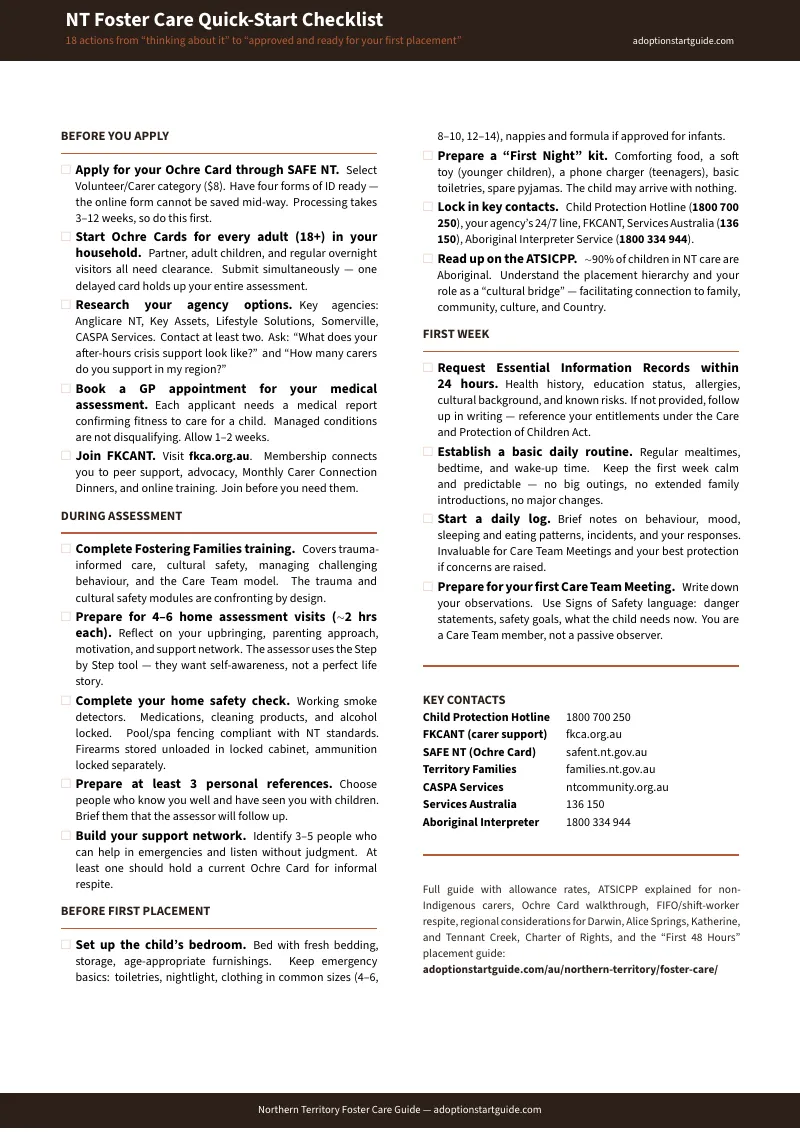
Download the Northern Territory Foster Care Quick-Start Checklist for a phase-by-phase overview of the approval process, from your first enquiry through to your first placement. Free, no commitment. If you want the full guide with the Ochre Card Accelerator, ATSICPP Cultural Safety Guide, FIFO strategy, financial breakdown, geographic support map, and all six printable worksheets, click the button in the sidebar.
— less than one Ochre Card employee application
A rejected Ochre Card application because you didn't have the right identity documents ready costs you weeks of processing time and kills the momentum when your motivation is highest. An assessment interview you weren't prepared for doesn't fail you outright, but it shakes your confidence at the exact moment you need it most. The difference between families who make it through the NT system and families who quietly withdraw after the third home visit isn't character or commitment. It's preparation.
If the guide doesn't deliver, reply to your download email at any time for a full refund. No forms. No justification required.